What Businesses Need from Commercial EV Charging Infrastructure
The Growing Importance of EV Charging for Businesses
What Businesses Need from Commercial EV Charging Infrastructure
The Growing Importance of EV Charging for Businesses
Electric vehicles are becoming a familiar sight across the UK. As adoption continues to increase, businesses are beginning to recognise that EV charging is no longer just an optional extra. It is rapidly becoming an important part of workplace facilities, customer experience and long-term sustainability planning.
Whether operating a corporate office, retail destination, industrial facility or commercial fleet, organisations are facing new expectations from employees, customers and stakeholders. Drivers want convenient charging options, while businesses are looking for ways to support environmental goals and prepare for future transport trends.
As a result, commercial EV charging infrastructure has moved from being a niche investment to a strategic business asset.
Why Basic Charger Installation Is Not Enough
Many organisations initially focus on the number of charging points they need today. However, successful EV charging projects require a broader perspective.
A charger installation should be designed with future growth in mind. Electric vehicle adoption is expected to continue increasing over the coming years, and businesses that plan only for current demand may find themselves facing expensive upgrades sooner than expected.
The most effective approach considers factors such as:
- Current and future vehicle usage
- Available electrical capacity
- Employee charging requirements
- Customer charging demand
- Fleet electrification plans
- Site accessibility
- Ongoing maintenance requirements
By viewing charging infrastructure as a long-term investment rather than a short-term project, businesses can achieve greater value and avoid unnecessary disruption later.
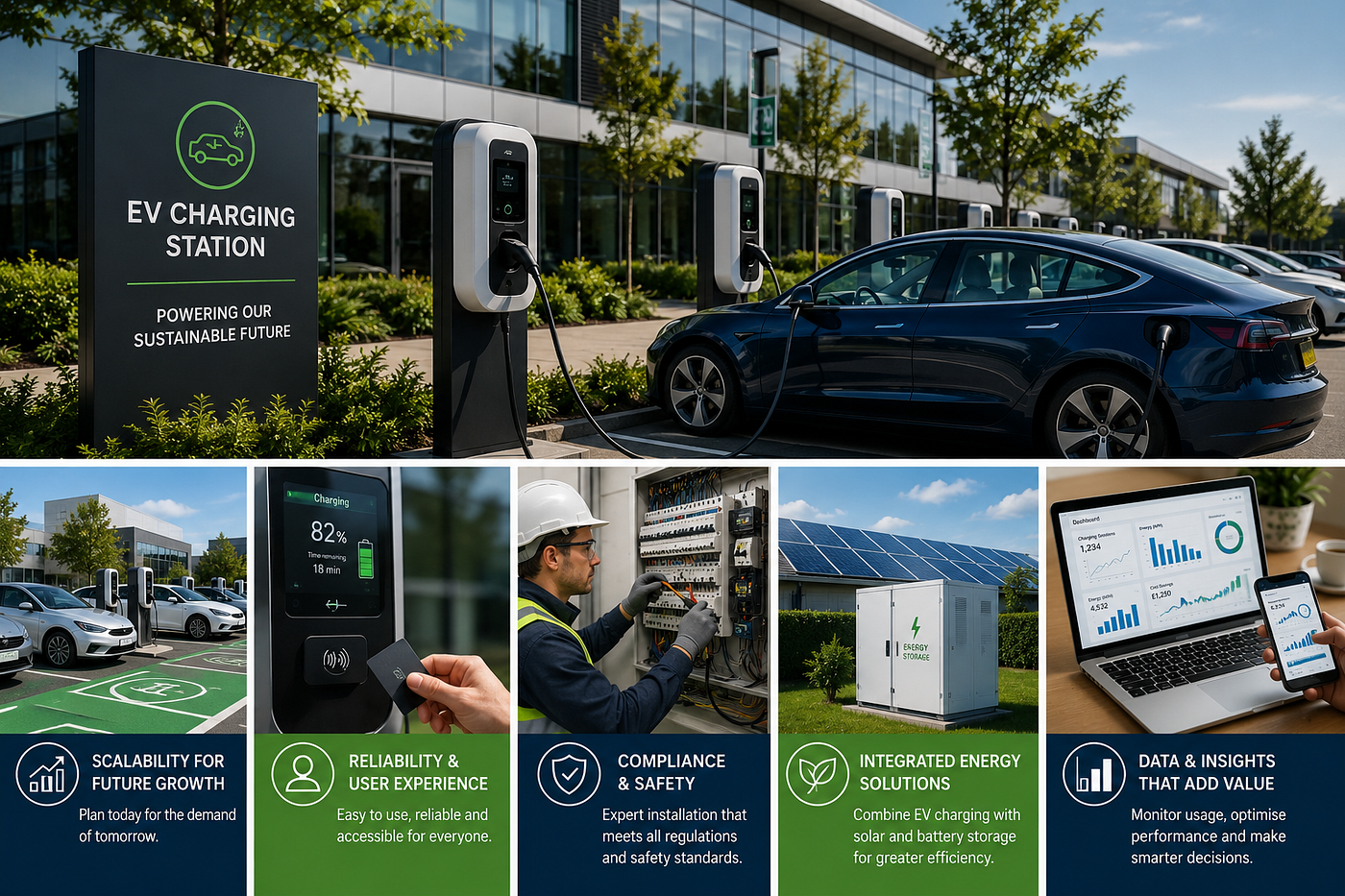
Scalability Should Be a Priority
One of the biggest mistakes businesses make is underestimating future demand.
Consider a company operating ten electric vehicles today. Within three to five years, that number could easily double or triple. If charging infrastructure has not been designed to accommodate growth, expansion can become costly and operationally disruptive.
Scalable infrastructure allows organisations to add chargers as demand increases while making the most of existing electrical capacity and site layout.
This is particularly important for businesses operating commercial fleets, logistics vehicles, service vans or employee vehicle schemes. A well-planned charging network should evolve alongside business growth rather than limit it.
Real-World Example
Imagine a regional delivery company installing four chargers to support an initial electric fleet. Within two years, the company expands its fleet to fifteen EVs. Because the original infrastructure was designed with future capacity in mind, additional chargers can be added quickly without major electrical upgrades.
This forward-thinking approach saves both time and money while reducing operational disruption.
Reliability and User Experience Matter
Installing charging points is only part of the equation. Businesses must also consider how people will interact with the system.
Poor user experience can reduce charger usage and create frustration among employees, visitors or fleet operators.
Modern charging infrastructure should offer:
- Reliable charger performance
- Simple user access
- Clear usage instructions
- Secure payment options where required
- Monitoring and reporting capabilities
- Remote management features
A charger that is frequently unavailable or difficult to use can quickly become a source of complaints. Businesses should focus on solutions that prioritise both functionality and ease of use.
For customer-facing environments such as retail parks, hospitality venues and leisure facilities, charger reliability can directly influence customer satisfaction and repeat visits.
Compliance and Safety Cannot Be Overlooked
Commercial charging infrastructure must meet relevant electrical and safety standards. Compliance is essential not only for legal reasons but also for protecting staff, visitors and company assets.
Businesses should ensure that installations are carried out by qualified professionals who understand current regulations, site requirements and industry best practices.
Regular inspection and maintenance are equally important. Like any critical electrical system, EV chargers require ongoing attention to maintain performance and safety standards.
Organisations that incorporate maintenance planning from the start often experience fewer operational issues and lower long-term costs.
Integrating Charging with Wider Energy Strategy
Many businesses are now viewing EV charging as part of a broader energy strategy rather than an isolated project.
Solar panels, battery storage systems and energy monitoring technologies can work alongside charging infrastructure to improve efficiency and reduce operating costs.
For example, solar-generated electricity can be used to support vehicle charging during daylight hours, while battery storage can help manage peak demand periods.
Businesses exploring charging projects may benefit from considering how their charging network fits into wider sustainability and energy objectives.
For organisations looking to develop future-ready ***commercial EV charging infrastructure***, integrating charging with broader energy planning often delivers stronger long-term results than treating each system separately.
Data and Insights Are Becoming More Valuable
Modern charging systems provide access to useful operational data. Businesses can monitor charger usage, energy consumption, charging patterns and system performance.
These insights help organisations:
- Understand charging demand
- Optimise charger allocation
- Plan future expansion
- Track sustainability performance
- Support environmental reporting
As environmental reporting becomes increasingly important, having access to accurate energy and charging data can provide valuable business intelligence.
This information also helps management teams make more informed decisions about future infrastructure investments.
Choosing the Right Delivery Partner
Not all charging projects are the same. Site requirements, operational needs and future goals vary significantly between organisations.
Businesses should look for partners that can provide:
- Site assessments
- Infrastructure planning
- Installation expertise
- Compliance support
- Maintenance services
- Future expansion guidance
In my view, the most successful projects are those where the installer understands the broader business objective rather than simply supplying equipment.
A charging solution should support operational efficiency, sustainability goals and long-term growth while remaining practical and cost-effective.
Final Thoughts
Commercial EV charging infrastructure is becoming an essential part of modern business operations. As electric vehicle adoption continues to grow, organisations that plan strategically today will be better positioned for tomorrow’s demands.
The most successful projects focus on more than simply installing chargers. They consider scalability, reliability, compliance, user experience and integration with wider energy strategies.
Businesses that take a long-term approach can create charging networks that support employees, customers and fleets while contributing to sustainability goals and future growth.
메타데이터
- post_id
- fd2f12d04240
- slug
- what-businesses-need-from-commercial-ev-charging-infrastructure-fd2f12d04240
- url
- https://medium.com/@ascentenergyservicesuk/what-businesses-need-from-commercial-ev-charging-infrastructure-fd2f12d04240
- canonical_url
- https://medium.com/@ascentenergyservicesuk/what-businesses-need-from-commercial-ev-charging-infrastructure-fd2f12d04240
- author_url
- https://medium.com/@ascentenergyservicesuk
- status
- ok
- fetched_at
- 2026-07-21 20:45:44