Data Privacy and Anonymization Techniques -A comprehensive Review
Over 4.8 billion active social media users worldwide generate approximately 2.5 quintillion bytes of data daily. The challenge of…
Data Privacy and Anonymization Techniques -A comprehensive Review
Over 4.8 billion active social media users worldwide generate approximately 2.5 quintillion bytes of data daily. The challenge of protecting individual privacy while maintaining data utility has become a huge concern for cybersecurity professionals.
In the context of privacy, data anonymization has evolved from simple identifier removal to sophisticated methodologies. These mathematical frameworks incorporating differential privacy, homomorphic encryption and automated synthetic data generation driven by multiple compliance requirements.
Unlike traditional database anonymization, high dimensional social media data presents unique challenges due to its heterogeneous and multimodal nature. It incorporates textual content, multimedia files, temporal patterns and complex network relationships. This interconnected nature of social media data gives way to lineage attacks where anonymized datasets were successfully re-identified through cross-referencing with publicly available information.
But in the context of successful anonymization, they require specialized approaches for each modality. While textual content can be anonymized through techniques like entity recognition and replacement, multimedia content presents more complex challenges requiring computer vision and audio processing capabilities.
Social media platforms collect multiple data types that require anonymization such as:
-
Direct Identifiers: Usernames, email addresses, phone numbers and profile URLs that directly identify individuals.
-
Quasi-identifiers: Demographic information (age, gender, location), posting patterns and network connections that can be combined to identify individuals indirectly.
-
Behavioral Data: Interaction patterns, content preferences, temporal activity signatures and social graph structures that reveal unique behavioral fingerprints.
4. Content Data: User-generated text, images, videos and metadata that may contain identifying information or allow for stylometric analysis.
Current Approaches to Social Media Data Anonymization:
Contemporary approaches to social media data anonymization employ various techniques ranging from traditional identifier removal to sophisticated privacy-preserving algorithms. The most common approaches include:
-
Data masking and Generalization -Removing or generalizing identifying information such as usernames, email addresses and specific location data
-
k — Anonymity and Extensions -Ensures that each record is indistinguishable from at least k-1 other records based on quasi-identifying attributes. Extensions like l diversity and t-closeness address specific vulnerabilities of k-anonymity by ensuring diversity in sensitive attributes and maintaining distribution similarity.
-
Graph Anonymization -Protecting privacy in datasets by altering or masking identifiable information while preserving the utility of the data for analysis through techniques include edge randomization, node clustering, and structural generalization.
-
Context Anonymization -Advanced NLP techniques are employed to anonymize textual content while preserving semantic meaning.
Privacy-Enhancing Technologies (PETs):
PET are technologies that embody fundamental data protection principles by minimizing personal data use, maximizing data security, and empowering individuals. They allow online users to protect the privacy of their personally identifiable information (PII), which is often provided to and handled by services or applications. Common examples include differential privacy, federated learning, homomorphic encryption, synthetic data generation, secure multi-party computation and confidential computing on trusted execution environments.
a. Differential Privacy (DP):
Differential privacy has emerged as the gold standard for privacy-preserving data analysis, providing formal mathematical guarantees about privacy protection.
The formal definition of ε-differential privacy states that a randomized mechanism M provides ε-differential privacy if for all datasets differing by at most one record and for all possible outputs S.
Pr[ M (D1) ∈ S ≤ exp(ε) × Pr[ M (D2) ∈ S ] + δ
M: A randomized algorithm or mechanism that processes a dataset
D₁ & D₂: Two datasets that differ by only one record (i.e., one individual’s data)
S: A possible output or subset of outputs from the mechanism M
ε (epsilon): The privacy budget, which controls how much the output can differ when one individual’s data is added or removed
δ (delta): This accounts for the probability of privacy failure
Here ε represents the privacy budget, controlling the trade-off between privacy and utility. Lower values of ε provide stronger privacy guarantees but may reduce data utility. The most common differential privacy mechanisms include:
-
Laplace Mechanism: Adds noise drawn from a Laplace distribution Lap(Δf/ε) to query results, where Δf is the global sensitivity of function f
-
Gaussian Mechanism: Utilizes Gaussian noise for (ε,δ)-differential privacy, particularly suitable for continuous queries
-
Exponential Mechanism: Selects outputs based on a utility function while preserving privacy, useful for non-numeric queries
Recent advances in differential privacy include the development of adaptive mechanisms that adjust noise levels based on data characteristics. Basic and strong composition theorems enable multiple differentially private analyses on the same dataset.
DP has seen significant real-world adoption by organizations like the U.S. Census Bureau for publishing demographic data, Google for collecting telemetry data via RAPPOR and Apple for analyzing user behavior on devices.
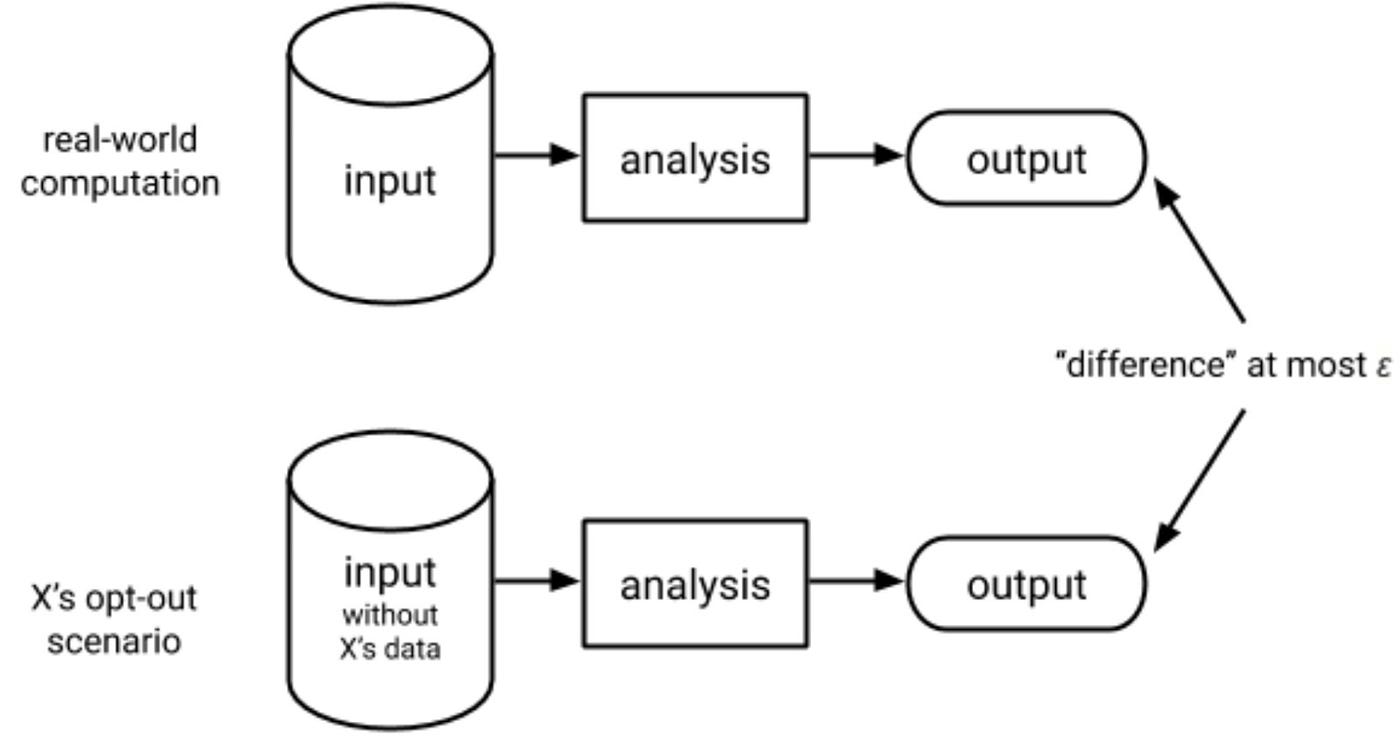
Visualizing the Core Principle of Differential Privacy: Ensuring Output Indistinguishability when an Individual’s Data is Added or Removed
b. Homomorphic Encryption (HE):
Homomorphic encryption represents a breakthrough in privacy-preserving computation, allowing mathematical operations to be performed directly on encrypted data without decryption. The result of the computation, when finally decrypted, is identical to the result that would have been obtained by performing the same operations on the original plaintext. This capability is often called the “holy grail” of cryptography because it enables secure outsourcing of computation, such as processing sensitive data in an untrusted cloud environment. It enables us to derive insights from sensitive data while maintaining complete confidentiality.
Fully Homomorphic Encryption (FHE) supports arbitrary computations on encrypted data, though current implementations face significant computational overhead. Practical applications often employ Partially Homomorphic Encryption (PHE) or Somewhat Homomorphic Encryption (SHE) for specific computational tasks.
IBM’s HE Layers framework and Microsoft’s SEAL library have made homomorphic encryption more accessible to practitioners, providing high-level interfaces for common privacy-preserving computations.
Cloud-based homomorphic encryption services are emerging, allowing organizations to leverage this technology without extensive cryptographic expertise.

FHE processing on cloud data
c. Secure Multi-party Computation (SMC):
SMC allows multiple parties to jointly compute functions over their inputs while keeping inputs private. The standout feature is that privacy is preserved throughout the computation, even if some parties are curious or semi-trusted. Applications include privacy-preserving statistical analysis and machine learning model training. SMC protocols rely on cryptographic primitives like:
- Secret sharing: Splitting data into pieces distributed among parties
- Oblivious transfer: Ensuring one party receives data without the sender knowing what was received
- Garbled circuits: Encrypting computation steps so inputs remain hidden
d. Federated Learning (FL):
Federated learning represents a paradigm shift in machine learning, enabling collaborative model training across distributed data sources without centralizing sensitive information. This approach is particularly relevant for social media applications where user data remains on local devices while contributing to global model improvement.
The federated learning process involves local model training on distributed devices, secure aggregation of model parameters, and iterative global model updates. FL uses techniques like: Secure aggregation protocols, Gradient compression with privacy-preserving noise and Client-side differential privacy applications. Privacy protection is achieved by sharing only model parameters rather than raw data, though recent research has identified potential privacy vulnerabilities through gradient-based attacks.

Differential Privacy in Federated Learning : Localized Differential Privacy Data Processing Framework
e. Synthetic Data Generation:
Privacy-preserving synthetic data generation techniques incorporate differential privacy mechanisms during the training process to prevent individual information leakage. These approaches are known as DP-GANs (Differentially Private GANs) , PATE-GAN (Private Aggregation of Teacher Ensembles) and DP-VAE (Differentially Private VAE) provide formal privacy guarantees. But DP-VAE especially still faces utility-privacy trade-off challenges.
Current Threats to Privacy and Anonymization:
The advancement of AI has introduced sophisticated re-identification attacks that can unmask anonymized data with unprecedented accuracy. Machine learning-based attacks combine anonymized datasets with publicly available information from social media, voter registrations and other sources.
· Membership inference attacks can determine whether specific individuals were included in training datasets, potentially exposing sensitive information
· Model inversion attacks attempt to reconstruct training data from machine learning models, particularly in federated learning scenarios where the model parameters are shared
· Property inference attacks extract aggregate statistics or properties from datasets without accessing individual records. While seemingly less severe than individual re-identification, these attacks can reveal sensitive organizational or population-level information.
· Deep learning techniques enable inference attacks that extract sensitive information from anonymized data without explicit re-identification.
· Temporal correlation attacks use Time-series analysis of user behavior patterns creates unique signatures that persist even after traditional anonymization, enabling re-identification through temporal correlation analysis.
These attacks can infer demographic attributes, health conditions and behavioral information from statistical patterns in the data. We must start designing and formalizing novel text anonymization techniques that are provably robust against de-anonymization attacks by the next generation of LLMs.
Biometric data protection is receiving increased regulatory attention, with specific requirements for biometric identifier processing under various privacy laws. The sensitive nature of biometric data necessitates enhanced protection measures beyond traditional anonymization techniques that we already have in place.

Model Inversion Example : Biometric based Model Inversion Attack
Current Regulatory Landscape :
The International Organization for Standardization (ISO) has developed comprehensive standards for privacy management, including ISO/IEC 29100 Privacy Framework and ISO/IEC 27701 Privacy Information Management System. These standards provide structured approaches to implementing privacy protections across organizations.
ISO/IEC 27559:2022 specifically addresses data anonymization, providing guidelines for privacy-enhancing data de-identification. This standard defines anonymization techniques, assessment methods, and implementation considerations for organizations seeking to implement robust anonymization programs.
The Organization for Economic Co-operation and Development (OECD) Privacy Guidelines provide internationally recognized principles for privacy protection. These guidelines influence national legislation and provide frameworks for international data sharing agreements.
Regulatory pressures such as the General Data Protection Regulation (GDPR) and California Consumer Privacy Act (CCPA), technological innovations in machine learning and quantum computing and growing consumer awareness of privacy rights. GDPR’s approach to anonymization is particularly nuanced, requiring that anonymized data be “irreversibly prevented” from being attributed to specific individuals. The regulation distinguishes between anonymization and pseudonymization, with different legal implications for each approach.
Artificial intelligence regulations are emerging globally, with the European Union’s AI Act representing the most comprehensive approach in recent times. This addresses specific privacy risks associated with AI systems, including requirements for data governance, risk assessment and algorithmic transparency.
The Health Insurance Portability and Accountability Act (HIPAA) provides specific guidance for de-identifying Protected Health Information (PHI) in the United States. It offers two distinct pathways for a covered entity to render PHI de-identified:
- The Safe Harbor Method: This is a prescriptive, rule-based approach that requires the removal of 18 specific types of identifiers from the data.
- The Expert Determination Method: This is a statistical, principles-based approach that requires a person with appropriate knowledge and experience in statistical and scientific principles to apply accepted methods and determine that the risk is “very small”.
The National Institute of Standards and Technology (NIST) has initiated a standardization process for post quantum cryptography, evaluating algorithms resistant to both classical and quantum attacks. The first set of these standards are CRYSTALS-Kyber (officially ML-KEM, FIPS 203) for key encapsulation and CRYSTALS-Dilithium (officially ML-DSA, FIPS 204) for digital signatures. Quantum-resistant cryptography will become essential as quantum computing capabilities mature.
Future Trends in Data Privacy :
The regulatory landscape is moving toward greater harmonization of privacy standards to address cross-border data flows and global platform operations. Sectoral regulations are likely to become more sophisticated, addressing specific risks and requirements of different industries. Healthcare, finance, education and other sensitive sectors will see more detailed privacy requirements tailored to their unique challenges.
Organizations must begin transitioning to post-quantum cryptographic algorithms to ensure long-term protection of sensitive data. The development of quantum key distribution (QKD) systems may provide additional layers of security for high-value applications. Zero knowledge proofs enable verification of computational correctness without revealing underlying data, particularly relevant for audit trails and compliance verification in anonymization processes.
Another very interesting frontier in emerging privacy design is Neuromorphic Privacy Computing. These architectures mimic neural networks at the hardware level - enabling parallel processing, energy efficiency and adaptive learning capabilities in systems. Neuromorphic privacy computing aims to embed privacy constraints directly into hardware logic, limit data exposure during processing and enable context-aware decision-making.
The role of cybersecurity professionals in advancing online privacy is both strategic and indispensable. Our responsibilities extend beyond the implementation of established best practices; they require the foresight to anticipate emerging vulnerabilities and the capacity to design proactive safeguards. Regulatory and industry standards must increasingly prioritize the integration of privacy protections at the architectural level, embedding them into the design phase rather than relegating them to post-deployment adjustments.
Future frameworks for privacy-preserving systems should enable adaptive and seamless protection across heterogeneous and highly complex data-processing pipelines. Within this context, subjective anonymization emerges as a viable and pragmatic strategy for reconciling the demands of data utility and personal privacy. Ultimately, the success of these efforts will be measured not only by their technical effectiveness, but by their ability to achieve a sustainable balance of progress with ethical responsibility.
메타데이터
- post_id
- fd335d9ffd7b
- slug
- data-privacy-and-anonymization-techniques-a-comprehensive-review-fd335d9ffd7b
- url
- https://medium.com/@amiltha.muralidharan/data-privacy-and-anonymization-techniques-a-comprehensive-review-fd335d9ffd7b
- canonical_url
- https://medium.com/@amiltha.muralidharan/data-privacy-and-anonymization-techniques-a-comprehensive-review-fd335d9ffd7b
- author_url
- https://medium.com/@amiltha.muralidharan
- status
- ok
- fetched_at
- 2026-08-01 10:20:08

