The 12kW Number Is the Least Important Part of a Fiber Laser Purchase
How to evaluate the ULE13020’s real cutting capacity, double-table workflow, facility requirements, and return on investment before the…
The 12kW Number Is the Least Important Part of a Fiber Laser Purchase
How to evaluate the ULE13020’s real cutting capacity, double-table workflow, facility requirements, and return on investment before the brochure becomes a purchase order.
A newly installed 12kW fiber laser is an impressive sight. The enclosure is spotless, the cutting head moves with unnerving speed, and the first demonstration part often comes off the table looking perfect.
Three months later, reality may look different.
The machine is waiting for nitrogen pressure. The operator cannot unload the previous nest quickly enough. The chiller struggles during the hottest part of the shift. Thick-plate piercing contaminates the protective window. Or the machine cuts so much faster than the press brakes can bend that work-in-process begins filling every available aisle.
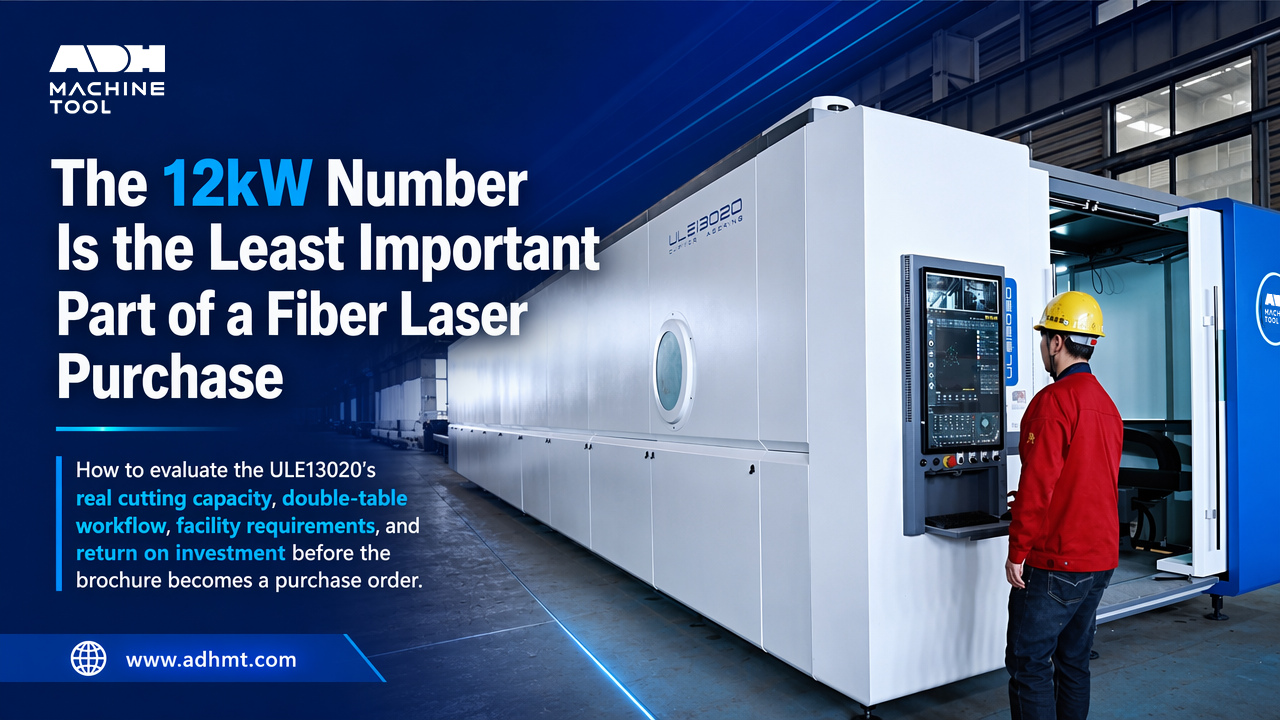
That is why I would not evaluate a machine such as the ULE13020 primarily as a 12kW laser. I would evaluate it as a complete production system. The same perspective should guide any review of ADH Machine Tool’s laser cutting machines, which include high-power, large-format CNC systems for demanding sheet metal applications.
Laser power tells you how much optical energy the source can produce. It does not tell you how many acceptable parts the shop can ship.
Start by Identifying the Machine You Are Actually Buying
The first challenge is that a model name rarely defines the full machine.
“ULE13020” may suggest a particular bed format, but buyers should not infer the usable cutting area from the designation alone. Gross table dimensions, maximum sheet dimensions, axis travel, and fully usable nesting area are not necessarily the same.
A long-format machine needs space for deceleration, table location hardware, clamps, sheet stops, and safety clearances. If the cutting head cannot process the outer edge of a standard mill plate while maintaining specified accuracy, that apparently small loss of travel can reduce nesting yield or force operators to reposition material.
The supplier should therefore provide a dimensioned drawing showing:
- Maximum loadable sheet size
- Guaranteed processable area
- Axis overtravel and inaccessible zones
- Maximum load per exchange table
- Overall footprint with doors and service panels open
- Space required for table exchange, loading, and maintenance
The same discipline applies to the internal hardware. “12kW fiber laser” is not a complete configuration.
The quotation should identify the laser source, cutting head, CNC controller, servo system, chiller, extraction unit, voltage-control equipment, gas train, and included software. It should also specify exact model numbers rather than broad descriptions such as “high-performance autofocus head.”
A premium source paired with an undersized chiller, marginal extraction, or a lower-grade cutting head remains a compromised machine. At high power, the weak component determines the cell’s sustainable performance.
Separate Maximum Separation from Repeatable Production Cutting
Thickness charts are among the most misunderstood documents in laser purchasing.
A chart may state that a 12kW source can separate very thick carbon steel. But “maximum cut,” “edge-start capability,” and “repeatable pierce-and-cut production” describe different processes.
Starting from the edge of a plate avoids the most violent part of thick-plate processing: piercing through the center. Internal piercing sends molten material and spatter toward the nozzle and protective optics. It also requires a stable combination of focal position, pulse strategy, gas pressure, and height control.
This distinction matters because real parts contain holes, slots, internal profiles, and closely nested geometry. A machine that can enter a thick plate from the edge may still be unable to produce those features reliably throughout an eight-hour shift.
Material grade complicates the picture further. Mild steel, stainless steel, aluminum, brass, and copper do not absorb laser energy in the same way. Reflective materials can place additional demands on the source and cutting head, including effective back-reflection protection.
Even within one material family, surface condition changes performance. Mill scale, coatings, oil, flatness, alloy composition, and batch variation can all affect piercing and edge quality.
For that reason, I would never accept a generic thickness chart as proof of capacity. I would ask the supplier to classify every figure as one of the following:
- Maximum separation from an edge
- Maximum internal piercing thickness
- Recommended production thickness
- Guaranteed thickness at a defined edge-quality standard
The commercially useful limit is not the thickest plate the beam can penetrate. It is the thickest plate the machine can pierce, cut, and repeat without unacceptable dross, taper, distortion, or downtime.
The Best Case for 12kW Is Often Mid-Gauge Work
The intuitive argument for 12kW is heavy plate. In practice, the strongest economic case may be much less dramatic.
Higher power can materially improve processing speed on thin- and medium-gauge work, especially where the machine can maintain clean edges without sacrificing feature quality. A shop processing large volumes of mid-gauge stainless or carbon steel may gain more from faster daily production than from occasionally cutting its maximum advertised thickness.
That does not mean every feature accelerates equally.
A cutting head cannot move through a small hole or sharp corner at its maximum straight-line speed. The controller must slow the axes, coordinate motion, and reduce or pulse the laser output to avoid overheating the geometry. If power modulation and servo response are weak, the machine either slows dramatically or burns away fine features.
Thick plate introduces a different set of compromises. Kerf width may increase, taper becomes harder to control, and heat accumulation can distort densely nested parts. Slowing the machine may reduce some forms of dross while adding more heat to the sheet.
This is why production economics should be based on a representative part mix, not an isolated straight-line speed. The relevant question is:
How many acceptable, fully usable parts does 12kW produce per hour compared with the lower-power alternative?
That calculation must include failed pierces, rejected parts, secondary grinding, nozzle changes, and the loss of speed around complex geometry.
Assist Gas Can Decide Whether the Speed Is Profitable
A faster cut is not automatically a cheaper cut.
Oxygen, nitrogen, and compressed air produce different combinations of speed, edge condition, oxidation, and operating cost. Oxygen can support carbon-steel cutting through an exothermic reaction, but it leaves an oxide layer that may need removal before coating or certain welding operations.
Nitrogen can produce a clean, oxide-free edge, but high-pressure nitrogen consumption may become one of the cell’s largest variable costs. Actual flow depends on material, thickness, nozzle diameter, pressure, and cutting parameters, so a supplier’s hourly estimate should be verified during testing.
Compressed air can be economical for suitable materials and thicknesses, but it must be clean and dry. Moisture or oil contamination in the gas stream can damage optics and undermine cut consistency. The cost model must therefore include the compressor, dryer, filtration stages, maintenance, and additional electrical load — not just the assumption that “shop air is free.”
Before approving the machine, I would request a process sheet for each high-volume material that includes:
- Material grade and thickness
- Assist-gas type, pressure, and purity
- Nozzle type and diameter
- Pierce time
- Cutting speed on representative geometry
- Measured gas consumption
- Edge quality and taper
- Expected consumable life
That document is far more useful than a colorful chart showing maximum speed under unspecified conditions.
A Double Table Removes Only One Kind of Waiting
The double table is easy to understand: one table is inside the enclosure while the other is available for unloading and loading. When the nest finishes, the tables exchange and cutting resumes.
But the advertised exchange time is only part of the cycle.
The head must retract, locating systems must release, safety devices must confirm a clear perimeter, and the table must move and lock into position. A tipped-up part or an interrupted safety curtain can delay the exchange.
More importantly, the external table must be ready.
Suppose a high-power laser completes a nest in three minutes. During those same three minutes, an operator may need to remove dozens of parts, separate them by job, clear the skeleton, inspect critical edges, and load a new sheet. Heavy plate may require a crane, vacuum lifter, or magnetic handling system. Thin sheet can sag, bow, or catch on worn slats.
If unloading takes six minutes, a 20-second table exchange does not create a 20-second turnaround. The machine waits for the operator.
This is the central limitation of a manually fed shuttle system:
The double table moves waiting away from the cutting enclosure, but it does not eliminate waiting.
In some shops, an automated loading and unloading system paired with a lower-power laser will produce more finished work per day than a manually handled 12kW double-table machine. Automation is especially valuable across breaks, shift changes, and unattended production.
The correct comparison is therefore not simply 12kW versus 6kW. It may be:
- 12kW with manual double-table handling
- 8kW with automated loading and unloading
- 6kW with lower operating costs and higher utilization
- Outsourced occasional heavy-plate work plus an optimized internal cell
The best option is the one that removes the actual constraint.
The Facility Must Support the Complete Cell

One of the quickest ways to identify an unreliable quotation is to compare the stated electrical load with the optical output.
A 12kW laser source cannot produce 12kW of optical power from an implausibly small total electrical connection. The source consumes more electrical power than it emits as laser light, and the complete cell also includes motion systems, cooling, extraction, controls, table drives, and possibly a high-pressure compressor or nitrogen generator.
The supplier should provide both running and peak requirements for the entire installed system. That includes:
- Laser source and machine controls
- Dual-circuit chiller
- Extraction and filtration
- Air compressor, dryer, and filtration
- Nitrogen generation or gas-vaporization equipment
- Table drives and hydraulic or pneumatic auxiliaries
- Voltage stabilizer or transformer, if required
The facility assessment must also cover three-phase supply, transformer capacity, grounding, voltage stability, and startup current. Nearby welders, presses, and other large loads can introduce voltage disturbances that cause faults or shorten component life.
Cooling deserves equal attention. Chiller capacity should be evaluated at the shop’s highest realistic ambient temperature, not only at a comfortable laboratory condition. If coolant temperature drifts during prolonged cutting, the focal position and beam delivery can become less stable.
Then there is the physical installation. Long-format exchange-table machines can require substantial floor area, delivery clearance, lifting capacity, and foundation work. The buyer should obtain foundation loads and dynamic load data from the manufacturer rather than assuming the existing slab is adequate.
Extraction is not a generic accessory either. High-power cutting produces significant fume, heat, sparks, and fine particulate. The system must provide sufficient airflow across the full bed while incorporating appropriate spark control, filtration, and fire protection for the materials being processed.
Test Accuracy After the Machine Is Hot
Brochure accuracy is usually measured under favorable conditions. Production accuracy is what remains after the machine has been cutting for hours.
This distinction becomes more important on a long bed. Machine structures, rails, sheets, and exchange-table location systems all respond to temperature. Sheet flatness, worn slats, table alignment, and capacitive height control add further variation.
A cold-machine test can therefore hide the errors that appear after sustained production.
For a ULE13020-class machine, I would require a multi-hour factory acceptance test using a full-format sheet and a demanding nest. The nest should include small holes, internal corners, long straight cuts, dense pierce zones, and repeated features near the extremes of the cutting area.
The supplier should measure the first and last parts, not merely display the best sample. The test should document:
- Dimensional change from cold start to thermal equilibrium
- Hole diameter and roundness
- Edge taper at multiple locations
- Dross and roughness
- Pierce success rate
- Table-to-table repeatability
- Gas consumption
- Protective-window condition
- Unplanned stops and alarms
The same test should be repeated during site acceptance using the buyer’s utilities, operators, drawings, and actual material. A video of a demonstration part is not acceptance evidence.
ROI Depends on Productive Hours, Not Rated Speed
The 12kW premium pays back only when faster cutting creates more billable output.
That requires material to be available, operators or automation to keep pace, and downstream processes to absorb the parts. If bending, deburring, welding, inspection, or material handling cannot support the increased flow, the laser merely creates a larger queue.
A realistic ROI model should begin with productive hours rather than scheduled hours. It should subtract setup, programming delays, loading, unloading, maintenance, nozzle changes, slat cleaning, material shortages, service downtime, and downstream constraints.
Then it should include the complete operating cost:
- Electricity for the cell and supporting systems
- Oxygen, nitrogen, or compressed-air preparation
- Nozzles, ceramics, protective windows, and filters
- Chiller and compressor maintenance
- Software and service agreements
- Operator and material-handling labor
- Scrap and secondary finishing
- Expected downtime and spare-parts lead time
- Site preparation and financing costs
Service capability belongs inside this calculation. A lower-priced machine can become the more expensive asset if a failed cutting head, controller, chiller pump, or table drive leaves it idle for days.
Remote diagnostics are useful, but they do not replace local parts or a qualified technician. Before buying, verify where critical spares are stocked, who performs optical repairs, what response time is guaranteed, and whether training and software updates are included.
Turn the Quote into Six Go-or-No-Go Gates
I would make the final decision through six gates.
Material: Can the machine repeatedly produce the shop’s actual grades, thicknesses, holes, corners, and edge standards?
Flow: Can loading, unloading, sorting, nesting, and downstream operations sustain the shorter cutting cycle?
Infrastructure: Can the facility support the complete electrical, cooling, gas, extraction, foundation, and space requirements?
Economics: Does the machine still pay back under realistic utilization, consumable cost, and downtime assumptions?
Acceptance: Will the supplier prove performance through multi-hour factory and site tests using the buyer’s parts and materials?
Contract: Are performance, training, warranty, spare-parts availability, and service response written into the purchase agreement?
Final payment should be tied to measurable acceptance criteria. Those criteria might include dimensional tolerance, taper, pierce reliability, table exchange performance, gas consumption, and sustained operation over a defined test period.
The exact terms will vary, but the principle does not: brochure promises must become contract obligations.
The ULE13020 may be an excellent investment for a shop with sustained mid-gauge demand, adequate infrastructure, disciplined material flow, and enough downstream capacity. It may be a poor investment for a single-shift job shop buying 12kW mainly to handle occasional heavy plate.
The decision should not begin with, “How thick can it cut?”
It should begin with a more useful question:
What constraint will this machine remove — and can the rest of the business keep up once it does?
메타데이터
- post_id
- fd3e0f5211c8
- slug
- the-12kw-number-is-the-least-important-part-of-a-fiber-laser-purchase-fd3e0f5211c8
- url
- https://medium.com/@adhmachinetools/the-12kw-number-is-the-least-important-part-of-a-fiber-laser-purchase-fd3e0f5211c8
- canonical_url
- https://medium.com/@adhmachinetools/the-12kw-number-is-the-least-important-part-of-a-fiber-laser-purchase-fd3e0f5211c8
- author_url
- https://medium.com/@adhmachinetools
- status
- ok
- fetched_at
- 2026-08-09 03:51:23