Why Can’t We Claim Our Inheritance
A while ago I had the pleasure of interviewing filmmaker Khalid Hasan Khan about his upcoming short film VELLICHOR. (Those interested can…
Why Can’t We Claim Our Inheritance

A while ago I had the pleasure of interviewing filmmaker Khalid Hasan Khan about his upcoming short film VELLICHOR. (Those interested can read the feature in *Penslips Magazine*). Besides everything great the film stands for, I couldn’t shake off from my mind one particular character, or rather its depiction.
The trailer starts, and you see the iconic Frere Hall with its 70,000 books on history, literature, culture, and civilization. There’s a haunting feel that promises mystery and thriller with just the right amount of ghosts and spirits, right at home for a South Asian production. We love spirits and djinns in our stories!
Right when you’re getting cozy, the spirit of the paper, the soul of intellectual heritage made flesh, Warqa, appears in a Roman toga.
The magic breaks!
My first instinct was, ‘Why is it in a Roman toga of all things!’ And almost in the same breath, I thought, ‘If not a toga, then what else?’
That image felt right and wrong at once.
Right, because the toga worked. Any viewer, anywhere, receives it immediately as a symbol of the intellect and the written tradition. The sentiment that words, written down and passed forward, were how civilisations retained and inherited their collective memory. The toga carries all of that without needing an explanation.
Wrong, because we’re in Pakistan. It’s filmed among our books, our libraries, and our inheritance. But when the film needed a body for that inheritance to inhabit, it dressed it in Rome.
I wished it had worn something else, but I also understood it couldn’t.
Not wouldn’t.
Couldn’t.
That instant rejection filled me with sorrow and helplessness as I explored different alternatives and hit dead ends.
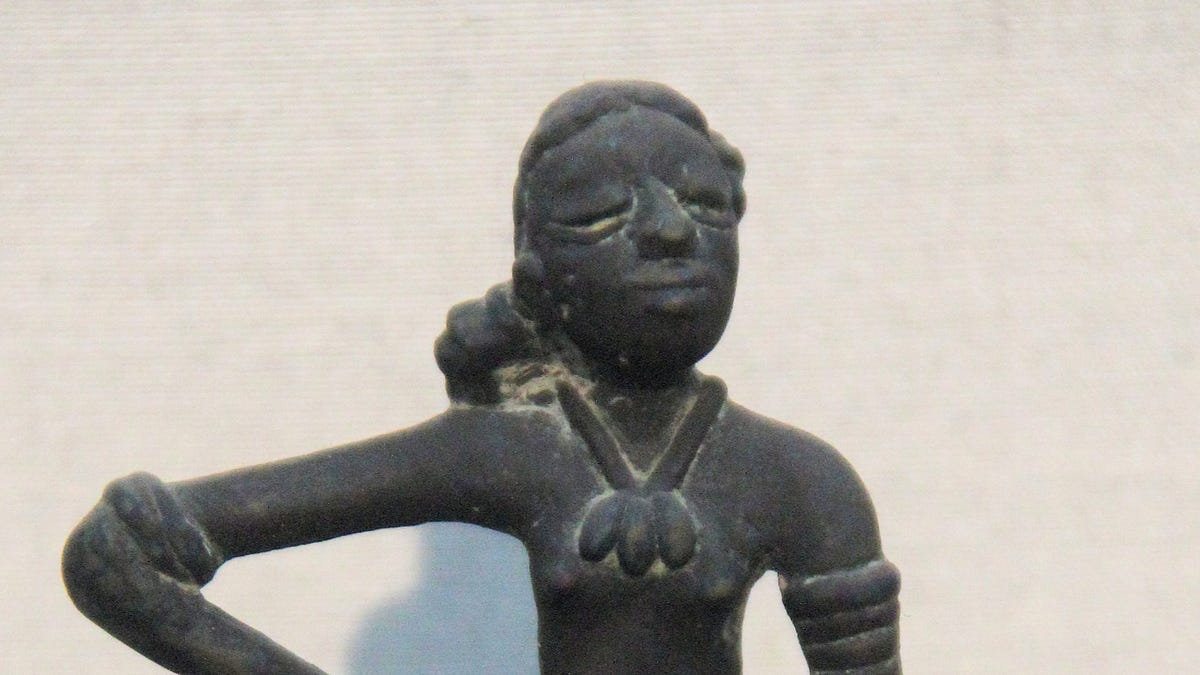
My first choice was the Indus Valley civilization. It could stand shoulder to shoulder with Roman civilization or any other ancient civilization for that matter. It was extraordinary, and should’ve been a source of immense pride and investigation for the people of this land.
At its height, around 2500 BCE, it was among the most sophisticated urban cultures the ancient world had produced. We know it had a writing system; more than 4700 inscriptions in the Indus script have been unearthed on stamp seals, sealings, copper tablets, copper tools, ivory rods, pottery, and miniature tablets. It’s proof that they were people of the letter who had something to say and a way of saying it. Unfortunately, we’ve never been able to read a single word of it.
Every attempt to decipher the script has met failure. There’s no bilingual key or Rosetta Stone to move the needle. The signs remain entirely silent to us, so there are no stories or philosophy. We cannot say, ‘here’s what our ancestors thought and here’s where our intellectual tradition begins.’
So when a filmmaker needs a visual shorthand for “the spirit of learning and the written word,” reaching toward the Indus Valley simply doesn’t work.
Where a toga reads as intellectual heritage, a seal from Mohenjo-daro only reads as archaeology or mystery, charming yes, but not legible as a symbol of intellectual heritage in the way the story needed. The visual vocabulary isn’t there.
But then, I thought, we have Gandhara, right? That tradition wasn’t lost the way the Indus Valley script was. The art and iconography that emerged from the encounter between Greek, Persian, Buddhist, and local traditions on this very soil survived.
It’s a genuine, unmatched synthesis civilisation, philosophically rich, visually distinct, and world-class by any measure. First Indus Valley civilization and then Gandhara art, the blood of this soil, our inheritance is ingenious.
And we still don’t reach for it.
Which means the problem isn’t simply about inaccessibility but also ownership.
We have a habit, centuries deep, of not quite claiming and owning what is ours. We let our intellectual heritage be filed under someone else’s identity, or absorbed into religion, or left to archaeologists and foreign explorers while we look elsewhere for understanding the examined life. Borrowing from others has come to feel easier and more natural than the work of claiming what is already ours.
The pattern repeats itself down the centuries. Punjabi is a living language carrying serious philosophical weight and a literary tradition that can hold its own against anything the Mediterranean produced. And in Pakistan, it’s still broadly perceived as the tongue of the unlettered. Its literature is sampled for warmth or a certain rustic flavour, but not inherited as an intellectual tradition. (On this topic, every Punjabi should read this book by Najam Hussain Syed at least once.)
There has been a shift recently. I can see a willingness to claim Punjabi identity with pride, which is then showing up in branding: using Punjabi as a USP to cater to this newly found interest.
But pride in a thing and genuine inheritance of it are different. One is aesthetic. The other requires treating it as the serious, challenging, and rewarding thing it actually is.
As a drowning man catches at a straw, I hope that while one feeds the other, some people may genuinely find their way back to the roots.
Back to the story of toga, think of it this way. A creative working on a project needs materials. Symbols, images, and references that can serve as a shared shorthand with their audience. When they reach for “the spirit of learning,” there is a kind of yarn they’re looking for: something with weight to it, something that has been wound through centuries of accumulated meaning.
The yarn that represents our own heritage is there too, but it’s tangled. It’s obscure, contested, parcelled out between neighbouring identities, religious traditions and cultural taboos. Pulling on any thread risks hours of archaeological uncertainty, contested ownership, or scripts no one can read.
You cannot spend a whole day untangling yarn when you’re trying to knit a sweater.
So you go to the shop and buy a clean skein. The shop sells Roman togas.
I won’t call it a weakness but a rational response to an unreasonable situation. The filmmaker or the writer reaching for a Western reference is not at fault. They’re working with what’s available, and that’s what every creative does.
The question is why ours is still so tangled, and whether anyone is actually trying to untangle it.
메타데이터
- post_id
- fd4fbd0a94df
- slug
- why-cant-we-claim-our-inheritance-fd4fbd0a94df
- url
- https://medium.com/@soniaahmed/why-cant-we-claim-our-inheritance-fd4fbd0a94df
- canonical_url
- https://medium.com/@soniaahmed/why-cant-we-claim-our-inheritance-fd4fbd0a94df
- author_url
- https://medium.com/@soniaahmed
- status
- ok
- fetched_at
- 2026-07-22 21:10:48