Build Bridges, Don’t Jump Canyons: The Case for Collaborative AI
While companies rush to automate jobs away, the most successful AI implementations are actually making human experts better at what they do
Build Bridges, Don’t Jump Canyons: The Case for Collaborative AI
The promise of artificial intelligence is often framed around replacement: AI will take over repetitive tasks, eliminate human error, and eventually automate entire professions out of existence. This automation-first mindset dominates boardrooms and article headlines. But evidence suggests this approach isn’t just premature. It’s counterproductive.
Recent research reveals a troubling pattern. While AI tools can boost expert productivity, they’re also making it harder for young people to enter the workforce. An August 2025 Stanford study found that total employment in AI-capable careers is declining for younger workers, creating what researchers call “canaries in the coal mine” effects. Meanwhile, automation attempts in high-stakes environments are producing mixed results at best.
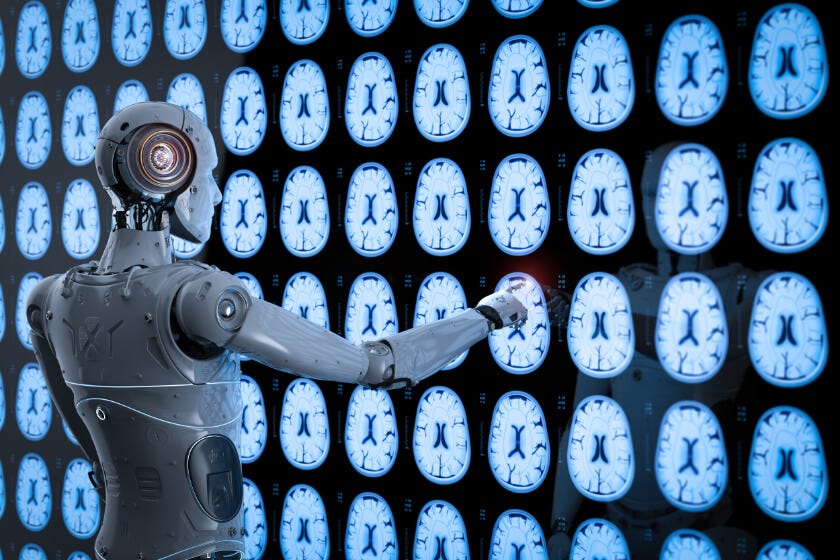
Image credit (RAI)
The radiology field is a good example, as mentioned in a recent The Atlantic article about automation overreach that could hold back opportunities to collaborate and hone new expert skills. MIT researchers studying CheXpert, an AI diagnostic tool, found something unexpected: when radiologists used this AI system, their diagnostic accuracy actually declined. Despite the AI outperforming two-thirds of radiologists individually, the human-AI combination produced worse results than doctors working alone.
The problem wasn’t the AI’s capability — it was the design philosophy. CheXpert was built to automate radiological diagnosis, attempting to read scans like a radiologist. But automating an entire diagnostic workflow proved impossible because the system couldn’t process the medical histories, conversations, and contextual data that radiologists rely on. When doctors disagreed with the AI, they faced a binary choice: trust the machine’s statistical guess or rely on their own judgment. No collaboration, no discussion, no learning.
The False Promise of Perfect Automation
This binary thinking reflects a fundamental misunderstanding about how AI should integrate into professional work. Automation tools promise to eliminate the need for human expertise entirely. But when automation fails , and it inevitably does in complex, high-stakes environments, it often fails catastrophically.
Consider the Air France Flight 447 example in June 2009. When the autopilot disengaged due to frozen airspeed sensors, it dumped a crisis onto pilots who had grown dependent on automated systems. The crew, out of practice with manual flying, lost control of a perfectly functional aircraft. The accident report described it as “total loss of cognitive control.” The autopilot was an excellent automation tool until it wasn’t — at which point it offered no useful support.
This reveals automation’s hidden cost: when machines handle routine operations, human skills atrophy. If automation worked flawlessly forever, this might not matter. But real-world systems fail, edge cases emerge, and human judgment becomes essential precisely when it’s most out of practice.
Designing for Human-AI Complementarity
The alternative isn’t to abandon AI — it’s to design for collaboration instead of replacement. Collaborative AI tools amplify human capabilities rather than attempting to duplicate them entirely.

Image credit (JetHead)
Modern aircraft offer an instructive contrast to that failed autopilot scenario. The heads-up display (HUD) is a pure collaboration tool that superimposes flight data in the pilot’s line of sight. It doesn’t fly the aircraft but assists pilots by integrating complex information into a single visual interface. When HUDs fail, there’s no jarring handoff — pilots already have their hands on the controls. Airlines have discovered that planes suffer fewer accidents when pilots use HUDs rather than fully automated landing systems, despite HUDs offering less automation.
The medical field is beginning to embrace similar approaches. Recent studies comparing doctors working alone, AI working alone, and human-AI collaboration consistently show the collaborative approach outperforming both alternatives. In one study covering over 2,000 mystery medical cases, human-plus-AI teams achieved 85% higher accuracy than physicians working solo and 15–20% better than AI alone.
The key difference lies in complementary strengths. When AI missed diagnostic clues, clinicians spotted them. When doctors overlooked patterns, AI filled the gaps. But this only works when systems are designed for ongoing collaboration, not automated replacement.
The Skills Development Crisis
The push toward automation creates another critical problem: it’s eliminating the traditional pathways for developing expertise. When AI systems can perform tasks previously assigned to residents, apprentices, and junior staff, learning opportunities disappear.
This matters because expertise remains essential, even in an AI-augmented world. Young radiologists still need to develop diagnostic intuition. Junior lawyers must learn to craft arguments. New teachers require practice reading classroom dynamics. If AI automates these developmental experiences away, where will the next generation of experts come from?
Research already shows troubling patterns. Novices who treat AI as an automation tool, accepting its outputs uncritically, often get led astray when systems provide confident but incorrect information. Meanwhile, experts who use AI collaboratively, treating it as a thinking partner rather than an oracle, tend to achieve better outcomes.
Building Collaborative AI Systems
What does collaboration-focused AI actually look like? Google’s Articulate Medical Intelligence Explorer (AMIE) offers one promising model. Instead of automating diagnosis, AMIE conducts multi-turn conversations that mirror real medical consultations. It asks follow-up questions when uncertain, explains its reasoning, and adjusts its approach as new information emerges.
In a recent study reported in Nature, doctors collaborating with AMIE showed improved performance across multiple clinical communication and diagnostic measures, including empathy and clarity of explanations. Crucially, AMIE pulls users into active problem-solving rather than handing down predetermined answers. Doctors can interrogate and correct the system in real time, reinforcing their own diagnostic skills rather than allowing them to atrophy.
This collaborative approach offers several advantages over automation:
- Resilience: Collaborative tools don’t need perfect performance to add value. A stethoscope helps doctors understand patients better even though it can’t diagnose independently.
- Learning: Human expertise grows through interaction with collaborative AI rather than withering from disuse.
- Adaptability: Human judgment can compensate for AI limitations while AI can augment human capabilities.
- Context: Humans provide situational awareness, ethical intuition, and emotional intelligence that current AI lacks.
The Business Case for Collaboration
From a business perspective, collaborative AI offers more sustainable value than automation attempts. Collaboration tools can deliver immediate benefits without requiring the near-perfect performance that automation demands. A financial advisor using AI to analyze market patterns can make better recommendations even if the AI isn’t ready to manage portfolios independently.
Moreover, collaborative approaches preserve the human capital that companies have spent years developing. Rather than replacing experienced professionals, AI can make them more productive and extend their capabilities to new domains.
The data supports this approach. Companies implementing collaborative AI report higher user satisfaction, better outcomes, and fewer unintended consequences compared to those pursuing automation-first strategies.
Choosing Our Route Wisely
The question isn’t whether AI will transform work. AI already has done that. The question is how we navigate that transformation. Should we pursue aggressive automation, hoping to eliminate human expertise before understanding the consequences? Or should we build collaborative systems that augment human capabilities while preserving pathways for developing new expertise?
The evidence points toward collaboration. AI’s comparative advantages — unlimited learning capacity, rapid inference, and 24/7 availability — can fill gaps where human experts struggle: remembering every precedent, analyzing edge cases, and drawing connections across disciplines. Meanwhile, interface design must preserve space for distinctly human strengths: contextual nuance, moral reasoning, creativity, and understanding how specific tasks serve broader goals.
The radiology field is beginning to learn this lesson. Future AI diagnostic tools are being designed for collaboration rather than automation. The aviation industry learned it decades ago, which is why modern aircraft blend automated and collaborative systems thoughtfully rather than pursuing full automation.
As AI capabilities continue advancing, we’ll face ongoing choices about when to automate versus when to collaborate. Both approaches have their place, but the current bias toward automation is premature and potentially harmful. We have a canyon to cross, but instead of asking AI to jump the full distance, we should use its extraordinary capabilities to build bridges that we can cross together.

A Guide for the Next Generation
If you’re starting your career right now, this shift toward collaborative AI might feel threatening. Your software engineering degree, pre-law coursework, or MBA suddenly seems less valuable when AI can code, draft legal briefs, and analyze business cases. The “Canaries in the Coal Mine” research confirms what many young professionals are experiencing: traditional entry-level positions are disappearing.
But this disruption also creates unprecedented opportunity — if you approach it strategically.
Stop Training to Be Replaceable
Most educational programs still prepare students to execute known processes: follow coding patterns, apply legal precedents, implement established business frameworks. This is exactly what AI excels at. Current models can produce predictable work based on historical data, but they can’t create genuinely new discoveries, theories, or approaches that advance human knowledge.
Ask yourself not whether AI will take your job. Are you developing capabilities that only you can bring to the world?
Develop Your Unique Curiosity
Start with radical self-awareness: What questions keep you up at night? What problems do you notice that others overlook? What connections do you make that surprise people? Your genuine curiosity is your competitive advantage because it leads to original thinking that no training data can replicate.
A software engineer might be fascinated by how code affects human behavior. A law student might question why certain communities remain underserved by legal systems. An MBA graduate might wonder how businesses can measure impact beyond profit. These aren’t just academic interests . They’re the seeds of new fields and approaches.
Build Tacit Knowledge Through Experience
While AI processes explicit information, the most valuable professional capabilities remain tacit , the implicit understanding that comes from lived experience. A nurse develops an intuitive sense for when patients are declining. A teacher recognizes learning patterns that don’t appear in any textbook. A consultant understands organizational dynamics that never get documented.
This tacit knowledge can’t be automated because it emerges from human interaction, contextual judgment, and ethical reasoning. But it only develops through practice and reflection. (I previously wrote about when your data can’t predict what matters most.)
Embrace Radical Adaptability
The traditional career ladder — junior associate to senior partner, entry-level coder to tech lead — may no longer exist in many fields. Instead of climbing someone else’s ladder, how can you build your own?
This requires a different mindset: Instead of asking “How do I get promoted in this system?” ask “What unique value can I create that doesn’t exist yet?” The most successful professionals in an AI-augmented world will be those who can identify emerging needs and position themselves as the human bridge between AI capabilities and real-world problems.
Practice Human-Centered Skills
While AI handles pattern recognition and data processing, focus on developing capabilities that are distinctly human:
- Contextual judgment: Understanding when rules don’t apply and why exceptions matter
- Ethical reasoning: Navigating moral complexity that algorithms can’t resolve
- Creative synthesis: Combining ideas from unrelated domains to generate new solutions
- Emotional intelligence: Reading situations, building trust, and managing complex human dynamics
These skills become more valuable as AI handles routine tasks, not less.
Collaborate with AI from Day One
Don’t wait for employers to figure out human-AI collaboration. Start experimenting now. Use AI tools as thinking partners, not replacement workers. Learn to prompt effectively, validate outputs critically, and identify where human insight adds value.
The professionals who will thrive aren’t those who fear AI or those who expect it to do everything. They’re those who become experts at human-AI collaboration.
Invent New Roles
The Stanford research suggests that traditional entry-level positions may continue disappearing. But every major technological shift creates new types of work. The internet eliminated some jobs but created entirely new industries.
Pay attention to gaps emerging between AI capabilities and human needs. Maybe there’s a role for “AI ethics auditors” who ensure algorithmic fairness. Or “human-AI experience designers” who create seamless collaboration interfaces. Or “tacit knowledge architects” who help organizations capture and transmit experiential wisdom.
The key is positioning yourself at the intersection of AI capabilities and unsolved human problems.
Think Long-Term
Remember that senior roles — the positions with real influence and decision-making authority — still require human judgment, leadership, and vision. AI can inform decisions, but humans must make them, especially when stakes are high and context matters.
The challenge is building a pathway to those senior roles when traditional junior positions are disappearing. This might mean creating portfolio careers, building expertise across multiple domains, or developing new forms of apprenticeship that combine human mentorship with AI-augmented learning.
The disruption is real, but so is the opportunity. Your generation has the chance to reshape how work gets done, creating more human-centered approaches that leverage AI’s capabilities while preserving what makes us uniquely valuable.
The future of work isn’t about humans versus machines. Think about humans with machines, working together to achieve what neither could accomplish alone. Your job is to become irreplaceably human while mastering the art of AI collaboration.
메타데이터
- post_id
- fd5b4d7adaba
- slug
- build-bridges-dont-jump-canyons-the-case-for-collaborative-ai-fd5b4d7adaba
- url
- https://medium.com/@hideh/build-bridges-dont-jump-canyons-the-case-for-collaborative-ai-fd5b4d7adaba
- canonical_url
- https://medium.com/@hideh/build-bridges-dont-jump-canyons-the-case-for-collaborative-ai-fd5b4d7adaba
- author_url
- https://medium.com/@hideh
- status
- ok
- fetched_at
- 2026-08-08 04:44:00