Why Mary is Mother of The Eucharist
Mother of the Eucharist is the perfect title for Mary? There are many others, like Mystical Rose, or this one used in the Litany to Our…
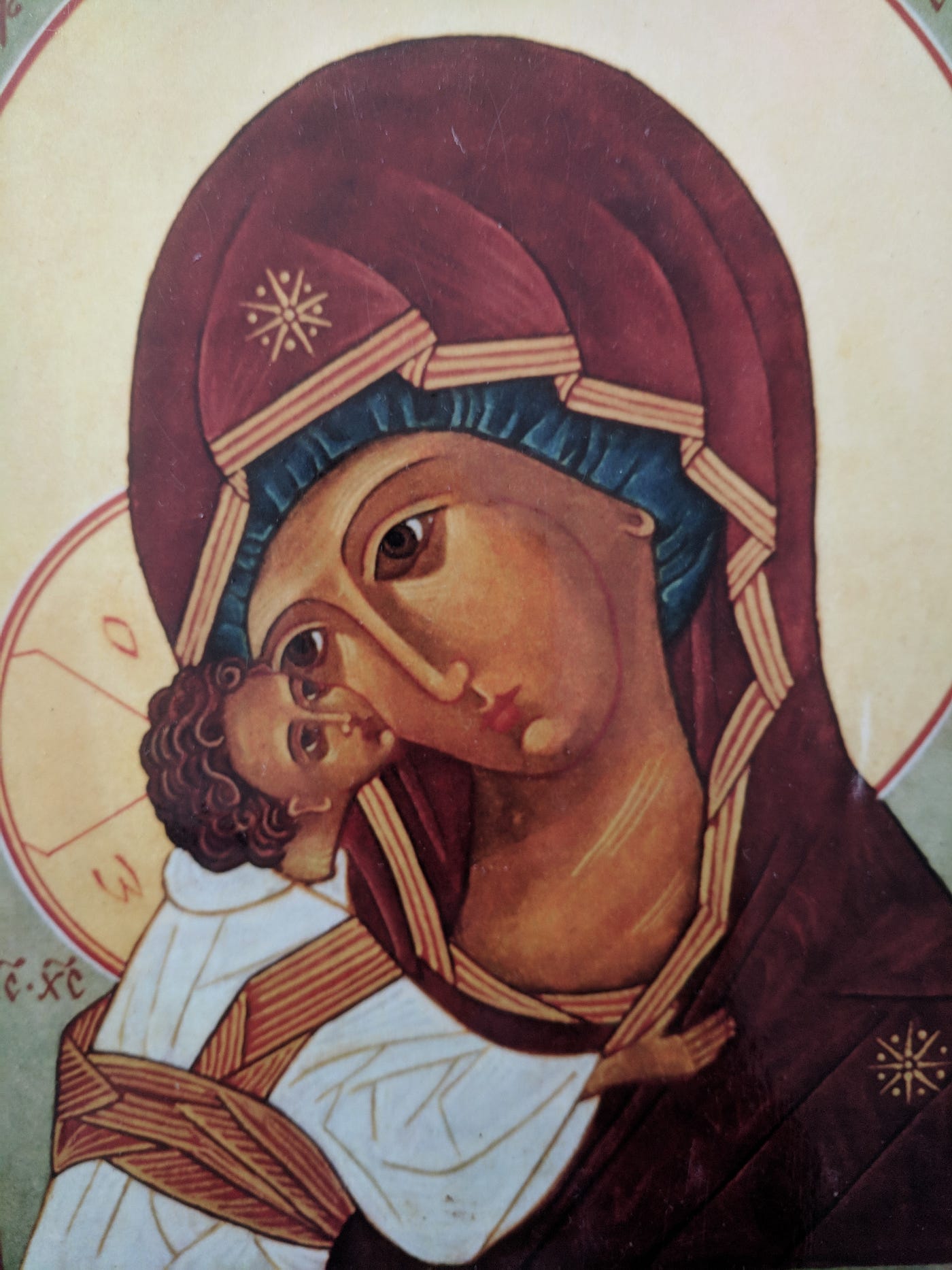
Why Mary is Mother of The Eucharist
Mother of the Eucharist is the perfect title for Mary? There are many others, like Mystical Rose, or this one used in the Litany to Our Lady of Combermere: “Golden door to the secret chambers of the King.” A list of the most widely used ones can be found in the oldest Litany to the Virgin Mary, the Loreto Litany. Each title guides us into the mystery of Mary, a virgin, conceiving Jesus by the power of the Holy Spirit.
I’ll explain why Mother of the Eucharist perfectly reveals the Incarnation, that Jesus, the second person of the Holy Trinity (God the Son), became fully human in the womb of the Virgin Mary, meaning the body, blood, soul and divinity of Christ the Son, the Eucharist.
What is Eucharist?
Recall the opening of St. John’s Gospel:
In the beginning was the Word, and the Word was with God, and the Word was God… And the Word became flesh and made his dwelling among us, and we saw his glory, the glory of the Father’s only Son, full of grace and truth. (John 1:1,14)
The Catechism of the Catholic Church makes two points about “The Word became flesh.” First, “the Son of God assumed human nature in order to accomplish our salvation in it” (CCC: 461) and second, that belief in the Incarnation is “the distinctive sign of Christian faith.” (CCC: 463) This “distinctive sign” reaches its full brilliance in the Paschal Mystery in which Jesus institutes the Eucharist.
In becoming “flesh,” the Word became bread, the Living Bread of Life in Mary’s womb to accomplish our salvation. St Julian Eymard (1811–1868) tells us, “The Eucharist was sown at Bethlehem. What is the Eucharist but ‘the wheat of the elect and ‘the living bread?”
St Peter Chrysologus revealed this truth in the fifth century, taking us briefly through the path of Christ becoming our food:
“He is The Bread sewn in the Virgin, leavened in the Flesh, moulded in His Passion, baked in the furnace of the Sepulchre, placed in the Churches, and set upon the Altars, which daily supplies Heavenly Food to the faithful.”
How is Jesus the Bread of Life, and why Bread?
Throughout Scripture, bread is used nearly 500 times in the various Biblical languages. It was the basis for survival, a symbol of life, and Jesus used it in the Lord’s prayer. Bread symbolizes God’s love and way of providing for His people. The supreme display of God’s love and care for the Israelites, despite their sins as they wandered through the desert for forty days, occurs when he provides “bread from heaven”, which the Israelites called manna. They ate this bread for forty years until they reached the land of Canaan (Exodus 16:4–5,15,35–36).
Jesus used the Exodus miracle to explain the full meaning of manna. We experience Jesus’s powerful revelation of himself as the Bread of Life in Chapter 6 of John’s Gospel.
He starts from our basic need to be fed. On the shore of the Sea of Galilee, a huge crowd gathered. Jesus sees their need for bread and asks Phillip, “Where shall we buy bread for these people to eat?” The Gospel tells us he was only testing Phillip; “He knew well what he intended to do.’’ (Jn 6:6)
His intention was not simply to respond to their needs and miraculously feed everyone with bread, rather, he uses this sign to draw them into the depth and mystery of who He is, the “Bread of Life”.
Following the miracle, Jesus tells the crowd to work for imperishable food lasting eternally, food which He alone can give. Questions arise about what this means. At this point, they tell him: “Our ancestors had manna to eat in the desert: according to scripture, 'He gave them bread from heaven to eat.”
This point is pivotal: “……it was not Moses who gave you bread from the heavens; it is my Father who gives you real heavenly bread. God’s bread comes down from heaven and gives life to the world.” (John 6:32). He has guided them to the threshold of who He is for them and for generations to come. Their response, “Sir, give us this bread always.”
I Am The Bread Of Life
This is the moment Jesus has been waiting for, saying, “I myself am the Bread of life.”
The discussion grows more intense as Jesus repeatedly tells them that He is the Bread of Life: “I am the Bread that came down from heaven…” This point creates restlessness in the crowd as they begin doubting his claim.
He has only begun, however, to emphasize boldly that he is the “…living bread come down from heaven. If anyone eats this bread he shall live forever; the bread I will give is my flesh, for the life of the world.”
Jesus is now crossing into the realm of absurdity, calling for trust in an incomprehensible mystery. Many cannot accept this, but he goes deeper, stronger, and more radical, leading them toward the Eucharist:
“Let me solemnly assure you. If you do not eat the flesh of the Son of Man and drink his blood, you have no life in you. He who feeds on my flesh and drinks my blood has life eternal, and I will raise him up on the last day. For my flesh is real food and my blood real drink…This is the bread that came down from heaven. Unlike your ancestors who ate and died nonetheless, the man who feeds on this bread shall live forever. (John 6:53–55, 58).
Those words cause an immediate departure of many of his disciples. Jesus not only listened to remarks like, “How can anyone take it seriously”, but knew from the beginning who would not believe and who would be sending him to death.
His choice of the twelve was intentional, and the twelve remain, because they are convinced that the authority shown to them can only come from God the Father.
“Master, to whom shall we go? You have the words of eternal life. We have come to believe and are convinced that you are the Holy One of God.”(John 6 68–69)
The Culmination: Passover Meal
John tells us that the passover was near when Jesus gave the discourse on the Bread of Life. This timing was deliberate, for in the upper Room at the Passover meal, Jesus instituted the Sacrament of the Holy Eucharist.
At this meal Christ took the bread, broke it and gave it to his disciples, saying,
“Take this, all of you and eat it: this is my body which will be given up for you.” Taking the cup of wine, he said to them: ”Take this all of you and drink from it: this is the cup of my blood, the blood of the new and everlasting covenant. It will be shed for you and for all so that sins may be forgiven.” (Mt 26:26; Luke 22:19).
The Church and The Eucharist
Pope John Paul II, in his 2003 encyclical, *The Church and The Eucharist, wrote in the opening chapter that the Eucharist is the “sacrament of the Paschal Mystery’ from which the Church was born. While emphasizing this, he adds, “In this gift [Eucharist] Jesus gave to the Church the perennial making present of the Paschal Mystery. With it, there is a “oneness in time” between the Triduum and the passage of the centuries.”*
When Jesus said, “This is my body given for you, do this in memory of me” (Luke 22:19), he, in the breaking of bread, initiated his bodily sacrifice, offering it to the apostles in the form of bread and wine.
John Paul II: “The blood which shortly before he had given to the Church as the drink of salvation in the sacrament of the Eucharist, began to be shed; its outpouring would then be completed on Golgotha to become the means of our redemption.”
Mary’s “Eucharistic Faith”
John Paul II devotes the final chapter of Ecclesia de Eucharistia to Mary’s “Eucharistic Faith’:
“If the Church and the Eucharist are inseparably united, the same ought to be said of Mary and the Eucharist.”
In what way did she possess a “Eucharistic faith”? First, by the very fact, he stresses, that she offered her “virginal womb for the Incarnation of God’s Word.” By saying yes to Gabriel, she believed that the body and blood of the Son of God would miraculously form in her womb by the action of the Holy Spirit. Her yes, the Pope underlines, is similar to the amen we say before receiving the Eucharist when we hear the words, “The Body of Christ”.
The Pope also makes a beautiful link to our adoration of the Lord present in the Eucharist when he writes, “[Mary is]the first “tabernacle” in history — in which the Son of God, still invisible to our human gaze, allowed himself to be adored by Elizabeth, radiating his light as it were through the eyes and the voice of Mary.”
The most striking image of Mary as the first tabernacle shows a donkey travelling to Bethlehem carrying a tabernacle with doors open, revealing a chalice filled with consecrated hosts. Canadian painter William Kurelek painted the image as a Christmas card for Madonna House in the late 1960s. Printed inside the card is the following quotation from Catherine Doherty:
“The donkey that carried Our Lady to Bethlehem took another form in my thoughts. For he carried the Word — a dumb animal, carrying a Virgin who carried God — and so he was the carrier of God too. His bells were the first church bells, for Mary was the first Church, the first tabernacle of Christ.”
Perhaps Kurelek’s 1960 painting inspired John Paul II to use the term “first tabernacle in history” in his 2003 encyclical.
Mary’s “Eucharistic faith” grew deeper when she brought the Child Jesus to the Jerusalem Temple to be presented to the Lord. There she heard Simeon announce that her son would be “a sign of contradiction” and “a sword would pierce her heart.”
From this experience, John Paul sees Mary living her “daily preparation for Calvary.” At the foot of the cross, she would experience in her own way full union with her Son’s Passion and Death.
John Paul II closes his encyclical with a profound insight into Mary’s inseparable union with the Eucharist and the Church. He writes that because everything Jesus did for us on the cross is present in the Mass, then “all that Christ did with regard to his Mother for our sake is also present.”
Because Jesus gave us the gift of His Mother through John, who represents all of us when he said to him, “Behold your Mother,” then each time we celebrate the Holy Sacrifice of the Mass, John Paul says, Christ gives us His Mother.
This is a bold and beautiful truth for us. To receive Mary from our Lord at each Mass is truly consoling because the gift of her Motherly protection is ever new and flows from her intimate union with her Son.
She gave us the Eucharist sewn in her womb, and her Son gives His Mother to us each time He gives Himself to us in the Eucharist.
Mary is the Mother of the Church, and because the Church was “born from the Paschal Mystery, and the Eucharist is the 'Sacrament of the Paschal Mystery”, Mary is also the Mother of the Eucharist.
In his Conclusion to Ecclesia de Eucharistia, Pope John Paul II writes, “Were we to disregard the Eucharist, how could we overcome our own deficiency?”
Since Mary and the Eucharist are inseparably united, were we to disregard Mary, Mother of the Eucharist, how could we have life in us when we consume the Body and Blood of Christ in the Holy Eucharist?
https://publications.madonnahouse.org/products/cc-donkey-carrying-god
메타데이터
- post_id
- fd748dac8ab7
- slug
- why-mary-is-mother-of-the-eucharist-fd748dac8ab7
- url
- https://medium.com/@rodminns7/why-mary-is-mother-of-the-eucharist-fd748dac8ab7
- canonical_url
- https://medium.com/@rodminns7/why-mary-is-mother-of-the-eucharist-fd748dac8ab7
- author_url
- https://medium.com/@rodminns7
- status
- ok
- fetched_at
- 2026-07-22 23:32:06

