Microservices Communication Mechanisms — From REST Calls to Event-Driven Architectures
Microservices communication mechanisms define how independent services exchange data, coordinate behavior, and handle failure — and while…
Microservices Communication Mechanisms — From REST Calls to Event-Driven Architectures
Microservices communication mechanisms define how independent services exchange data, coordinate behavior, and handle failure — and while this often looks like simple API calls on paper, in production these interactions determine latency, reliability, and system stability.
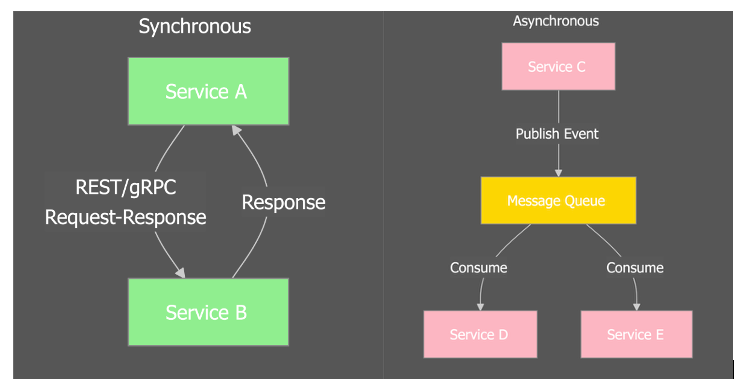
Synchronous Communication
1. REST/HTTP APIs (Most Common)
Direct request-response interactions
// Service A calls Service B
@RestController
public class OrderService {
    @Autowired
    private RestTemplate restTemplate;

    public Order createOrder(OrderRequest request) {
        // Call Inventory Service
        ResponseEntity<Inventory> response = restTemplate.getForEntity(
            "http://inventory-service/api/products/" + request.getProductId(),
            Inventory.class
        );
        return processOrder(response.getBody());
    }
}
This code shows synchronous REST-based communication between two microservices:
Service A → Order Service Service B → Inventory Service Here, Order Service depends on Inventory Service to fetch product availability before creating an order
Pros: Simple, widely understood, easy debugging Cons: Tight coupling, cascading failures, latency accumulation
2. gRPC (High Performance)
Low-latency, high-throughput communication
//service definition
//This defines a gRPC method where a client asks for an order’s status
service OrderService {
    rpc GetOrderStatus (OrderStatusRequest) returns (OrderStatusResponse);
}

message OrderStatusRequest {
    string order_id = 1;
}

message OrderStatusResponse {
    string status = 1;
}
//---------------------------------------------------------------------------

//Client call
OrderServiceGrpc.OrderServiceBlockingStub stub =
    OrderServiceGrpc.newBlockingStub(channel);

OrderStatusResponse response = stub.getOrderStatus(
    OrderStatusRequest.newBuilder()
        .setOrderId("ORD-456")
        .build()
);
gRPC lets services communicate by invoking remote methods directly, using fast binary data over HTTP/2 instead of REST and JSON. The client calls getOrderStatus() like a local method. gRPC handles serialization, network communication, and response handling automatically.
Pros: Fast (binary protocol), type-safe, bi-directional streaming Cons: Steeper learning curve, less human-readable
3. GraphQL
Flexible data fetching, mobile/web clients
// Client query
query {
  user(id: "123") {
    name
    orders {
      id
      total
    }
  }
}
Instead of calling multiple REST endpoints, the client gets user + orders in a single request. GraphQL lets the client fetch everything in one round trip, while still controlling the response shape.
Pros: Single endpoint, no over/under-fetching, strong typing Cons: Complexity, caching challenges, potential N+1 queries
Asynchronous Communication
1. Message Queues (RabbitMQ, AWS SQS)
Task distribution, decoupling services
// Producer (Order Service)
@Autowired
private RabbitTemplate rabbitTemplate;

public void placeOrder(Order order) {
    rabbitTemplate.convertAndSend("order.exchange",
                                   "order.created",
                                   order);
}

// Consumer (Inventory Service)
@RabbitListener(queues = "inventory.queue")
public void handleOrderCreated(Order order) {
    updateInventory(order);
}
The Order Service publishes an order.created event, and the Inventory Service listens to that event to update inventory without directly calling the Order Service.
Pros: Decoupling, load leveling, guaranteed delivery
Cons: Eventual consistency, complexity, debugging harder
2. Event Streaming (Kafka, AWS Kinesis)
Event sourcing, real-time analytics, high throughput
// Producer
@Autowired
private KafkaTemplate<String, OrderEvent> kafkaTemplate;

public void publishOrderEvent(OrderEvent event) {
    kafkaTemplate.send("order-events", event.getOrderId(), event);
}

// Consumer
@KafkaListener(topics = "order-events", groupId = "payment-service")
public void processOrderEvent(OrderEvent event) {
    processPayment(event);
}
The producer publishes order events to the order-events topic, and the Payment Service consumes them independently to process payments, enabling scalable and decoupled microservices.
Pros: High throughput, event replay, multiple consumers
Cons: Operational complexity, eventual consistency
3. Pub/Sub (Redis, Google Pub/Sub)
Broadcasting events to multiple subscribers
// Publisher
redisTemplate.convertAndSend("notifications",
    new NotificationEvent("Order shipped", userId));

// Subscriber
@RedisListener(topics = "notifications")
public void handleNotification(NotificationEvent event) {
    sendEmail(event);
    sendPushNotification(event);
}
The publisher broadcasts a notification event on the notifications channel, and all subscribed services receive it instantly.
Subscribers react to the event by sending emails or push notifications without persisting messages.
Pros: Fan-out pattern, real-time updates, simple
Cons: No message persistence (Redis), delivery guarantees vary
Service Mesh Communication
Istio/Linkerd
Service-to-service communication with observability Pros: Traffic management, security, observability, resilience Cons: Complexity, resource overhead, learning curve
Best Communication Mechanism by Use Case
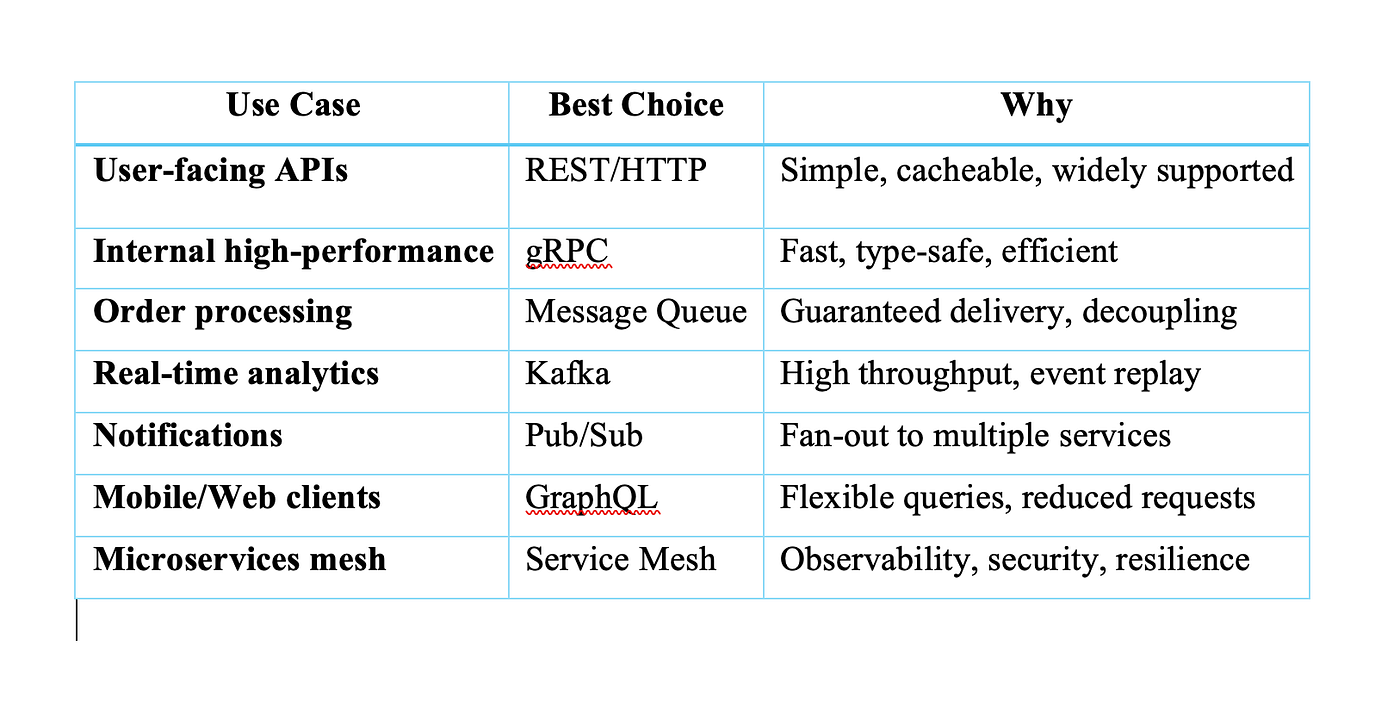
When to use which communication mechanism
Decision Framework
Use Synchronous (REST/gRPC) when:
- Need immediate response
- Simple request-response pattern
- Strong consistency required
Use Asynchronous (Kafka/RabbitMQ) when:
- Long-running operations
- Multiple consumers needed
- Eventual consistency acceptable
- High throughput required
Best Practice: Start with REST for simplicity, add async patterns as complexity grows.
Found this helpful? Follow for more clear and actionable tech content.
메타데이터
- post_id
- fd751d796590
- slug
- microservices-communication-mechanisms-from-rest-calls-to-event-driven-architectures-fd751d796590
- url
- https://javascript.plainenglish.io/microservices-communication-mechanisms-from-rest-calls-to-event-driven-architectures-fd751d796590
- canonical_url
- https://javascript.plainenglish.io/microservices-communication-mechanisms-from-rest-calls-to-event-driven-architectures-fd751d796590
- author_url
- https://medium.com/@techmentor-labs
- status
- ok
- fetched_at
- 2026-07-20 16:49:03