Kafka vs. Pulsar: Which Message Broker Actually Wins?
Most companies think their message broker is “fast enough.” Until it isn’t.
Kafka vs. Pulsar: Which Message Broker Actually Wins?
Created By Servifyspheresolutions, using Kafka and Pulsar logo.
Most companies think their message broker is “fast enough.” Until it isn’t.
That’s when dashboards freeze, data pipelines choke, and real-time apps turn into delayed nightmares.
Kafka loyalists still swear by its legacy strength. Pulsar fans claim it’s the only system that actually scales. But here’s the problem both sides are only half right.
- Why are teams migrating away from Kafka after nearly a decade of dominance?
- Why are Pulsar’s adoption numbers exploding, yet its failures rarely discussed publicly?
- And the real question is, which one actually survives under high message workloads?
This isn’t another feature checklist or vendor fluff.
It’s a breakdown of what happens when real-world scale meets architectural truth and which broker still stands when the numbers stop lying.
By the end, you won’t just know who wins.
You’ll know who fails first and why that’s the only metric that matters.
What Are Kafka and Pulsar And Why They Still Matter
Real-time systems are now the backbone of every modern product from stock trading apps reacting in milliseconds to AI models fed with continuous data streams.
At the center of all this motion sit two powerhouses: Apache Kafka and Apache Pulsar. Both handle messages at massive scale, but they approach the problem from two very different worlds.
What is Kafka?
Kafka started at LinkedIn and quickly became the standard for real-time data streaming across tech giants like Netflix, Uber, and Shopify.
Its strength lies in throughput and simplicity one continuous log of messages, processed in order, making it perfect for event-driven systems and analytics pipelines.
Kafka turned raw event data into a structured flow businesses could act on instantly, replacing slow batch jobs with live insights.
Even in 2025, Kafka remains the default name in large-scale event streaming, not because it’s flawless, but because its ecosystem, tooling, and enterprise trust are unmatched.
What is Pulsar?
Pulsar emerged from Yahoo’s data team, built to solve problems Kafka couldn’t handle at planetary scale.
It separates storage from compute, letting data live on indefinitely without crushing broker performance. This decoupled design allows infinite topic scaling, geo-replication, and instant recovery features essential for the hybrid and multi-cloud reality of 2025.
Unlike Kafka, Pulsar was born in a containerized, distributed era, where scaling horizontally across regions is not optional it’s survival.
Today, Pulsar powers companies like Tencent, Verizon, and Splunk, proving it can compete with and sometimes outperform Kafka in production-grade environments.
Why They Still Matter
Both tools dominate for one reason: data never stops moving.
The choice between Kafka and Pulsar isn’t just technical, it defines how fast a company can adapt, recover, and grow.
Kafka built the world’s streaming foundation. Pulsar is rewriting its future.
And in late 2025, the line between the two isn’t about features anymore, it’s about who can handle the next billion messages without collapsing.
The Late 2025–2026 Reality Check: Streaming Isn’t the Same Anymore
If you last compared Kafka and Pulsar in 2021, forget everything you knew.
The streaming world of 2025 isn’t just about moving messages it’s about surviving data explosions that never pause.
The Scale No One Prepared For
Data volume didn’t just grow it multiplied at a pace traditional architectures couldn’t keep up with.
Billions of IoT devices now push live telemetry every second.
Edge systems aren’t just sending updates they’re running localized AI models and pushing decisions back to the cloud in real time.
And every action, every prediction, every transaction generates a stream that needs to be captured, processed, and acted on instantly.
From Centralized Streams to a Distributed World
By late 2025, hybrid and multi-cloud pipelines have become the default.
A single enterprise might run analytics on AWS, training workloads on Azure, and event ingestion through private clusters, all at once.
This complexity exposed the weakness of monolithic message brokers, where scale depends on centralized coordination.
Kafka’s traditional design began straining under global deployments, while Pulsar’s decentralized model started gaining serious ground.
The AI & ML Trigger Era
Streaming is no longer about real-time dashboards, it’s about feeding AI systems that demand microsecond-level consistency.
Message brokers aren’t just data movers; they’re decision enablers.
AI pipelines depend on them for real-time inference updates, feedback loops, and automated retraining cycles.
If a broker can’t scale or recover fast enough, the AI output becomes unreliable and the entire feedback system collapses.
Why Scalability and Cost-Efficiency Are Now Survival Metrics
In 2026, scalability isn’t a benchmark, it’s a survival metric.
The cost of maintaining uptime and message integrity under unpredictable spikes now defines which broker wins.
Companies no longer ask
“How fast is Kafka or Pulsar?”
They ask,
“Which one keeps my AI pipeline alive at 3 a.m. when the load triples?”
And that question leads straight into the next battle, architecture. Where the design itself decides who stays standing when the data storm hits.
Architecture Face-Off That Define Their Fate
Every streaming platform claims it can scale. But when terabytes per second start flowing and cross-region latency kicks in, only the architecture tells the truth. And that’s exactly where Kafka and Pulsar begin to drift in opposite directions.
Kafka: The Monolith with Muscles
Kafka was engineered for throughput long before “cloud-native” was even a buzzword. Its architecture revolves around topics, partitions, and brokers tightly bound together to move data in a straight, powerful line.
This structure delivers speed, but at a cost: complexity and coupling.
Each partition in Kafka carries its own replication metadata, coordination logic, and leader election process.
The moment the cluster expands beyond a threshold, partition rebalancing slows, consuming both compute and network bandwidth.
In Kafka’s 2025 evolution, KRaft (Kafka Raft) replaced Zookeeper and made metadata handling cleaner, but it didn’t change the core principle.
Kafka still scales like a muscle: powerful when trained, exhausting when overworked.
In a single region, it’s a monster.
Across multiple clouds, it becomes a headache.
Pulsar: Distributed Brain Built for Endless Scale
Pulsar’s design story starts differently. When It was created at Yahoo to manage trillions of messages across global data centers which was an architecture problem, not just a software one.
Instead of merging everything into one pipeline, Pulsar separates it cleanly into two layers:
- Brokers handle message routing and delivery.
- BookKeeper nodes manage durable storage.
This decoupling means compute and storage scale independently which was a critical edge for 2025’s hybrid, data-heavy workloads.
- Need more message throughput? Add brokers.
- Need deeper retention? Add storage nodes.
No rebalancing chaos. No downtime roulette.
And its segment-based storage model allows automatic offloading of older data to cheaper cloud storage (like AWS S3 or Azure Blob), making it cost-efficient without performance decay.
Pulsar’s 3.x release in 2025 further optimized metadata handling and multi-tenancy, making it capable of millions of topics and instant geo-replication without breaking a sweat.
Micro Summary
Kafka scales like muscle; Pulsar scales like math. Kafka’s strength lies in raw force and proven reliability. Pulsar’s power lies in architectural precision efficiency born from separation and parallelism.
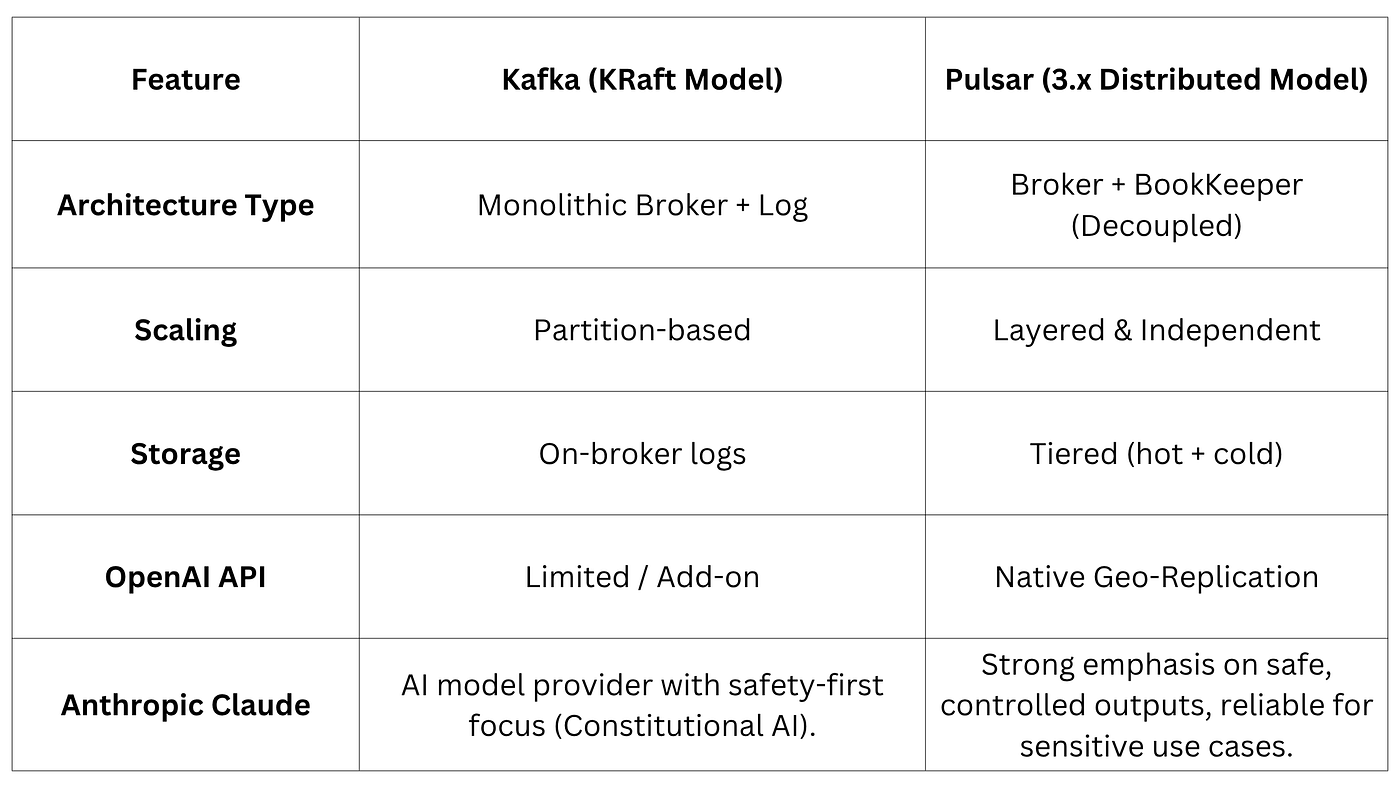
Created By Servifyspheresolutions
But scalability isn’t the same as stability. Because when clusters crash, brokers go silent, and messages start backing up, raw design alone doesn’t save anyone. The real question isn’t who scales fastest it’s who survives failure better??
That’s where the next round begins.
Developer Experience & Operational Overhead
Architecture tell half the story. The other half lives in the hands of the people running the clusters. A broker may be fast, but if it constantly demands firefighting, scaling becomes a nightmare.
Kafka Power Comes with a Price
Kafka’s ecosystem is mature and battle-tested, but that maturity carries operational weight:
- Setup & Maintenance: Even with KRaft, cluster initialization and partition management require careful orchestration.
- Zookeeper Legacy (historical baggage): Teams still face coordination headaches in older deployments.
- Monitoring & Troubleshooting: Tools exist, but the learning curve is steep.
- Scaling Effort: Horizontal scaling isn’t instant. Rebalancing partitions can block traffic and trigger latency spikes.
For teams, Kafka demands expert oversight. A small mistake in partition management or replication settings can ripple into hours of downtime.
Pulsar Built for Human-Friendly Scale
Pulsar was designed with operations in mind from day one:
- Decoupled Architecture: Brokers and storage scale independently, reducing operational friction.
- Native Multi-Tenancy: One cluster can serve multiple applications or teams with isolation and minimal configuration.
- Cloud-Native Tooling: Kubernetes-friendly deployment, Pulsar Functions for lightweight compute, and REST APIs simplify management.
- Failover & Recovery: Automatic replication and segment-aware recovery reduce the need for constant monitoring.
The result: less firefighting, faster iteration, and higher developer productivity crucial in the AI-driven, data-heavy pipelines of 2025–2026.
Micro Summary
Kafka requires mastery. Pulsar rewards automation. Kafka thrives when teams can babysit every broker. Pulsar thrives when pipelines must run themselves at planetary scale.
Developer effort isn’t just a human problem it’s a cost problem. Every hour spent troubleshooting Kafka is money lost. Every hour saved with Pulsar scales directly into productivity and cloud savings.
Cost & Cloud Economics
Performance and developer experience are critical, but scale kills budgets if not managed properly. By late 2025, enterprises are realizing that cloud spend dominates the streaming equation and not all message brokers are equal when the bill arrives.
Kafka Power Comes at a Price
Kafka’s architecture demands heavy infrastructure for true scale:
- Partition & Replication Overhead: Each partition requires broker resources and replication traffic, inflating node count.
- Storage Costs: Long-term retention on high-performance disks can get expensive.
- Cross-Region Replication: Adds additional network and storage charges, especially in hybrid cloud setups.
In practical terms, processing billions of messages per month across multiple regions can cost tens of thousands of dollars with Kafka, even with modern KRaft optimizations.
Pulsar Architected for Cost Efficiency
Pulsar’s tiered storage model and decoupled architecture cut both compute and storage costs:
- Hot vs Cold Storage: Recent messages stay in high-speed BookKeeper nodes; older data automatically moves to cost-effective cloud storage.
- Independent Scaling: Brokers can scale without adding storage, reducing cloud VM or container overhead.
- Geo-Replication Efficiency: Multi-region replication uses segment-level transfers, minimizing unnecessary duplication.
Late 2025 benchmarks show Pulsar deployments 30–50% cheaper than equivalent Kafka clusters in multi-region, high-retention environments.
Cost isn’t just dollars it’s time, resources, and reliability. Even a technically capable broker fails if the ecosystem, support, and tooling don’t match the scale.
Ecosystem, Plugins, and Managed Cloud Support (2025–2026)
Raw performance and cost efficiency matter but a broker is only as strong as its ecosystem. By late 2025, enterprises aren’t just asking which broker scales. They’re asking:
Which one integrates seamlessly, recovers fast, and gets support when it matters most?
Kafka
Kafka has an unmatched ecosystem, built over more than a decade:
- Managed Services: Confluent Cloud, Aiven, and AWS MSK simplify deployments.
- Stream Processing & Connectors: ksqlDB, Kafka Streams, and Kafka Connect power robust analytics and ETL pipelines.
- Community & Enterprise Support: Large community, extensive documentation, enterprise SLAs, and commercial support.
- Limitations: Multi-tenancy and hybrid cloud setups require careful planning; cross-region orchestration is mostly manual.
Kafka is reliable because it’s battle-tested at scale. But maintaining that reliability demands operational expertise a hidden cost in time and money.
Pulsar
Pulsar is growing fast, with an ecosystem built around automation and scale:
- Managed Services: StreamNative Cloud, DataStax, and Aiven provide ready-to-go deployment across regions.
- Advanced Integrations: Pulsar Functions, SQL, and Flink connectors enable real-time analytics and AI-driven workflows.
- Multi-Tenancy & Hybrid Cloud: Built-in isolation and geo-replication reduce operational friction.
- Community Momentum: GitHub stars, contributors, and adoption are growing exponentially, showing increasing trust and momentum.
Pulsar’s ecosystem is lean, efficient, and cloud-ready, making it ideal for modern AI, ML, and hybrid cloud data architectures.
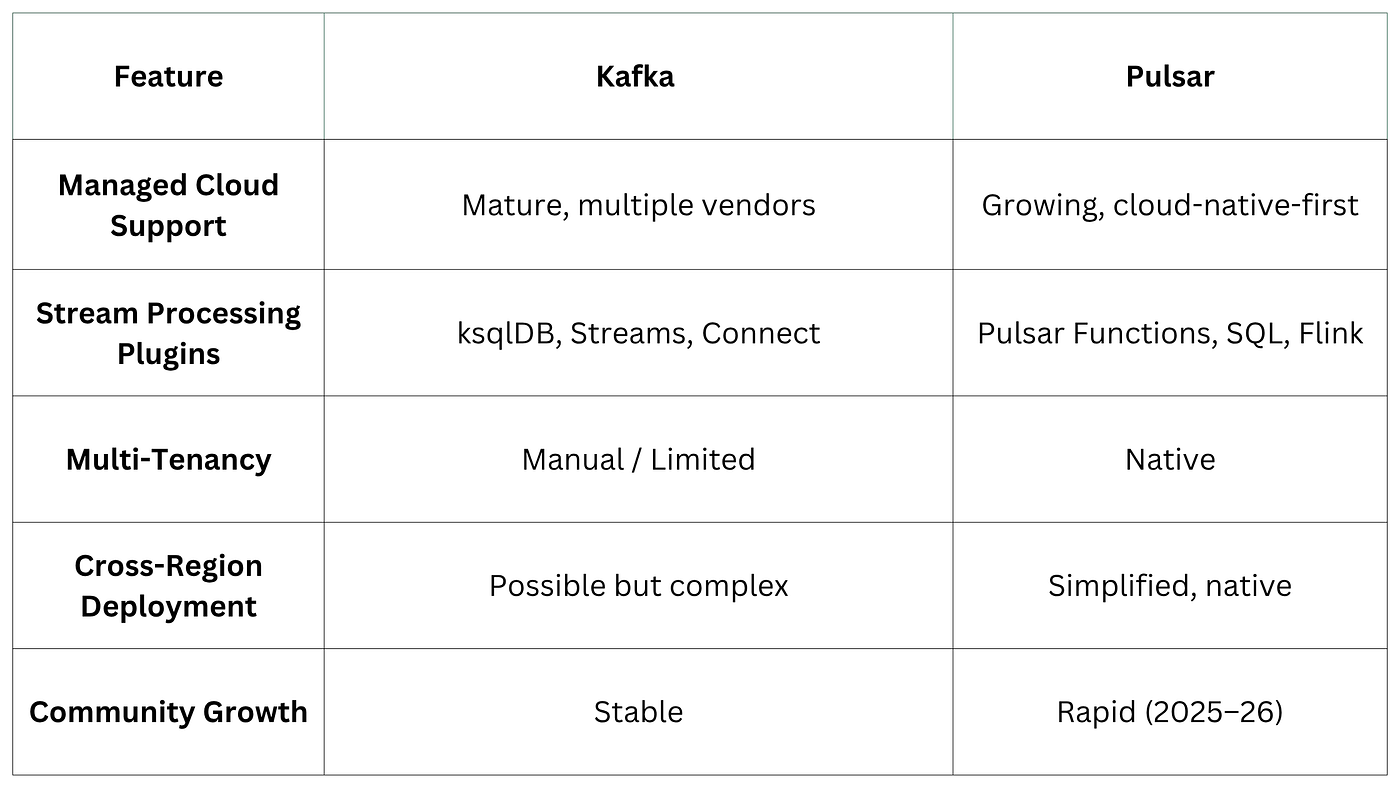
Created By Servifyspheresolutions
The ecosystem isn’t just convenience it’s a force multiplier. Brokers with richer tools, integrations, and managed services reduce risk, save time, and amplify scale.
Even the best architecture fails if teams can’t integrate, monitor, and maintain it. That leads to the final proving ground: stability, failover, and reliability under real-world stress, which we cover in the next section.
Reliability, Recovery & Failover in Real-World Outages
Performance and cost mean little if the system collapses under pressure. Real-world workloads expose weaknesses that benchmarks never show and in 2025, the stakes are higher than ever.
Kafka Powerful, But Fragile Across Regions
Kafka performs exceptionally well within a single region, but global deployments reveal cracks:
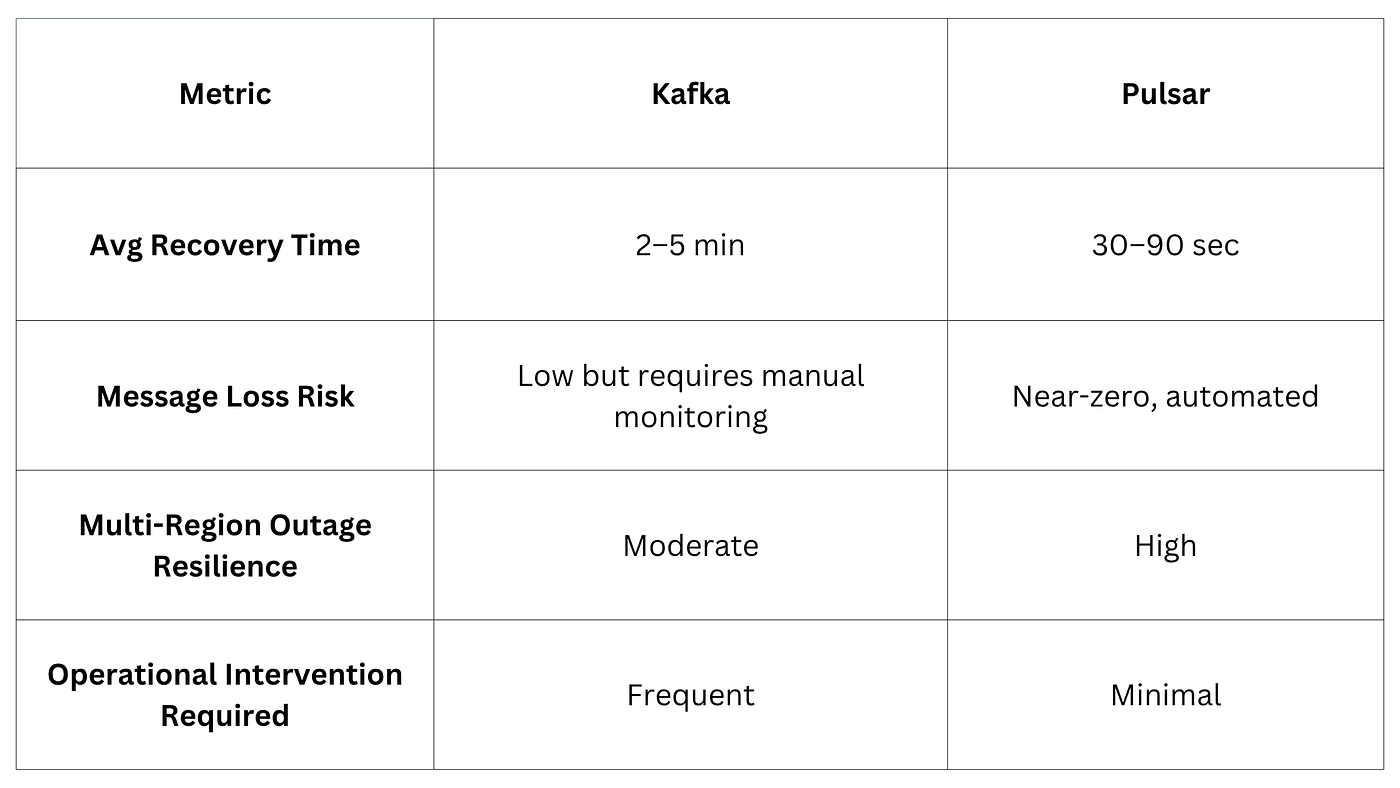
- Failover Time: Even with KRaft, broker recovery can take minutes, delaying message processing.
- Partition Rebalancing: Node failures trigger metadata rebalancing that can pause traffic and spike latency.
- Cross-Region Sync: Multi-cloud replication can lag, causing temporary inconsistencies in AI pipelines or real-time dashboards.
In practice, enterprise teams report that Kafka clusters under extreme load need continuous monitoring to prevent cascading failures.
Pulsar Designed for Chaos
Pulsar’s decoupled architecture shines under outages:
- Segment-Aware Recovery: BookKeeper nodes store durable segments; brokers can fail without data loss.
- Faster Failover: Recovery often occurs within seconds, minimizing downtime.
- Geo-Replication Resilience: Multi-region clusters continue processing even when individual regions fail.
Created By Servifyspheresolutions
Reliability isn’t theoretical it’s the measure of who survives real stress and unpredictable spikes.
Architecture, performance, cost, ecosystem, and reliability all matter. The final question remains: Which broker actually wins when every metric, edge case, and operational reality is considered?
What Actually Wins in 2025–26
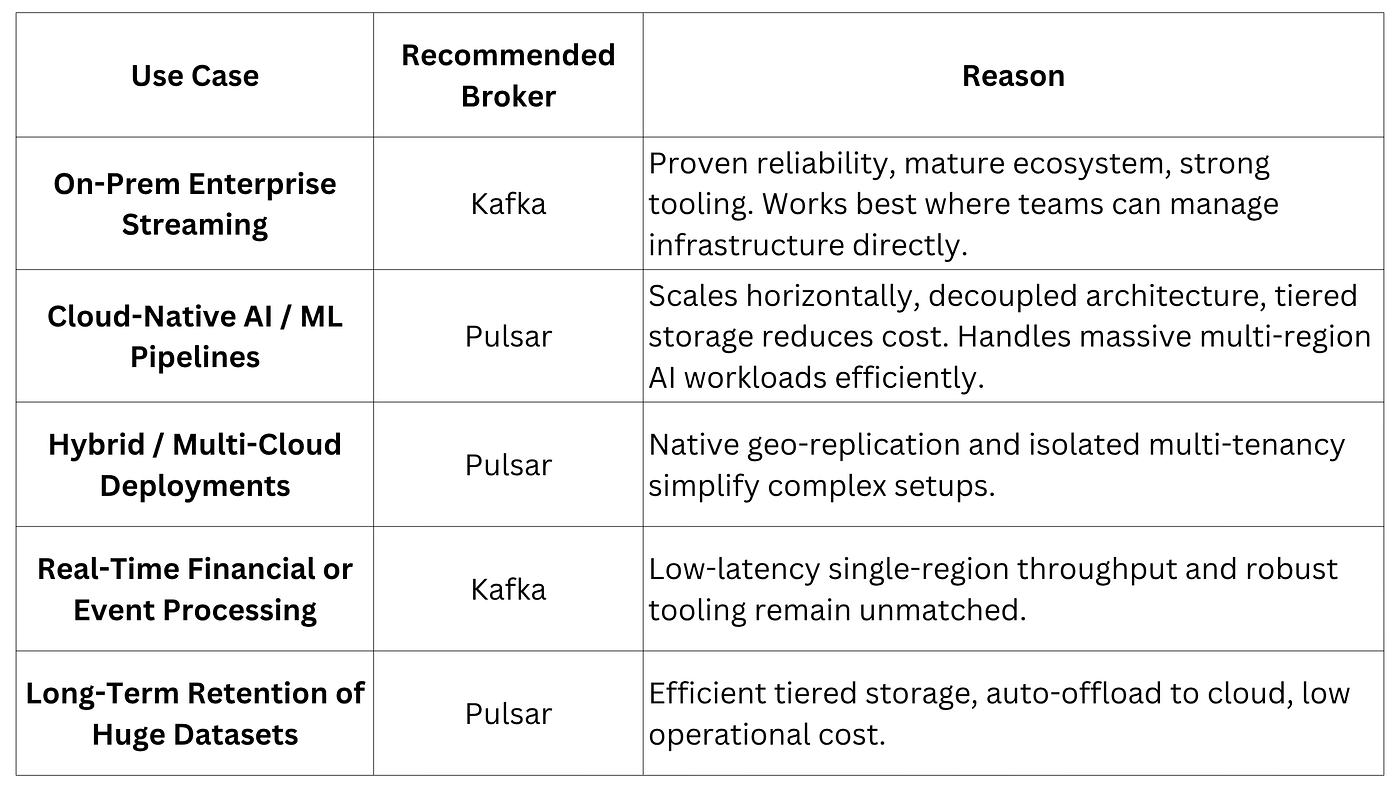
After architecture, performance, cost, ecosystem, and reliability, the picture becomes clear: there’s no universal winner, but context defines the champion.
Created By Servifyspheresolutions
Key Takeaways
- Kafka still dominates legacy pipelines companies with existing infrastructure benefit from its stability and enterprise support.
- Pulsar is the future modern cloud-native workloads, AI pipelines, and hybrid architectures favor its efficiency and flexibility.
- Survival beats raw speed in 2025–2026, the broker that recovers faster under load and scales without exploding costs wins more business than the fastest broker.
Strategic Insight
The real winner isn’t just a product it’s the team that leverages the right broker for the right workload. Late 2025 decisions should focus on matching architecture to business needs, not just following trends.
Looking Ahead: 2026 and Beyond
- Expect more hybrid broker setups, combining Kafka and Pulsar for maximum coverage.
- AI-driven routing, automated failover, and predictive scaling will become standard.
- Brokers will increasingly integrate observability and intelligence, not just message delivery.
By 2026, the question won’t be which broker wins it will be which broker learns faster and adapts to planetary-scale data flows.
The Real Lesson from Kafka vs. Pulsar in 2025–26
The debate isn’t about hype. It’s about survival, efficiency, and adaptability.
Kafka proves its strength in legacy, high-throughput environments, where stability and enterprise support matter most. Pulsar shines in cloud-native, AI-driven, multi-region pipelines, offering cost-efficient scaling and unmatched operational resilience.
By late 2025, success isn’t just speed it’s how well your data system survives real-world chaos, scales with minimal effort, and supports next-gen workloads.
Take Action Now
- Audit your pipelines: Identify workloads where Kafka or Pulsar’s strengths align with business needs.
- Plan for hybrid setups: Don’t bet entirely on one broker; leverage strengths of both where necessary.
- Prepare for AI & ML workloads: Your broker will be the backbone of real-time intelligence in 2026.
Final Thought: The winner isn’t the broker with the most users or the fastest throughput. The winner is the system that keeps your data moving, your AI pipelines alive, and your business ahead of the curve. Kafka laid the foundation. Pulsar is building the future. And your choice today decides who powers your data tomorrow.
메타데이터
- post_id
- fd88239dc09d
- slug
- kafka-vs-pulsar-which-message-broker-actually-wins-fd88239dc09d
- url
- https://towardsaws.com/kafka-vs-pulsar-which-message-broker-actually-wins-fd88239dc09d
- canonical_url
- https://towardsaws.com/kafka-vs-pulsar-which-message-broker-actually-wins-fd88239dc09d
- author_url
- https://medium.com/@servifyspheresolutions
- status
- ok
- fetched_at
- 2026-07-17 15:44:51