Camrys, not Bugattis
Product suites and product reuse
Camrys, not Bugattis
Product suites and product reuse
Everyone would like a Bugatti.* Why wouldn’t they? Bugattis are beautiful, hand-crafted, a fusion of art, craft and engineering.
[embed]Bugattis being made by hand
There is some kind of deep satisfaction that comes from knowing this was built specifically for you. And it’s easy to sell a Bugatti to someone who has the money.
But that’s the crux, isn’t it? Bugattis are rare and labor-intensive but most critically they are expensive.
Enter the Camry
The single best-selling sedan in the United States has been the Camry. In fact, you could say that most people, asked to picture a sedan, are picturing a Camry.
[embed]Camry manufacturing in Kentucky (includes Lexus and RAV4)
The Camry has a highly templated process, one that can be repeated over and over. Large parts of this industrial process are done by robot; but the parts that need to be completed by humans are optimized as well.
You can build 1,000 Camrys in the same time as you build one Bugatti.
Even better, the Camry production line can be re-used to build a RAV4, a Prius, or others. The drivetrain is the same for a large number of Toyota’s vehicles, making it flexible as well.
What does this mean for product management?
My former colleague Patrick Kanouse and I came up with this metaphor when we were trying to explain to yet another group of business stakeholders that any process that requires massive amounts of custom integrations or interaction is going to be expensive.
It’s not surprising that internal stakeholders in Enterprise organizations want to build Bugattis: either for themselves, or to sell to their customers!
But to be cost effective, to scale appropriately, products for enterprise need to be built like Camrys.
What does this mean for a product manager?
Evaluation
First of all, any roadmap, feature or workflow will need to be evaluated against the Bugatti vs. Camry matrix:
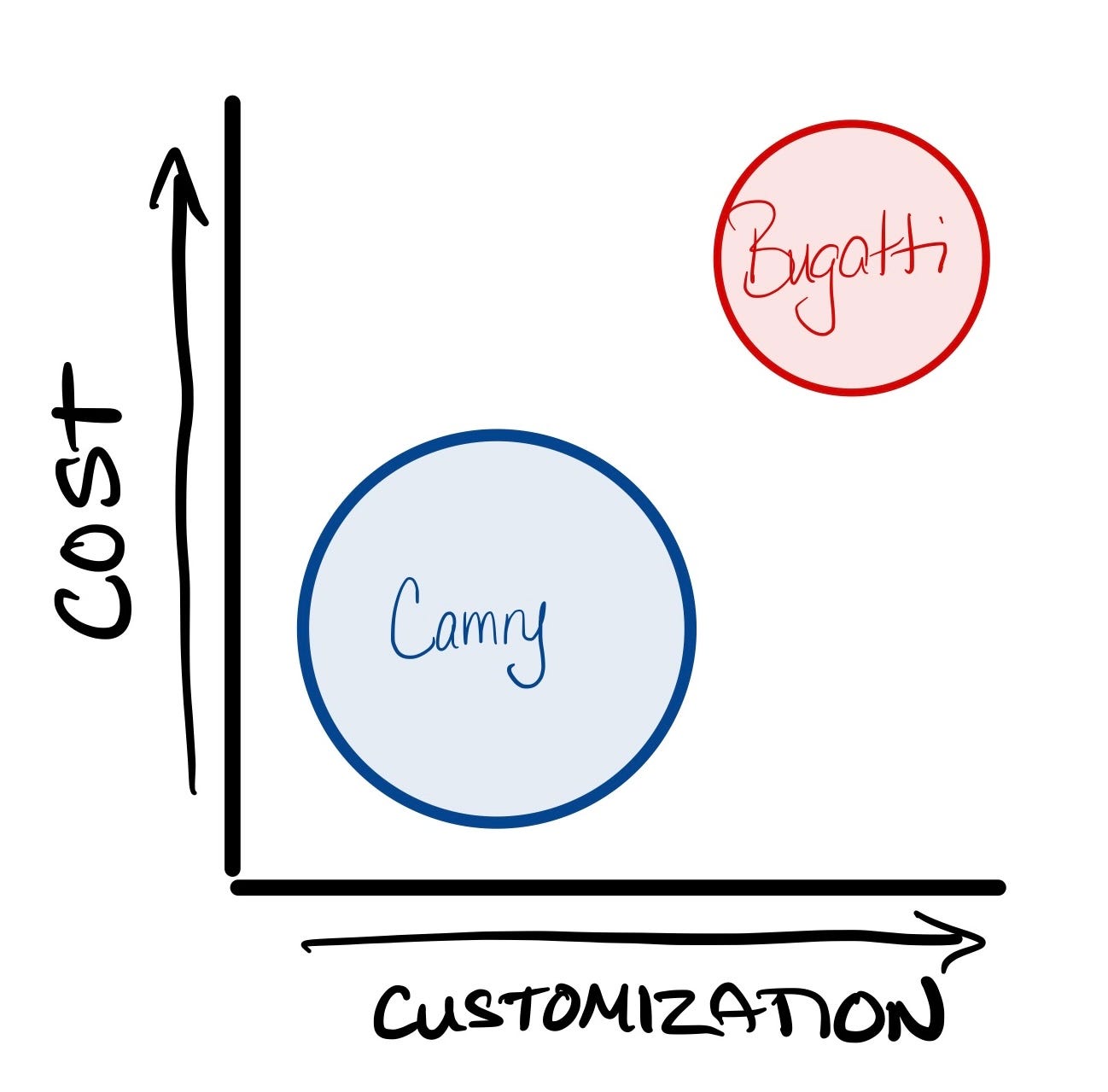
Please enjoy my terrible drawing
The key questions include some pretty standard ones:
- How much does this cost? — to implement, to support, to reuse
- What’s the impact on our other features?
- Can this be used by many users/groups/workflows/personas?
- If not, how can we revise this feature so that it will be usable by more than one?
Stakeholders will need to be reminded that:
- They won’t get a Bugatti at Camry prices
- Camrys have some advantages too: for example, they’re cheaper and easier to fix
- Camry-style production can still be customized.
So… what about AI?
The expectation is definitely that Generative AI will make this easier, if it hasn’t already. I’m not sure how closely that expectation hews to reality, but you can get some additional features at low cost. To abuse my metaphor, perhaps GenAI gives the ability to adapt similar to the improvements in robotics or supply chains in the 1990s gave to the Camry production line. (Honestly, I don’t know enough about car manufacturing to take this any further.)
The Lowest Common Denominator
The most critical questions are about how to make a spine that is strong but flexible. For that, I find thinking about the lowest common denominator is the most important, especially around the process or the sequence.
You need to be able to abstract the pieces of your product/products enough that you can see them as types, not just as individuals.
A Real Life Example
I was working with a business group that wanted to create a library online as sales support for their end users. Think user instructions, but also regulatory documentations. They currently had PDFs, so it would need support for that format, but they wanted to also move to a reflowable, and more easily searchable format.
Earlier they had spoken to the delivery team (who were very Bugatti/custom development oriented) who told them it was impossible: the delivery team did not have the dev cycles to deliver a new output pipe.
When I met with them about replacing their PDFs, they told me.
But to me, this was just a lowest common denominator problem. They didn’t need a special pipeline, they needed ANY pipeline. So I gave them an alternate pathway that used the existing infrastructure.
Long story, but this is the easiest way to float AI over existing processes to improve customization. Find the most common inflection point, add AI on top of it.
When I was scoping our intern project in the summer of 2022, I knew I wanted to add a ML component. The easiest inflection point was concept checks — if you are struggling with a concept, you may want infinite questions to review, until the point that you finally are confident. So we built an endless question engine that could be inserted into Chemistry courses using the same mechanisms as other questions.
Concept checks are a baseline in instruction; they’re a lowest common denominator. These days, this feature is built directly into the Coursera platform, as well as NotebookLM. NotebookLM even has flashcards, which I really wish I’d thought to add to the scope back then.
The Production Line
No matter what you put on top of it — AI content customized to your users, components or reusable features, if you can see your production line, and divide it into “doors” and “chassis” and “seats” etc. — you’ll make your life a lot easier, and your products more flexible and reusable.
- Except my Dad, who dislikes cars so much that he’d likely complain about the potential insurance cost/taxes if you even gave him a Bugatti as a gift.
메타데이터
- post_id
- fda87f580c9f
- slug
- camrys-not-bugattis-fda87f580c9f
- url
- https://medium.com/@kyrces/camrys-not-bugattis-fda87f580c9f
- canonical_url
- https://medium.com/@kyrces/camrys-not-bugattis-fda87f580c9f
- author_url
- https://medium.com/@kyrces
- status
- ok
- fetched_at
- 2026-06-27 18:20:27




