The Thousand Cuts: China Is Expelling Journalists, Recruiting Spies, and Watching Taiwan Arm Itself…
The Trump-Xi summit produced photo opportunities and a Boeing jet order; what it did not produce was any answer to Beijing’s systematic…
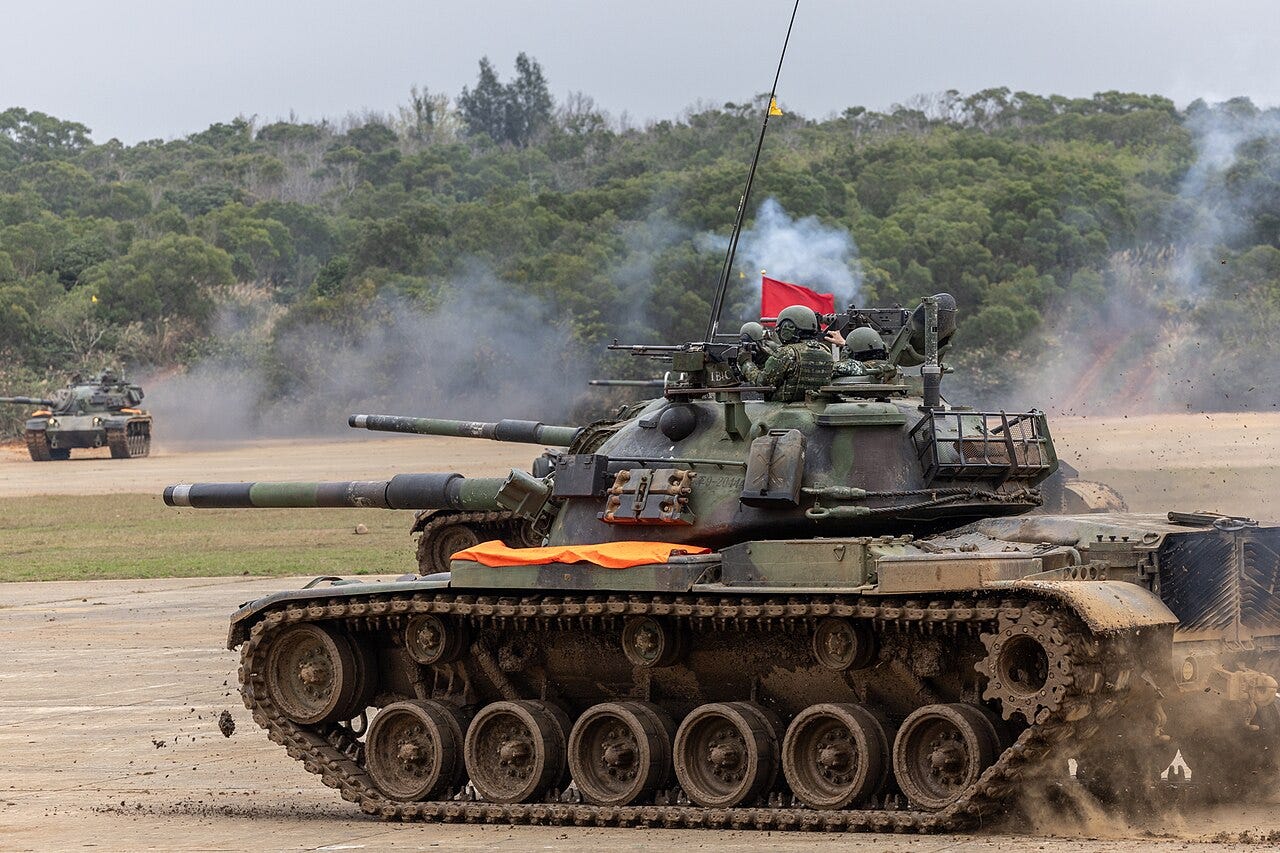
Taiwanese tanks rehearshal
The Thousand Cuts: China Is Expelling Journalists, Recruiting Spies, and Watching Taiwan Arm Itself — All at Once
The Trump-Xi summit produced photo opportunities and a Boeing jet order; what it did not produce was any answer to Beijing’s systematic campaign to reshape the global information environment, intelligence landscape, and military balance
The world in mid-2026 finds itself navigating a labyrinth of tensions, strategic calculations, and shifting alliances centered on one dominant axis: the relationship between China and the Western-led international order.
A once largely economic rivalry has metastasized into a multidimensional contest spanning trade, intelligence, press freedom, military deterrence, and nuclear proliferation.
Understanding this moment requires holding many threads simultaneously — the journalist expelled from Beijing, the spy recruiter on LinkedIn, the missiles stockpiling in Taiwan, the summit photo opportunity in the Great Hall of the People, and the nuclear factory Kim Jong Un proudly toured last week. Each thread, examined alone, tells a partial story.
Woven together, they reveal something more consequential: a world order under sustained, methodical pressure.
The expulsion of New York Times correspondent Vivian Wang from China in February 2026 was, in isolation, another data point in a long series of press freedom retreats.
But its details illuminate the broader logic of Beijing’s information strategy with unusual clarity. Chinese officials told the Times they acted against Wang, a China correspondent since 2020, in response to the appearance by video of Taiwan’s president at a Times DealBook summit in New York in December — an event in which Wang played no role.
The pretext was transparently manufactured. Chinese officials had complained for months about Wang’s coverage, which focused on the lives of ordinary Chinese people and often addressed sensitive matters such as censorship, Beijing’s unpopular response to the coronavirus pandemic, and the steady expansion of China’s security state.
The message was not really about a video appearance by a Taiwanese politician. It was about the kind of journalism Wang practiced: granular, human, and therefore subversive to a government that depends on controlling the narrative of its own society.
The pattern is now well established. Several major American outlets that had a robust presence in China before Xi Jinping’s consolidation of power over the last decade are now barely present, if at all. With Wang’s departure, the Times has just one correspondent based in mainland China, down from a peak of roughly a dozen. The Washington Post has not had one for several years.
This is not an accident or the cumulative result of individual editorial decisions. It is the outcome of a deliberate policy, executed through the blunt instrument of visa denial.
China’s foreign ministry is now more likely to grant short-term visas to reporters, which may not be renewed if Beijing officials dislike their coverage. The result is a form of conditional journalism — correspondents whose continued presence depends on not offending their hosts. For any reporter serious about covering authoritarian governance, that condition is incompatible with the job.
The Trump administration’s response — revoking the visa of a Xinhua journalist based in the United States — followed the now-familiar logic of reciprocal escalation that has characterized the media war between the two countries since 2018. In September 2018, the Justice Department ordered the American branches of Xinhua and China Global Television Network to register as foreign agents.
In February 2020, three Wall Street Journal correspondents were expelled from mainland China after the newspaper published an opinion essay critical of Beijing that angered Chinese officials. The expelled reporters had no role in the essay’s publication. The tit-for-tat has continued ever since, each move producing a counter-move, the total number of journalists on both sides slowly declining, the informational terrain between the two countries growing ever more opaque.
There is an asymmetry worth noting. American restrictions on Chinese state media journalists do not involve censoring their content — the Trump administration said as much — whereas Beijing’s expulsion of foreign correspondents is explicitly aimed at controlling what information reaches the outside world about China.
The Foreign Correspondents’ Club of China denounced what it called a “spate of targeted attacks on press freedom in China,” including “temporary detention, visa revocation and a growing pattern of intimidation directed at interview partners and journalists themselves, alongside the denial of access to official events.” The Chinese embassy’s characterization of the Five Eyes intelligence alliance as “the world’s largest intelligence organization” engaged in global espionage is a rhetorical move, not a rebuttal. It deflects rather than engages. But it is also a reminder that in this information war, both sides have learned to play offense.
The intelligence dimension of China’s global strategy extends far beyond the management of foreign journalists. The Five Eyes warning issued earlier this month described a recruitment operation of striking sophistication and banality simultaneously. Chinese intelligence operatives, working on behalf of the Ministry of State Security, are posting job advertisements on LinkedIn, Indeed, and Upwork — the mundane digital infrastructure of the modern economy — to identify and cultivate sources inside Western governments and militaries.
The operation works in stages: first, a CV screening to identify candidates with relevant access; then a virtual interview to probe the depth and nature of that access; finally, a request to write analytical reports on sensitive topics, compensated at up to a thousand dollars per submission through standard payment platforms. The genius of the approach is its plausible deniability. At no point does a target feel they are being recruited as a spy. They believe they are doing freelance consultancy work.
MI5 identified two specific LinkedIn profiles used in these operations — listed as Amanda Qiu and Shirly Shen — in November 2025. A researcher working for a British Member of Parliament confirmed he had been contacted by one of the accounts, which approached him in poor English with what appeared to be a straightforward job offer.
The Security Minister’s response — urging government and military personnel to follow protective guidance — underscores how difficult it is to defend against operations that exploit the normal, benign routines of professional life. People look for jobs. People update their CVs. People respond to messages from recruiters. The attack surface is essentially the entirety of professional society.
What makes this intelligence picture more alarming is the broader geopolitical context in which it sits. China’s intelligence-gathering is not incidental to its foreign policy; it is integral to a long-term strategy of achieving what the Five Eyes bulletin describes as “a strategic and tactical advantage.” That advantage is most visibly at stake in the Western Pacific, where the question of Taiwan’s future is moving from a matter of diplomatic abstraction to one of concrete military preparation on all sides.
Taiwan’s parliament approved an extra defense spending package of twenty-five billion dollars in May, though this fell well short of the forty billion the government of President Lai Ching-te had sought. The opposition Kuomintang, which controls parliament and maintains warmer relations with Beijing, argued that the government’s proposals were vague and risked corruption, and restricted the approved spending exclusively to the purchase of American weapons. The ruling Democratic Progressive Party described the shortfall in terms that went beyond budgetary disappointment. In their framing, every dollar not spent was a signal sent — to China, to the United States, and to Taiwan’s own population — about the island’s commitment to its own survival.
That framing is not melodramatic given the pace of Taiwan’s military preparations. According to a Reuters calculation published this month, Taiwan is on course to possess more than 1,800 anti-ship missiles by early 2029, representing a substantial expansion of the arsenal it is building around a strategy of asymmetric deterrence. The approach draws explicit lessons from two ongoing conflicts. Ukraine’s ability to inflict serious losses on Russian naval assets in the Black Sea using missiles and surface drones demonstrated that a smaller, outgunned force can contest control of maritime space if it has sufficient numbers of precise, affordable weapons. Iran’s continued capacity to threaten shipping in the Strait of Hormuz, even after sustained American and Israeli strikes on its military infrastructure, showed that a dispersed, mobile missile force is extraordinarily difficult to neutralize in a preemptive strike.
Taiwan’s military planners are applying these lessons to the specific geography of the Taiwan Strait. The core concept is the creation of a “kill zone” — a stretch of water in which any Chinese invasion fleet would face concentrated, layered anti-ship fire from ground-based mobile launchers, aircraft-launched missiles, and ship-based systems. The spearhead of this arsenal consists of American-supplied Harpoon missiles and domestically produced Hsiung Feng variants. By early 2029, Taiwan expects to have approximately 850 Harpoon missiles — including 400 from a 2020 arms sale that are now being delivered on schedule — and around 1,000 Hsiung Feng II and III missiles, bringing the total anti-ship inventory to roughly 1,850 weapons. On July 1, Taiwan will activate a new Littoral Combat Command, consolidating its coastal radars, anti-ship missiles, and drone forces under unified operational control for the first time.
The explicit goal, as stated by Taiwan’s leading military think tank, is not to destroy every vessel in a Chinese invasion fleet, but to deny the People’s Liberation Army the ability to complete a landing. The distinction matters. Taiwan’s planners are not imagining a naval victory in any conventional sense. They are trying to raise the cost of invasion to a level that makes it strategically irrational for Beijing to attempt, and to buy sufficient time for allied forces — meaning, principally, the United States — to intervene.
That last calculation is precisely where the uncertainty lies, and where the behavior of the Trump administration introduces its most dangerous variable. Throughout May and June, Trump made a series of statements that, taken together, amount to a sustained erosion of the strategic clarity on which Taiwan’s deterrence depends. In a Fox News interview following his summit with Xi in Beijing, Trump described American arms sales to Taiwan as a “strong bargaining chip” — language that frames a legal obligation under the Taiwan Relations Act as a transactional asset to be leveraged against either Taipei or Beijing as circumstances dictate. He also mentioned having discussed weapons deliveries with Xi directly, breaking with every administration since Ronald Reagan’s, which had explicitly promised Taiwan that such consultations with Beijing would not occur.
The acting Secretary of the Navy added to the confusion with congressional testimony suggesting that weapons deliveries to Taiwan were being paused to preserve American munitions stocks for the war against Iran. This was described as misleading on its face — the package in question had not yet been formally approved by the president, and even after approval, deliveries would take years. But the signal sent was unmistakable: Taiwan’s arms pipeline is subject to interruption for reasons that have nothing to do with Taiwan’s security needs.
Trump also spoke publicly about wanting to call Taiwan’s President Lai — which would make him the first sitting American president to speak with a Taiwanese counterpart since diplomatic relations with Beijing were established in 1979. The prospect simultaneously alarmed Beijing, which regards Lai as a separatist, and raised questions in Taipei about what such a call would actually accomplish, given that Trump’s other statements had framed Taiwan less as an ally than as a pawn. Xi had warned at the beginning of the Beijing summit that mishandling the Taiwan question could put the two superpowers on a path toward conflict, and China was reportedly delaying the visit of a senior Pentagon official to Washington in response to uncertainty over whether Trump would approve the pending fourteen-billion-dollar arms package.
The backdrop to all of this is the Trump-Xi summit itself, which analysts at the World Economic Forum described as delivering “managed trade” rather than strategic resolution. The two leaders agreed to establish a board of trade for managing bilateral commerce in non-sensitive goods, to reduce tariffs in selected sectors, and to have China purchase American aircraft while addressing concerns about critical minerals. But as the analysts noted, the same issues had arisen during Trump’s first term and remained unresolved then. The fundamental disagreement over what “reciprocity” means — Washington focusing on trade deficits, Beijing emphasizing relative levels of development — was not addressed. Industrial policy, state subsidies, and the role of state-owned enterprises were, once again, left off the table.
China’s trade strategy going forward will not wait for these disagreements to be resolved. Analysts identify four emerging trends: selective liberalization in sectors that serve China’s own development priorities; deepened regional trade cooperation through agreements like the China-ASEAN Free Trade Area upgrade concluded in October 2025 and continued pursuit of CPTPP accession; supply chain diversification through the Belt and Road Initiative and the “China Plus One” strategy, routing production through Southeast Asia, Latin America, and Africa to reduce dependence on any single market; and the systematic institutionalization of countermeasures against foreign trade restrictions. This last trend is particularly significant. China has been building a regulatory toolkit that goes well beyond tariffs and export controls, enabling coordinated responses to the “poison pill” clauses that Washington has been inserting into its bilateral and regional trade agreements to discourage third-country economic engagement with China.
The nuclear dimension of the emerging world disorder deserves sustained attention, partly because it tends to get crowded out by more immediate crises, and partly because it represents the most potentially catastrophic trajectory if current trends continue unchecked. Two developments in particular warrant close scrutiny.
The first is North Korea. Kim Jong Un has ordered an exponential expansion of his country’s fissile material production, calling for output that would support a dramatic increase in the nuclear arsenal beyond the approximately fifty warheads he currently possesses. North Korea has been testing its Hwasong-18 intercontinental ballistic missiles since 2023 — missiles with the range to reach the continental United States. Kim’s condition for any diplomatic engagement with Trump is that Washington accept the reality of North Korea’s nuclear arsenal, a condition the administration says it cannot meet while officially maintaining the goal of denuclearization. The impasse is total, and North Korea’s weapons program continues to advance regardless.
Xi Jinping’s planned visit to Pyongyang — his first since 2019 — is an attempt to reassert Chinese influence over a relationship that has drifted toward Moscow. North Korea’s deployment of approximately fourteen thousand soldiers to fight alongside Russian forces in Ukraine, roughly half of whom are estimated to have been killed or wounded, and the mutual defense treaty Pyongyang signed with Moscow in 2024, have demonstrated that Kim is willing to leverage his relationship with Russia to reduce his dependence on Beijing. For China, which has historically been North Korea’s economic lifeline and security guarantor, this drift is uncomfortable. Xi’s visit is a reminder that economic dependence — Chinese tourism revenue, railway links, trade flows — still gives Beijing significant leverage over Pyongyang’s options, even if it cannot fully control Kim’s strategic choices.
The divergence between American and Chinese definitions of denuclearization was starkly illustrated in the differing readouts from the Trump-Xi Beijing summit. The American version stated that both presidents shared the goal of denuclearizing North Korea. The Chinese version mentioned only that the two leaders had exchanged views on regional topics, including the Korean Peninsula. This is not a translation error. China’s preferred formulation — denuclearization of the Korean Peninsula — encompasses the American nuclear umbrella over South Korea and, potentially, Seoul’s newly acquired uranium enrichment capability, which Beijing and Pyongyang both cite as justification for the North’s own weapons development. Washington wants North Korea to disarm. Beijing wants stability on the peninsula and is unwilling to press Kim to the point of destabilizing his regime.
The second nuclear concern is the deepening relationship between North Korea and Iran. Western intelligence agencies have watched with growing alarm as the two isolated, sanctions-laden states draw closer together. Their cooperation has historically focused on ballistic missiles — Iran’s Shahab series is partly derived from North Korean Nodong systems — but the fear is that a new phase is beginning, one in which North Korea’s hard-won expertise in building and concealing a nuclear arsenal under conditions of extreme international pressure becomes a model and potentially a source of direct technical assistance for Tehran.
The logic driving this concern is straightforward. Iran’s nuclear infrastructure has been repeatedly attacked — by American and Israeli strikes on Natanz, Fordo, and Isfahan, and by the targeted killing of Iranian nuclear scientists over many years. American intelligence assessments suggest these attacks have delayed rather than destroyed Iran’s nuclear program. But the lesson Tehran’s hardliners are drawing from these attacks, combined with the experience of watching regimes in Iraq, Libya, and Syria fall or be severely weakened without the protection of nuclear deterrence, is exactly the lesson North Korea has embodied: possession of a deliverable nuclear weapon makes a regime essentially uninvadable. Kim Jong Un’s survival, despite decades of sanctions and isolation, while other leaders who abandoned or never pursued nuclear weapons faced military overthrow, has demonstrated a strategic logic that Iranian hardliners find compelling.
The cooperation being discussed by analysts is not a simple transfer of finished weapons — too visible, too risky — but something more subtle and therefore harder to counter: technical knowledge about underground facility construction, mobile launcher systems, fissile material enrichment under conditions of international inspection, and the integration of warheads with delivery vehicles. North Korea has decades of experience in all of these areas. Iran has resources and strategic motivation. Russia, which has deepened ties with both countries through the Ukraine war — receiving Iranian drones and North Korean ammunition and soldiers — provides the connective tissue of an emerging antiwestern network that Western security planners regard with mounting alarm.
The Shangri-La Dialogue security conference in Singapore at the end of May brought these anxieties into sharp focus. American Defense Secretary Pete Hegseth delivered what observers described as an unusually restrained speech — no mention of Taiwan, careful not to disturb the architecture of the Beijing summit — while warning more generally that no country, China included, should be permitted to establish hegemony in the Pacific.
Chinese Defense Minister Dong Jun was absent for the second consecutive year, but lower-ranking Chinese delegates used panel discussions to accuse Japan of failing to reckon with its militarist past — a line of argument that Japan’s Defense Minister Shinjiro Koizumi rejected with pointed logic, noting the absurdity of accusing a country with no nuclear weapons or strategic bombers of militarism while the accuser is rapidly expanding its own nuclear arsenal. China, by Western estimates, has nearly doubled its nuclear warheads in the past five years, without explanation or dialogue with neighbors who have legitimate cause for concern.
The tightening defense cooperation between Japan and the Philippines — including Japan’s first participation in the Balikatan exercises and discussions about Japan transferring decommissioned warships to the Philippine navy — reflects a growing recognition among American allies in Asia that they cannot fully rely on Washington’s guarantees.
The Trump administration’s transactional approach to alliances, its courtship of Xi, and its ambiguous signals on Taiwan have produced a predictable response: allies hedging by building bilateral relationships with each other, reducing their dependence on American commitments that may or may not materialize when needed.
The sum of all these developments is a picture of a world in which the rules, norms, and institutions that governed international behavior for the past several decades are under sustained pressure from multiple directions simultaneously. China is reshaping the information environment through journalist expulsions and intelligence recruitment.
It is building an alternative trade architecture through regional agreements and supply chain diversification. It is deterring confrontation through military buildup while simultaneously probing for weaknesses in the Western alliance structure. North Korea is advancing a nuclear program that has moved from theoretical to operational threat. Iran is drawing lessons from North Korea’s survival strategy. Russia is stitching all these strands together with military cooperation and shared antiwestern sentiment.
Against this backdrop, the Trump-Xi summit’s “managed trade” framework and the carefully worded joint communiqués look less like strategic accomplishments than tactical pauses — temporary reductions in surface tension that leave the underlying pressures intact. Taiwan continues to arm itself because its security depends on preparations that outlast any particular American administration’s priorities.
Taiwan’s opposition approves a defense budget smaller than the government wants, knowing that even the approved amount is insufficient without a sustained American commitment to deliver the weapons it has already paid for. A journalist who spent years documenting the lives of ordinary Chinese people packs up her Beijing apartment on a temporary visa, unable to return to the country she covered. Government workers in London, Canberra, Ottawa, and Washington are warned to treat unexpected LinkedIn job offers as potential intelligence operations.
What holds this moment together is not chaos but a kind of grim coherence: a major power pursuing its interests through every available instrument, and a collection of democracies struggling to develop a response that is both principled and strategically coherent.
The struggle is real, the stakes are not abstract, and the outcome is genuinely uncertain. That uncertainty — and the weight of what hangs on it — is perhaps the defining feature of the present moment in world affairs.
Sources and Further Readings
https://www.nytimes.com/2026/05/29/us/politics/china-expels-times-reporter.html
메타데이터
- post_id
- fdba7543c7a9
- slug
- the-thousand-cuts-china-is-expelling-journalists-recruiting-spies-and-watching-taiwan-arm-itself-fdba7543c7a9
- url
- https://medium.com/the-geopolitics-report/the-thousand-cuts-china-is-expelling-journalists-recruiting-spies-and-watching-taiwan-arm-itself-fdba7543c7a9
- canonical_url
- https://medium.com/the-geopolitics-report/the-thousand-cuts-china-is-expelling-journalists-recruiting-spies-and-watching-taiwan-arm-itself-fdba7543c7a9
- author_url
- https://medium.com/@jens_sorensen_geopol.
- status
- ok
- fetched_at
- 2026-06-15 20:49:13