Your Company Is the Hardware. Culture Is the Software.
Dani Herrera on why culture and DEI are not optional extras, they are the operating system every organization needs to function, and most…
Your Company Is the Hardware. Culture Is the Software.
Dani Herrera on why culture and DEI are not optional extras, they are the operating system every organization needs to function, and most are running them wrong.
[embed]CultureClub X by CultureMonkey — Season 06, Episode 05
There is a version of the culture conversation most organizations keep having wrong. Leadership agrees that culture matters. A committee is formed. An initiative is launched. A survey goes out. Results are reviewed, celebrated, or quietly shelved. Culture gets managed like a project with a launch date, a check-in meeting, and a finish line. Then it stalls, and everyone wonders why.
Dani Herrera has spent 20 years watching this pattern repeat across industries. As a Culture, DEI and Talent Consultant at Kay and Partners, she works with organizations trying to understand where their culture work keeps breaking down. Her diagnosis is consistent: most leaders treat culture as an add-on when it is actually the foundation.
In a recent conversation with Darcy Mehta on CultureClub X — CultureMonkey’s global HR thought leadership video podcast — Dani offered an analogy that cuts through the usual abstraction.
“Culture is the software. You cannot run your computer without software. Your company, your organization is the hardware. It is the computer.”
It is a deliberately simple comparison, but it reframes the entire conversation. Strategy, finance, product development — those are also pieces of software. But culture is the operating system running underneath everything else, every single day. When you treat it as optional, as one more checklist item to tick before moving on to “real” business priorities, you are not just neglecting culture. You are actively removing components the rest of the system depends on to function.
“The moment you start thinking about culture or DEI or inclusion as a separate thing, as a nice to have, that’s when you fail the computer. We fail because we are removing important parts of how the software runs.”
DEI ownership is not the same as DEI being everyone’s job
One of the more counterintuitive points Dani makes in the episode concerns how DEI responsibility gets distributed. The phrase “DEI is everyone’s responsibility” sounds inclusive. In practice, it often functions as an excuse for nobody to take meaningful action.
Effective DEI work requires dedicated expertise at the leadership level — a head of DEI, a VP, or ideally a C-suite seat — before it can be embedded into the processes and policies that everyone else then operates within. Without that structural foundation, you do not get shared ownership. You get diffused accountability. And diffused accountability, in Dani’s words, is the same thing as no accountability.
“If it’s everyone’s responsibility, it’s actually no one’s responsibility.”
This is not an argument against broad organizational participation in DEI. It is an argument for doing the foundational work first. When DEI is eventually embedded in hiring, communications, product decisions, and leadership behavior, it works because someone with the expertise and the authority made sure it was built in — not because everyone meant well.
The data hiding inside your survey silence
Engagement scores are typically treated as the headline metric for culture health. Dani challenges this directly. The score is not the finding. The demographic pattern underneath it is.
Looking at aggregate engagement data tells you an average. It can easily mask serious problems that only become visible when you disaggregate: which groups are responding consistently, which groups are consistently silent, and whether the responses from a particular segment are pointing to a specific leader, a recurring policy, or an internal process that is not working for everyone equally.
“Not just looking at the numbers in general, but who is answering the questions and what they’re telling us with their responses.”
Silence in survey data is not a gap. It is a signal. A demographic that does not respond to your engagement surveys is telling you something, even when that something is not yet showing up in your headline numbers. The real culture intelligence lives one layer below the score.
Trust is rebuilt through communication, not apology
On the question of recovering from organizational missteps, Dani is clear that most companies get it only halfway right. The standard response follows a familiar sequence: acknowledge the problem, apologize to those who were harmed, announce some form of corrective action. For most leadership teams, that sequence feels like the work is complete.
It is not.
The step that gets skipped almost every time is communicating throughout the recovery, not just at the beginning of it. Updating people at every stage of the process. Being transparent when a chosen approach is not delivering what was promised. Telling your organization that you are pivoting, and why, rather than going quiet and hoping momentum carries through.
“When things are not going great, we should be communicating that either. That is part of building trust.”
Trust is not restored by a well-timed apology. It is restored by a sustained pattern of transparency over time, including the moments when there is no good news to share. Organizations that only communicate when they have positive updates are not rebuilding trust. They are managing optics.
“We are rebuilding trust only by doing those steps. And that’s only half of the steps, honestly.”
Culture is performance infrastructure
Dani’s broader argument across the conversation is that culture is not soft. It is structural. The organizations that perform consistently over time are the ones that build their business around their people, not the ones that manage people as a function that serves the business. Culture is how that commitment operates at scale.
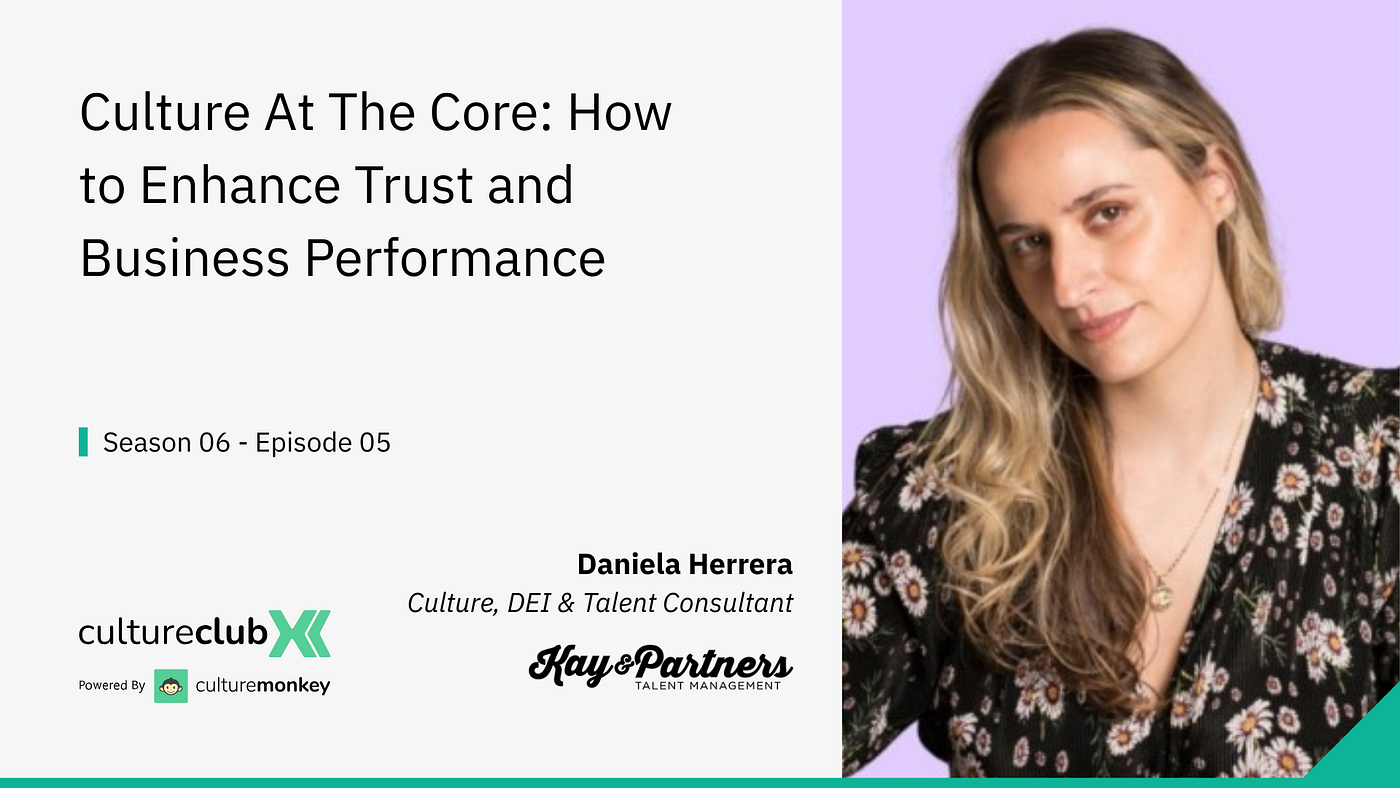
CultureClub X by CultureMonkey — Season 06, Episode 05
How strong company culture drives employee performance: https://www.culturemonkey.io/employee-engagement/how-a-strong-company-cultures-drives-employee-performance/
메타데이터
- post_id
- fdbb65ca31d5
- slug
- your-company-is-the-hardware-culture-is-the-software-fdbb65ca31d5
- url
- https://medium.com/culturemonkey-hq/your-company-is-the-hardware-culture-is-the-software-fdbb65ca31d5
- canonical_url
- https://medium.com/culturemonkey-hq/your-company-is-the-hardware-culture-is-the-software-fdbb65ca31d5
- author_url
- https://medium.com/@hari-cm
- status
- ok
- fetched_at
- 2026-06-13 07:35:29