Guidewire Consultant Job Roles and Responsibilities
A single misconfigured business rule can delay thousands of insurance claims. That’s the kind of pressure a Guidewire consultant works…
Guidewire Consultant Job Roles and Responsibilities
A single misconfigured business rule can delay thousands of insurance claims. That’s the kind of pressure a Guidewire consultant works under every day, and it’s exactly why insurers pay so much attention to who fills this role.
Most people assume a consultant just “sets up software.” In reality, the job sits at the intersection of insurance logic, technical configuration, and client communication — and that mix is what makes it demanding.
What Does a Guidewire Consultant Actually Do?
What Does a Guidewire Consultant Actually Do?
A Guidewire consultant configures and customizes PolicyCenter, ClaimCenter, or BillingCenter to match how a specific insurer actually operates. No two insurance companies handle underwriting or claims the same way, so out-of-the-box Guidewire rarely fits without adjustment.
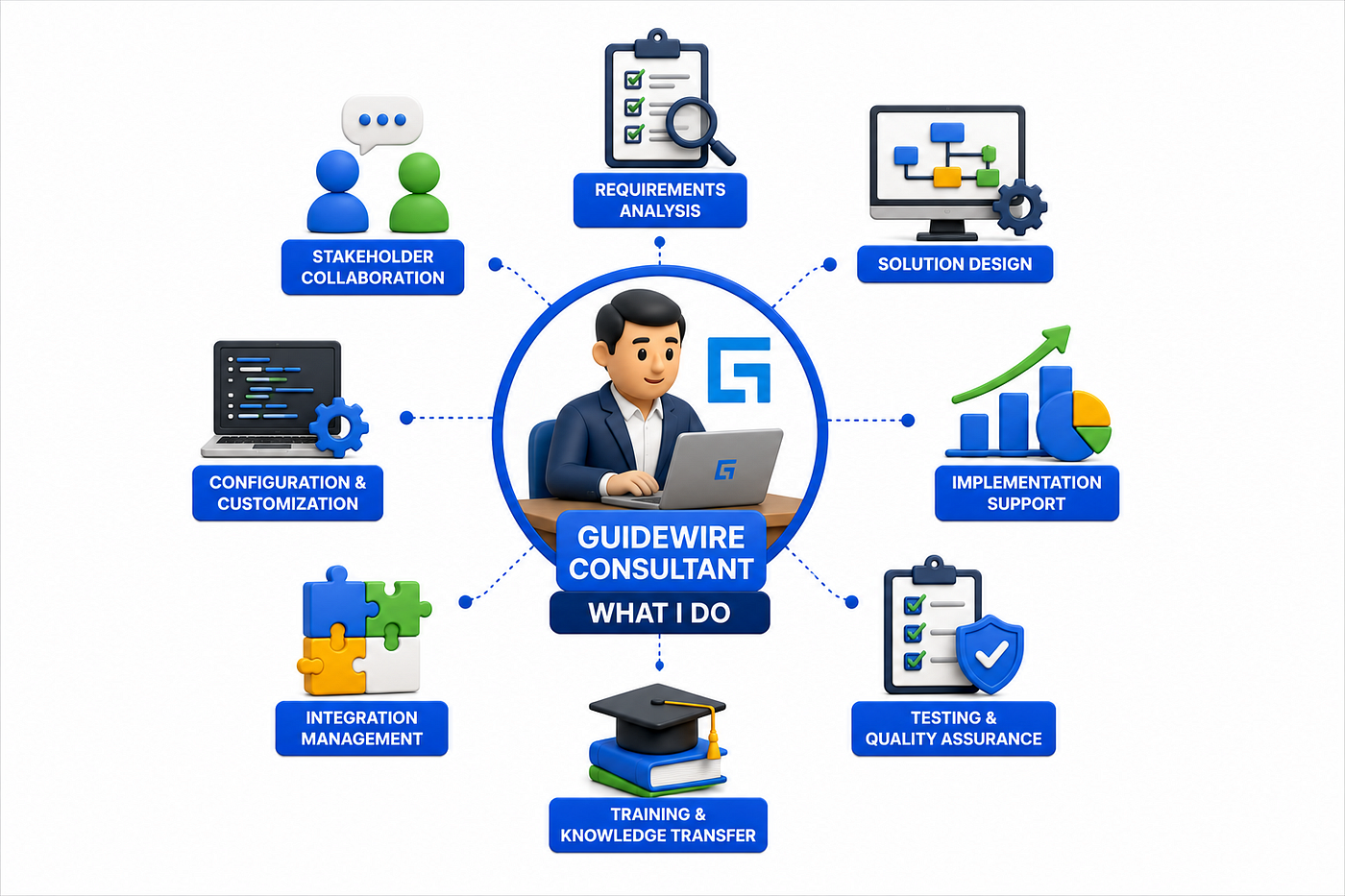
This means translating business requirements — often written by non-technical stakeholders — into working configuration using Gosu scripting, business rules, and workflow design. A consultant might spend one week refining claim intake screens and the next debugging an integration with a third-party rating engine.
Communication matters as much as coding here. Consultants regularly sit in requirement-gathering sessions, explain technical trade-offs to business teams, and document decisions for future developers. That’s a skill many purely technical guidewire developer roles don’t demand to the same degree.
Testing and support round out the job. Consultants validate configurations against real-world claim or policy scenarios, then troubleshoot issues once the system goes live. If you’re mapping out this career path, this guide on becoming a Guidewire ClaimCenter developer breaks down the technical foundation consultants build on.
Core Responsibilities That Define the Role

Core Responsibilities That Define the Role
Strip away the job-description jargon, and a Guidewire consultant’s responsibilities usually fall into a few consistent buckets:
- Requirement analysis — meeting with underwriters, claims teams, or business analysts to understand what the system needs to do
- Configuration and customization — building rules, workflows, and UI changes using Gosu and Guidewire’s studio tools
- Integration support — connecting Guidewire to external systems like payment gateways or rating engines
- Testing and defect resolution — catching configuration errors before they affect live policies or claims
- Client and team communication — presenting progress, flagging risks, and documenting changes clearly
Seniority shifts the balance. Junior consultants lean heavily on configuration and testing, while senior consultants spend more time on architecture decisions and client-facing strategy. Either way, the role rewards people who can move comfortably between technical detail and business context — a combination that keeps demand for skilled Guidewire consultants consistently strong across the insurance tech industry.
The Bottom Line
A Guidewire consultant isn’t just a configuration specialist — they’re the bridge between insurance business needs and working software. Master that balance, and the role opens into one of the more stable, well-respected paths in insurance technology today.
메타데이터
- post_id
- fdf27f30dc8f
- slug
- guidewire-consultant-job-roles-and-responsibilities-fdf27f30dc8f
- url
- https://medium.com/@worksanmitra450/guidewire-consultant-job-roles-and-responsibilities-fdf27f30dc8f
- canonical_url
- https://medium.com/@worksanmitra450/guidewire-consultant-job-roles-and-responsibilities-fdf27f30dc8f
- author_url
- https://medium.com/@worksanmitra450
- status
- ok
- fetched_at
- 2026-08-21 17:13:44