Claude Opus 4.8 Launch: Effort Controls, Dynamic Workflows, and Mid-Task System Messages
Claude Opus 4.8 matters less for the model and more for 3 upgrades: effort controls, dynamic workflows, and mid-task system messages.
ANTHROPIC
Claude Opus 4.8 Launch: Effort Controls, Dynamic Workflows, and Mid-Task System Messages
Claude Opus 4.8 matters less for the model and more for 3 upgrades: effort controls, dynamic workflows, and mid-task system messages.
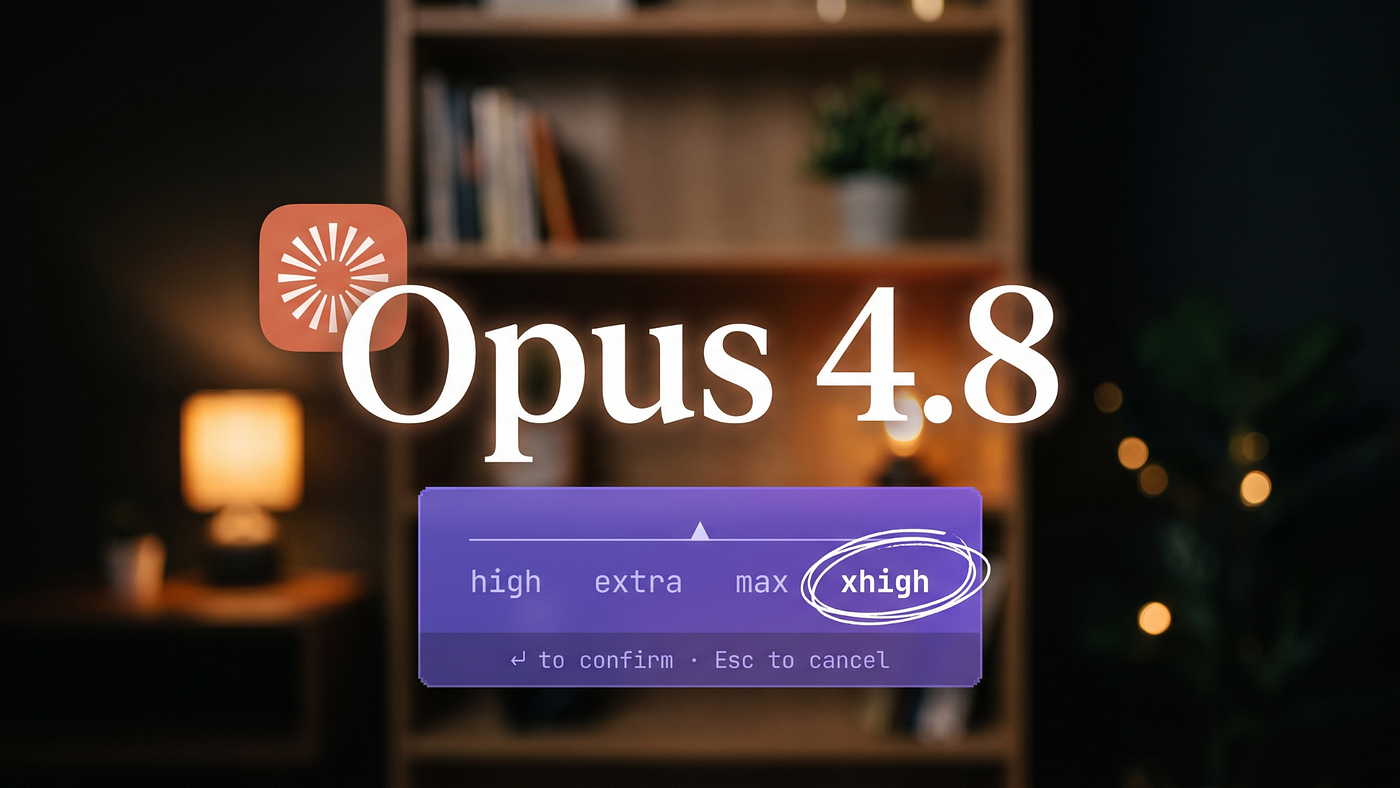
Claude Opus 4.8 shipped on May 28, just over a month after 4.7, at the same price and with Anthropic calling its own model “a modest but tangible improvement.”
Most of the coverage took that line at face value and turned the launch into another benchmark recap.
That’s where the actual story gets missed… the model itself is a little sharper, sure.
But the three features that shipped beside it are the part that changes how you work, and one of them quietly landed for every paying user instead of staying locked to developers.
So this is the overview that skips the leaderboard screenshots: what actually shipped, what each piece costs you in practice, and where that “modest” label is doing a lot more positioning than Anthropic lets on.
Effort Control Left Claude Code and Landed in the App
The most underrated change isn’t a capability, it’s a slider.
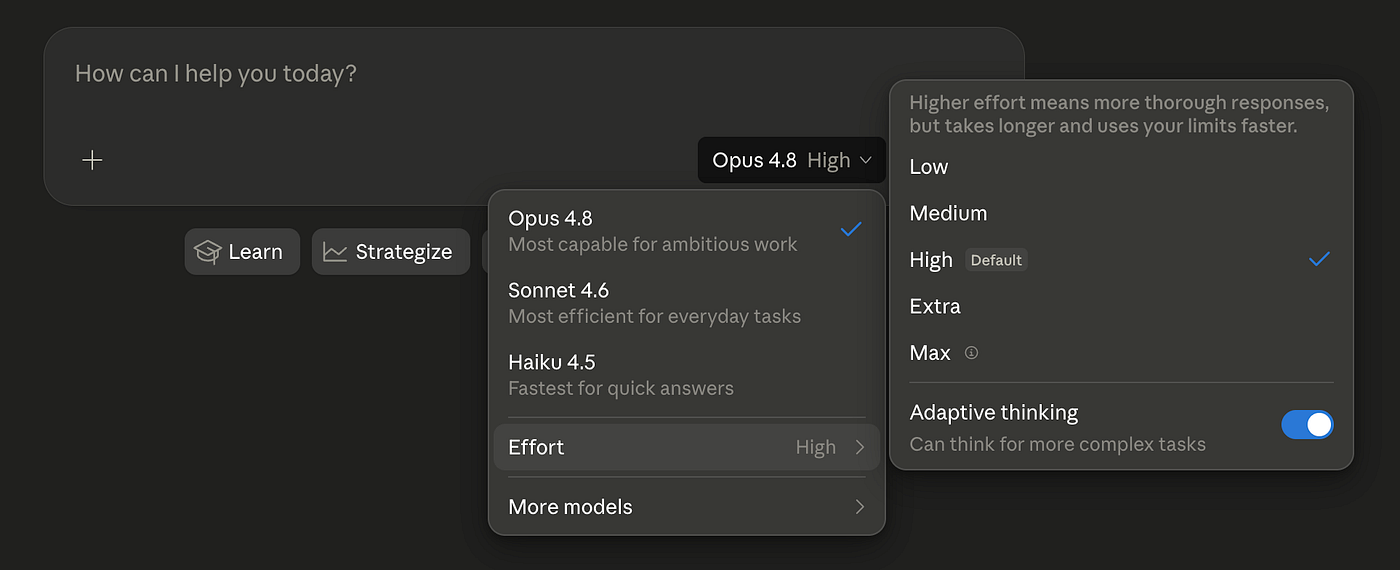
There’s now a control sitting next to the model selector in claude.ai and Cowork, on every plan, that lets you set how hard Claude thinks before it answers.
This used to live only in the Claude Code CLI, so for most people it didn’t exist.
The settings run from high (the new default) up through extra and max. High burns roughly the same tokens as 4.7’s old default but produces better results, so for normal work you do nothing and quietly come out ahead.
Extra is for hard or long-running tasks where you want it to chew longer.
Max is the deepest reasoning, and it hits diminishing returns fast, so you save it for the kind of problem you’d hand a senior engineer for an afternoon.
Higher effort eats your rate limits faster, and the app shows that burn as a percentage rather than actual token counts. That’s a fair thing to be annoyed about, because it’s hard to budget against a number you can’t see.
I usually use high by default, extra when I’m stuck, max almost never.
Dynamic Workflows Spawn a Swarm of Subagents
This is the one rewriting how Claude Code handles big jobs, and it’s a research preview on Enterprise, Team, and Max plans.
Instead of working a problem in one long thread, Claude plans the task, then fans out hundreds of subagents in parallel.
One set attacks the problem while another set tries to refute the findings, and it iterates until the answers converge.
Before it reports back, it verifies its own work against your existing test suite. That’s what makes codebase-scale migrations and sessions that run for hours actually viable instead of a hopeful mess.
The honest downside is cost… a swarm of subagents is token-heavy by design, and a single heavy run can eat a noticeable chunk of a weekly rate-limit cap.
Nobody is publishing clean numbers on this yet, which tells you to test small before you point it at anything serious.
It’s genuinely useful, and it’s also the clearest reason 4.8 still feels like a point release.
The model is incremental, the harness around it is the upgrade.
Mid-Task System Messages Are the Builder’s Quiet Win
If you build on the Claude Opus 4.8 API, this is your section, and it’s the least-covered of the three.
The Messages API now accepts system entries inside the messages array, not just at the top.
So you can update Claude's instructions partway through a run: change permissions, tighten a token budget, feed it new environment context.
You can change the rules mid-task without breaking the prompt cache and without faking a user turn to sneak the update in.
For a long agent loop, that’s the difference between a clean redirect and tearing the whole context down and rebuilding it.
It’s a small surface change that removes a genuinely annoying workaround.
If you’ve ever hacked a “user message” just to tell your agent it now has fewer permissions, you already know why this matters.
The Honesty Upgrade Changes How You Review Output
Anthropic led the announcement with honesty, and underneath the marketing there’s a real behavioral shift.
Opus 4.8 is around 4x less likely than 4.7 to let flaws in its own code pass without flagging them, per Anthropic’s own evaluations.
Worth holding that as a vendor-reported number until outside testers confirm it, but the direction is credible.
How it gets there is the interesting part… it’s more willing to decline to answer when it’s uncertain instead of guessing confidently and being wrong.
The alignment team also reports its misalignment rates land close to Mythos Preview, their best-aligned model so far.
This changes your review job, it doesn’t remove it.
You spend less time catching confident bluffs, and more time deciding whether an abstention was honest caution or the model dodging something you actually needed.
Different failure surface, less babysitting, but not zero.
Fast Mode Got 3x Cheaper, and Almost No One Noticed
Standard pricing didn’t move. It’s still $5 per million input, $25 per million output, same as 4.7.
The quiet move is fast mode.
The version that runs at 2.5x output speed dropped to $10/$50 per million, three times cheaper than the previous fast tier at $30/$150.
Cheaper fast tokens are exactly what subsidizes long-running agentic work, which is the same work dynamic workflows just made possible.
The pricing and the features are pointing in the same direction on purpose.
When Opus 4.8 Is Worth It, and When “Modest” Is the Tell
For agentic and long-running tasks, the switch pays for itself, mostly because of the harness and the honesty behavior, not the raw scores.
If you mainly chat with it, the upgrade is marginal and you won’t feel much.
The benchmark gains are real but vendor-reported.
It leads GPT-5.5 and Gemini 3.1 Pro across most coding axes, though GPT-5.5 still wins terminal coding under its own Codex harness, so scope any comparison to the work you actually do.
The app itself is the rough edge, it now has three tabs, Chat, Code, and Cowork, and the critique that it feels like a mess is fair.
The features outran the interface holding them.
Anthropic called 4.8 “modest,” then in the same post promised to bring Mythos-class models to everyone “in the coming weeks.”
Read the 4.8 features as a runway: effort control, dynamic workflows, and honesty-by-abstention are teaching you to work the way you’ll need to work once the real frontier model lands.
“Modest” isn’t humility there, it’s expectation management.
FAQ
Is Claude Opus 4.8 worth switching to?
If you run agentic or long tasks, yes, mostly for dynamic workflows and the honesty behavior. For plain chat, the gain is small enough that you can wait.
How much do dynamic workflows actually cost?
A lot of tokens. The feature spins up hundreds of subagents, so it’s gated to Enterprise, Team, and Max plans and a heavy run can burn a real slice of your weekly cap. Test on something small first.
Which effort setting should I use?
High by default, since it’s already tuned to give better results at roughly the old token cost. Bump to extra for genuinely hard problems. Max only when the payoff justifies the diminishing returns.
Conclusion
Open claude.ai, find the effort control next to the model picker, and run a normal task at high and then at extra to feel the difference before you guess at it.
If you’re on Max, Team, or Enterprise, point dynamic workflows at a small, low-stakes repo task and watch the rate-limit burn so you know the real number before a serious run.
If you build on the API, swap one mid-run context hack over to a proper mid-task system message and delete the workaround.
Then keep one eye on the “coming weeks” promise, because everything 4.8 just taught you to do is practice for the model Anthropic isn’t selling you yet.
메타데이터
- post_id
- fdf4407d4028
- slug
- claude-opus-4-8-launch-effort-controls-dynamic-workflows-and-mid-task-system-messages-fdf4407d4028
- url
- https://medium.com/ai-systems-lab/claude-opus-4-8-launch-effort-controls-dynamic-workflows-and-mid-task-system-messages-fdf4407d4028
- canonical_url
- https://medium.com/ai-systems-lab/claude-opus-4-8-launch-effort-controls-dynamic-workflows-and-mid-task-system-messages-fdf4407d4028
- author_url
- https://medium.com/@0xmega
- status
- ok
- fetched_at
- 2026-06-10 10:12:36