Meet the Lachenalias
Who knew that flowers could be turquoise?
Meet the Lachenalias
Who knew that flowers could be turquoise?
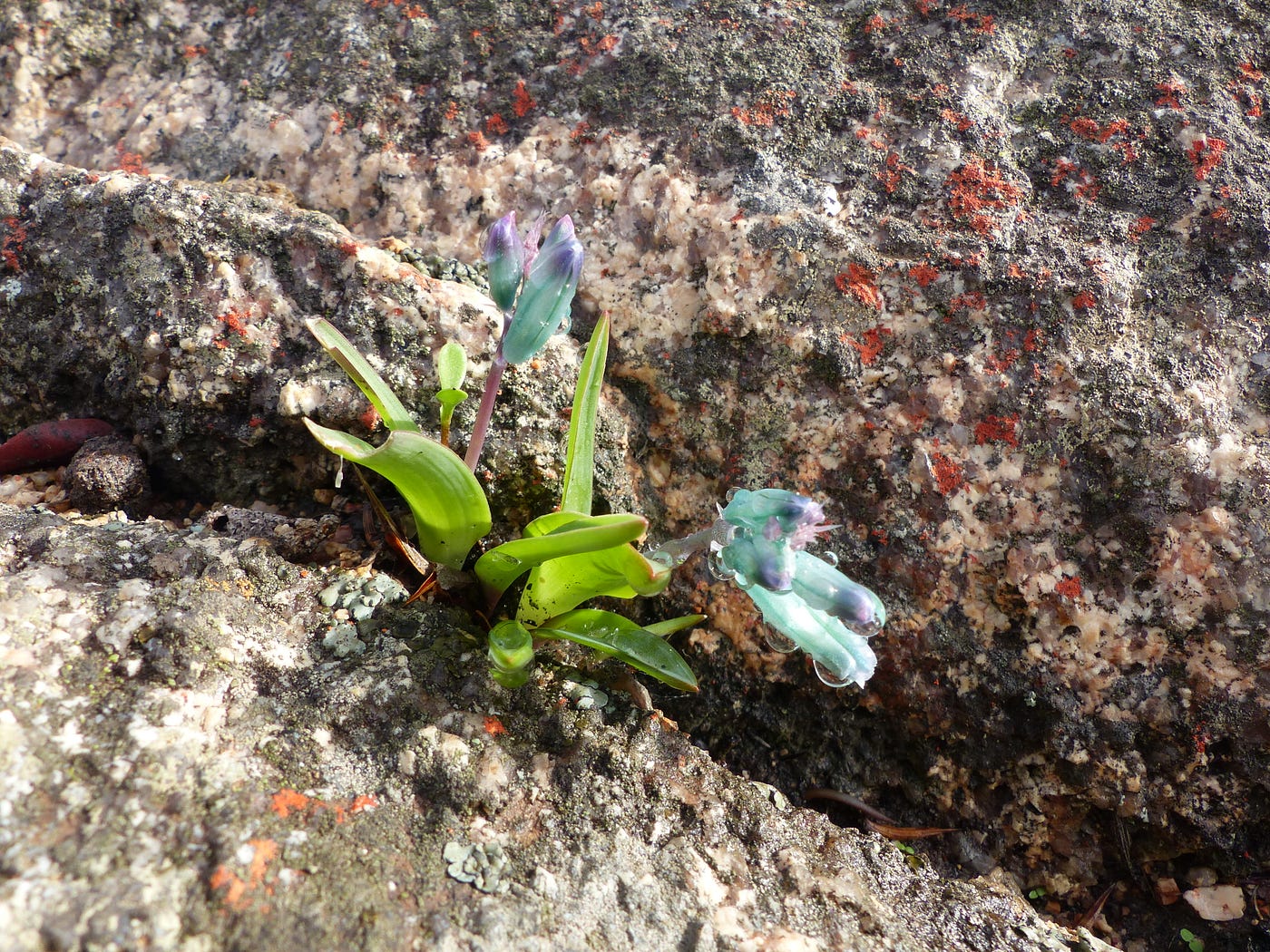
Lachenalia viridiflora in bloom in its West Coast granite boulder habitat, South Africa. ©Zoë Chapman Poulsen.
As a botanist, writer, and editor, I am lucky enough to live in Cape Town, one of the most biodiverse cities at the heart of South Africa’s Greater Cape Floristic Region (GCFR).
The sheer floristic diversity and extraordinary colours of the blooms of the GCFR, one of the world’s biodiversity hotspots, are epitomised by the genus Lachenalia, which forms part of the Asparagaceae family.
At the time of writing in 2026, there are 144 described Lachenalia species. These bulbous plants are known for their often spectacular and vividly coloured flowers that light up the veld when they come into bloom.
Most Lachenalia species are distributed from the Western Cape northwards to southern Namaqualand.
The diversity of Lachenalias

Yellow soldiers (Lachenalia reflexa) in flower in their urban lowland habitat, Cape Town, South Africa. ©Zoë Chapman Poulsen.
Members of the genus Lachenalia are known for their extraordinary diversity of different growth forms, flower types, and colours.
Some species are tiny in size, with their leaves and flowers hugging the ground. Others can grow up to 40 cm tall. Some Lachenalia species have flowers that are urn-shaped, bell-shaped, or tubular.
Flower colour can vary widely between species, from dull shades of mauve to vivid blues, yellows, reds, and greens, and even turquoise. Who knew that flowers could be that colour?
With time and progress in high-throughput DNA sequencing technologies, the number of species being described by taxonomists, that is, scientists who specialise in naming organisms, is steadily increasing.
But new Lachenalia species being located and described is not only down to technology.
Some species have been hiding in plain sight, such as the Overberg renosterveld specialist Lachenalia barbarae, which was described by Graham Duncan in 2017.
Only known from one site, this species remained relatively elusive because it flowers at the height of summer, when most other renosterveld plants with underground storage organs (geophytes) are dormant to survive the harsh Cape summer sun.
Lachenalias in habitat

Lachenalia quadricolor in flower in late winter in Critically Endangered Cape Flats Sand Fynbos, Cape Town, South Africa. ©Zoë Chapman Poulsen.
Most Lachenalia occur in parts of South Africa that receive most of their rainfall during winter, with some species occurring in areas that receive year-round rainfall. Some species also occur in South Africa’s summer rainfall zone.
Although some Lachenalia species are habitat generalists, many are specialists that only grow in the wild in relatively small areas with very specific habitat conditions.
Many members of the genus are xerophytes, meaning that they are adapted to grow in arid conditions with low moisture availability.
Three Lachenalia species are pyrophytes, which means that they only come into flower after a fire has burnt the vegetation in which they grow.
One such example is Lachenalia sargeantii, which grows on north-facing acid sandstone ridges. The bulbs can remain dormant for years or even decades while waiting for the perfect conditions to rise from the ashes.
Threats and conservation

Lachenalia orchoides subsp. orchioides in bloom after an ecological burn in Critically Endangered Cape Flats Sand Fynbos, Cape Town, South Africa. ©Zoë Chapman Poulsen.
One of the main threats facing many Lachenalia species, particularly those with limited distributions, is that of habitat loss.
This can occur due to urban expansion, illegal ploughing of indigenous vegetation, and the spread of alien invasive plants such as pine trees (Pinus pinaster) and Port Jackson (Acacia saligna) that have been introduced to South Africa from overseas.
Under the oversight of the South African National Biodiversity Institute (SANBI), volunteers and staff from the Custodians of Rare and Endangered Wildflowers (CREW) help to monitor populations of threatened species in their habitats. This includes multiple Lachenalia species.
These data are then passed on to the SANBI Red List team, who ensure that each species has been classified at the correct status on the Red List of South African Plants.
At present, seven Lachenalia species are listed as Critically Endangered (CR), one of the highest threat statuses. One example is Lachenalia abunothiae, which is endemic to Cape Town’s Cape Flats, where it grows in seasonally waterlogged depressions at wetland margins.
Further north in southwestern Namibia and the western Richtersveld, Lachenalia klinghardtiana (CR) has lost most of its habitat due to open-cast mining. The remaining plants are further threatened by climate change-driven drought and the upcoming construction of a green hydrogen plant and its associated infrastructure.
Some Lachenalia species are strongly dependent on the survival of cultivated individuals in ex-situ collections held by botanical gardens such as Kirstenbosch National Botanical Gardens.
One of the most well-known examples is Lachenalia macgregorianum, which is classified as Critically Endangered, Possibly Extinct.
It is only known from one single subpopulation collected from the Bokkeveld Escarpment near Nieuwoudtville in the Northern Cape in 1962. Since then, it has never been seen in the wild, but survives in ex-situ cultivation.
Lachenalia pollination

Lachenalia contaminata in flower in late spring in freeway road reserve habitat, Cape Town, South Africa. ©Zoë Chapman Poulsen.
Most Lachenalia species are pollinated by bees. The more showy species with more brightly coloured flowers are bird-pollinated, numbering 14 species in total.
For example, the traffic light-coloured Lachenalia quadricolor is pollinated by nectar-feeders, including orange-breasted, southern double collared, and malachite sunbirds.
Some Lachenalia species are able to self-pollinate in the context of pollinator absence.
Lachenalia cultivation
Botanical illustration of Lachenalia quadricolor. Photo by The New York Public Library on Unsplash
So, how are Lachenalia cultivated? The answer to this question varies depending on the wild growing conditions of that specific species.
In most cases, the bulbs should be planted in early autumn in a well-drained growing medium. The ideal mix should be slightly acidic, comprising equal parts river sand and well-drained potting compost.
Once the bulbs have been planted, they should be watered once thoroughly, and then regularly only after the leaves have emerged. They should be kept moist throughout their growing season and then kept dry once dormant.
Most Lachenalia can be propagated easily from bulb offsets. With a little more patience, they can also be grown from leaf cuttings or seed.
Seed should be sown in autumn into a well-drained growing medium. Lachenalia grown from seed usually takes around three years after germination to flower for the first time.
Further reading
Duncan, G.D. (2025) Molecular phylogenetics, systematics, reproductive safeguarding, and chromosome evolution of the genus Lachenalia (Asparagaceae: Scillodae). PhD thesis, Department of Biological Sciences, University of Cape Town, South Africa.
메타데이터
- post_id
- fdf5154c1ee3
- slug
- meet-the-lachenalias-fdf5154c1ee3
- url
- https://medium.com/@zoepoulsen/meet-the-lachenalias-fdf5154c1ee3
- canonical_url
- https://medium.com/@zoepoulsen/meet-the-lachenalias-fdf5154c1ee3
- author_url
- https://medium.com/@zoepoulsen
- status
- ok
- fetched_at
- 2026-07-14 07:52:58


