Why Magento Stores Become Harder to Manage Over Time
Hidden technical debt, extension conflicts, performance slowdowns, and scaling challenges can quietly turn Magento management into a…
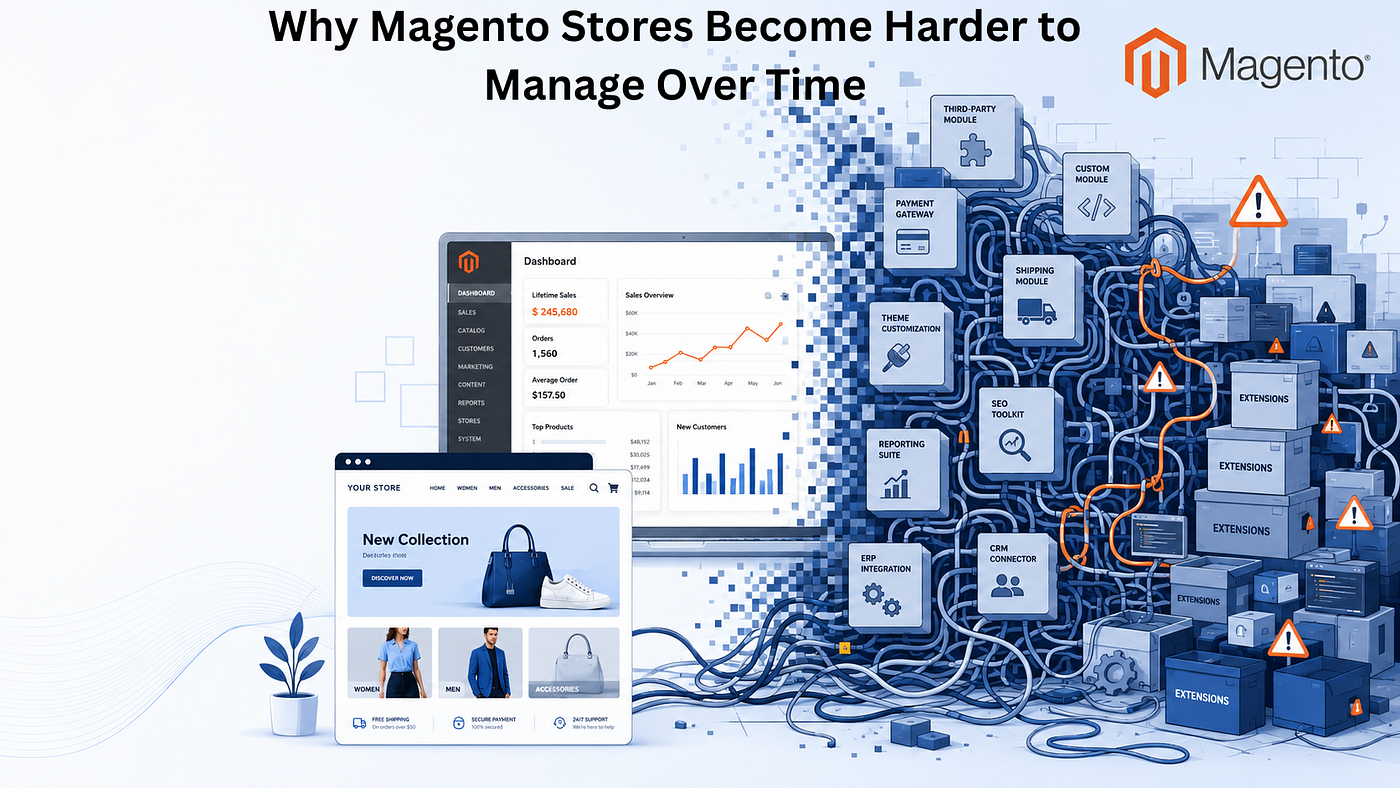
Why Magento Stores Become Harder to Manage Over Time
Hidden technical debt, extension conflicts, performance slowdowns, and scaling challenges can quietly turn Magento management into a serious business problem.
Running a Magento store looks exciting in the beginning. The platform is powerful, flexible, and capable of supporting businesses of almost any size. Many brands choose Magento because it offers deep customization, scalability, and advanced ecommerce capabilities.
But as months and years pass, many store owners start facing a different reality.
Simple updates become risky. Loading speeds begin to drop. Extensions conflict with each other. Product management takes longer. Developers spend more time fixing problems instead of improving the business. Eventually, managing the store feels heavier than growing it.
This is one of the most common issues experienced by long term Magento store owners.
The truth is, Magento itself is not the problem. The real challenge comes from how ecommerce businesses evolve over time. As stores expand, the technical complexity behind the scenes also grows. Without proper planning, maintenance, and optimization, the store slowly becomes difficult to manage.
In this article, we will explore the major reasons why Magento stores become harder to manage over time and what businesses can do to prevent these problems before they affect growth.
Magento becomes harder
1. Continuous Customizations Create Technical Complexity
Most Magento stores do not stay standard for long.
Businesses usually begin adding custom features such as:
- Custom checkout flows
- ERP integrations
- Inventory management systems
- Advanced shipping rules
- Customer specific pricing
- Marketplace integrations
- Loyalty programs
- Custom themes
At first, these changes improve operations and customer experience. But after years of modifications, the store becomes heavily customized.
The issue is that every new customization adds another layer of complexity.
Over time:
- Different developers may follow different coding standards
- Old code may become incompatible with newer Magento versions
- Custom modules may overlap with third party extensions
- Documentation often becomes outdated or missing
Eventually, store owners reach a point where even a small update feels risky because one change can unexpectedly break another feature.
This is one of the biggest reasons Magento stores become difficult to manage as they mature.
Businesses that invest early in proper architecture and scalable coding practices usually avoid many of these long-term issues.
If your store is growing and becoming difficult to maintain, investing in a professional **Magento Website Development Service** can help restructure the platform before the complexity becomes unmanageable.
2. Too Many Extensions Lead to Conflicts
Magento extensions are useful because they save development time and quickly add features.
However, many store owners gradually install more and more extensions to solve individual problems.
Examples include:
- SEO tools
- Marketing automation
- Payment gateways
- Analytics tools
- Product filters
- Shipping integrations
- Security plugins
The problem is that not all extensions are built with the same quality standards.
Over time, stores often face:
- Extension conflicts
- Database overload
- Slow backend performance
- Broken admin functionality
- Checkout issues
- Security vulnerabilities
Some extensions may also stop receiving updates from developers. When Magento releases a major update, outdated extensions can suddenly stop functioning correctly.
Many Magento stores eventually become dependent on dozens of third party modules, making the platform fragile and difficult to maintain.
A cleaner approach is to regularly audit installed extensions and remove unnecessary ones before they create long term performance problems.
3. Magento Updates Become More Difficult
Magento regularly releases updates for:
- Security patches
- Performance improvements
- Bug fixes
- Compatibility enhancements
In theory, updates are beneficial.
In practice, heavily customized stores often struggle during upgrades.
Why?
Because custom themes, modules, and extensions may not be compatible with the latest Magento version.
As the store grows older, upgrades become increasingly complicated because developers must:
- Test all existing customizations
- Fix compatibility issues
- Update deprecated functions
- Rebuild outdated integrations
- Prevent downtime during deployment
Some businesses postpone updates because they fear breaking the store.
Unfortunately, delaying updates creates even bigger risks:
- Security vulnerabilities
- PCI compliance issues
- Performance degradation
- Compatibility problems with payment systems
Eventually, the store becomes stuck on an outdated Magento version that is expensive and risky to maintain.
This situation is extremely common among older ecommerce businesses.
4. Database Size Grows Rapidly
As ecommerce stores expand, the Magento database grows continuously.
Over time, databases accumulate:
- Product data
- Customer records
- Order history
- Search logs
- Session data
- Cart information
- Inventory changes
Large databases slow down both frontend and backend operations.
Store owners may notice:
- Slow admin panel loading
- Delayed product updates
- Long search response times
- Slower checkout performance
- Increased server resource usage
Many businesses underestimate how much database optimization affects Magento performance.
Without regular maintenance, the platform becomes heavier and harder to manage every year.
Database cleanup, indexing optimization, and infrastructure scaling become necessary as order volume increases.
5. Performance Problems Increase Over Time
Magento is a powerful platform, but it is also resource intensive.
As stores grow, performance problems become more noticeable.
Common causes include:
- Large product catalogs
- Poorly optimized themes
- Excessive JavaScript
- Heavy extensions
- Unoptimized images
- Weak hosting infrastructure
- Inefficient database queries
Initially, small slowdowns may not seem serious.
But over time, they directly affect:
- SEO rankings
- Conversion rates
- Customer trust
- Mobile experience
- Cart abandonment
Many Magento stores slowly become bloated because performance optimization is ignored during growth phases.
This creates a frustrating experience for both customers and administrators.
Regular speed optimization and infrastructure reviews are essential to keeping Magento manageable long term.
6. Multiple Integrations Increase Maintenance Work
Modern ecommerce stores rarely operate independently.
Magento stores often connect with:
- ERP systems
- CRM platforms
- Shipping providers
- Accounting software
- Payment gateways
- Marketing platforms
- Warehouse systems
Each integration introduces another dependency.
When one external system changes its API or functionality, Magento integrations may fail.
Over time, managing these integrations becomes increasingly complex because:
- APIs evolve
- Authentication methods change
- Third party platforms discontinue features
- Data synchronization issues occur
Businesses may spend significant time troubleshooting integration failures instead of focusing on growth.
This is especially common in fast scaling ecommerce businesses.
7. Team Changes Create Knowledge Gaps
One overlooked problem is developer turnover.
Magento stores often pass through multiple developers or agencies over the years.
Unfortunately, not every team documents their work properly.
This creates major problems later because:
- New developers struggle to understand old code
- Custom features lack documentation
- Hidden dependencies remain undiscovered
- Debugging becomes slower
Eventually, businesses become afraid to modify the store because nobody fully understands the entire system anymore.
This is one reason why long term Magento management becomes expensive and stressful.
A structured development process with proper documentation helps reduce these risks significantly.
8. Business Growth Changes Store Requirements
The store that worked perfectly for a small business may no longer fit a growing company.
As businesses expand, they usually require:
- Multi store functionality
- International support
- Advanced inventory systems
- B2B capabilities
- Personalized experiences
- Faster fulfillment processes
Older Magento architectures may not be prepared for these larger operational demands.
This forces businesses to continuously patch and modify the platform instead of building scalable foundations.
Over time, the store becomes difficult to maintain because it was never originally designed for its current scale.
9. Security Management Becomes More Critical
As Magento stores grow, they become larger targets for cyber threats.
Security management becomes harder because stores must continuously monitor:
- Admin access
- Vulnerable extensions
- Server configurations
- Payment security
- Malware risks
- Data protection compliance
Older Magento stores that skip security maintenance often face serious risks.
Even one compromised extension or outdated patch can create major business damage.
Security is no longer a one time setup. It becomes an ongoing responsibility that grows with the store.
How Businesses Can Prevent Magento Management Problems
Magento stores do not automatically become difficult to manage. Most problems develop gradually due to unmanaged growth.
Businesses can reduce long term complexity by:
- Using clean development practices
- Avoiding unnecessary extensions
- Maintaining proper documentation
- Performing regular code audits
- Optimizing databases consistently
- Updating Magento proactively
- Monitoring performance regularly
- Choosing scalable hosting infrastructure
Most importantly, businesses should treat Magento as a long term digital infrastructure rather than a one-time website project.
Final Thoughts
Magento remains one of the most powerful ecommerce platforms available today. Its flexibility is exactly why so many businesses choose it.
However, that same flexibility can also create complexity over time if the store is not managed strategically.
As stores grow, technical debt, outdated extensions, performance issues, and integration challenges slowly accumulate. Eventually, even simple operations become harder than they should be.
The key is proactive management.
Businesses that regularly optimize, maintain, and modernize their Magento stores can continue scaling successfully without facing overwhelming operational problems later.
If your Magento store is becoming slower, more difficult to update, or harder to manage, it may be the right time to invest in professional support through a dedicated Magento Website Development Service to improve scalability, stability, and long term performance.
메타데이터
- post_id
- fe04447b5dfb
- slug
- why-magento-stores-become-harder-to-manage-over-time-fe04447b5dfb
- url
- https://medium.com/@madhublogger/why-magento-stores-become-harder-to-manage-over-time-fe04447b5dfb
- canonical_url
- https://medium.com/@madhublogger/why-magento-stores-become-harder-to-manage-over-time-fe04447b5dfb
- author_url
- https://medium.com/@madhublogger
- status
- ok
- fetched_at
- 2026-06-09 15:37:30