Dependency Hell: The Silent Killer of Software Development
Dependency hell isn’t just a buzzword — it’s the nightmare where libraries clash, builds explode, and deadlines vanish. Imagine debugging…
Dependency Hell: The Silent Killer of Software Development
Dependency hell isn’t just a buzzword — it’s the nightmare where libraries clash, builds explode, and deadlines vanish. Imagine debugging for three days because two libraries demand different versions of the same JSON parser. This isn’t rare; in 2026, it’s a standard Monday.
The “Diamond Problem” Defined
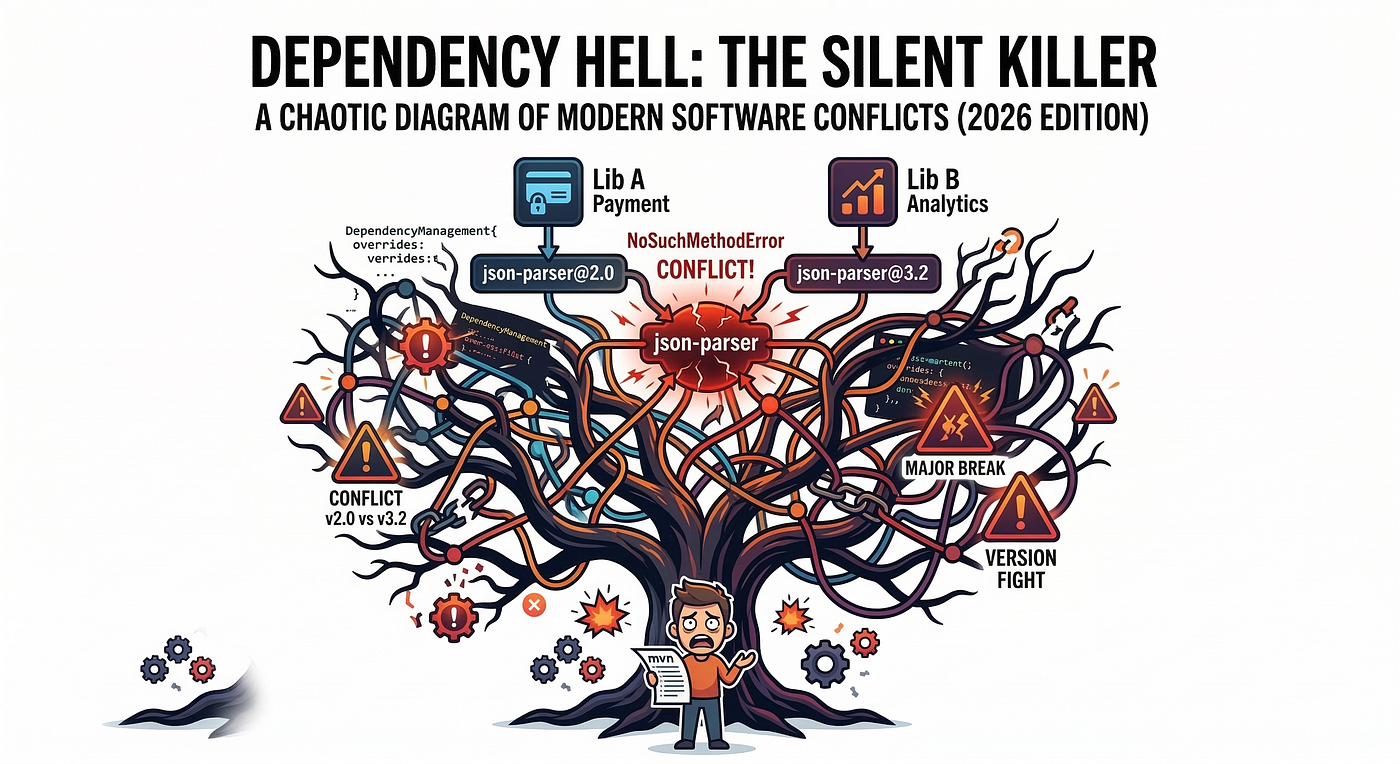
At its core, dependency hell occurs when your project requires multiple libraries that conflict over shared sub-dependencies.
- Lib A (Payment Processor) needs
json-parser@2.0 - Lib B (Analytics Tool) demands
json-parser@3.2 - The Conflict: Your runtime picks one. The other breaks silently or throws a
NoSuchMethodError.
The Stats: Studies show dependency conflicts cause 25–40% of production outages. In modern Node.js apps, transitive dependencies average 1,200+ packages — each a potential time bomb.
Why Does This Keep Happening?
It’s not bad luck; it’s the math of modern software:
- Transitive Explosion: Adding one library (like Stripe) can pull in 50+ sub-dependencies. The average app now manages 800–4,000 packages.
- Broken SemVer: Semantic Versioning promises safety, but reality is different. Patch updates break APIs, and “Minor” updates often hide “Major” changes.
- The AI Bloat: In 2026, AI-generated code and LLM integrations (like TensorFlow) inject hundreds of dependencies instantly. Human review can’t keep up.
The “False Fixes” to Avoid
**npm audit fix --force**: Usually breaks seven features to fix one vulnerability.- “Just use the latest”: Impossible when Lib A requires React 17 and Lib B requires React 19.
- “Delete node_modules”: A temporary band-aid that doesn’t solve the underlying version drift.
2026 Survival Strategy: Battle-Tested Solutions
1. Centralized Version Control
Stop letting sub-dependencies roam free. Use Overrides (Node), Dependency Management (Maven), or Constraints (Python) to force a single version of critical libraries across your entire tree.
2. Automated Conflict Detection
If it’s not in the CI/CD, it doesn’t exist.
- Node: Use
npm lsin a pre-commit hook. - Java: Use the Maven Enforcer Plugin to fail builds on version conflicts.
- Python: Run
pipdeptree --warn-conflictregularly.
3. Surgical Isolation
- Docker Multi-stage builds: Separate build-time and runtime dependencies to keep images lean.
- WebAssembly (WASM): Run conflicting libraries in sandboxed modules side-by-side.
Your Survival Checklist
- Audit Weekly: Use
npm auditormvn dependency-check. - Lock the Core: Pin high-risk deps (React, Lodash, Numpy) to exact versions.
- CI/CD Fail-Fast: Ensure builds fail immediately if a conflict is detected.
- Quarterly “Dep Diet”: Aggressively remove unused or redundant packages.
Conclusion: Fight Smart
Dependency hell won’t die — the industry grows dependencies by 30% every year. You can’t avoid the fire, but you can build a better fire extinguisher. Master your dependency tree, or it will master your weekend.
What’s your worst dependency scar? Left-pad 2.0? The Log4j Monday? Let’s swap battle stories in the comments.
메타데이터
- post_id
- fe0cd003b89b
- slug
- dependency-hell-the-silent-killer-of-software-development-fe0cd003b89b
- url
- https://medium.com/@dilhan9g/dependency-hell-the-silent-killer-of-software-development-fe0cd003b89b
- canonical_url
- https://medium.com/@dilhan9g/dependency-hell-the-silent-killer-of-software-development-fe0cd003b89b
- author_url
- https://medium.com/@dilhan9g
- status
- ok
- fetched_at
- 2026-06-09 15:37:30