The Myth of the Self-Made Man
What soil, microbes and forests can teach us about human survival
Opinion
The Myth of the Self-Made Man
What soil, microbes and forests can teach us about human survival
Holobionts
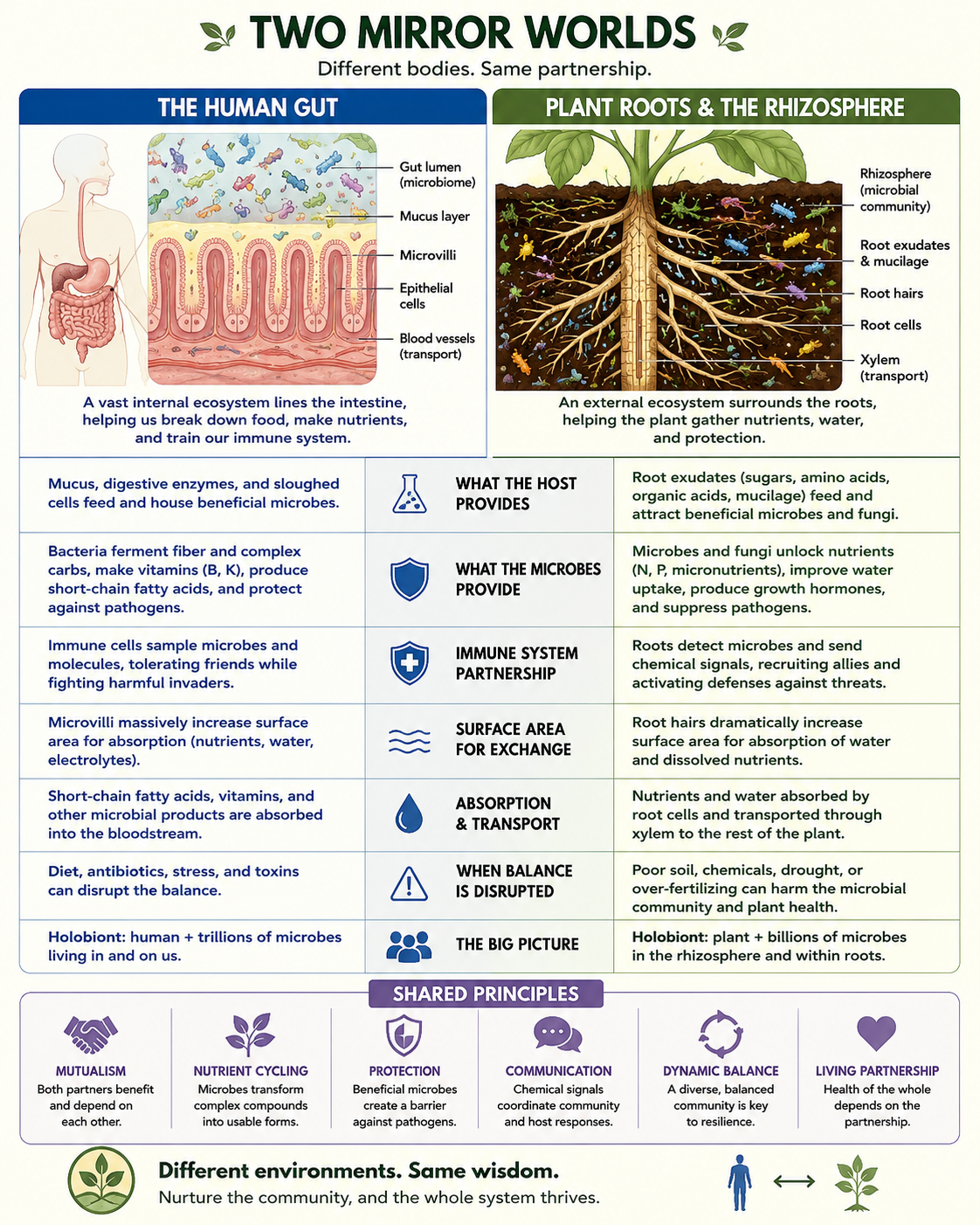
Almost a lifetime ago, I sat in a biology class and learned about the human digestive system. That food goes in one end under normal circumstances (lol) and inside our gut, it gets broken down and absorbed through tiny finger-like structures called microvilli.
When I learned it, I didn’t know that the process was dynamic; that there was more going on than just chewing and digesting. I’ve since learned that there is a continuous communication that takes place between what my body needs and the trillions of microbes that live on and in us.
Our bodies provide the environment and nutrition for these organisms. We release mucus, proteins and dead cells into our guts and many gut bacteria survive by consuming these substances.
In return these microorganisms break down fiber and complex carbs and help to produce vitamins and other useful molecules we require for normal health.
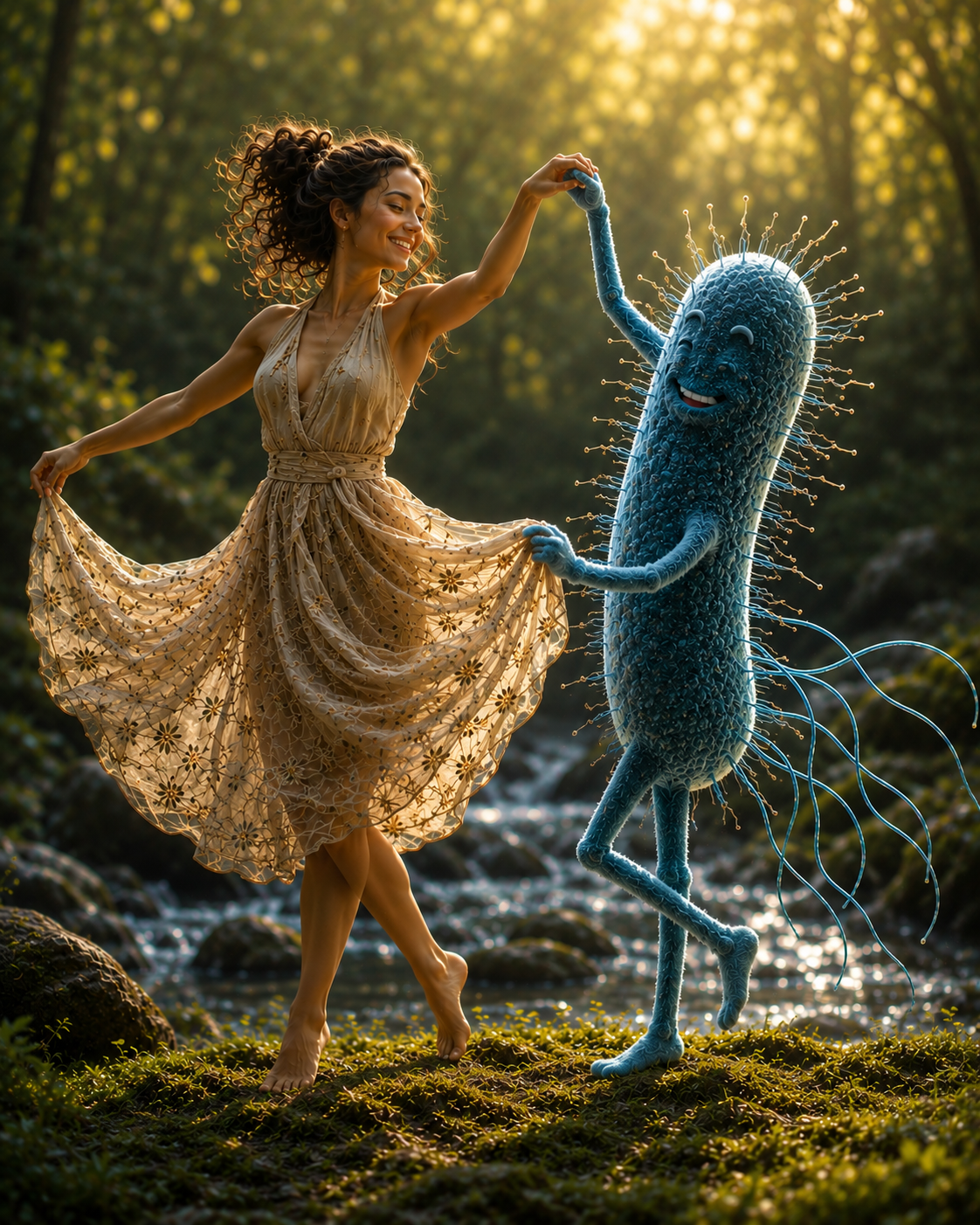
It’s a dance, an ebb and flow of us and them, both cooperating to keep us functioning. The process is called symbiosis: A partnership between humans and non humans that literally keeps us alive.
There’s a fancy word for this functioning ecosystem of discrete host and dependent species: holobiont. Humans are holobionts.
The Pattern Repeats
Nature repeats successful systems. We’re not the only holobionts. Plants do the same thing.
When we plant a…plant, (there’s no better way to express this), the roots don’t just go into the soil and extract nutrients. The dance repeats. Plant roots exchange sugars with fungi. The fungi trade phosphorous and water for carbon. Bacteria fix nitrogen. Worms and other insects break down dead matter and return nutrients to the soil.
Roots provide the environment in which plants absorb these nutrients through tiny root ‘hairs’ which are functionally similar to the microvilli that line our gut.
Notice the relationship, humans and plants interact with the organisms around them in ways that benefit both. When the relationship goes awry, both humans and plants can get disease, it’s the delicate balance that preserves health.
Just as an aside for the gardeners: having roots in the ground, even weeds are better for the soil than leaving it empty. Yes weeds can compete with crops for nutrition, but the better answer is not always to kill everything around the crop. Often, it is to outcompete weeds with beneficial companion plants that work with your crops and support the soil. Deeper dive here.
The Bigger Pattern
When we go deeper, it becomes harder to separate when one organism ends and the other begins. A tree for example isn’t just a tree. It’s made up of what we can recognize as tree cells, as well as the bacteria that live on it and in the soil. It’s the insects that pollinate its flowers, and the fungi that colonize its roots.
In the same way a human isn’t just a human. We can identify our individual cells, as well as the microbes in our guts, the microbes in our skin and in our mouths, as well as fungi and bacteria that swarm us so thoroughly that some estimates suggest we’re made up of about 43% human cells and 57% microbial cells.
More than half of us isn’t human at all — we are not biologically alone. Even more interesting, we have about 20,000 genes that make our proteins while our microbiome contains millions. Our symbiotes possess far more biochemical tools than our human genome alone.
Other Holobionts include corals that provide shelter for photosynthetic algae; lichens that combine both a fungus and an algae; termites that digest wood because of their relationship with gut bacteria; and cows that digest grass because of the microbes in its rumen.
In these and hundreds of other cases, organisms form integrated communities that extend the capabilities of each other and extend the survivability of both.
Science calls this systems theory. The ecological version calls it interdependence. The spiritual version calls it unity. Call it what we will, the bottom line is life is not a solo act; life is a chorus.
Of course, societies are not forests and people are not microbes, but the pattern is too persistent to ignore: life depends on relationships.
Shouldn’t the lesson apply to us as humans as well?
The Human Ecosystem
What are the nutrients we need for healthy human beings? What are the basic building blocks we need for a successful society? When we examine some of the civilizations that report high levels of human happiness we find a few basic building blocks repeating themselves.
- Trust, so we are not prey to one another.
- Education, so that the mind may work and the body has work.
- Public Health, so one person’s illness doesn’t become everyone’s suffering.
- Family and social networks, so care has hands, names and doors to knock on.
This isn’t an exhaustive list, only that these are well represented in desirable civilizations. We build societies around nutrients that nourish the human — body and soul. We deliver these nutrients via social networks that move resources, information and support from one part of society to another.
When they function well, communities become stronger, more resilient. When they fail, people become isolated, depressed, and ill.
Just as in nature, when we deplete the soil supporting a plant, it may well survive for a while. It’s leaves may remain green, it can stand upright and appear to be healthy.
But beneath the surface, the relationships that sustain its life are disappearing. The plant weakens, its leaves yellow and droop then fall. Pests make their way towards stressed plants bringing disease and death.
What have we learned in our modern society?
We celebrate the self made man. The entrepreneur, the rugged pioneer and the lone genius. But behind the scenes, there’s little doubt these people did not stand alone.
The entrepreneur depends on roads, schools courts, power grids, customers, workers and knowledge accumulated over centuries.
The Pioneer depends on tools forged by others and knowledge accumulated from countless ancestors.
The genius depends on language, teachers, books and communities of inquiry.
And every single one among them depended on microbial partners they couldn’t see.
The self made man is made by many. The self made organism is a myth and it’s time to let it go.
Society Today
Do you trust your neighbors? What about your Government? Do your institutions support you? Is it useful to seek out an education?
From where I sit, many of us feel trust in our leaders is declining. Many of us experience loneliness as it is on the rise even as birth rates are falling. We’re separating into political tribes where we treat one another as enemies rather than neighbors. It’s hard not to, particularly when we believe their politics brings harm to others.
It should come as no surprise that we’ve lost the lesson of our interconnectedness. We’re not islands standing alone in a desperate sea. We are shores, bridges, harbors and tides. Our very survival depends on us working to bring back the networks and nutrients we need.
Our biology was not evolved for living as rugged individuals, it was designed for us to participate within living systems in which we are a part of a functioning whole.
As holobionts, we recognize life persists through relationships, not just the ones we can see, but the ones hidden below the surface. The fungi beneath the forest floor. The microbes in the human gut. The neighbors who help after a hurricane, knocking on doors, carrying bottled water, clearing branches from a driveway or sharing an extension cord over their back fence. It’s the teacher who changes a child’s future. The grandparent caring for a grandchild. The citizen who contributes to a better tomorrow.
When we stand alone, we often build systems that forget the living world that sustains us. We search for nourishment in places where human beings cannot truly survive: in fantasies of planetary escape (Mars) or buried in bunkers, lost to futures that imagine survival without belonging.
Just like the forest, nature’s lessons are simple and inevitable. The strongest organisms are not individuals, they are communities. Not the sealed self but the living system. Not the lonely genius but the nourished network. Not survival apart but flourishing together.
That means rebuilding trust locally. It means supporting education, public health and civic life. It means checking on neighbors, joining the work of repair and designing institutions that make care easier than isolation.
It’s time we put our energy and focus there.
In the meantime, Walk Good. Mitch.
메타데이터
- post_id
- fe34365069af
- slug
- the-myth-of-the-self-made-man-fe34365069af
- url
- https://medium.com/open-microphone/the-myth-of-the-self-made-man-fe34365069af
- canonical_url
- https://medium.com/open-microphone/the-myth-of-the-self-made-man-fe34365069af
- author_url
- https://medium.com/@sacredkarailee
- status
- ok
- fetched_at
- 2026-06-13 00:25:45