Why the Kitsune Belongs on the Shrine Road
A symbolic reading of the fox as a figure of ambiguity, attention, and liminal passage in Japanese folklore.
Why the Kitsune Belongs on the Shrine Road
A symbolic reading of the fox as a figure of ambiguity, attention, and liminal passage in Japanese folklore.
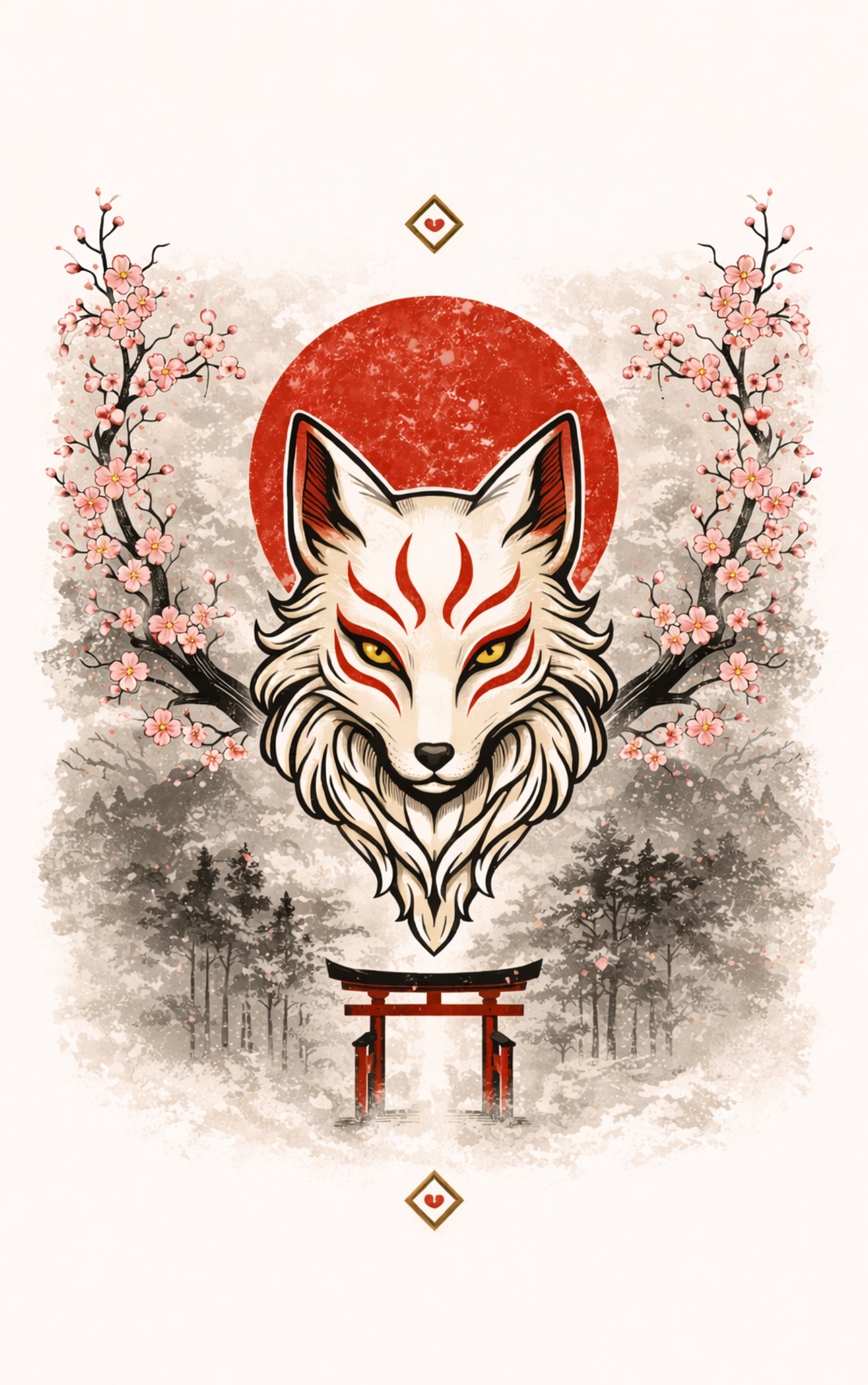
Designed by Oblivion Rise
A fox does not enter a path the way a horse does.
It does not announce weight. It does not turn the road into a procession. It appears at the edge of sight, near a tree line, between one patch of shadow and another. You notice it late. Then, almost as soon as you notice it, the animal is already elsewhere.
This is part of why the kitsune remains such a powerful figure in Japanese folklore and symbolism.
The fox is not only an animal in the field. It is also a problem for the eye.
Did it cross the road, or did it lead you somewhere? Was it watching, or simply passing? Was the path already strange, or did the fox make it strange?
These are not questions to answer too quickly.
The kitsune belongs on the shrine road because the shrine road itself is not only a road. It is a place of approach, hesitation, and changing attention. It is where ordinary walking begins to feel less ordinary. A path toward a shrine, especially when framed by gates, trees, stone, lanterns, or quiet, can turn movement into a slow adjustment of the senses.
The fox fits that adjustment perfectly.
It does not stand at the center like a monument. It waits near the margin.
The fox as a figure of the edge
Some symbols belong to the center.
The sun at noon. The throne. The altar. The mountain peak. These images gather meaning by being fixed, visible, elevated, or unmistakable.
The fox belongs somewhere else.
It belongs to the edge of the field, the bend in the path, the hour when light changes, the moment when certainty begins to loosen. Even when represented in stone near a shrine, the fox often carries a feeling of alertness rather than rest. Ears raised. Body held. Expression unreadable. It seems less like a domestic guardian and more like a sign that the road has become intelligent.
That is one of the central symbolic qualities of the kitsune: it complicates the path.
A simple road takes you from one point to another. A shrine road asks you to notice the approach. A fox on that road makes the approach unstable in a richer way. It suggests that the path may not only be crossed, but interpreted.
This does not require sensationalism. The kitsune does not need to be inflated into a dramatic supernatural creature every time it appears. In symbolic terms, its force comes from ambiguity.
It is not entirely wild, because it appears near shrine imagery and human-made paths. It is not entirely tame, because it remains fox. It is not merely animal, because folklore and shrine symbolism have given it a charged presence. It is not merely concept, because the fox still has fur, teeth, paws, and a body made for vanishing.
The kitsune lives in that unsettled middle.
Why the shrine road matters
The phrase “shrine road” is important.
A kitsune in an open field would still carry symbolic force. A kitsune in a story of transformation, trickery, or warning would carry another kind. But the kitsune on the shrine road belongs to a particular atmosphere: the road of approach.
A shrine is not entered all at once.
There is usually some form of transition. A gate, a path, a turn, a clearing, a visible change in the density of objects. The visitor may pass through one space before reaching another. Even without knowing every ritual or historical detail, the body can often feel the shift. The road prepares the person.
This preparation is not dramatic. It can be quiet. A line of stone lanterns. A red gate. A gravel path. Trees that narrow the view. The sound of footsteps changing underfoot.
The kitsune belongs to this zone because it is itself a creature of preparation. It does not give the whole meaning directly. It heightens attention. It makes the traveler less careless.
A fox at the edge of the shrine road asks a simple thing:
Are you awake enough to keep walking?
Messenger, trickster, guardian, or warning?
The kitsune is often discussed through familiar labels: messenger, trickster, guardian, shapeshifter, fox spirit. These words are useful, but they can also become traps.
If the kitsune is only a messenger, it becomes too obedient. If it is only a trickster, it becomes too cartoonish. If it is only a guardian, it becomes too stable. If it is only a supernatural being, it risks losing its animal sharpness.
The better reading allows the fox to remain multiple.
In Japanese folklore and shrine symbolism, foxes are often associated with Inari-related imagery, where they may be read as messengers or attendant figures. But even there, the kitsune should not be flattened into a simple mascot. Its presence near the sacred road is not cute in the modern sense. It is alert, watchful, and slightly dangerous to over-explain.
The fox does not offer a clean meaning.
It offers a condition of reading.
This is why it is so valuable as a symbolic animal. It teaches attention through uncertainty. The traveler must resist the urge to decide too quickly what the fox “means.” The point may be that the path has become less simple.
Some symbols clarify.
The kitsune complicates.
The intelligence of ambiguity
Ambiguity is often treated as a weakness.
We want symbols to be clear. We want meanings to sit still. We want the fox to represent exactly one thing so we can file it away and move on.
But mythic animals rarely work well when forced into single definitions.
The fox is intelligent because it does not stand where we put it. Its symbolic force comes from movement, misdirection, and the tension between visibility and disappearance. It can be seen, but not held. Interpreted, but not exhausted.
That is why the kitsune is not simply “mysterious.” Mystery is too vague a word. The fox is more precise than that. It is a symbol of active uncertainty. It creates a kind of disciplined doubt.
On the shrine road, this doubt matters.
A person walking toward a marked place should not arrive with the blunt confidence of someone entering a shopping center. The road asks for a different attention. The fox sharpens that attention by making the familiar slightly unstable.
A stone fox near a shrine road does not need to move in order to suggest movement.
It only needs to look as if it might have moved before you arrived.
Against the cute fox and the fantasy fox
Modern kitsune imagery is often pulled in two directions.
On one side is the cute fox: decorative, marketable, soft, instantly readable. On the other side is the fantasy fox: glowing, powerful, seductive, overcharged with supernatural drama. Both versions can be visually enjoyable, but both can weaken the older symbolic tension.
The kitsune of the shrine road should not be explained too quickly in either direction.
It is not only a charming animal. It is not only a magical being. It is not only folklore content. It is not only aesthetic mood.
It is a figure that stands where interpretation becomes uncertain.
This is the difference between atmosphere and decoration. Decoration gives the viewer something to consume. Atmosphere changes how the viewer moves through the scene.
The kitsune is atmospheric because it alters the path around it. A road with a fox is not the same road as before. A shrine entrance watched by fox figures is not just an entrance with animal statues. It becomes a space where alertness, offering, message, and ambiguity gather.
The fox changes the temperature of the approach.
The kitsune in the Oblivion Rise reading
The Kitsune and the Shrine Road approaches the kitsune as a liminal presence rather than a fantasy creature. The focus is not on cataloging every story or explaining every folklore variation. The book reads the fox through the atmosphere of the shrine road: the path, the turn, the messenger, the watcher, the possible deviation.
This reading connects naturally with Codex of Japanese Mythic Guardians, where the kitsune appears within a broader field of guardian and messenger figures. It also connects with The Animal Gate in Japanese Symbolism, which treats mythic animals as living thresholds: creatures that stand between human space, sacred space, warning, guidance, and omen.
But the kitsune remains distinct.
A stone guardian may hold the boundary firmly. A crow may direct the road with a solar command. A dragon may gather sky, water, and force. The fox moves differently. It does not command the path as much as it bends it.
That bend is the symbol.
A straight road becomes more interesting when the fox appears near it.
What the fox asks from the traveler
The kitsune does not give comfort in the obvious way.
It does not say that everything is safe. It does not promise that the path will be simple. It does not remove uncertainty from the road.
Instead, it asks the traveler to become more attentive.
This is why the kitsune belongs among symbols of passage. A passage is not only a transition from one place to another. It is also a test of perception. The question is not simply whether you can reach the destination. The question is what kind of awareness you bring to the approach.
The fox may suggest guidance, but not the kind that removes thinking.
It may suggest warning, but not the kind that freezes movement.
It may suggest trickery, but not the cheap trick of being fooled. More deeply, it suggests that reality sometimes bends around the assumptions we bring to it.
If the traveler thinks the road is simple, the fox makes it strange.
If the traveler thinks the symbol is easy, the fox refuses to stay still.
The shrine road after the fox
Once the fox has appeared, the road cannot return to being neutral.
That is its symbolic achievement.
The trees seem more deliberate. The bend in the path feels less accidental. The gate ahead becomes more than architecture. Even silence changes. It becomes not emptiness, but listening.
This is not because the fox has explained the shrine road.
It is because the fox has taught the traveler how not to flatten it.
The kitsune belongs on the shrine road because the shrine road is a place where ordinary movement becomes charged with possible meaning. The fox is the perfect companion for that passage: alert, ambiguous, intelligent, and unwilling to be reduced.
A symbol should not always answer.
Sometimes it should make the road harder to ignore.
If this symbolic reading of the kitsune and the shrine road speaks to you, The Kitsune and the Shrine Road explores this motif through the atmospheric lens of Oblivion Rise Japan, alongside related volumes on mythic guardians and symbolic animals.
Disclosure: This article was written with AI assistance and human editorial direction for structure, language, and refinement.
메타데이터
- post_id
- fe3bb5f71aa6
- slug
- why-the-kitsune-belongs-on-the-shrine-road-fe3bb5f71aa6
- url
- https://medium.com/@oblivionrise0/why-the-kitsune-belongs-on-the-shrine-road-fe3bb5f71aa6
- canonical_url
- https://medium.com/@oblivionrise0/why-the-kitsune-belongs-on-the-shrine-road-fe3bb5f71aa6
- author_url
- https://medium.com/@oblivionrise0
- status
- ok
- fetched_at
- 2026-07-19 12:11:04