Unmanned Warfare and Information Ecosystems: Drone Strikes, Attribution, and the Speed of Online…
Drones have become ubiquitous on the modern battlefield, transforming the way militaries gather intelligence and conduct strikes. Beyond…
Unmanned Warfare and Information Ecosystems: Drone Strikes, Attribution, and the Speed of Online Escalation
Drones have become ubiquitous on the modern battlefield, transforming the way militaries gather intelligence and conduct strikes. Beyond the battlefield itself, the use of drones is also increasingly reshaping the information environment around it. A claimed drone strike, a blurry clip of an explosion, or a rumor about where a drone came from can travel faster than verification and trigger a chain reaction of speculation, fear, and blame. What makes drone-related misinformation especially potent is that it combines visual drama, technical ambiguity, and geopolitical sensitivity in a format that is easy to share and hard to assess in real time.
Alice researchers on the Emerging Trend Detection team analyzed recent examples from between April and June 2026 and found that false or misleading drone narratives are rarely just about the aircraft itself. Instead, they tend to perform three recurring functions.
- They widen the blame beyond the immediate incident.
- They make escalation feel imminent before facts stabilize.
- They turn uncertainty into conspiracy, recasting ambiguous events as evidence of hidden plots.
Taken together, these patterns suggest that drone misinformation is best understood not simply as false content about military hardware, but as a powerful vehicle for shaping how conflict is perceived.
1. From strike to sponsor: how drone claims expand blame
One consistent pattern in recent drone misinformation narratives is the speed with which they expand responsibility beyond the alleged attacker. The attack becomes a story about who enabled it, who coordinated it, and who should be blamed alongside the visible actor.
On 15 May 2026, for example, online users claimed that Finland had deliberately allowed Ukraine to use its airspace to conduct drone strikes on Russia. The real-world anchor was genuine: Finnish authorities closed Helsinki airport after detecting drones in Finnish airspace that day. Pro-Russia users incorrectly reframed this response as complicity, alleging that Finnish air defense had “capitulated” and that Finland had “opened a corridor for drone strikes on Russia,” creating what they described as a “grey zone.” The purported route ran from Lithuania, across the Baltic Sea, through Estonian and Finnish airspace, bypassing Russian air defenses.
In reality, the Finnish government condemned the entry of Ukrainian drones into its airspace and actively deployed military assets in response, the opposite of facilitation.
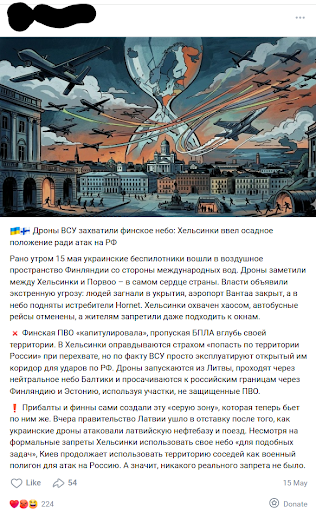
Pro-Russia social media post alleging that Finland allowed Ukrainian drone operators to access Finish airspace.
On 29 April 2026, a parallel narrative emerged following a drone crash near the Russia-Kazakhstan border. Users claimed that one of the drones used in an attack on Orsk, in Russia’s Orenburg region, had been launched from Kazakhstani territory, pointing to the discovery of debris in Kazakhstan’s Aktobe region, roughly 10 kilometers from the Russian border and around 20 kilometers from Orsk. Users cited several Russian military commentators who amplified the claim, alleging that Kazakhstan had “covertly provided its territory” for Ukrainian strikes and calling for a “transit embargo” on the country.
Kazakh authorities acknowledged the discovery of unidentified debris and opened an investigation, but attributed nothing to Ukraine. The framing ignored a basic operational fact that Ukrainian long-range strike drones carry a reported range exceeding 1,000 kilometers, comfortably placing Orsk within reach from Ukrainian-controlled territory without any third-country transit.
This pattern persisted into June 2026. Following the 3 June Ukrainian drone attack on the St Petersburg oil port and Kronshtadt naval base, a narrative emerged claiming the drones had been launched from trucks on Estonian roads “under the supervision of NATO specialists,” and potentially from Finnish forests and Estonian fishing boats. Users cited air alerts that were activated in Estonia during the attack as evidence of Estonian involvement.
In fact, Estonian authorities have previously issued air alerts in response to the detection of Ukrainian drones in or near Estonian airspace, including in earlier unrelated incidents, as a precautionary measure rather than as an indication of operational coordination. Deploying NATO member territory for offensive strikes against Russia would contradict Estonia and Finland’s stated security policies, Ukraine’s arrangements with its NATO partners, and the alliance’s own doctrine on the conflict.
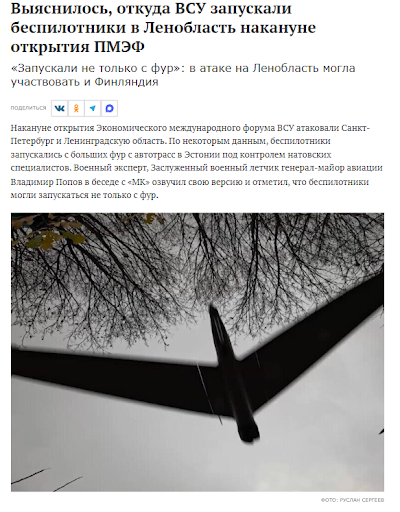
Segment of an article falsely claiming that Ukrainian drones deployed in a strike against Russia were launched from Estonia.
This logic can also extend beyond states. In May 2026, one narrative claimed that Palantir was directly orchestrating Ukraine’s drone strikes on Moscow and other Russian cities. The real-world anchor was the 12 May visit of Palantir CEO Alex Karp to Kyiv to discuss the company’s cooperation with President Zelensky. Pro-Russia users embellished this with a fabricated quote attributed to Karp, a promise of coordinated future strikes on Moscow, and alleged that Ukraine had provided Palantir with millions of hours of battlefield footage in exchange for AI-generated attack plans and flight routes. No verified reporting supports either claim. The narrative advances the Russian state framing that Moscow is fighting the “collective West” rather than Ukraine, while attributing Ukrainian operational capacity to a Western corporate conspiracy.
A second narrative from the same period directed suspicion inward rather than outward. Following the 16 to 17 May attack on Moscow, described by multiple outlets as Ukraine’s largest drone strike on the capital since the war began, users circulated an audio clip purportedly capturing Russian military personnel ordering radar to be switched off and drones allowed to pass, implying deliberate internal sabotage. The clip contains internal contradictions, and the commands described are operationally implausible: deliberately standing down radar would constitute sabotage with severe legal and military consequences, and doctrine requires maintaining tracking even when interception is impossible. No official source has verified the recording, and it is likely AI-generated.

An inauthentic audio clip shared on social media, allegedly of Russian military personnel discussing a drone interception. The audio recording was likely AI-generated.
These stories are effective because drone incidents naturally invite questions about origin, guidance, and support. Where did the drone come from? Who supplied the intelligence? Who let it pass? Misinformation exploits that uncertainty. It uses the technical opacity of drone warfare to widen culpability and internationalize blame before facts are established.
2. Before facts stabilize: drones as crisis accelerants
A second recurring pattern is the use of drone claims to create an immediate sense of escalation. Drones are especially suited to this because they imply surprise, vulnerability, and reach. A rumor about an incoming drone can make a distant war feel suddenly close, or a dramatic clip can appear to confirm an unverified event.
This dynamic was visible in several narratives from early to mid-May. On 5 May 2026, online users circulated a video purporting to show an Iranian Shahed-136 drone striking Dubai, framed as evidence of a fresh Iranian offensive following US and Israeli threats to strike Iran. The video was mislabeled: it originated from 3 March 2026 and showed an earlier Iranian drone strike near the US consulate in the city.
The real-world context made the claim easy to believe. Following a ceasefire between Iran, the US, and Israel on 8 April, tensions had re-escalated sharply on 4 May when US forces engaged Iranian vessels in the Strait of Hormuz. Iran responded early on 5 May with missiles, drones, and small-boat attacks, and the UAE reported its first strikes since the ceasefire, including on oil infrastructure. On 4 and 5 May, Dubai residents had sheltered as the UAE intercepted incoming projectiles, with authorities quickly issuing all-clear messages. In this environment, unverified footage required little framing to gain traction, as the underlying threat felt real.
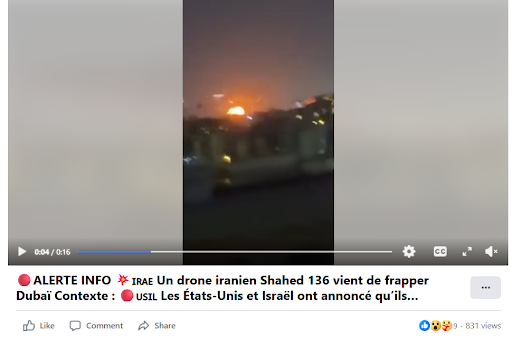
Users circulated a video falsely claiming it showed an Iranian Shahed 136 striking Dubai.
A similar mechanism appeared in a 13 May 2026 narrative claiming that a video showed a tanker attacked during an unauthorized passage through the Strait of Hormuz. The video was unrelated to the situation there. Instead, footage had previously appeared on the official LinkedIn account of a shipping education provider in early April 2026 as an illustration of a ship collision, with no signs of shelling or drone attack.
The real-world context again did the heavy lifting. By May 2026, the strait had been largely closed to international shipping following a sequence of escalations between Iran and the US. In that environment, a single clip tied to one of the world’s most strategically sensitive chokepoints can intensify fears of escalation and shipping disruption regardless of whether it is genuine.
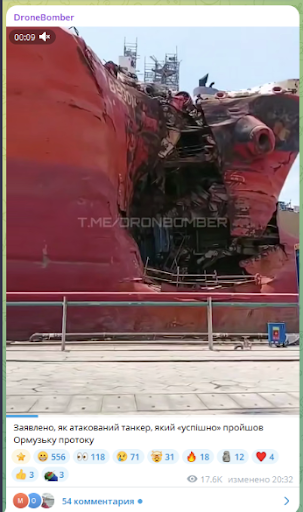
Online users circulated an image of a damaged tanker, claiming that it was attacked in the Strait of Hormuz; however, the image was unrelatedto hostilities in the region.
In each of these cases, the central informational function is acceleration. Before facts can stabilize, the emotional weight of the claim has already done its work.
3. When uncertainty becomes conspiracy
A third pattern is the rapid conversion of ambiguity into false-flag or engineered-provocation conspiracy theories. Because attribution is often unclear in the immediate aftermath of a claimed drone incident, that uncertainty creates space for conspiratorial storytelling.
A clear example appeared on 21 May 2026, when users claimed that drone strikes on the UAE on 19 and 20 May were in fact Israeli false-flag attacks designed to derail ongoing US-Iran peace negotiations. Users circulated a video featuring Russian commentator Nikolay Lilin, who alleged that drones targeting UAE civilian and strategic facilities had been launched from secret Israeli bases in Iraq using pickup trucks, and that a 17 May strike near a UAE nuclear power plant bore the hallmarks of deliberate Israeli provocation rather than an Iranian attack. The claim rested on the observation that the UAE had not explicitly attributed the attacks to Iran, reframing official caution as implicit confirmation of a cover-up.
This pattern also appeared outside the immediate Middle East theater. On 16 June 2026, following FBI reports that it had disrupted an alleged explosive drone plot targeting a UFC event near the White House, users rapidly reframed the announced threat as a false-flag operation orchestrated by Western and Israeli intelligence agencies to justify continued hostility toward Iran. Authorities had described a plot involving explosive-laden drones intended to trigger a mass evacuation and funnel crowds toward a pre-positioned sniper team, with five suspects in custody. Users dismissed or inverted this account entirely, treating the announcement itself as the deception. As in other such cases, uncertainty around the event was repurposed into apparent evidence of orchestration.

Conspiracy theories circulated on several social media platforms, claiming that FBI reports concerning an explosive drone plot targeting a UFC event at the White House were linked to a false flag attack.
This pattern is powerful because it offers audiences a sense of explanatory closure at moments when information is fragmentary. It tells them not to wait for evidence because the uncertainty itself is supposedly proof of deception. The less clear the event, the more easily it can be reimagined as staged, manipulated, or misattributed.
The broader implication
The lesson from these cases is that drone misinformation is rarely just about whether a drone was real, whether a video was authentic, or whether an attack occurred exactly as described. Its deeper function is to shape interpretation at speed. It widens blame, compresses the timeline of escalation, and turns uncertainty into apparent proof.
That makes drone narratives especially important for researchers, journalists, and platforms to watch during ongoing crises and conflicts. The risk lies not only in factual inaccuracy, but in the way these narratives reorganize public understanding while evidence is still emerging. In conflict settings, that may be their most consequential effect of all.
If your platform is facing similar risks during fast-moving events, Alice’s intelligence experts can help you identify and mitigate them early. Learn more about our Intelligence offerings here, or speak with an expert here.
메타데이터
- post_id
- fe3cc8e2a257
- slug
- unmanned-warfare-and-information-ecosystems-drone-strikes-attribution-and-the-speed-of-online-fe3cc8e2a257
- url
- https://medium.com/intelligence-alice/unmanned-warfare-and-information-ecosystems-drone-strikes-attribution-and-the-speed-of-online-fe3cc8e2a257
- canonical_url
- https://medium.com/intelligence-alice/unmanned-warfare-and-information-ecosystems-drone-strikes-attribution-and-the-speed-of-online-fe3cc8e2a257
- author_url
- https://medium.com/@alexanderg_61304
- status
- ok
- fetched_at
- 2026-06-27 07:40:21