The First Microbrewery Was in Mesopotamia. Really?
At least archeologists think so. Let’s explore!
The First Microbrewery Was in Mesopotamia. Really?
At least archeologists think so. Let’s explore!

Image by KING G from Pixabay
My husband is a beer connoisseur. Not in a snobby, pretentious way, but when he shops for beer (always looking for something new), I know that I might as well bring a good book to read because well, it’s gonna take a while.
He carefully examines each label, taking note of the descriptors — is it hoppy with notes of grapefruit? Perhaps there’s a hint of bready malt. Is the stout bold with chocolate flavors and a subtle raspberry finish?
That’s not the end of the story. When we return home with our precious purchases he enters his new finds into a spreadsheet which is updated whenever he samples a new brew. Aroma, appearance, body, mouthfeel … the list goes on. (And yes, he has his own beer refrigerator).
With all of this beer-ness going on in my house, it was only a matter of time before I’d end up writing about beer.
Once Upon a Time, There Was a Field of Grain
The grain was reaped, ground, and mixed with water to form cakes, the progenitor of what we know as bread.
There have been many iterations and innovations between those first rough cakes and what ultimately became the staff of life, but none more important than natural leavening. The discovery of yeast, that miracle microscopic bit of airborne life, was captured and put to use centuries before it could be seen or understood — a milestone in the history of bread.
There’s another product, made also of grain and yeast, that’s been consumed and refined for probably as long as bread — beer.
Grain and bread and yeast and fermented beverages are by nature and history intertwined, but food historians can’t establish with even a smidgeon of precision when this marriage of ingredients began.
However, this we do know — fermentation takes time, and so the dawn of leavened bread and yeasty brews probably didn’t occur until nomadic people became an organized, agrarian society.
This is why beer is better than wine: “….human feet are conspicuously absent from beer making. — Steve Mirsky, Scientific American (May 2007)
Was the First Brew Pub in Mesopotamia?
The Zagros Mountains bisect the fertile plains of Assyria and Babylonia. The landscape here is harsh and brutal; swift-moving rivers scour the earth creating deep canyons and exposing the sedimentary layers that mark the passage of eons. The Great Khorasan Road permits passage through the Zagros, one of several routes known as the Silk Route. An important stop along the way was Godin Tepe, a Sumerian village and fortress.
In 1961, archeologists from the Museum of the University of Pennsylvania conducted large-scale excavations of the area, exposing courtyards, a gatehouse, storage rooms, and fortification walls. The work exposed relics from the period 3500 to 3100 B.C. and revealed writing tablets, pottery, bevel-rimmed bowls, and clay jars where barley had been fermented; perhaps this was the advent of beer making.
By the third millennium B.C., Mesopotamia was already well-versed in beer-brewing; old Sumerian texts mention eight barley beers, eight emmer beers, and three mixed beers. Aromatic plants were added to the beer to improve the flavor and to assist in its preservation, and extra honey, cereals, and malt gave varying added strengths. “Food in Antiquity” (p. 166–167).
Some of the oldest known writings speak of the production of beer. The Hymn to Ninkasi (the Sumerian goddess of beer) was written around 1800 B.C. and serves not only as a song of praise but also as a recipe so that future generations will not forget the important steps in brewing.
Here are excerpts from the Hymn:
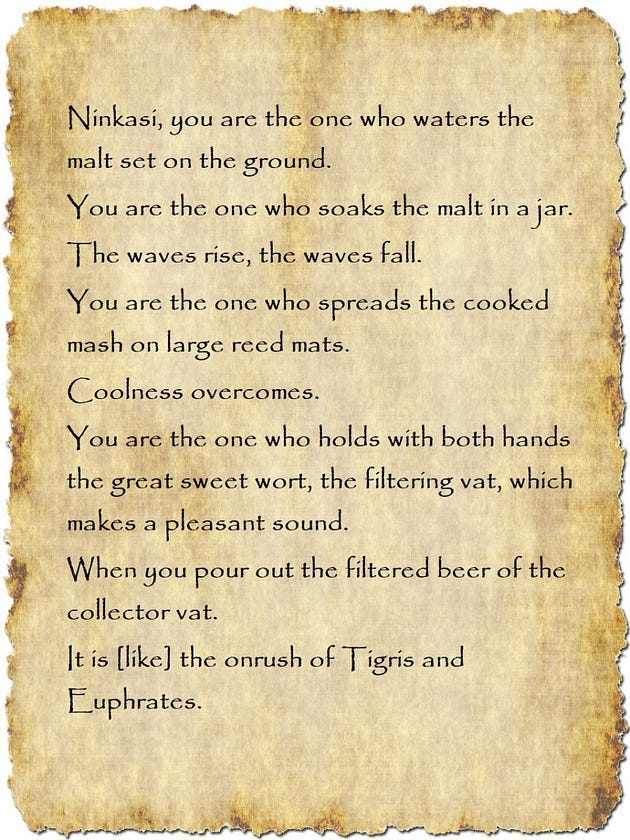
Graphic created by author (Source: University of Oxford)
In 7,000+ years, the basic recipe has not changed. Just four ingredients are needed to make beer — grain (converted to malt), water, Hops (the flavoring/preservative), and yeast.
- Malt: Grain is a seed. Barley is most common in beer production today, but corn, rice, and other cereals have been used as well. The grain is soaked in hot water to release the carbohydrates (natural sugars). It is those sugars that will ultimately feed the yeast and make alcohol, but we’re getting ahead of ourselves. The soaked grain is separated from the sugar-laden liquid. That liquid is the malt; the technical name is wort (pronounced “wert”). The wort is boiled to sterilize it.
- Water: Beer is about 90 percent water, pure water. But as you know, not all waters taste the same. Naturally occurring minerals alter the flavor of local brews.
- Hops: Hops are the flavoring/preservative in modern beer. They provide the bitter, citric tang that contrasts with the sweet flavor of the grain-malt. Hops can be added at the start of the boiling, near the end, or any time in between. The brewmaster knows that the timing (when the hops are added) will affect the ultimate taste of the beer.
- Yeast: Yeast is a microorganism, a naturally occurring airborne cell that, when added to the wort, converts the sugar into alcohol.
The Most Common Types of Beer
There are two types of beer — ales and lagers. Ales are the beers of antiquity and are created with yeasts that ferment at warm temperatures; they settle at the top.
Lagers use yeast that settles at the bottom; their fermentation process is slower, longer, and takes place under cool temperatures. They typically have a light, malty taste and are the “gateway” beer for newcomers.
Within those two classifications, there are endless varieties.

The most common types of beer from dark to light, sweet to bitter | Graphic by author
Ales
- Belgian Styles: Belgian beers have such a wide spectrum of flavors it is difficult/near impossible to identify them in 25 words or less. They can be pale and light, mid-range fruity, sour, or dark. In general, they have a high alcohol content and low bitterness.
- Brown Ales: The brown ales we enjoy today are nothing like those created in England in the 19th century. Olde-time English browns are sturdy and dark like a porter or stout. The 21st-century Americanized brown ale is mild and malty and slightly hoppy.
- India Pale Ales: IPAs have a pronounced hops flavor; many are grapefruit-like while others are more bitter. In general, New England IPAs are fruity, British IPAs are malty and bitter, and those from the West Coast fall somewhere in the middle.
- Lambic: The lambic is a Belgian beer fermented with wild yeasts.
- Oatmeal Stout: If your tastes lean toward creamy, rich, dark beers, the oatmeal stout might be for you. This is a full-bodied beer, dark brown to almost black in color, chocolate-like, and smooth.
- Pale Ales: This type of beer has a mild to medium hops flavor but tends to be lower in alcohol content.
- Porters: These originated in the United Kingdom; they are dark, like stouts, and similar in taste to an American porter.
- Russian Imperial Stout: Despite the name, most RISs are brewed in the United States. Russian stout is dark and hoppy with flavors of dark chocolate, coffee, fruit, and a decidedly rich mouthfeel. The alcohol level is high — 7 to 12 percent.
- Stouts: Dark and syrupy, English and Irish stouts are sweet (Guinness for example) with coffee undertones. American-brewed stouts tend to have a more bitter flavor and can be reminiscent of dark chocolate.
- Wheat and Hefeweizen Beers: As the name implies, wheat beers rely on wheat, not barley, for their malt. They are light in color and alcohol.
Lagers
- Doppelbock: Doppel means double and this brew is definitely double. Originally made by Munich monks, it is rich and extra strong with a malty sweetness and a hint of hops for balance. Alcohol levels are high.
- Pilsners and Pale Lagers: These central-European beers are pale with a crisp flavor. Pilsners are fuller, more aromatic, and spoil easier than some other types of beers.
And Then
- Wild/Sour Beers: These are puckery with fruit undertones such as peach, cherry, or raspberry. They can be ales or lagers.

Would this be an article by me without a recipe or two? (Of course not.) Here are five recipes that champion today’s featured ingredient. There’s something for everyone — even a dessert!
Guinness Beef Stew with Cheddar Herb Dumplings
Morgan, food creator/photographer of Host the Toast, the Kitchen Kaper Blog lives in the mid-Atlantic states where winters can be brutal. In 2014, her little corner of the world experienced what has been coined a snowpocalypse — a snow event of apocalyptic proportions. That storm was the inspiration for Morgan’s almost world-famous Guinness Beef Stew.
The meat is incredibly tender, the vegetables deeply flavored, and the gravy rich and savory. Herby cheddar dumplings simmer atop the finished stew to make a satisfying one-bowl meal.
Guinness Potato Soup
My friend and co-editor Dim Nikov created an almost Guinness world record soup a few months ago — the recipe is here. If you are craving a rich and savory bowl of comfort, something to warm your spirit (and your tummy) I hope you’ll give this beefy-potato-garlic-Guinness soup a try.
Pan-Fried Beer and Onion Bratwurst
Many of my friends are from the state of Wisconsin, the bratwurst capital of the world. I could not provide beer-based recipes without including a nod to brats simmered in beer (which is, I believe, the unofficial №1 beverage of Wisconsin).
This dish isn’t a hasty, cook-at-the-last-minute process. An initial sear in butter (put away the vegetable oil) creates an umami-rich exterior that snaps with the first bite. After that sear, cover the pan so that valuable moisture isn’t lost. When the sausages are cooked through, the real fun begins. Sliced onions add sweetness and beer (a dark malty Belgium please) allows them to reduce and caramelize.
Classic Welsh Rarebit
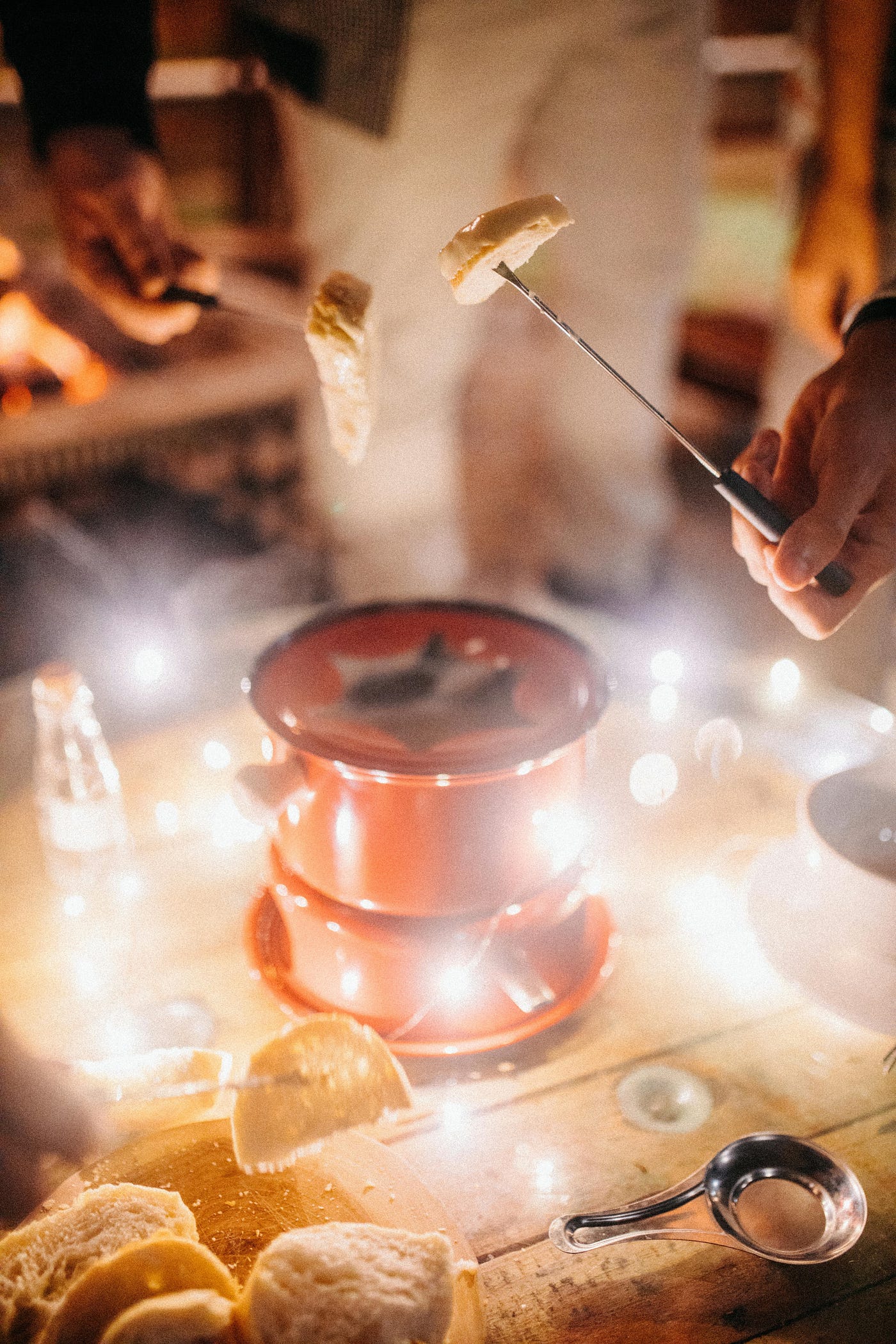
Cheese and toast is a simple, warm, and comforting peasant food. It’s a humble meal when the weather outside is frightful. Only one thing can make it better — add beer to that melted cheese to create a rich gooey sauce flavored with malt, mustard, and hops. And don’t worry, it’s classic Welsh rarebit, not rabbit. No bunnies were harmed in the making of this food.

Beer Cheese Soup (Photo by Veronika FitArt on Unsplash)
Spicy White Cheddar Beer Cheese Soup
When Sara lived in Chicago, she worked at a restaurant. As you know, one of the perks of working in the food industry is that you get a free meal — that’s the good news. The bad news is that after a few days or weeks, the menu becomes a bit monotonous. However, where Sara worked the chef created a “soup of the day,” and she knew it would always be something original, flavorful, and innovative.
This spicy beer cheese soup was her favorite and, after much pleading and cajoling, he gave the recipe to her.
Fudgy Beer Brownies
At first glance beer and chocolate might seem an odd-couple pairing, but I’m not proposing the use of a hoppy IPA or Belgium ale. Instead, let’s focus on the attributes of a porter or stout — dark and rich, with caramel-like, smokey black coffee espresso flavors. Aren’t those the same qualities in bold, cacao-rich chocolate?
Megan uses a traditional fudgy brownie recipe and replaces the butter with a flavorful bourbon-barrel-aged beer.
Have I cooked or baked with beer? In all honesty, I don’t want to use one of my husband’s treasures to create a dish or dessert that might not completely satisfy — hit all the notes he cherishes in his beer mug.
I’ll let him sip and smile. But, if any of you happen to try one of the recipes I’ve shared, I’d love to hear back from you.
Sources
- Food Timeline
- History.com
- Beer History
- Wikipedia
- Vine Pair
- Encyclopedia Iranica
- Ancient History Encyclopedia
Did you like what you read? If you wish to read my future writings, subscribe to my email list, and you’ll be notified every time I publish a new story.

메타데이터
- post_id
- fe4345302bc4
- slug
- the-first-microbrewery-was-in-mesopotamia-really-fe4345302bc4
- url
- https://medium.tastyble.com/the-first-microbrewery-was-in-mesopotamia-really-fe4345302bc4
- canonical_url
- https://medium.tastyble.com/the-first-microbrewery-was-in-mesopotamia-really-fe4345302bc4
- author_url
- https://medium.com/@lindalum_2779
- status
- ok
- fetched_at
- 2026-07-20 15:04:06