The 600 Word Brief: Baby KJ and The Future of CRISPR
Clustered Regularly Interspaced Short Palindromic Repeats, otherwise known more commonly as CRISPR, is a natural feature found in bacterial…
The 600 Word Brief: Baby KJ and The Future of CRISPR
https://www.nature.com/articles/d41586-025-01596-w
Clustered Regularly Interspaced Short Palindromic Repeats, otherwise known more commonly as CRISPR, is a natural feature found in bacterial DNA. Simply, CRISPR is a repeating pattern of genetic code, which is found in bacterial DNA. This repeating pattern of genetic code acts as an immune system for many bacteria, allowing it to recognize viruses that try to enter and attack.
Repeating DNA sequences were first reported at Osaka University by a team led by Yoshizumi Ishino. They discovered a strange repeating pattern of DNA in E. coli bacteria. From there, researchers began to find these repeats in other bacterias. Eventually, the increasing amount of research coming out on DNA repeats and their role in bacteria’s immunity, led to an incredible discovery by Jennifer Doudna and Emmanuelle Charpentier in 2012: CRISPR, accompanied by a Cas9 protein, could be used to cut DNA in living organisms at specific locations.
A common trap that many people continue to fall into when trying to understand CRISPR-Cas9 is the notion that DNA could not be cut before the discovery of CRISPR-Cas9. However, before this, DNA could be cut, but only at specific, lengthy, predetermined sites. CRISPR-Cas9 gave scientists the freedom to design their own gRNA.
CRISPR-Cas9 relies on two key molecules: the Cas9 protein and a guide RNA (gRNA). The gRNA is created to have a region identical to the DNA scientists want to edit. The Cas9 and gRNA then bind together and begin looking for PAM, which would be a tiny sequence of DNA next to the target site. Once this sequence is found, Cas9 unzips the DNA and the gRNA tests to see if the site is a match. If the match is correct, Cas9 works like a pair of scissors to cut that section and make a break in the DNA.
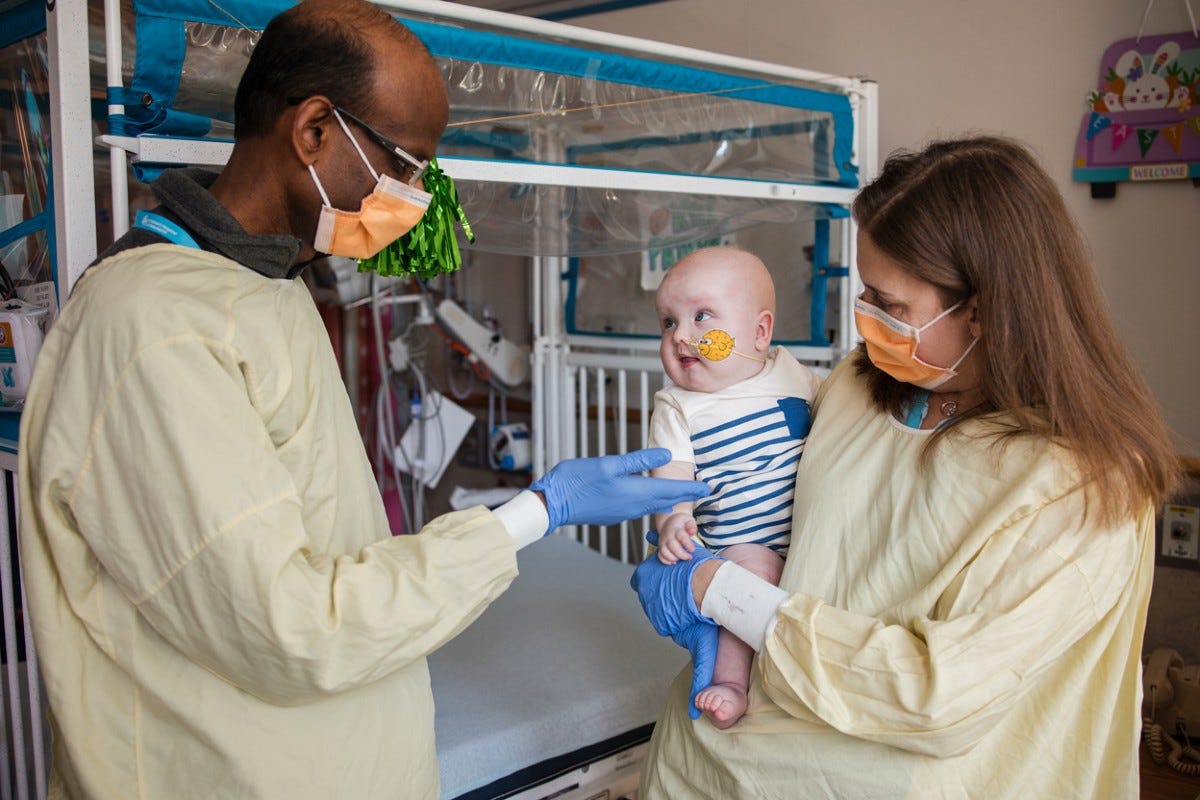
The potential applications of CRISPR-Cas9 are vast. From research, to treatments, to agricultural advancements, CRISPR is being experimented with all over the scientific fields, The one that will be focussed on today is Baby KJ, who is the first patient to ever receive custom CRISPR gene-editing therapy. Although CRISPR had been giving patients before, it was never a custom therapy.
Born in 2025, KJ Muldoon, otherwise known as Baby KJ, was diagnosed with carbamoyl phosphate synthetase 1 (CPS1) deficiency, which is a severe, life-threatening urea cycle disorder. Partnering with Penn Medicine, doctors at the Children's Hospital of Philadelphia decided to work to create a CRISPR therapy, custom to Baby KJ’s DNA mutation and at just six months old, Baby KJ received the treatment. The early results? His condition drastically improved.
In 2020, Jennifer Doudna and Emmanuelle Charpentier won a Nobel Prize for their revolutionary contribution to science. In 2025, Baby KJ’s story became one of the most well known in the world. Truly, this is just the start of the innovation, and I am excited to see how the technology develops next. Beyond medicince, I know that there have been some interesting discussions happening in the agriculture space.
메타데이터
- post_id
- fe4867bdd2ca
- slug
- the-600-word-brief-baby-kj-and-the-future-of-crispr-fe4867bdd2ca
- url
- https://medium.com/@nandula.nitya/the-600-word-brief-baby-kj-and-the-future-of-crispr-fe4867bdd2ca
- canonical_url
- https://medium.com/@nandula.nitya/the-600-word-brief-baby-kj-and-the-future-of-crispr-fe4867bdd2ca
- author_url
- https://medium.com/@nandula.nitya
- status
- ok
- fetched_at
- 2026-08-19 16:19:04