What Is Primary Market Research? A Business Guide
Learn how primary market research gathers first-hand data, its methods, costs, timelines, and best use cases.
What Qualifies as Primary Market Research?
A product team is about to commit USD 5 million to launch a new diagnostic device. The sales projections look strong on paper. The data behind those projections comes from published reports and internal assumptions. But no one has spoken directly to hospital procurement teams yet, and that is where the gap emerges and the risk of compounds.
Primary market research is the process of collecting original data directly from target respondents rather than relying on existing sources. The respondents can be customers, users, experts, or buyers. Primary research is able to answer questions that published data cannot and reduce uncertainty before decisions get expensive. Most businesses turn to it when secondary data alone fails to serve the purpose.
Understanding the Scope of Primary Market Research
Primary market research refers to the direct collection of data from individuals or organizations relevant to a business question. Primary market research includes surveys, interviews, focus groups, and observations which are specifically conducted for a defined objective. The defining feature is ownership of the data, as it is gathered first-hand, for a specific purpose, and under controlled conditions.

But any research does not fall under the purview of primary research. Reports, databases, and government statistics are secondary research as they already exist. Primary research begins where those sources fall short, and it is used to validate assumptions or to test hypotheses that are not visible in published datasets.
Why Businesses Commission Primary Research?
Primary research is rarely commissioned out of curiosity. It is tied to decisions that carry cost and timing pressure.

A common reason where primary research is commissioned is market entry. A company may see favorable macro indicators, such as population growth, rising healthcare spending, expanding industrial output, increasing urbanization rates, shifts in consumer income levels, etc. But the indicators alone do not confirm demand for a specific product. The executives need to know who buys, how decisions are made, and what barriers exist, what triggers a purchase, how long the buying cycle runs, and who influences the final call. Such information does not exist in public datasets and has to be uncovered through primary research.
Product validation is another reason for commissioning primary research. Direct input from users exposes usability gaps, price sensitivity, and switching resistance before launching.
The pricing strategy also drives primary research. Public benchmarks indicate price ranges but do not reveal willingness to pay for specific configurations or service levels. Such insight comes from targeted questioning.
There is also competitive repositioning. When a business loses share or sees margin pressure, it needs to understand why. Internal data highlights outcomes but often fails to show the causes.
Meanwhile, as per SDKI Analytics, the global spending on market research reached over USD 135 billion in recent years (2025). The number indicates a sustained demand for first-hand data in decision-making environments.

Qualitative vs Quantitative — How to Choose the Right Data Type?
Qualitative research can indicate why people think or behave in a certain way. The qualitative research relies on smaller samples and on open-ended formats such as interviews or focus groups. The output is descriptive as it identifies patterns.
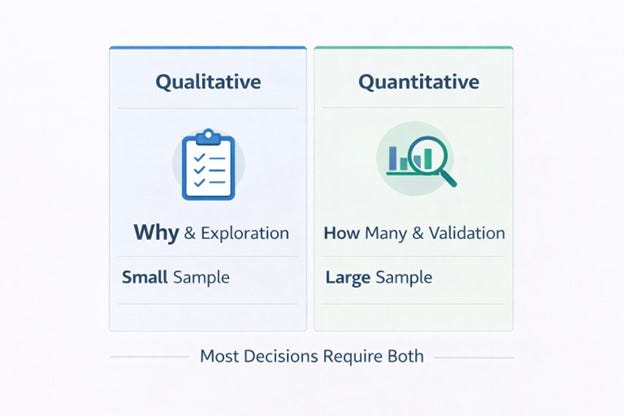
Quantitative research differs as it measures how many people think or behave in a certain way. It uses surveys with larger samples. The output is numerical and can be generalized to a broader population if sampling is designed correctly.
The decision between the two depends on what stage the question is asked. The early-stage exploration requires qualitative work as it defines the problem. The later-stage validation requires quantitative data as it measures scale and significance. Most business decisions require both. Qualitative research identifies variables, and quantitative research tests them.
[Link: What Is the Difference Between Qualitative and Quantitative Market Research?]
How Long Does Primary Market Research Take?
Primary research timelines vary by method, scope, respondent availability, recruitment difficulty, geographic coverage, and survey length. There is no fixed duration, but patterns are consistent across projects.

Source: SDKI Analytics
The constraint is rarely data collection itself, but the key challenge is recruitment. Finding the right respondents, especially in specialized industries, takes time. Additionally, the rushed timelines reduce data quality.

Primary vs. Secondary Research — How Do You Choose?
Secondary research is sufficient when the question is broad and well-covered. Market size, macro trends, demographic data, trade statistics, industry output figures, and public health or infrastructure data; these are available through government agencies and institutional sources. If the decision depends on those variables alone, the primary research may not be necessary.

Primary research becomes necessary when the question is specific. Who buys this product? Why do they choose one supplier over another? What price point triggers switching? What factors delay or block adoption? What role do distributors or intermediaries play? What level of customization is expected? These are not answered in published reports.
In practice, businesses combine both as secondary research defines the context, and primary research fills the gaps. One without the other leads to incomplete decisions. Choosing between them is driven by what is missing.
How SDK Analytics Offers Primary Market Research — Two Client Scenarios
We have highlighted how SDKI Analytics provided was commissioned with primary research services, and helped the clients navigate the market.
Case Study 1 — Healthcare Sector
A mid-sized diagnostics company planned to enter a new market with a portable testing device. Our analysis of secondary data indicated rising disease prevalence and an increase in healthcare spending in the past 5 years. The opportunity looked attractive.
But the identified gap emerged in procurement behavior. The company did not know how hospitals evaluated such devices or what were the criteria that mattered in purchasing decisions.
Our team compiled a research design which began with in-depth interviews with clinicians and procurement officers. These conversations identified decision drivers. The conversations pinpointed that reliability, maintenance requirements, reimbursement compatibility, ease of integration into existing workflows, training requirements for staff, and after-sales support. The interviews dispelled the notion that price was the primary factor.
A customized survey followed, and it targeted a larger sample of hospitals. It quantified the importance of each factor and tested different product configurations. Then, the output of a clear demand profile emerged. Subsequently, the company adjusted its product positioning and delayed launch by one quarter to address serviceability concerns identified in the interviews.
The research was successful in changing the approach to entering the market. Our services were successful in helping the company avoid a misaligned launch and improve early adoption potential.
Case Study 2 — Industrial Equipment Sector
A mid-sized industrial equipment manufacturer planned to introduce a new machine designed to improve production efficiency. Their internal assessments suggested strong performance advantages. The secondary data also pointed to steady growth in manufacturing output.
But the constraint rose in the adoption behavior at the plant level. The company did not know how production managers and procurement teams evaluated new equipment or what were the factors that influenced replacement decisions.
SDKI Analytics was commissioned to run primary research and our team designed a study that began with in-depth interviews with plant managers and operations heads. These interviews identified decision drivers such as downtime risk, compatibility with existing production lines, training requirements for operators, maintenance support, and total cost of ownership.
We followed it with a customized survey followed, targeting a broader sample of manufacturing firms. Our survey report quantified the relative importance of these factors and tested different value propositions.
The findings highlighted that performance improvements were not sufficient on their own. The buyers were placing greater weight on ease of integration and service reliability. Based on the findings, the company revised its rollout timeline to address the concerns. Once the constraints were removed, the company entered the market with a clearer value proposition and reduced execution risk.

A Step-by-Step Guide on How to Conduct Primary Market Research
We asked our team to prepare a guide on how to conduct primary market research. Below is a guide and an indication of the mistakes that businesses make in conducting research.

- Define your research objective: Clarify the exact decision the research will inform. Vague objectives lead to unusable data.
- Design the methodology: Select the methods that match the question. Depth requires interviews and scale requires surveys.
- Build your sample: Identify who needs to be included. A misaligned sample invalidates results.
- Develop your instruments (survey/interview guide): Structure questions to avoid bias. Test them before full deployment.
- Collect data: Execute the fieldwork with consistency. Monitor the quality during collection, do not keep quality assessment on hold.
- Analyze and code: Organize the responses into themes or statistical outputs. The interpretation must be succinct as any mistake in it will defeat the whole purpose of the research.
- Report and apply findings: The data without application has no value. Ensure, the results translate into decisions.
What are the Common Mistakes Businesses Make in Primary Research? Many companies start research without a clear objective. They gather data first and decide what to do with it later, and it leads to irrelevant findings. Another mistake is the over-reliance on surveys. The surveys measure predefined options, but they do not uncover unknown issues. Skipping qualitative work creates blind spots.
The sample bias is frequent as businesses often survey accessible respondents rather than relevant ones. The sample bias leads to distorted results. There is also a tendency to rush through timelines. To achieve actionable insights and quality leads, it is essential to ascertain due time to the research framework.
Also, shortening recruitment or fieldwork reduces reliability, and the data ends up looking complete but lacking in depth. Finally, some teams treat research as validation. They look for confirmation of existing beliefs, and that defeats the purpose.
Frequently Asked Questions
Ques: What is primary market research?
Ans: Primary market research is the process of collecting original data directly from target respondents such as customers, users, or industry experts. It is conducted for a specific objective and provides insights which are not available in existing reports or databases.
Ques: What are the main methods of primary market research? Ans: The main methods include surveys, in-depth interviews, focus groups, observational research, and field trials. Each method serves a different purpose, ranging from measuring preferences at scale to exploring detailed decision-making behavior.
Ques: What is the difference between primary and secondary market research?
Ans: Primary research collects new data directly from respondents, while secondary research uses existing data from published sources. Primary research answers specific questions, while secondary research provides broader context.
Ques: How much does primary market research cost?
Ans: Costs related to primary research vary depending on scope, sample size, and method. Surveys are generally less expensive than interview-based studies, while specialized respondent recruitment can increase costs significantly. There is no fixed price range.
Ques: How long does primary market research take?
Ans: Timelines for primary research typically range from two weeks for simple surveys to several months for complex studies involving interviews or field trials. Recruitment and access to respondents are the main factors affecting duration.
Ques: What is the difference between qualitative and quantitative research? Ans: Qualitative research explores motivations and behavior using small samples and open-ended formats. Quantitative research measures patterns using larger samples and structured data, producing statistically analyzable results.
Ques: When should a business use primary market research? Ans: A business should use primary research when existing data does not answer specific questions about customers, pricing, demand, or adoption barriers. It is often used before major decisions such as product launches or market entry.
Ques: Can small businesses conduct primary market research? Ans: Yes! Small businesses can conduct primary research using scaled-down methods such as online surveys or targeted interviews. The key is aligning the method with the decision, not the size of the company.
메타데이터
- post_id
- fe4ba8a97a9f
- slug
- what-is-primary-market-research-a-business-guide-fe4ba8a97a9f
- url
- https://medium.com/@sdki-analytics/what-is-primary-market-research-a-business-guide-fe4ba8a97a9f
- canonical_url
- https://medium.com/@sdki-analytics/what-is-primary-market-research-a-business-guide-fe4ba8a97a9f
- author_url
- https://medium.com/@sdki-analytics
- status
- ok
- fetched_at
- 2026-08-04 19:32:56