The Code Patterns That Prevented Countless Bugs
The most reliable code patterns are not clever abstractions. They make bad assumptions visible before they become production bugs.
The Code Patterns That Prevented Countless Bugs
The most reliable code patterns are not clever abstractions. They make bad assumptions visible before they become production bugs.
Most bugs are not born dramatic.
They start as small assumptions.
A value is probably not null. A response probably has the same shape. A user probably has permission because the button is hidden. A retry probably will not duplicate anything. A status probably means the same thing in every screen. A helper probably does not mutate anything. A form probably cannot submit twice.
Then the system grows.
The assumption travels from one function to another. It gets copied into another component. It becomes part of a helper. It gets hidden behind a generic name. It survives code review because nothing looks obviously broken. One day, the bug appears far away from where the wrong assumption first entered.
That is why some code patterns matter more than others.
Not because they look clean.
Not because they impress reviewers.
Because they stop bad assumptions from moving deeper into the system.
The best patterns I have seen are usually boring. They do not make the code look clever. They make the code harder to misunderstand. They force invalid states to become visible. They separate decisions that change for different reasons. They create small checkpoints where a mistake can be caught before it becomes a production issue.
That is the real value of a good pattern.
It prevents entire categories of bugs from becoming normal.
Guard Clauses Stop Bad Inputs From Becoming Bad Flows
A lot of bugs become expensive because the code keeps going after it already knows something is wrong.
A missing user continues into permission logic. An empty ID continues into an API call. A failed lookup continues into formatting. A null record continues into a payload builder. The function does not crash immediately, so the wrong state travels further than it should.
Then the failure appears later in a place that looks unrelated.
That is why guard clauses are more than style.
They are boundaries.
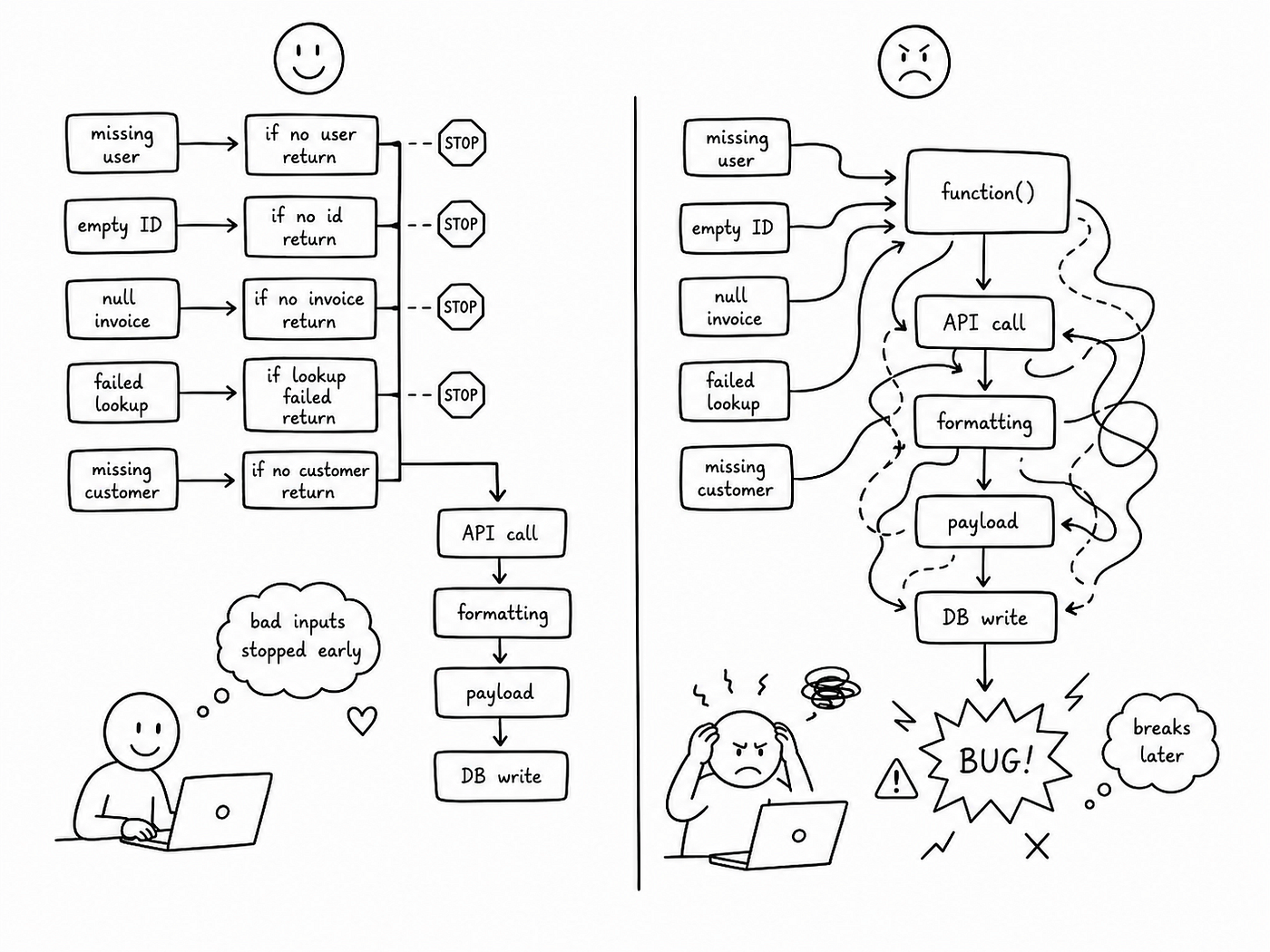
A guard clause says, “This function does not continue unless the conditions required for safe behavior are true.” That simple pattern can prevent long chains of defensive code and strange downstream failures.
The weak version of code tries to handle every possible state deep inside the flow. The stronger version refuses invalid states early.
function buildInvoicePayload(invoice: Invoice | null) {
  if (!invoice) {
    return { ok: false, reason: "Invoice is missing" };
  }
  if (!invoice.customerId) {
      return { ok: false, reason: "Customer is missing" };
    }
    return {
      ok: true,
      value: {
        invoiceId: invoice.id,
        customerId: invoice.customerId,
        total: invoice.total
      }
    };
}
The exact shape does not matter. Some teams throw. Some return result objects. Some use validation libraries. The pattern matters more than the syntax: do not let unsafe input pretend to be safe.
Guard clauses also improve debugging. When a function stops early with a clear reason, the failure has a location. Without that, the same bad input might become a vague UI bug, a failed database write, or a confusing API response.
Good guard clauses do not make code defensive everywhere.
They reduce the need for defense everywhere else.
Explicit Result States Prevent Mystery Failures
One of the most damaging patterns in codebases is returning vague failure values.
A function returns null. Another returns false. Another returns an empty array. Another catches an error and returns nothing. The caller now has to guess what happened.
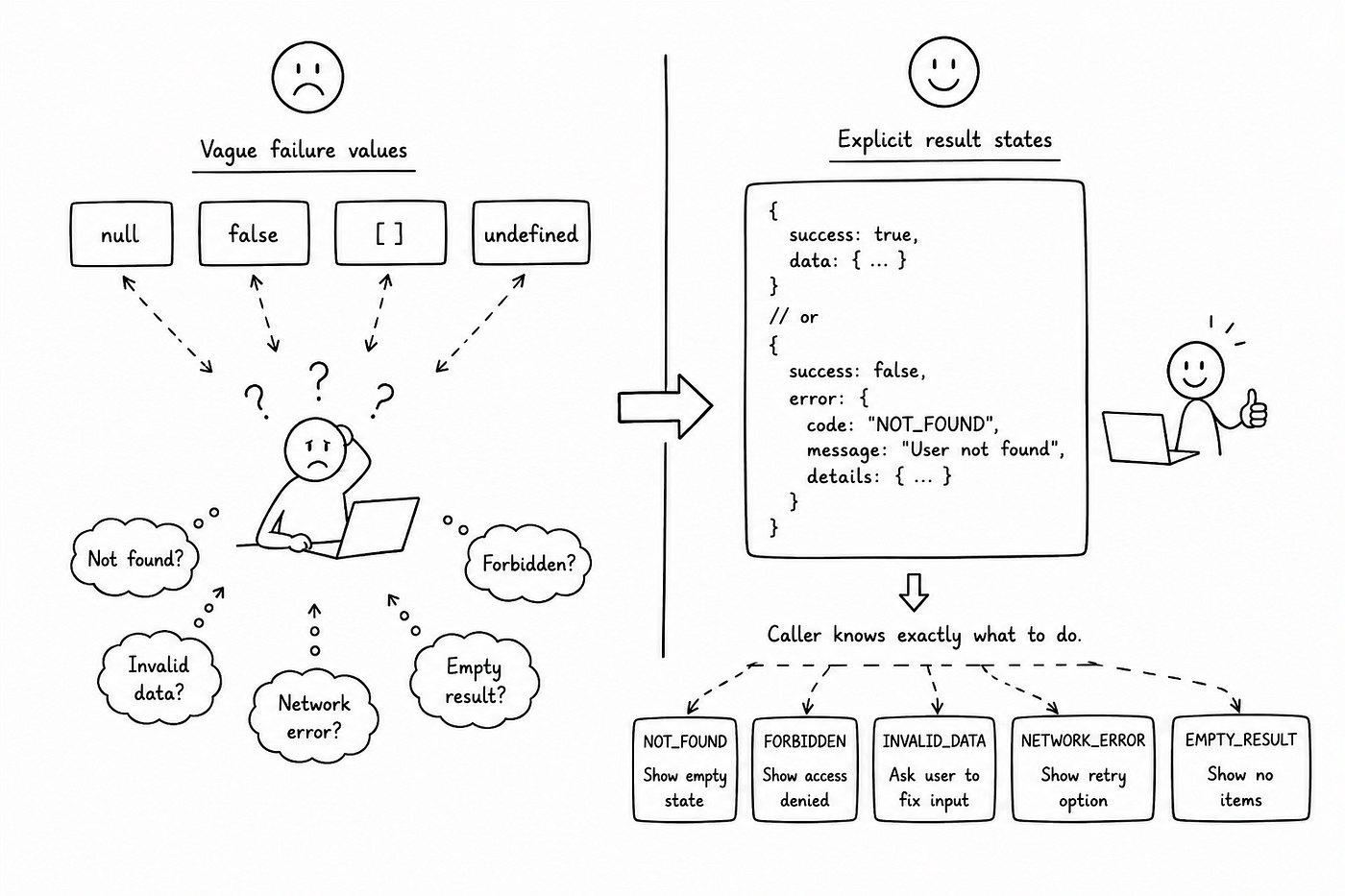
Was the record not found?
Was the user not allowed?
Was the response invalid?
Did the network fail?
Was the data empty?
Did the parser reject it?
Those are different states. Treating them the same creates bugs because the caller chooses the wrong behavior. It shows an empty state for a permission failure. It retries a validation error. It hides a real backend problem behind fallback UI. It stores partial data because the failure looked like a normal value.
Explicit result states prevent that.
A function that can fail should make failure meaningful enough for the caller to respond safely.
type Result<T> =
  | { ok: true; value: T }
  | { ok: false; reason: "not_found" | "forbidden"
  | "invalid_data" | "network_error" };
function getProjectAccess(user: User, project: Project | null): Result<Project> {
  if (!project) {
    return { ok: false, reason: "not_found" };
  }
  if (!canViewProject(user, project)) {
    return { ok: false, reason: "forbidden" };
  }
  return { ok: true, value: project };
}
This pattern is not about making every function verbose. Many functions do not need it. But functions that sit near boundaries, such as API parsing, permissions, validation, storage, and workflows, benefit from explicit outcomes because the cost of guessing is high.
Mystery failures spread confusion.
Explicit failures create decisions.
That is why this pattern prevents bugs before they become UI patches, support tickets, or silent data problems.
Normalize Data Once Before the Rest of the App Touches It
Raw data should not wander through an application forever.
Backend responses have their own shape. Third-party APIs have their own shape. Form values have their own shape. Local storage may contain old shapes. Feature flags may return values that are technically valid but product-wise incomplete.
If every component handles those differences independently, the system develops many small interpretations of the same data.
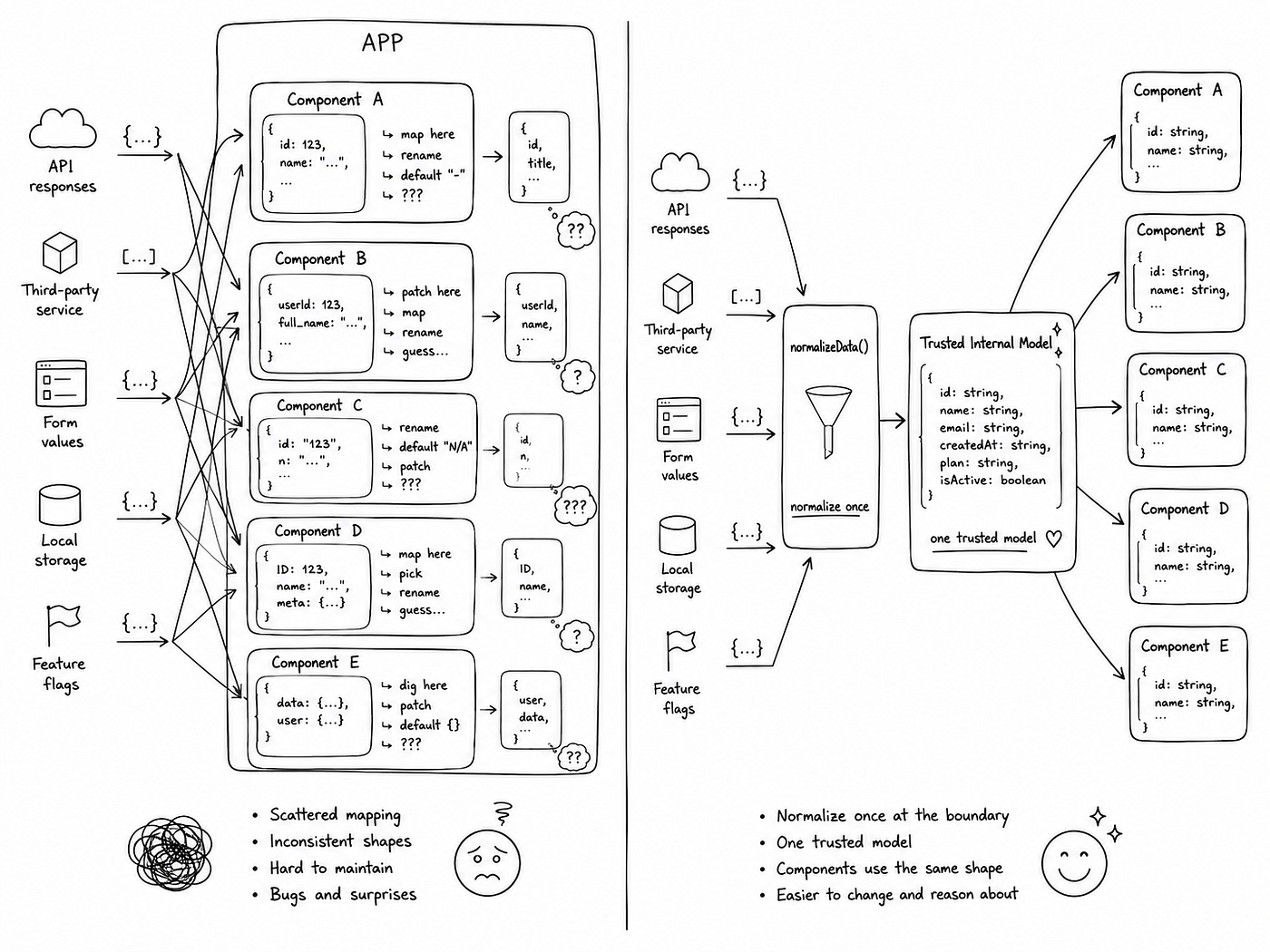
One screen maps first_name into firstName. Another uses name. Another combines firstName and lastName. Another shows Unknown. Another sends the raw value back to the server. None of these decisions feels big alone. Together, they create a codebase where nobody can trust what a user object means.
Normalizing once prevents that spread.
A boundary function should translate outside data into inside meaning. After that point, the rest of the application should work with a stable model.
This pattern is especially useful in JavaScript and TypeScript applications because data often moves through many layers: API client, cache, hooks, components, forms, tables, exports, and mutations. If the raw shape leaks everywhere, every layer becomes responsible for understanding the backend’s quirks.
That is how bugs multiply.
A good normalization boundary does not hide every problem with fallbacks. It decides what is safe to default and what must fail. A missing avatar may be harmless. A missing ID is not. A missing display label may be acceptable. A missing permission state may not be.
The pattern is not “make all data look valid.”
The pattern is “make the trusted shape honest.”
Once the app has a trusted internal model, components become calmer. Tests become clearer. Refactors become safer. Debugging becomes shorter because there is one place where raw input becomes product meaning.
The bug still might exist.
But it stops closer to where it entered.
Make Ownership Visible Where State Can Drift
Many bugs are state ownership bugs with better names.
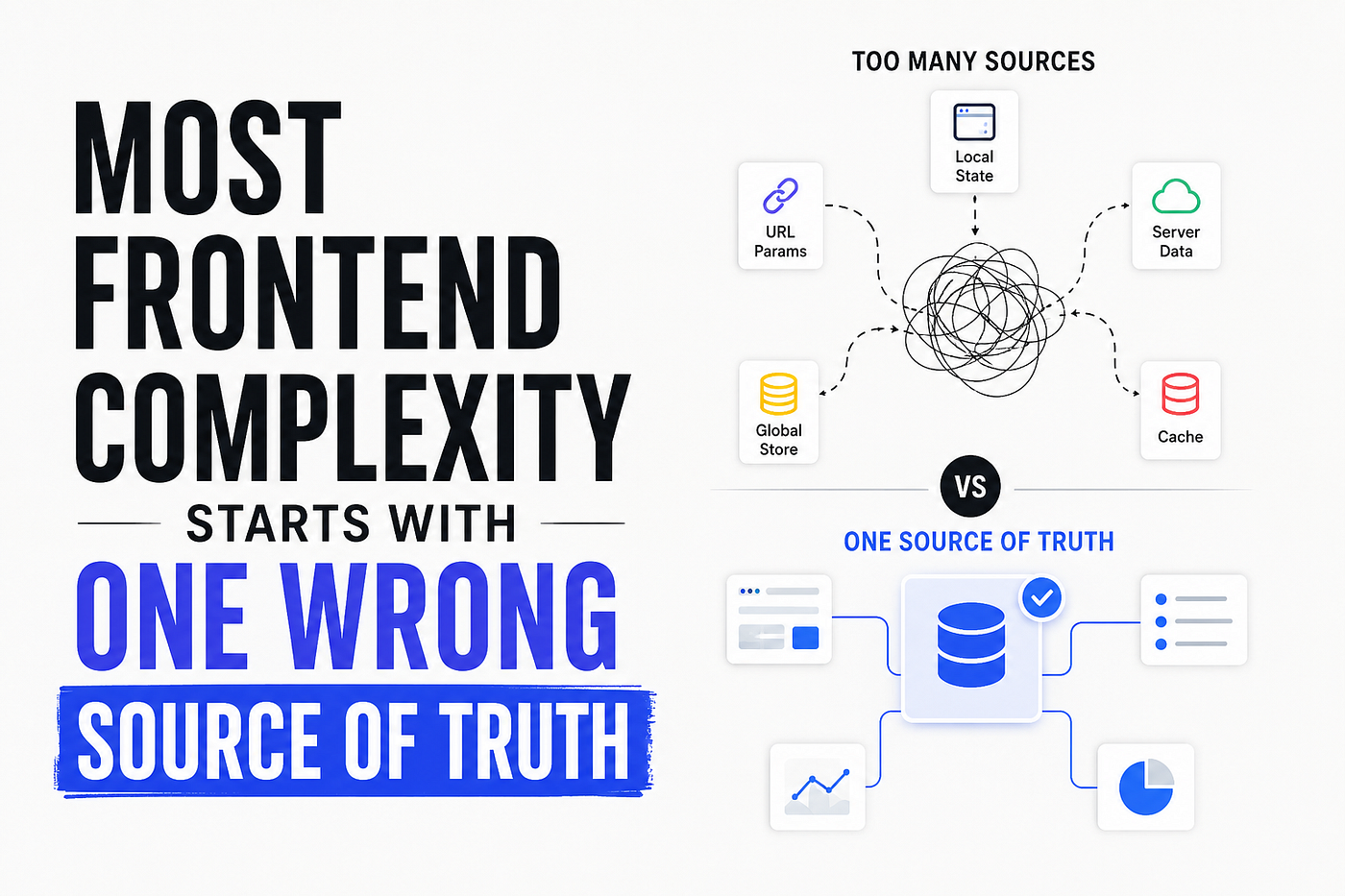
The URL has one version of the filter. Component state has another. The server cache has another. A form has a draft. A Redux store has the selected item. Local storage has an older account ID. A table reads from one source while export reads from another.
Everything works until one source changes and the others do not.
Then the bug feels random.
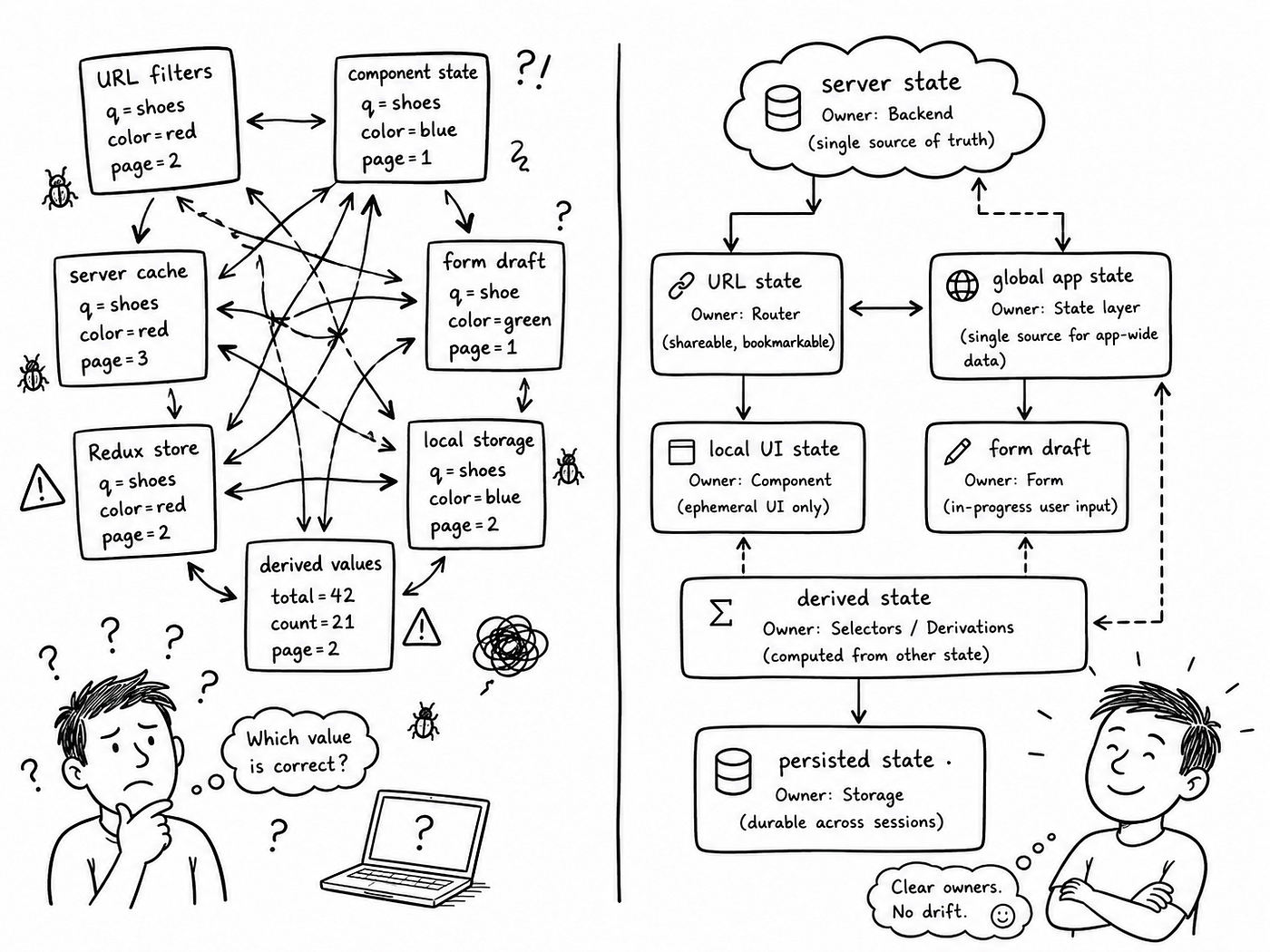
This is why one of the most useful patterns is making state ownership visible. Before storing a value, decide what kind of state it is. Is it server state? URL state? local UI state? form draft state? derived state? global app state? persisted browser state?
Those categories are not academic. They decide how the value should change, who can update it, and how bugs will appear when it drifts.
A filter that belongs in the URL should not also be maintained as a separate truth in local state unless there is a clear reason. A value derived from server data should not be stored again unless it needs to survive independently. A form draft should not automatically mirror every prop change if the user has unsaved edits.
A strong state pattern does not mean using one state tool for everything.
It means not letting several tools own the same meaning accidentally.
This prevents bugs because the code stops relying on synchronization effects and hidden updates to keep reality together. Developers can tell where a value comes from, what changes it, and which layer should fix it when it is wrong.
When state ownership is unclear, every fix becomes suspicious.
When ownership is visible, the bug has a smaller search area.
Keep Business Rules Close to the Thing They Protect
A business rule in the wrong place is a future bug.
A permission rule inside a button component. A billing rule inside a formatter. A validation rule inside a route handler. A workflow rule inside a utility function. These choices often work for the first feature because the first feature is the only place that needs the rule.
Then another place needs it.
The rule gets copied, adjusted, and forgotten.
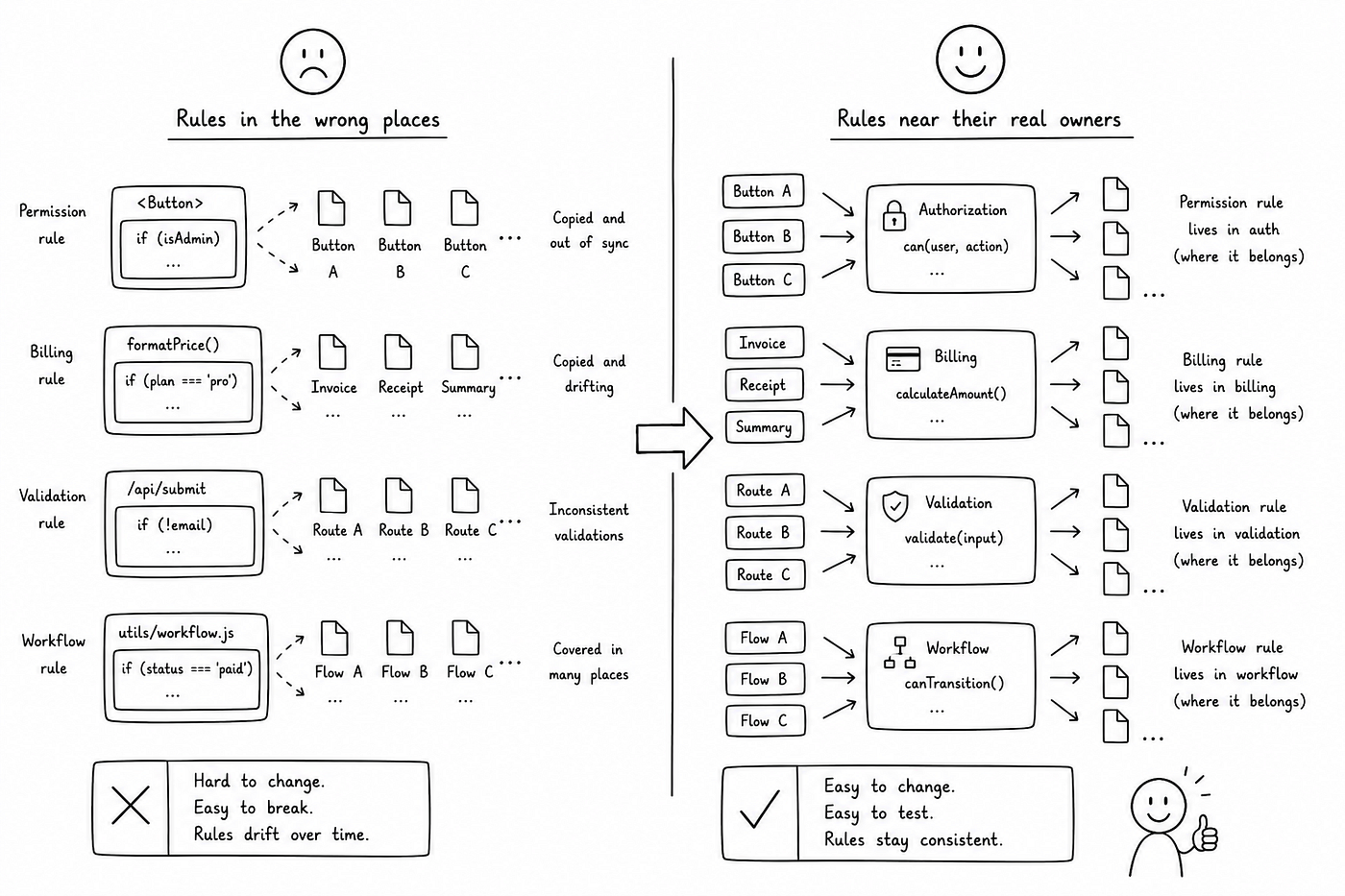
One screen blocks archived projects. Another does not. One endpoint checks account status. Another assumes it. One form validates trial limits. Another lets the backend fail later. One admin tool bypasses a rule accidentally because the rule lived in UI code.
The system now has multiple versions of the truth.
A better pattern is to keep rules close to the owner of the meaning. Permission logic should live near authorization. Billing logic should live near billing. Workflow state transitions should live near the workflow. API response rules should live near the API boundary. The UI can ask questions, but it should not secretly own policies that protect data or business behavior.
This is not a call for heavy architecture everywhere. Small projects can stay simple. Local rules can stay local until they prove they are shared. But once a rule protects access, money, data integrity, workflow state, or customer trust, placement matters.
The pattern prevents bugs because future changes have one obvious place to happen.
Without that, the team relies on memory.
And memory is a weak architecture.
Separate Commands From Questions
Some functions ask.
Some functions change.
Bugs appear when a function pretends to ask but secretly changes something.
A function called getSession reads storage, refreshes a token, updates global state, clears cookies, and redirects. A function called isAllowed checks permission and records analytics. A function called formatUser removes fields and mutates the original object. A function called validateForm modifies values while validating them.
The code works until someone calls the function in a place where the side effect is surprising.
This pattern prevents that class of bug: separate commands from questions.
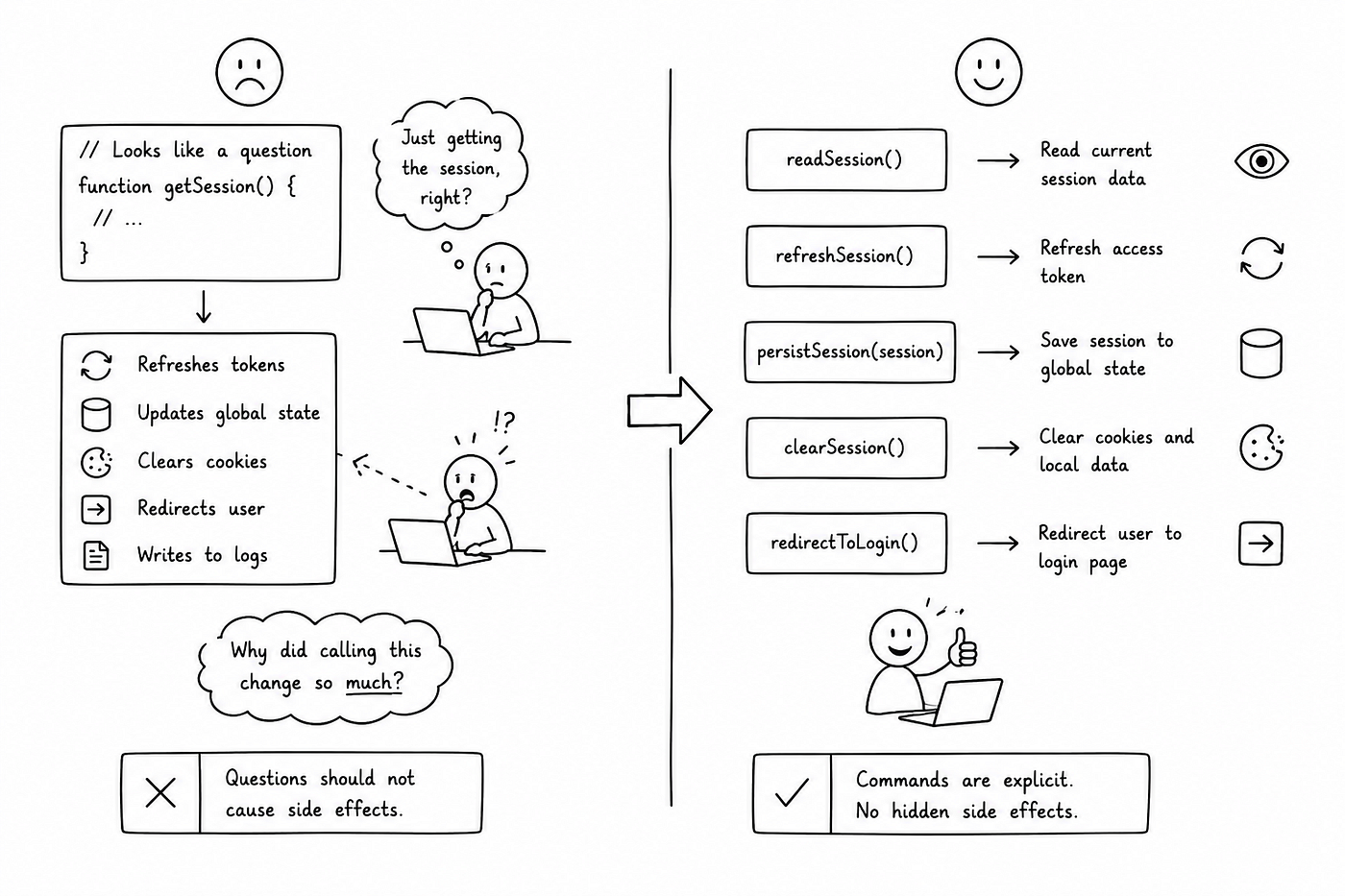
A query-style function should mostly return information. A command-style function should make its side effect visible through its name, location, and usage. This does not mean systems must be perfectly pure. Real applications need writes, caches, analytics, storage, redirects, and synchronization.
The point is honesty.
If a function stores something, call it save, persist, or write. If it refreshes, say so. If it redirects, do not hide that behind a getter. If it mutates, either make the mutation obvious or return a new value.
This pattern improves trust at the call site. A developer reading code should be able to tell whether calling a function is safe inside render, safe inside a mapper, safe inside a test, or safe to run repeatedly.
Hidden side effects create bugs because they create hidden paths.
Clear commands create visible consequences.
That visibility is often enough to stop a bug before it becomes a debugging session.
Use Exhaustive Handling for States That Must Not Be Ignored
Many bugs happen because code handles the current states but silently forgets the future ones.
A status can be draft, published, or archived. Later, scheduled is added. The UI falls into a default branch and shows the wrong action. A payment can be pending, paid, or failed. Later, refunded appears. Reports misclassify it because the old code never had to think about it.
The system did not break loudly.
That was the problem.
Exhaustive handling is the pattern that makes missing cases visible.
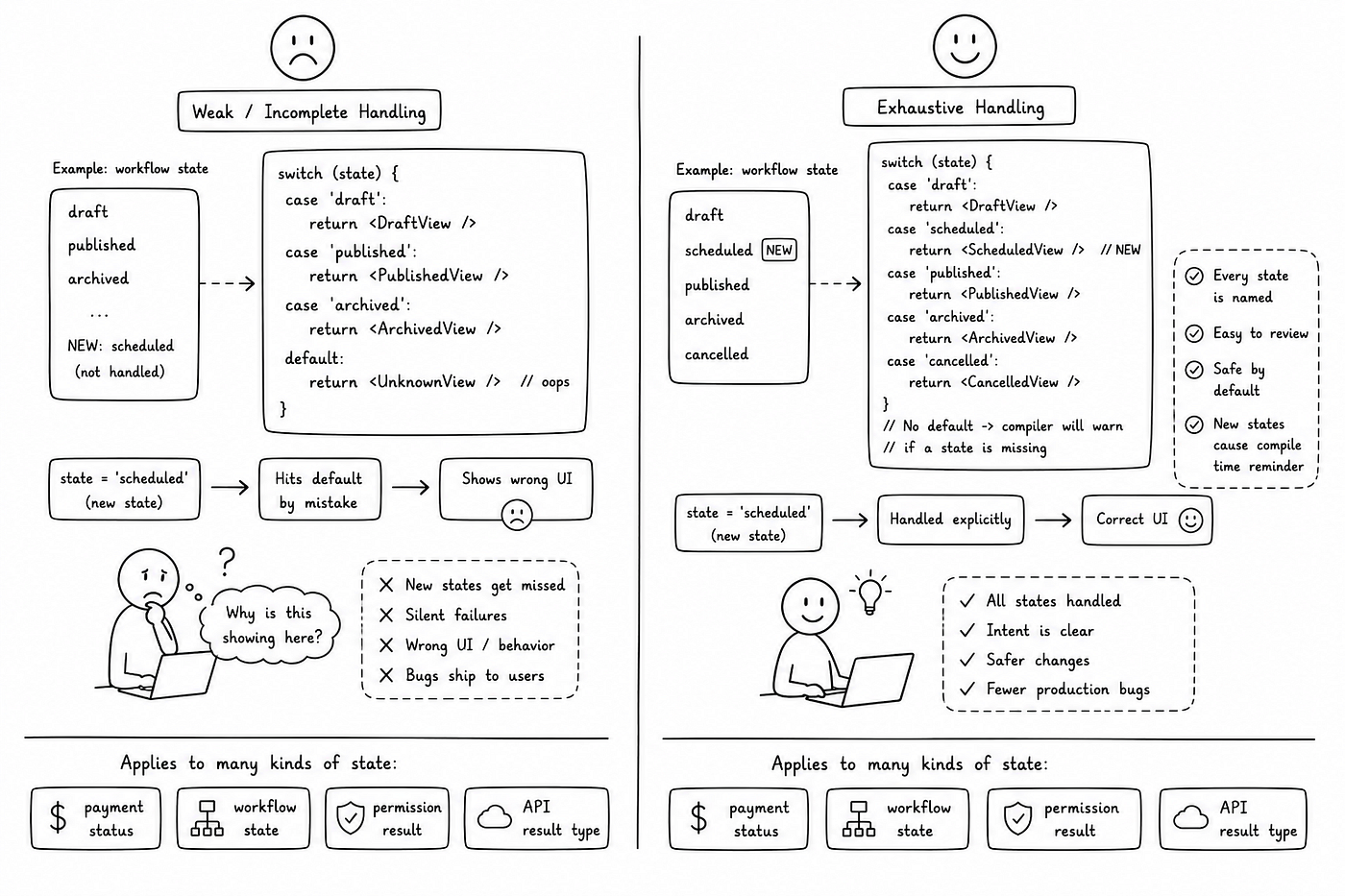
In TypeScript, this often means using union types and forcing switches to handle every case. In plain JavaScript, it can mean using explicit maps, runtime guards, or default branches that fail clearly instead of pretending unknown states are normal.
The pattern is most valuable for workflow states, permissions, payment statuses, API result types, feature availability, and anything where a new state changes product behavior.
A weak default branch hides change.
An exhaustive pattern exposes change.
For example, a UI label for invoice status should not casually return "Unknown" for every new status unless unknown is truly acceptable. If a new status requires a product decision, the code should make that decision unavoidable.
This pattern prevents bugs because it turns future change into a visible edit point. When the domain changes, the compiler, tests, or runtime checks force the developer to update every meaningful branch.
That is not ceremony.
That is protection against silent drift.
Make Repeated Actions Safe to Repeat
A lot of real user behavior is uncomfortable.
Users double-click. They refresh after submitting. They go offline. They retry. Browsers resend requests. Mobile clients reconnect. Background jobs run twice. Queues redeliver messages. Webhooks arrive more than once.
If code assumes an action happens exactly once, bugs will eventually appear.
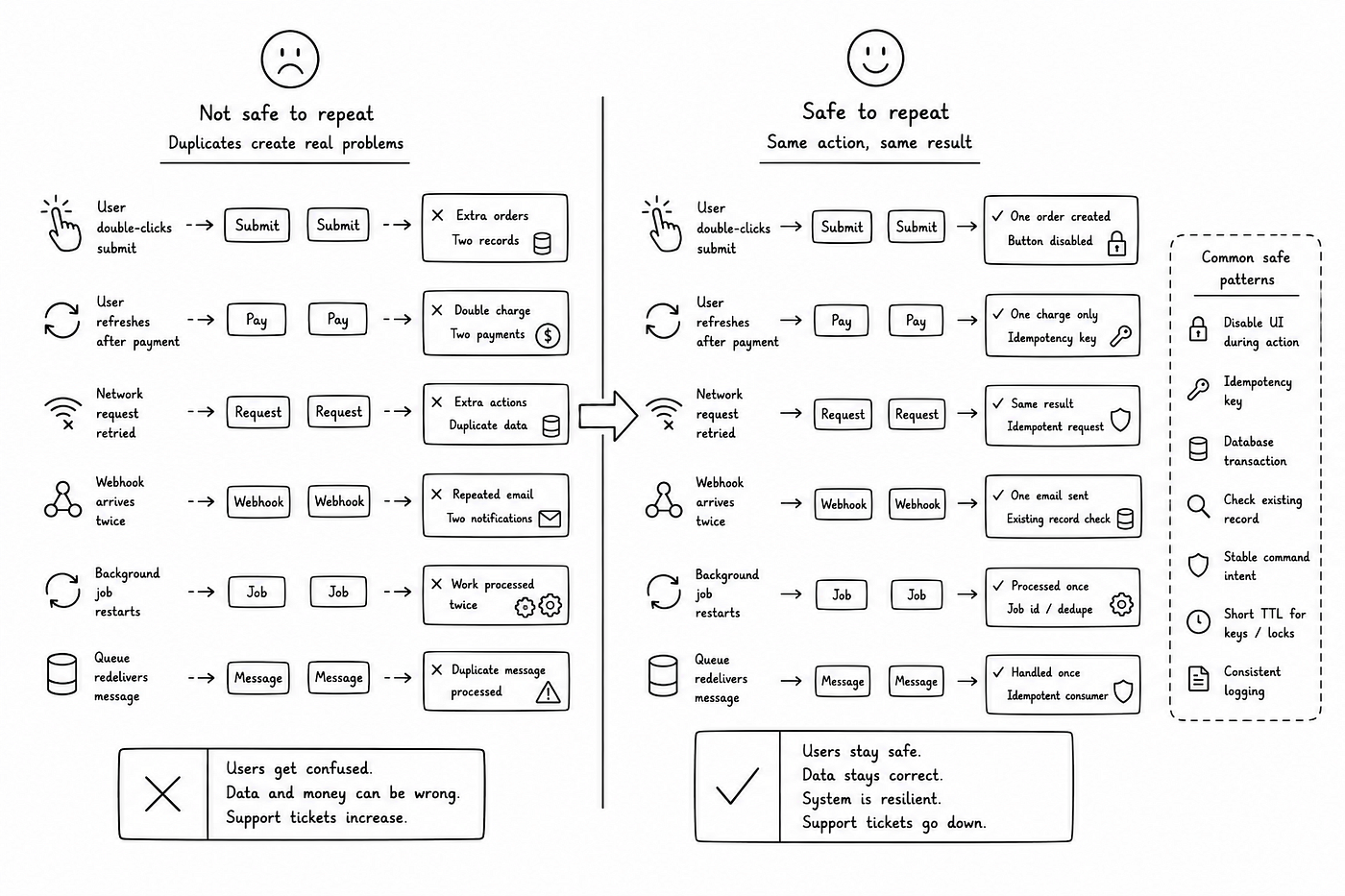
A good pattern is making important repeated actions safe to repeat. This is not only a backend concern, though it matters deeply there. Frontend forms, API mutations, job processors, payment flows, notification systems, and imports all benefit from this mindset.
A submit button should not create duplicate orders because the user clicked twice. A retry should not charge a customer twice. A webhook should not create two records for the same event. A background job should not send the same email repeatedly because it was restarted.
The pattern usually involves some combination of disabling repeated UI actions, using idempotency keys, checking existing records, making operations transactional, and designing commands around stable intent instead of raw clicks.
The exact implementation depends on the risk.
A duplicate toast is annoying. A duplicate payment is serious. A duplicate analytics event may be acceptable. A duplicate account deletion is not.
The important habit is to ask which actions must be safe when repeated.
This pattern prevents bugs because it respects real behavior instead of perfect behavior. Production users do not move through systems politely. Networks fail. Devices retry. Humans click again when nothing appears to happen.
Reliable code assumes repetition can happen.
Then it decides what repetition should mean.
The Best Patterns Reduce the Number of Places Bugs Can Hide
Good code patterns are not magic.
They do not remove every bug. They do not replace careful thinking. They do not make architecture decisions for you. A team can misuse any pattern, over-abstract any solution, or turn a reasonable guard into unnecessary ceremony.
But the best patterns share one quality.
They reduce the number of places a bug can hide.
Guard clauses stop invalid flows early. Explicit result states prevent mystery failures. Normalization keeps raw data from spreading. Clear state ownership prevents drift. Business rules near their owner prevent copied policy bugs. Separating commands from questions makes side effects visible. Exhaustive handling exposes missing states. Safe repeated actions protect against real user and system behavior.
None of these patterns is mainly about looking clean.
They are about making wrong assumptions harder to ignore.
That is what prevents countless bugs in real codebases. Not one clever abstraction. Not one perfect folder structure. Not one universal best practice. Just repeated discipline around where assumptions enter, where they are checked, where they are named, and where they are allowed to travel.
A bug that fails near the boundary is cheaper.
A bug that travels through the system becomes expensive.
That is the difference these patterns create.
The code still has complexity. The product still changes. Requirements still arrive late. APIs still evolve. Users still behave unpredictably. But the system becomes easier to trust because fewer assumptions are floating around unnoticed.
Great code is not code that never faces messy reality.
It is code that refuses to let messy reality spread without being seen.
Which code pattern has prevented the most bugs in your own projects?
Call to Action
👏 Found it useful? Clap. 💬 Got thoughts? Comment. 🔔 Follow for more insights, practical lessons, and ideas that help you grow professionally and personally.
메타데이터
- post_id
- fe536dfe5152
- slug
- the-code-patterns-that-prevented-countless-bugs-fe536dfe5152
- url
- https://medium.com/skillstuff/the-code-patterns-that-prevented-countless-bugs-fe536dfe5152
- canonical_url
- https://medium.com/skillstuff/the-code-patterns-that-prevented-countless-bugs-fe536dfe5152
- author_url
- https://medium.com/@masaood
- status
- ok
- fetched_at
- 2026-07-17 22:06:40