The Real Bottleneck Isn’t Technology
It’s coordination.
The Real Bottleneck Isn’t Technology
It’s coordination.
What planners, engineers, founders, and public officials taught me about one of humanity’s hardest problems.
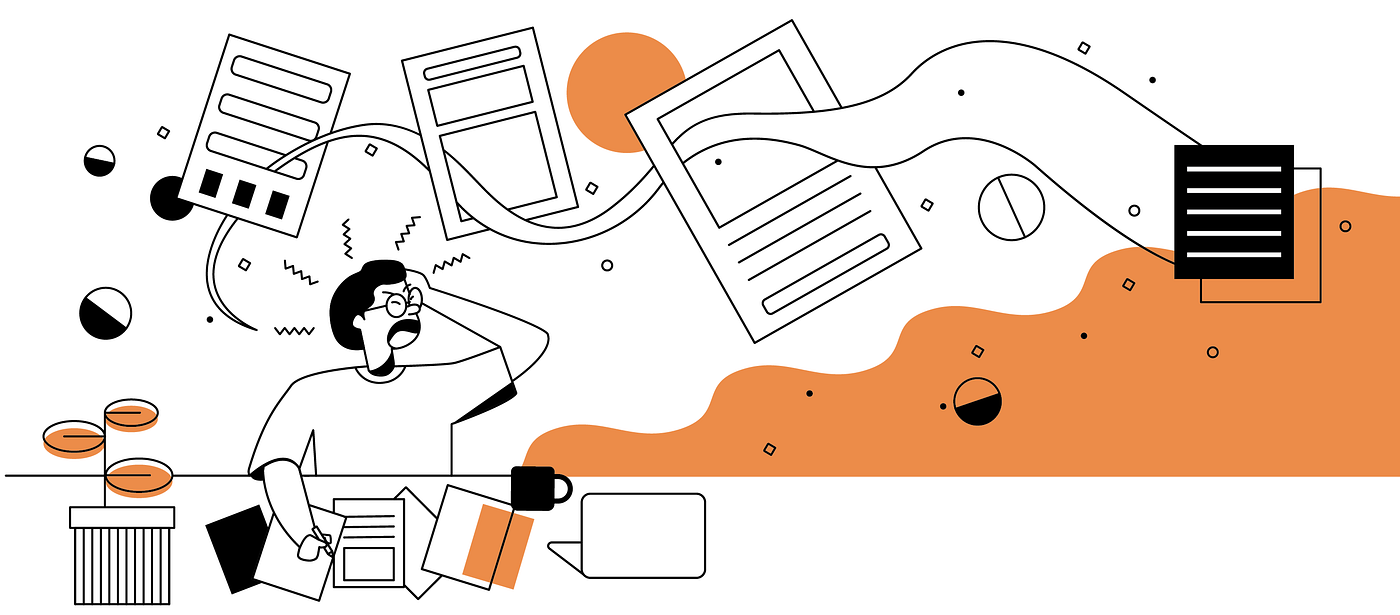
A few months ago, I attended a meeting that never happened.
The meeting was scheduled for 3:00 PM. I showed up on time, prepared and ready to present work I had spent weeks developing. Of the seven people expected to attend, only three appeared.
At first, I was frustrated.
Not because the meeting was missed, but because it wasn’t the first time something like this had happened.
I had seen similar situations while working with startups, healthcare organizations, property management firms, public agencies, and student groups.
Projects stalled. Emails went unanswered. Deadlines slipped.
Decisions that appeared straightforward from the outside often took weeks — or months — to move forward.
What surprised me was not the inefficiency itself.
It was how consistently it appeared across organizations that otherwise seemed completely different.
Over the past year, I have independently connected with planners, engineers, utility operators, environmental professionals, policy staff, founders, and executives throughout the Bay Area. Initially, I expected each field to have its own unique challenges.
Instead, I kept encountering the same one: Coordination.
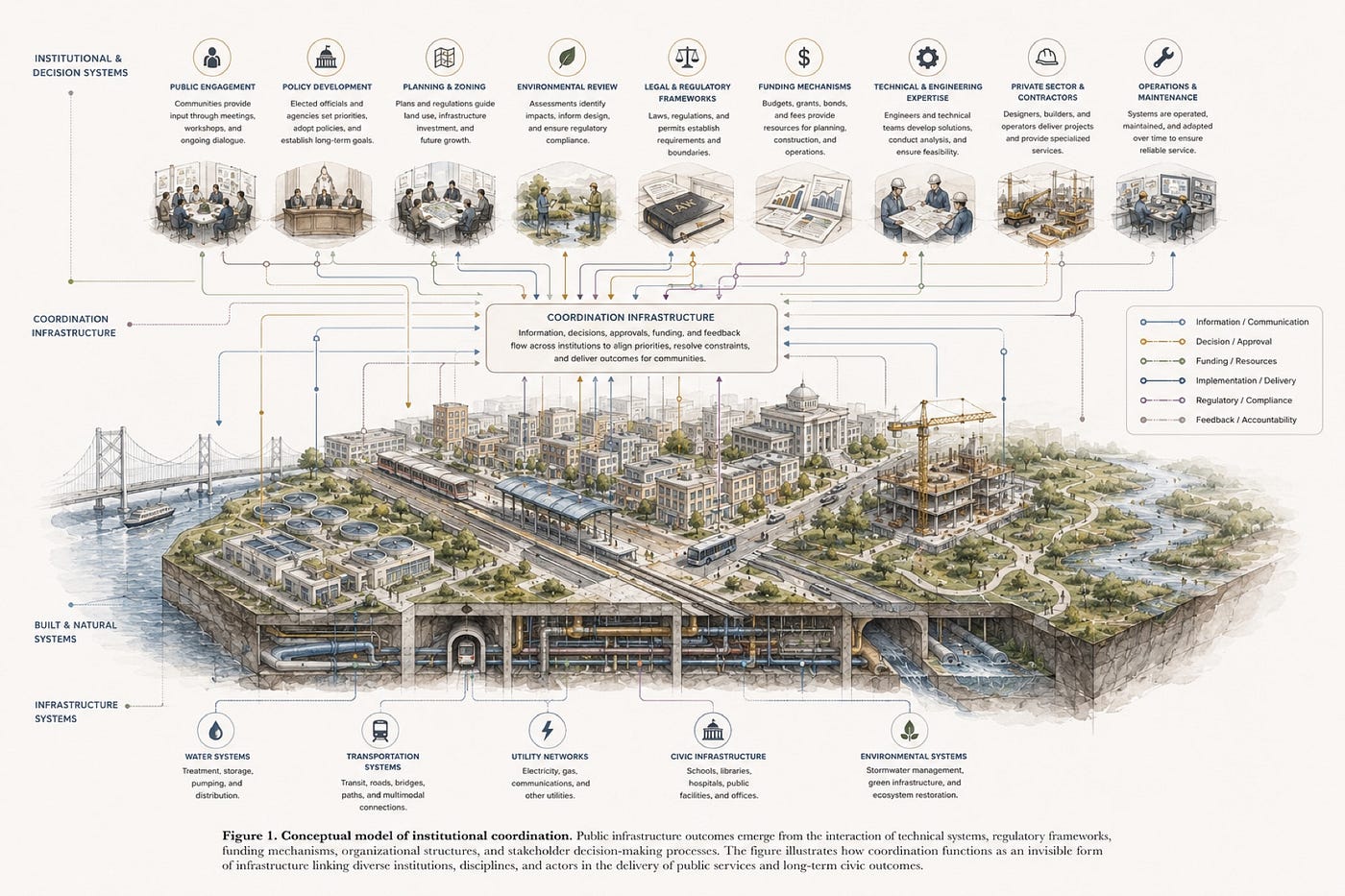
The greatest challenges facing public infrastructure are rarely technical limitations. More often, they arise from fragmented governance, communication barriers, funding constraints, competing priorities, and the difficulty of aligning diverse stakeholders around long-term goals.
But the same thing seemed to be true outside of infrastructure as well.
Startups struggled with coordination.
Corporations struggled with coordination.
Governments struggled with coordination.
Universities struggled with coordination.
Even small teams of highly intelligent and motivated people struggled with coordination.
The pattern was impossible to ignore.
For a long time, I assumed that large organizations moved slowly because the people within them lacked urgency or initiative. It seemed obvious that if everyone communicated more clearly, responded more quickly, and took greater ownership of problems, progress would accelerate dramatically.
The more people I spoke with, however, the more that explanation began to fall apart.
- The planner who took weeks to respond was simultaneously managing multiple projects, public meetings, political pressures, and budget constraints.
- The utility manager was balancing operational reliability, regulatory requirements, staffing shortages, and aging infrastructure.
- The founder was attempting to raise capital, manage employees, satisfy customers, and make strategic decisions under significant uncertainty.
The delay was rarely the result of indifference.
More often, it was the consequence of limited attention.
Every individual was operating within a system that imposed constraints on their ability to coordinate with everyone else.
That realization fundamentally changed how I thought about institutions.
The hardest problems were often not technical problems.
They were coordination problems.
And coordination, I came to realize, may be one of humanity’s most difficult challenges.
Economists study it through incentives.
Political scientists study it through institutions.
Engineers study it through systems.
Urban planners study it through governance.
Lawyers study it through rules and accountability.
Yet despite approaching the issue from different perspectives, many disciplines ultimately confront the same question:
How do we enable large groups of imperfect people to work together toward shared goals?
This question becomes particularly important in the context of public infrastructure.
Most people rarely think about the systems that make modern life possible...
Water arrives when a faucet is turned on. Transit vehicles arrive at scheduled stops. Roads connect communities. Waste disappears. Electricity flows.
The technical achievements behind these systems are remarkable.
Yet maintaining them often requires coordinating thousands of individuals across multiple agencies, disciplines, jurisdictions, and time horizons.
Building a reservoir, modernizing a transit network, or upgrading aging infrastructure is rarely constrained by engineering knowledge alone.
The greater challenge often lies in navigating approvals, funding mechanisms, stakeholder interests, environmental regulations, political priorities, and public expectations.
In other words, the challenge is frequently organizational rather than technical.
This observation has led me to become increasingly interested in the relationship between systems, institutions, and human behavior.
Growing up, I often viewed problems through the lens of individual responsibility. If something was not working, the assumption was that someone had made a mistake.
Now I am less certain.
Sometimes individuals make mistakes.
But sometimes the system itself produces outcomes that no individual intended.
A transportation delay may emerge from dozens of rational decisions made by different actors.
A policy failure may result from fragmented responsibilities rather than malicious intent.
An infrastructure project may stall because multiple organizations possess different incentives, priorities, and definitions of success.
Understanding these dynamics requires moving beyond simple explanations.
It requires recognizing that intelligent, well-intentioned people can still create frustrating outcomes when operating within complex systems.
Paradoxically, this realization has made me more optimistic.
If every problem were simply the result of bad actors, many challenges would be impossible to solve.
But if at least some problems emerge from the way systems are structured, then better systems can produce better outcomes.
The question becomes not how to create perfect people.
It becomes how to design institutions that enable imperfect people to work together effectively.
That idea sits at the intersection of many fields that increasingly interest me, including cognitive science, urban planning, public administration, infrastructure management, and law.
Each discipline asks a variation of the same question:
How do we design environments, organizations, and institutions that help people coordinate, communicate, and solve problems collectively?
The answer is undoubtedly complicated.
Yet after countless conversations with professionals across different sectors, I have become convinced of one thing:
The future of our cities, infrastructure systems, and public institutions will depend as much on our ability to coordinate as our ability to innovate.
For years, I assumed infrastructure was primarily a technical achievement.
Pipes.
Roads.
Transit systems.
Power grids.
But the more people I spoke with, the more I realized that beneath every visible system exists another one.
A less tangible infrastructure composed of communication, trust, incentives, governance, and shared understanding.
When that infrastructure functions well, projects move forward.
When it breaks down, even the best technical solutions struggle to succeed.
Perhaps that is why coordination appears everywhere.
In planning.
In engineering.
In law.
In public administration.
In business.
In relationships.
Different fields use different language, yet many are ultimately wrestling with the same challenge:
How do we enable large groups of imperfect people to make decisions, solve problems, and act collectively over time?
I do not yet know the answer.
But I suspect it may be one of the most important questions facing modern society — because humanity has never lacked ideas. More often, it struggles to coordinate around them.
The greatest challenges ahead will require more than technical innovation. They will require governance, communication, trust, and institutions capable of turning individual effort into collective action.
If there is a bottleneck, it is not our capacity to imagine better futures.
It is our ability to organize around them.
메타데이터
- post_id
- fe59eeff07fd
- slug
- the-real-bottleneck-isnt-technology-fe59eeff07fd
- url
- https://medium.com/@poiset/the-real-bottleneck-isnt-technology-fe59eeff07fd
- canonical_url
- https://medium.com/@poiset/the-real-bottleneck-isnt-technology-fe59eeff07fd
- author_url
- https://medium.com/@poiset
- status
- ok
- fetched_at
- 2026-06-10 14:03:00