Everyone Is Watching the AI Bubble. Nobody Is Watching the Factories That Decide If It Pops.
The bubble debate misses the point. Whether the boom keeps going is decided in three memory factories and one packaging plant, and the…
Everyone Is Watching the AI Bubble. Nobody Is Watching the Factories That Decide If It Pops.
The bubble debate misses the point. Whether the boom keeps going is decided in three memory factories and one packaging plant, and the market just proved it in a single day.
For two years the argument about artificial intelligence has been the same argument: is it a bubble or not. Trillions in capital expenditure, circular deals between the giants, a revenue gap that will not close, and on the other side, real chips, real revenue, real usage. Everyone is watching that fight. Almost no one is watching the thing that actually decides who wins it.
Here is how much it decides. On a single trading day in late June, a rumor about one factory erased roughly a trillion dollars. Not a war, not a bankruptcy, not a central bank: a whisper that one South Korean memory maker might slow the expansion of a single product line. Within hours the KOSPI, Seoul's main index, had its largest single-day fall on record and tripped its circuit breakers twice. SK Hynix and Samsung fell around twelve percent; Micron, a hemisphere away, about thirteen. The most expensive buildout in the history of capitalism shuddered because of a supply signal about memory.
That reaction is the whole argument in forty-eight hours. The fate of the AI boom is not set by the models, the valuations, or even the graphics chips everyone can name. It is set in three memory factories and one packaging plant, and the market proved it in a day.
This article is an adapted edition of a larger investigation. The complete version, with the full evidence map, the source notes, and the forensic analysis, is available free at The Manifest Archive.
The story everyone tells
The visible spectacle is genuinely enormous. The four largest American cloud companies are on course to spend somewhere between roughly six hundred and thirty and seven hundred and twenty-five billion dollars on AI infrastructure in 2026, depending on whose tally you take, up something like seventy percent from the year before. By the summer their combined free cash flow had reportedly fallen toward zero, which means the buildout is now being bridged with debt. The money moves in circles that make careful observers uneasy: the leading chipmaker investing in the model company that then buys its chips; that model company signing compute commitments reported to total around one and a half trillion dollars against a revenue a small fraction of that size. More than a hundred and twenty billion dollars of construction has been pushed off the giants' balance sheets into vehicles funded by private credit. And the productivity meant to justify it all stays stubbornly hard to find: study after study reports that the overwhelming majority of enterprise AI pilots show no measurable effect on profit.
This is the story the financial press has told a thousand times, and it is real. Depreciation schedules quietly stretched from four years to six to flatter earnings. Analysts warning of a six-hundred-billion-dollar gap between the revenue the buildout implies and the revenue anyone can find. It is a genuinely alarming picture. But it is the visible layer, and the visible layer is not where the outcome is decided. It is a story about money, and money is downstream of something physical.
What money cannot conjure
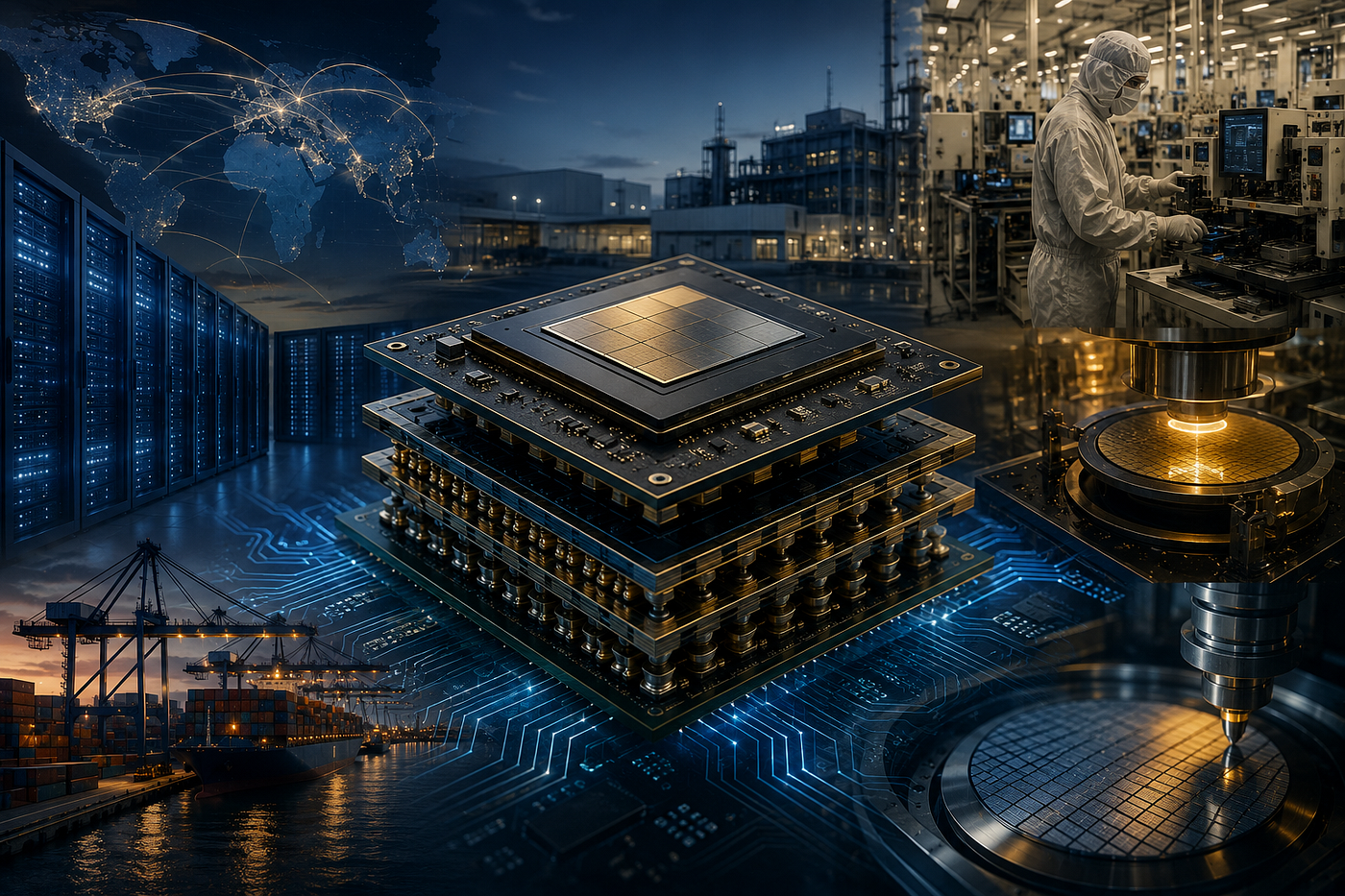
A modern AI accelerator is not one chip. It is a logic die, the processor everyone talks about, surrounded by stacks of high-bandwidth memory, all of it fused onto a silicon platform by a technique called advanced packaging. The processor is the face. The memory and the packaging are the body, and the body is where the constraint lives.
High-bandwidth memory, or HBM, is the part the phrase "AI chip" hides. It is memory stacked a dozen dies high and threaded with thousands of microscopic vertical connections, and it is brutally hard to make: producing one bit of it consumes roughly three times the factory capacity of a bit of ordinary memory. By 2026 it had swollen to consume close to a quarter of the world's entire output of DRAM wafers, and the spillover was severe enough that the price of ordinary computer memory climbed as the makers diverted their lines to the AI product that pays more. The supply is already gone: SK Hynix's own chief financial officer has said the company sold out its entire 2026 HBM supply, and Micron says the same. When something is sold out a year ahead, price no longer clears the market. Allocation does, and allocation is decided by three firms, one of them dominant, with no fourth.
The economics are worth pausing on, because they explain why the bottleneck resists money. A single stack of high-bandwidth memory reportedly sells for several hundred dollars, many times the price of the equivalent conventional memory, at a margin so wide that redirecting capacity toward it is nearly irresistible. That is why ordinary memory prices are rising as a side effect: every wafer turned into HBM is a wafer not turned into the memory that goes into laptops and phones and servers. The AI buildout is not just consuming the world's most advanced memory. It is quietly reaching into the price of all the rest.
The other half of the accelerator is the packaging, and here the concentration is starker: not three firms but effectively one. The technique that fuses the logic die and the memory into a working accelerator is dominated, at the leading edge, by a single company, TSMC, and its packaging lines have been sold out, with lead times of roughly a year to a year and a half. Every high-end AI chip in the world, whoever designs it, passes through that one process to become usable. In fairness, the squeeze is projected to ease through 2026 as capacity ramps from tens of thousands of wafers a month toward a target more than three times higher, and all three memory makers are now qualified on the next generation. But for the window in which these trillions are actually being committed, the single most valuable industrial process on earth runs through the back-end lines of one company, and the second most valuable through three.
Why memory became the wall
None of this was always true. For most of computing's history the processor was the scarce, glamorous part and memory the cheap commodity that fed it. The trouble is that processors grew faster than the memory feeding them, decade after decade, until the gap itself became the defining constraint: the point where a chip spends most of its time waiting for data rather than computing. Engineers call it the memory wall, and they have warned about it for thirty years.
AI walked straight into it. A large language model is mechanically an enormous pile of numbers that must be hauled from memory to the processor and back for every word it generates; the arithmetic is trivial next to the moving. Real inference is memory-bound the majority of the time, meaning the expensive processor sits idle waiting for the memory to deliver. That is why the answer was to bolt the memory onto the processor and stack it high, and why, the moment AI became the center of gravity, the scarce resource moved with it, from the logic die everyone watches to the stack and the package almost no one does. The wall did not disappear. It moved to the middle of the chip and became the whole game.
The treadmill nobody steps off
There is a reason the bottleneck does not simply resolve itself once the factories catch up, and it is the cruelest part of the arrangement. High-bandwidth memory does not sit still. Each generation stacks higher, runs hotter, and demands a new round of qualification, the long and unforgiving process by which a memory maker proves to a chip designer that its stacks will work reliably inside a specific accelerator. Qualification takes many months and cannot be rushed, because a single bad stack can kill a package worth far more than the memory inside it. So even as capacity expands to meet today's demand, the target moves. The next generation reopens the same scarcity at a higher altitude, and the makers who are qualified first capture the premium while the rest wait.
This is why the shortage behaves less like a temporary imbalance and more like a permanent condition that migrates upward. The industry is not climbing toward an end state where memory becomes abundant. It is running on a treadmill where each step forward resets the scarcity, and the handful of firms that can keep pace pull further ahead of any conceivable challenger. Abundance at one generation is scarcity at the next. The wall is not a moment. It is a direction of travel.
Three names, and no fourth
Step back and look at who these facts name. The memory is made, at the leading edge, by three companies: SK Hynix and Samsung in South Korea, Micron in the United States. The packaging is dominated by one, TSMC in Taiwan. That is the real map of power in artificial intelligence, and it looks nothing like the public one. The public map is a gallery of founders and chatbots and trillion-dollar valuations, American and loud. The real map is a short list of industrial firms on the Pacific rim whose names most investors in the boom could not reliably produce, whose factories decide how much of the ambition can actually be built, and against whom there is no near-term alternative.
And a fourth is not going to appear on any timescale that matters. A single advanced facility costs tens of billions, takes years to build, and then takes years more of yield learning that cannot be bought or copied, because much of it lives in the tacit experience of the engineers who run the lines. You cannot hire your way to a mature memory yield; you have to earn it, slowly, on real production. The scarcity is not a temporary imbalance that high prices will summon new entrants to correct. It is structural, defended by physics, capital, and time. This is the pattern beneath every visible power: the part everyone watches, the model, the brand, the market cap, is the part abundant enough to become famous; the part that decides the outcome is the part concentrated enough to stay quiet.
The day the market admitted it
For two years the financial story and the physical story ran on separate tracks. The press debated the bubble; the trade publications quietly tracked stacking yields and packaging lead times. Then, for forty-eight hours in June, the two tracks touched. A rumor that one memory maker might favor its high-margin ordinary-memory business and slow its next-generation HBM ramp convinced the market that the supply feeding the entire buildout might tighten, and the whole AI complex repriced at once.
Mark the claim carefully: markets are never moved by one thing alone, and the rumor was the reported trigger, not a proven sole cause. But the sensitivity it revealed is the finding. The leading accelerator maker shed close to six hundred billion dollars of market value in the sell-off. A major American processor firm fell around a fifth. And the confidence of a seven-hundred-billion-dollar annual spending cycle turned out to rest on the production decisions of a handful of factories most of the people funding the boom could not name. The market did in a day what two years of commentary had not: it admitted where the outcome actually lives.
The counterfactual that settles it
The way to know whether a variable is decisive is to remove it. Remove the models and the buildout continues; there are many. The graphics processors are a harder case, because the leading maker's software ecosystem is a real moat that competitors have struggled for years to cross. But even there the point holds from the other side: whoever's chip and whoever's software win, every design still depends on the same memory and the same packaging. Remove the high-bandwidth memory, or the packaging that turns a logic die into a finished accelerator, and the entire buildout stalls no matter how many chips have been designed or how many billions raised to buy them.
You can already see it in the physical world. Data centers stand built and powered, their racks waiting, because the accelerators to fill them are held up behind memory and packaging, not behind money or electricity. The buildings are ready. The capital is ready. The power contracts are signed. The bottleneck is a stacking line in Korea and a packaging line in Taiwan. The determining variable is not the part with the trillion-dollar valuation. It is the part with the year-long lead time.
This is also why throwing money at the problem does not solve it on the timescale that matters. Capital can commission a new facility, but it cannot compress the years of yield learning that make the facility productive, and it cannot conjure the qualified engineers who carry that learning in their hands. The one input the buildout cannot buy is the one input it most needs. That is the signature of a true bottleneck: not that it is expensive, but that money bounces off it.
A chokepoint in the worst place on the map
There is one more fact that should keep strategists awake. The scarce step in the most important technology of the age does not sit somewhere neutral and defended. The one company that packages nearly every leading-edge accelerator is in Taiwan, which a nuclear-armed China claims and has never renounced taking by force. Two of the three memory makers are in South Korea, within artillery range of a hostile, nuclear-armed North. The entire Western AI buildout runs through a supply chain concentrated on the front line of the two most volatile standoffs in Asia.
A blockade of Taiwan would not merely raise chip prices; it would sever the step that turns silicon into a usable accelerator, with no substitute standable in less than years. Export controls already show governments treating these chips as strategic materiel rather than ordinary goods, which is its own admission of where the leverage sits. The scarce thing is held in a few hands, and those hands sit on a fault line.
It is worth naming how unusual this is. The internet was built on infrastructure spread across thousands of firms and dozens of countries, resilient precisely because it was diffuse. The AI buildout is the opposite. Its most critical step has been concentrated, over a single decade, into a geography that two nuclear standoffs run straight through. A technology sold as the great decentralizer of intelligence turns out to depend, at its physical root, on the most centralized and most exposed supply chain in modern industry. That is not a detail the valuations price. It is the risk they ignore precisely because it is not on the visible layer.
The strongest objection
The best case against this framing deserves full strength, because a memory-bottleneck thesis can curdle into its own hype. A fair critic would say the chokepoint is easing, not tightening: capacity is expanding fast, the packaging gap is projected to close, all three memory makers are now qualified on the next generation. And the revenue at the chip layer is real, not fictional the way a bubble's is, with the leading accelerator maker's data-center sales up more than ninety percent year on year. If the constraint is loosening and the money is real, calling memory the thing that decides the boom is just the bearish story in an engineer's coat.
The honest reply concedes the facts and narrows the claim. The chokepoint is loosening, and the revenue is real; this essay says both. What neither touches is the core point: for the near-term years in which these trillions are actually committed and spent, the outcome is gated by memory and packaging capacity rather than by models or money, and the market has demonstrated, with a record crash, that it knows this even when the coverage does not. The claim is not that memory makes the boom a fraud. It is that memory, not the model or the valuation, sets the ceiling. What would prove it wrong is concrete: if the buildout accelerated through a genuine, sustained memory shortage with no effect on its pace or its valuations, memory would not be the binding constraint after all. Watch what moves the sector next. If it is a factory again, the case is made.
The factory, not the model
The AI economy has three layers, and only the top two are ever discussed. The visible layer is the models and founders and valuations that fill the news. Beneath it is the memory and packaging that gate how much can be built. And beneath that is a governing layer: the physics, the geography, and the handful of firms that set the middle layer's capacity. The market trades the top layer, glimpses the middle on a day like June's, and almost never looks at the bottom. Yet the causation runs upward. The valuation is the shadow; the stacking line is the object casting it.
None of this is unique to silicon. It is the oldest pattern in industrial history, and it repeats because the physics of scarcity does not care about the fashion of the moment. In every gold rush the durable fortunes were made not by the miners but by the few who controlled the one thing every miner needed and could not make themselves. The AI boom is a gold rush with better marketing, and the picks and shovels are stacked in a handful of factories on the Pacific rim.
There is a lesson here that outlives this boom. When the exciting part of a technology becomes abundant, the design, the model, the money, power does not stay with the exciting part. It migrates to whatever remains scarce, and the scarce thing is almost always physical, unglamorous, and concentrated in a few hands. The breakthrough gets the valuation. The bottleneck sets the ceiling. So the next time the AI complex lurches and the headlines reach for a bubble or a genius or a crash, look past all three, to a handful of factories in Korea and Taiwan whose production schedules quietly decide how far the most expensive story in the world is allowed to go.
Read the complete investigation, with the full memory-and-packaging model, the June crash, and the evidence map, free at The Manifest Archive.
메타데이터
- post_id
- fe7d9ffd4fe8
- slug
- everyone-is-watching-the-ai-bubble-nobody-is-watching-the-factories-that-decide-if-it-pops-fe7d9ffd4fe8
- url
- https://medium.com/the-geopolitical-economist/everyone-is-watching-the-ai-bubble-nobody-is-watching-the-factories-that-decide-if-it-pops-fe7d9ffd4fe8
- canonical_url
- https://medium.com/the-geopolitical-economist/everyone-is-watching-the-ai-bubble-nobody-is-watching-the-factories-that-decide-if-it-pops-fe7d9ffd4fe8
- author_url
- https://medium.com/@jerry71
- status
- ok
- fetched_at
- 2026-07-13 06:23:13