Ukraine is Strangling Crimea
Slowly but surely the noose is tightening — fuel supplies are now at critically low levels and 30–45 days is probably the limit
Ukraine war
Ukraine is Strangling Crimea
Slowly but surely the noose is tightening — fuel supplies are now at critically low levels and 30–45 days is probably the limit
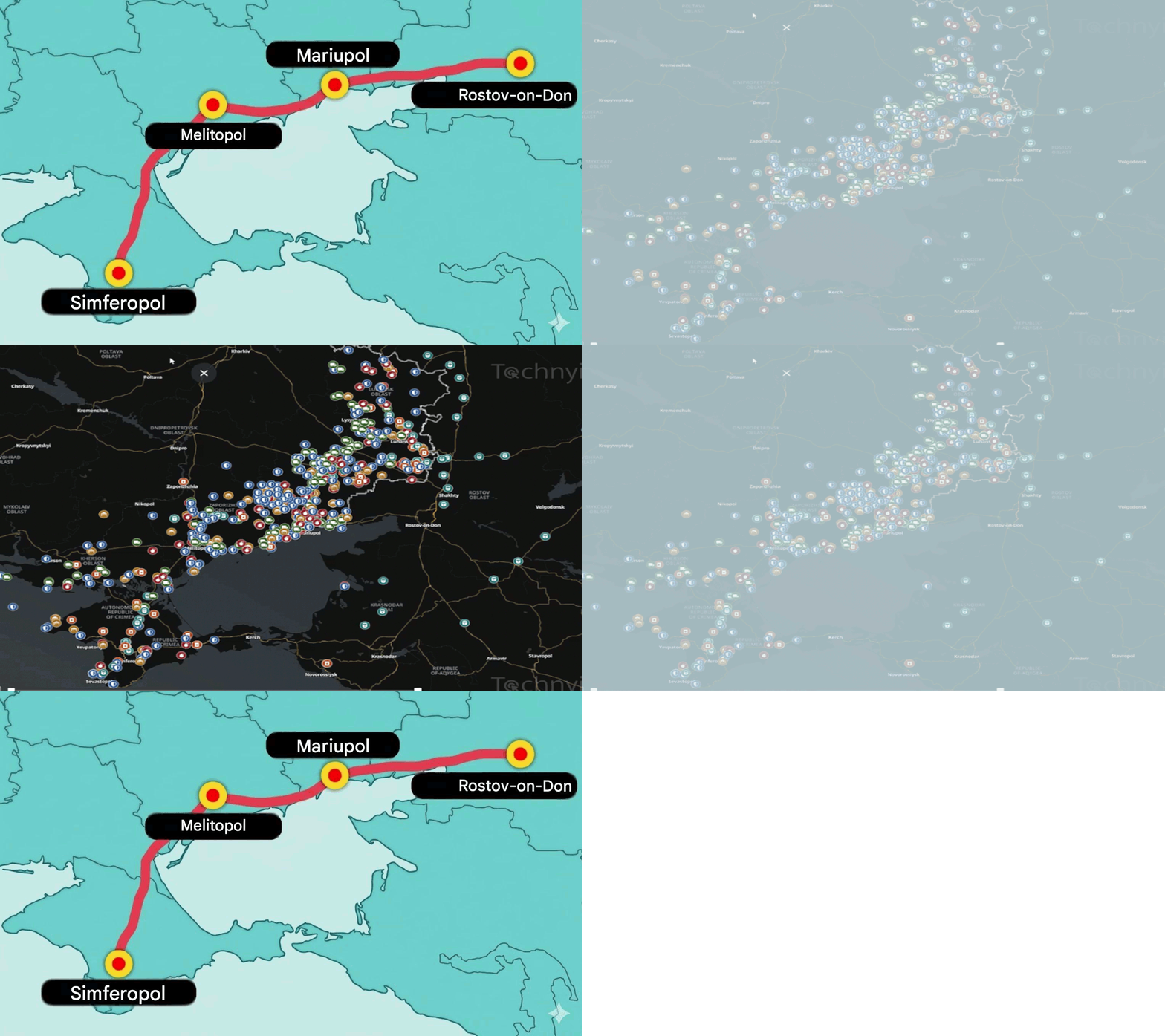
Ukraine attacks 9 Jan-28 May 2026, accelerating. Credits: Igoe Sushko and Tochnyi on Twitter (blended)
As I write it’s another day following a huge Russian aerial attack on Ukraine. 10 dead in Kyiv, and many missing. I think that Putin is now throwing everything he has at Ukraine, bar nuclear weapons. Surely a sign of desperation?
But there is some good news.
Ukraine is ramping up drone and artillery attacks on military targets and now almost all the land corridor from beyond the Russian border to Crimea is under Ukrainian fire control.
From ‘Fighterbomber’, a well known Russian milblogger on Telegram, translated:
In summary, here are the explanations from the explanatory team regarding the reasons for the fuel shortage in Crimea.
It is allowed to transport fuel by rail across the bridge in exceptional cases after a terrorist attack. Plus, the owners of railway fuel tanks are not eager to provide them, because no one insures them.
There were three ferries for rail transport, all of which were damaged, and a new one is expected around September. Moreover, there is a shortage of sailors for these ferries.
The railway pier is blocked.
The waiting time for car ferries can be up to 5 days.
There are simply no drivers willing to transport fuel in new territories. Because these are civilian drivers and they don’t even accept more than 100 rubles per trip. Or even 200.
On the peninsula itself, there are practically no private individuals willing to store fuel, because everything is repeatedly attacked.
Insurance companies don’t insure it.
Therefore, without the intervention of the state and the military (who will transport fuel for free), this problem cannot be solved.
The logistical integrity of the land corridor connecting the Russian border to Crimea is failing.
Recent operational shifts suggest this vital artery, once considered a secure strategic achievement, now faces systemic collapse as the frequency of Ukrainian attacks accelerates.
The main highway runs largely parallel to the coast of the Sea of Azov, often at a distance of approximately 7 to 10 kilometres from the coastline. While the front line itself is further north, the effective reach of Ukrainian forces has been fundamentally altered by the deployment of middle-range strike drones and precision artillery.
Shift in operational depth
Rather than relying solely on the physical distance between the front line and the road, Ukrainian strategy now emphasises operational depth. Intelligence assessments indicate that Ukrainian units are now targeting Russian logistics at ranges of 75 to 150 kilometres.
This shift means that large sections of the M14, particularly those stretching from the Russian border through Melitopol toward the approaches to Crimea, are effectively within the “kill zone” of modern unmanned aerial systems. Consequently, the highway is no longer considered a “rear” route safely removed from combat; it is an active zone of interdiction where supply vehicles remain under threat regardless of their exact distance from the immediate contact line.
Ukrainian forces have established persistent fire control over these routes, transforming what was intended to be a robust supply line into a perilous zone of attrition.
The strategy
The campaign focuses on the disruption of ground lines of communication. Ukrainian forces have adopted a multi-layered approach, employing medium-range strike unmanned aerial vehicles to monitor and neutralise convoys.
Military intelligence indicates that the risk to transit is so high that convoys are often forced to move in smaller increments or abandon paved highways for secondary dirt roads.
This shift in tactics creates a compounded disadvantage for Russian logistics: lower speed, increased visibility to surveillance, and restricted capacity to move heavy equipment.
Data from monitoring groups suggests that the average speed of military supply convoys along the M14 highway has decreased by roughly 40 percent due to the necessity of evasive routing. Reports from the region confirm that the transit of logistics is no longer a fluid process but a fragmented effort hindered by the remains of previous engagements.
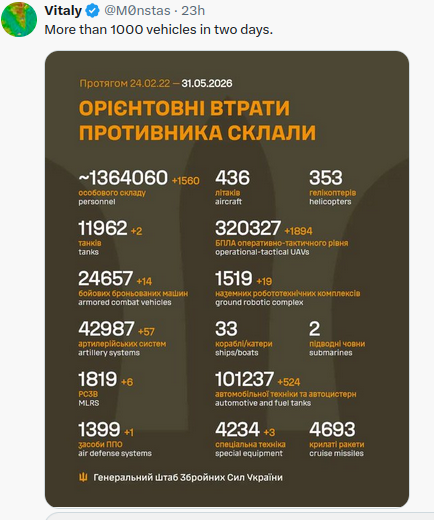
And the toll on Russian vehicles generally is upward. More than 1000 vehicles in two days:
Russia has been testing new camouflage schemes for its trucks in a desperate bid to confuse AI targeting systems in Ukrainian drones. They do not work!

The end of the land bridge
For over a year, Russia relied upon the occupied territories of the Zaporizhzhia and Kherson regions to serve as a secure logistical rear. This land corridor was designed to bypass the vulnerability of the Kerch Bridge by providing a stable rail and road connection to the Russian Federation.
However, as of June 2026, this assumption has proven flawed.
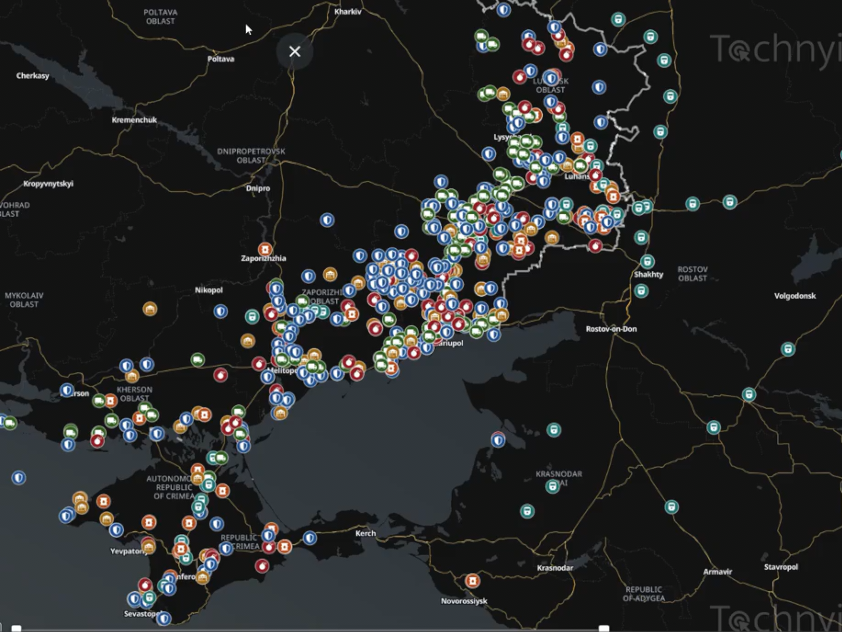
Ukraine hits Feb — May 2026 increasing in intensity
The operational depth of Ukrainian strike capabilities has expanded significantly, allowing drones and precision artillery to target transit corridors from Mariupol to the approaches of the peninsula.
Recent satellite imagery analysis indicates that at least 65 percent of the primary highway sections within these corridors are now subject to constant observation, drone attacks and active engagement by long-range artillery units.
Local occupation authorities have been forced to implement traffic restrictions, effectively acknowledging that civilian and military transit is no longer sustainable under normal operational conditions.
Critical fuel scarcity
The most immediate effect of this logistical breakdown is a severe fuel crisis across the Crimean peninsula. Major fuel station networks have stopped selling petrol vouchers, and severe rationing is in effect.
Premium and regular fuels are restricted for public services, while private access is limited to minimal quantities per vehicle.
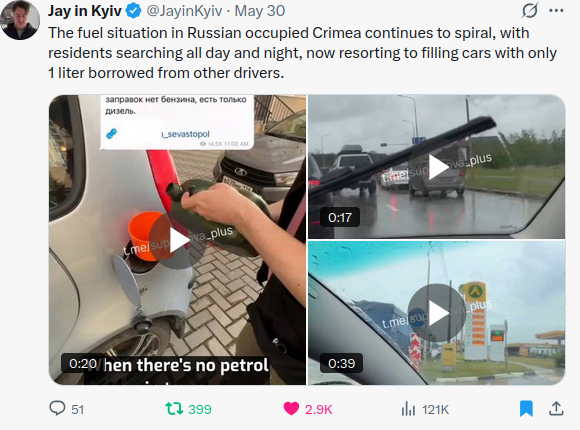
Twitter screenshot
Regional fuel stocks are estimated to be at 25 percent of typical operational capacity, a figure that continues to decline as supply replenishment remains blocked.
The disruption is a direct result of Ukraine hitting the fuel convoys moving through the land corridor. With local reserves depleting, the reliance on external supply becomes paramount.
Ferry failure
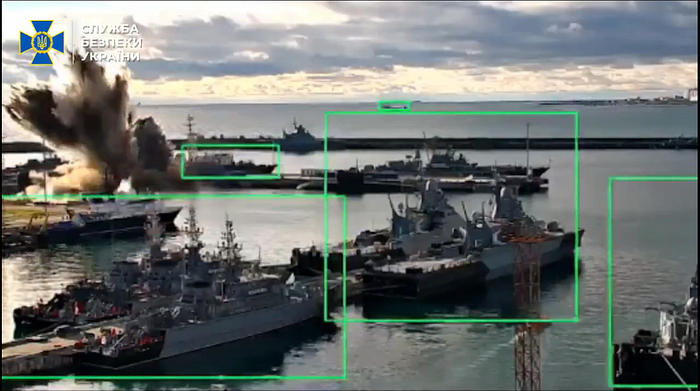
The Kerch rail ferries are not currently operational. The infrastructure and vessels have been systematically neutralised by Ukrainian strike operations. Key developments include:
- Total incapacitation of the fleet: According to reports from the Ukrainian Main Directorate of Intelligence (HUR), the ferry fleet was effectively wiped out over the spring of 2026. The Slavyanin, identified as the last remaining rail-capable ferry operating in the strait, was disabled during a drone strike overnight on April 6, 2026. Prior to this, other key vessels such as the Avangard and Conro Trader were also struck and rendered non-operational.
- Inadequacy of alternatives: Ukrainian Navy spokesperson Dmytro Pletenchuk has noted that while some conventional ferries may still be present, they lack the capacity to handle the heavy military cargo — such as fuel trains and armored equipment — that the specialised rail ferries were previously responsible for moving.
Due to the loss of the ferry route, Russia is under mounting pressure to use the Crimean (Kerch) Bridge for heavy and hazardous cargo, despite the significant security risks and structural limitations the bridge currently faces following successful attacks by Ukraine — from the air to damage the road structure, and under the sea to damage the bridge foundations.
Trucking companies
Russian truck drivers are now sabotaging their own vehicles by setting them on fire to avoid driving to Crimea via the “road of death.” It’s not only fuel and ammunition now — regular supplies are also being constrained.
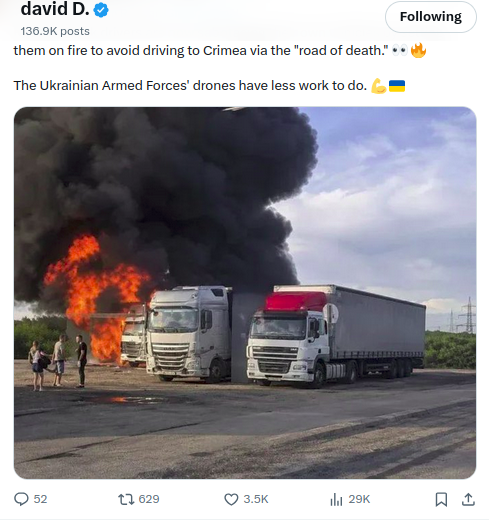
Others are demanding much higher payments, reported by the head of the Center for the Study of Occupation Petr Andryushchenko.
Drivers are only willing to take the risk for very large sums of money and want up to 100,000 rubles for a single trip, which is their monthly salary. And this is for a round trip through the land corridor from Taganrog in Russia to Crimea.
They understand that it’s dangerous,” noted Andryushchenko.
Strategic implications for the peninsula
Crimea is slowly but surely being strangled.
Military analysts suggest that the peninsula, previously imagined as an unsinkable fortress, is transitioning into an isolated enclave. The reliance on the Kerch Bridge is expected to increase as a result of the collapse of the land corridor, yet the bridge itself remains subject to structural risks and safety constraints that limit its efficacy for large-scale military shipments.
The bridge currently operates at an estimated 35 percent of its pre-war freight capacity due to ongoing repair efforts and security precautions.
The cumulative effect of these pressures suggests that current reserves will be insufficient to support sustained combat operations if the supply chain remains severely constrained.
In mediaeval times, fortresses could be starved into submission. Today, even with food and water, they cannot survive long without fuel.
Outlook for total isolation
While occupation officials have promised to stabilise the fuel situation, the current operational data reveals no mechanism to overcome the security risks posed by widespread fire control.
Evidence suggests that if supply rates continue at the current restricted pace, logistical reserves could reach a critical failure point within the next 30 to 45 days.
As long as these supply lines remain under constant monitoring and attack, the logistical viability of Crimea as a hub for Russian military power will continue to erode, forcing a total re-evaluation of its defense by late 2026.
As I said at the start of this piece, Putin is desperate.
And I am certain that the Kremlin wolves are surrounding him.
[embed]
메타데이터
- post_id
- fe80df2b9018
- slug
- ukraine-is-strangling-crimea-fe80df2b9018
- url
- https://medium.com/the-dock-on-the-bay/ukraine-is-strangling-crimea-fe80df2b9018
- canonical_url
- https://medium.com/the-dock-on-the-bay/ukraine-is-strangling-crimea-fe80df2b9018
- author_url
- https://medium.com/@james-marinero
- status
- ok
- fetched_at
- 2026-06-14 11:28:49