Nobody Talks About the 7 Minutes Before the Shift Starts
There’s a quiet chaos that happens at most jobsites every single morning, and it rarely makes it into any HR report. An operator pulls into…
Nobody Talks About the 7 Minutes Before the Shift Starts
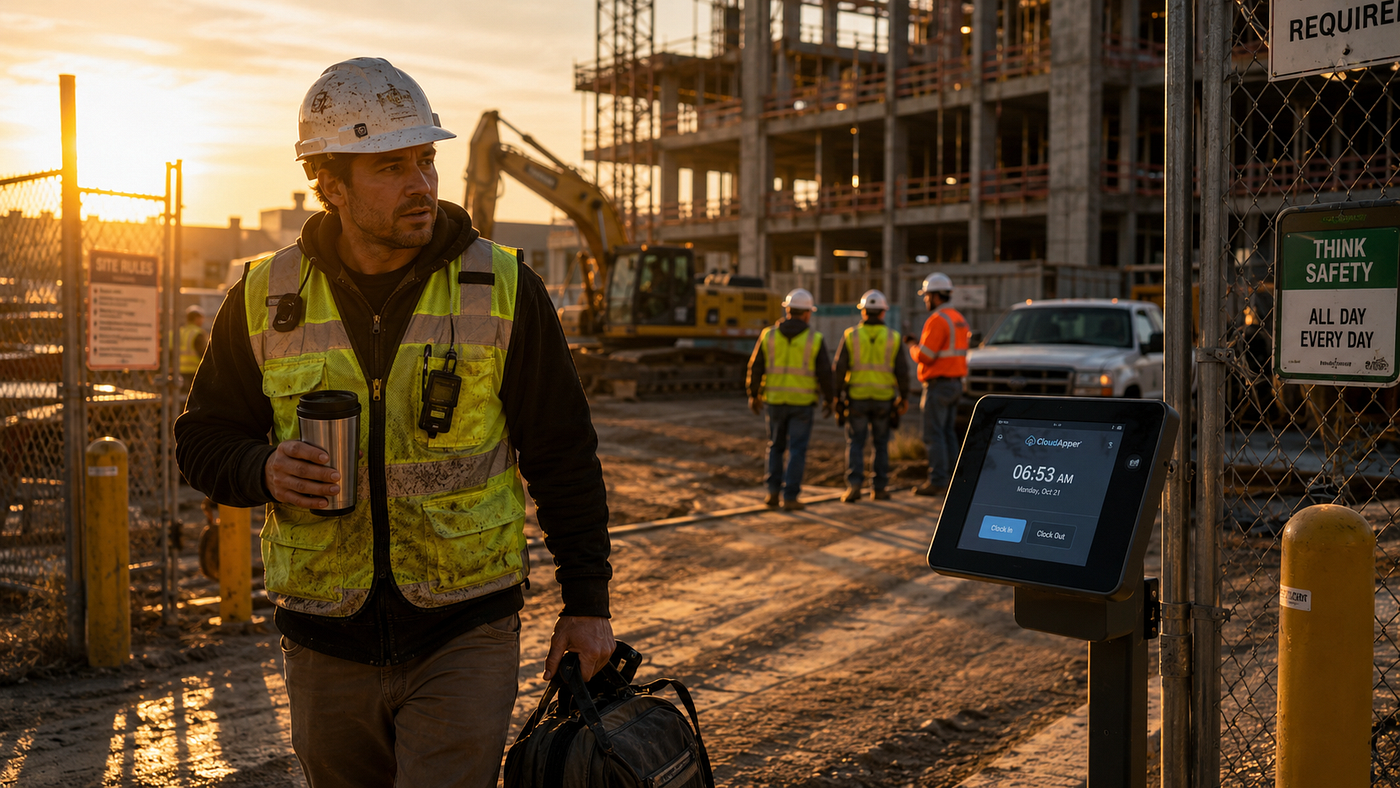
There’s a quiet chaos that happens at most jobsites every single morning, and it rarely makes it into any HR report. An operator pulls into the parking lot at 6:53 AM. Shift starts at 7:00. He’s got his gloves, his boots, his coffee. What he doesn’t have — or doesn’t want to deal with — is logging into a workforce app on his phone before he’s even had a chance to put his hard hat on.
So he doesn’t clock in right away. Maybe he asks a coworker to do it for him. Maybe he figures he’ll catch it at lunch. Maybe he just forgets entirely.
By the time payroll closes, there are eleven exceptions just like his. The HR coordinator spends two hours tracking them down. The foreman gets three texts asking him to confirm hours he barely remembers. And the timesheet still goes in late.
This isn’t a discipline problem. It’s a design problem.
Jobsites Aren’t Offices. The Tech Stack Shouldn’t Pretend Otherwise.
Most timekeeping systems were built with a desk worker in mind. Clean WiFi. A chair. Time to navigate a few menus before the day kicks off.
On a jobsite — construction, field services, manufacturing floor, distribution yard — none of that exists. Workers are moving the second they arrive. Connectivity is inconsistent. Personal phones stay in trucks or pockets because the work doesn’t leave room for them.

When you tell a field crew to “just use the app,” you’re asking them to add a step to the start and end of every single shift that competes with everything else demanding their attention in that moment. Most of the time, it loses.
The result is a slow leak: missed punches, estimated hours, retroactive edits, buddy punching, and payroll exceptions that pile up week after week. For California contractors in particular, the stakes are even higher — missed attestations and undocumented break acknowledgments can turn into wage claims faster than most managers expect.
The Clock-Out Problem Nobody Talks About Enough
Clock-in gets all the attention. But clock-out is where compliance risk actually lives.

That’s when you need employees to answer questions. Did you take your meal break? Did you work past eight hours? Did you receive a safety briefing today? Were you at the assigned jobsite for the full shift?
These aren’t optional in regulated environments. They’re documentation. And if a worker is standing in a parking lot at the end of a ten-hour shift, mentally done for the day, the last thing they’re going to do is pull out a phone, log in, and thoughtfully answer four attestation questions before driving home.
What happens instead? They skip it. Or they click through as fast as possible without reading. Or they answer “yes” to everything just to get past the screen.
None of that holds up if you ever need it to.
The deeper issue is that most workforce platforms don’t support conditional logic at the punch level. If an employee answers “No — I did not take a meal break,” the system should immediately require an explanation before the punch processes — and notify a manager in real time. That’s not a nice-to-have for California employers. That’s the difference between a defensible record and a wage claim.
What Actually Works: Putting the Clock Where the Work Is
The fix isn’t a better mobile app. It’s removing the device dependency entirely.
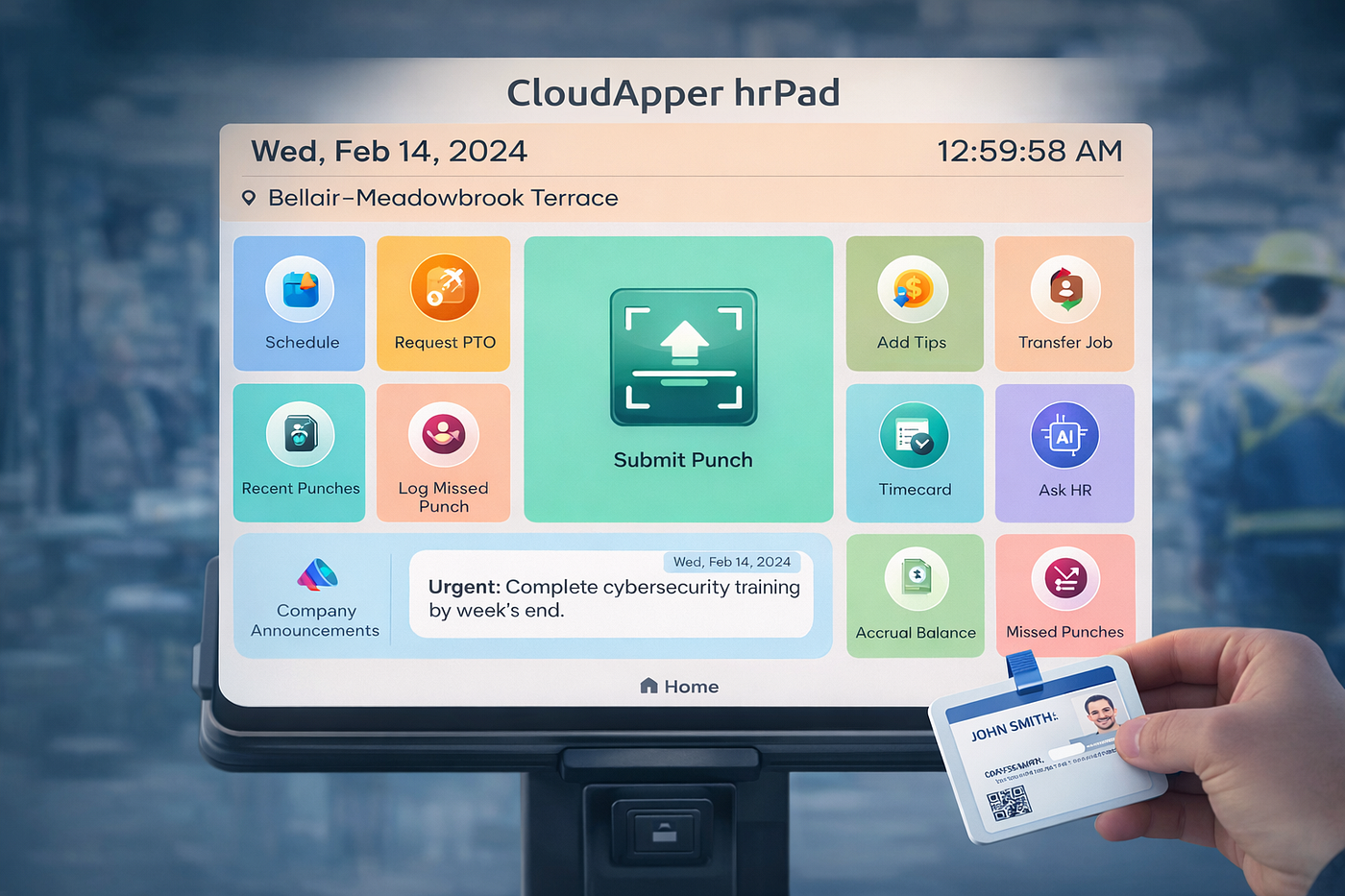
A shared tablet kiosk placed at the site entrance, break room, or staging area does something no mobile app can: it’s just there. Employees walk past it. It becomes part of the routine. No login required — Face ID or a QR code scan gets them in and out in seconds.

This is exactly what CloudApper hrPad is built for. As a certified UKG partner, CloudApper built hrPad specifically to extend workforce management tools into the physical environments where frontline work actually happens — not to replace the core system, but to close the last-mile gap that leaves so many timesheets a mess.
On a tablet running hrPad, a worker clocks in with a face scan. At clock-out, they move through a configurable set of attestation questions — tailored to your jobsite, your state’s labor requirements, your policies. If an answer triggers a flag, a follow-up question appears automatically and cannot be skipped. Your office gets notified immediately. The record is time-stamped, signed, and synced to your HR system in real time.

For contractors managing crews across multiple jobsites, hrPad also handles the commute and travel pay documentation problem. You can build custom questions right into the clock-in flow — “Did you use the company vehicle today?” or “Was today’s site more than 30 minutes from your home location?” — capturing the data you need for California travel pay compliance without relying on employees to remember to report it separately.
Employees can also sign documents directly on the device. Policy acknowledgments, safety briefings, onboarding paperwork — it all happens at the kiosk with a digital signature, logged and stored.
The Foreman Isn’t an HR System
Here’s something worth saying plainly: when your timekeeping process breaks down, the foreman becomes the workaround. He’s the one fielding texts about missed punches, vouching for hours, relaying schedule changes, and chasing down signatures on forms that should have been handled at punch-out.
That’s not what you hired him to do. And every hour he spends untangling timekeeping issues is an hour he’s not running the job.

Good time capture infrastructure doesn’t just make payroll easier. It gives supervisors their time back, gives HR a defensible paper trail, and gives employees a process that doesn’t feel like one more thing to deal with at the end of a hard day.
The Unglamorous Truth
Jobsite time tracking will never be a flashy topic. It won’t generate conference keynotes or vendor case study videos. But it’s one of the most consistent sources of avoidable cost, compliance risk, and administrative drag in field-heavy industries — and it almost always traces back to the same root cause: a tool that was designed for someone else’s workday.

The crews showing up at 6:53 AM deserve a clock-in process that works as hard as they do. That means it has to be fast, physical, and available at the point of work — not three taps deep in an app they forgot the password to.
The technology to do that already exists. The question is whether the people managing these jobsites know to ask for it.
CloudApper hrPad is an employee self-service kiosk that integrates with UKG, Dayforce, Workday, and other major HCM platforms. It runs on any standard iPad or Android tablet and is purpose-built for frontline and field workforce environments.
메타데이터
- post_id
- fe852a4646fb
- slug
- nobody-talks-about-the-7-minutes-before-the-shift-starts-fe852a4646fb
- url
- https://medium.com/hr-unfiltered/nobody-talks-about-the-7-minutes-before-the-shift-starts-fe852a4646fb
- canonical_url
- https://medium.com/hr-unfiltered/nobody-talks-about-the-7-minutes-before-the-shift-starts-fe852a4646fb
- author_url
- https://medium.com/@si.tamim.701
- status
- ok
- fetched_at
- 2026-07-08 04:28:09