Artists Never Have To Leave the Stage… The Age of the Holographic Residency.
By: Michael J. Whalen
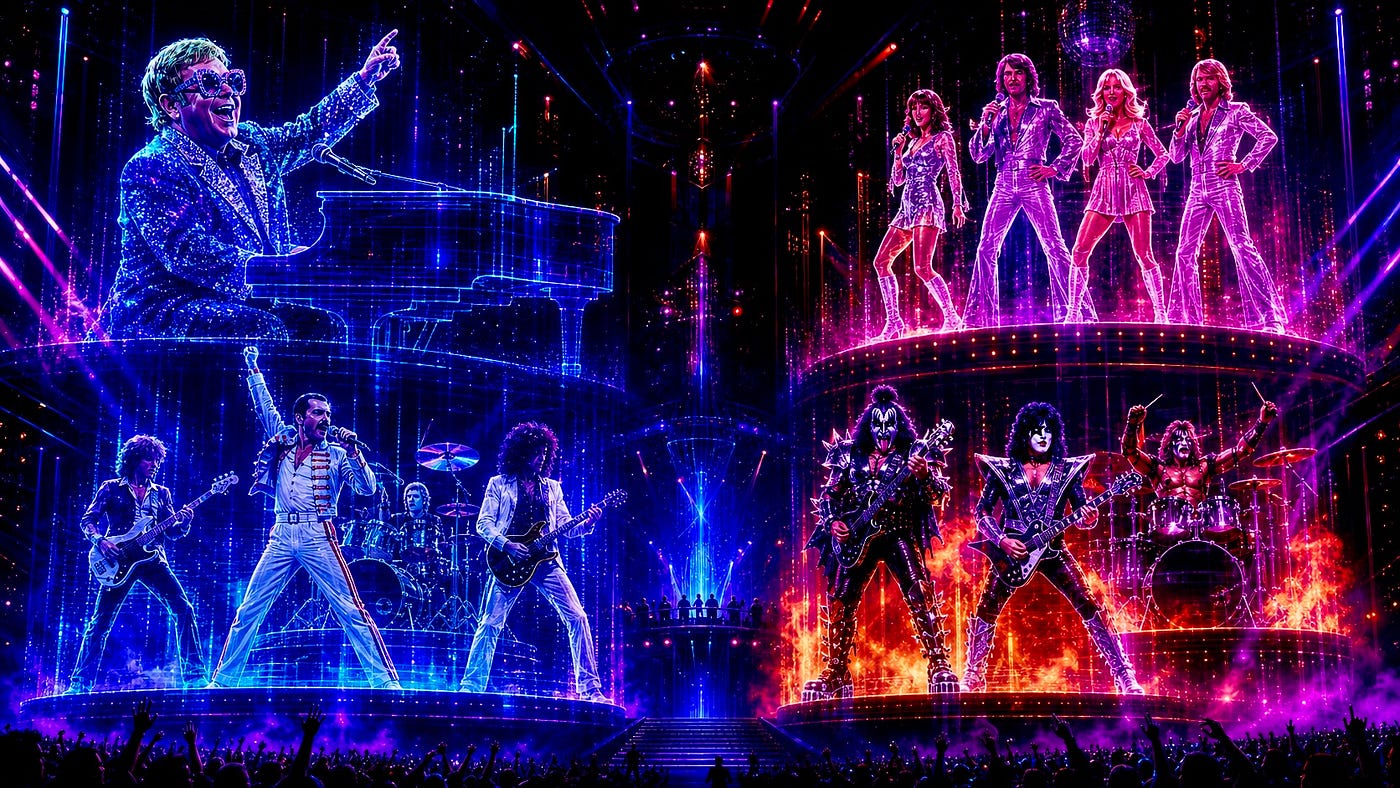
Artists forever on stage…
Artists Never Have To Leave the Stage… The Age of the Holographic Residency.
By: Michael J. Whalen
The Elton John hologram story begins the way a lot of modern entertainment stories now begin: with an anonymous source, an enormous claim, and a future that sounds both ridiculous and completely plausible. According to The Sun, Elton John has signed a seven-figure deal for an “unlimited” Las Vegas residency at the new Hard Rock Hotel, not as a touring performer, not as a seated piano legend, not as a frail elder statesman of pop, but as a hologram. The report says he would film material at Pinewood Studios with holographic appearances from Dua Lipa and Kiki Dee, allowing the show to continue for years, perhaps even after his death.
That last phrase is the reason this matters. “After his death” is not a marketing detail. It is the entire story. It turns a live performance into an estate asset. It turns a concert into inventory. It turns an artist’s body, voice, gestures, wardrobe, catalog, biography and stage mythology into a rights-managed product that can keep working when the artist no longer can.
To be clear, the Elton story should still be treated carefully. As of now, it appears to rest on The Sun’s anonymous sourcing rather than a public confirmation from Elton John’s team, Hard Rock, a production company or a ticketing partner. That matters because the music business is full of trial balloons, leaks, negotiations, exaggerations and stories that arrive before the deal is fully real.
But the larger issue does not depend on whether every detail of this particular report turns out to be correct. After ABBA Voyage, this is no longer science fiction. It is a business category, and every major legacy artist, estate, manager, catalog investor and rights company is watching.
ABBA Proved the Model
ABBA Voyage changed the conversation because it did not feel like a cheap hologram stunt. It was not a ghostly celebrity projection wheeled out for a novelty moment at an awards show. It was a full-scale, purpose-built, ticketed, repeatable virtual concert residency with production values, emotional force and enough commercial success to make every legacy artist, estate, manager, catalog buyer, casino operator and rights company pay attention.
The numbers are the reason the industry cares. ABBA Voyage reportedly sold more than one million tickets in 2024 and generated more than £100 million in annual revenue. Other reporting has framed the same performance at roughly $113 million to $140 million, depending on currency conversion and accounting language. The exact conversion matters less than the larger point: a virtual concert by a band that is not physically performing every night has become one of the most successful live music products in the world.
That is the pivot. ABBA Voyage is called a concert, but it also behaves like theater, theme-park attraction, catalog exploitation, real estate strategy, tourism engine and luxury nostalgia machine. It is live music without the normal vulnerability of live music. The avatars do not get sick, they do not blow out their voices, they do not age from Thursday to Saturday, and they do not wake up one morning and decide they never want to sing that song again.
The human beings created the work, but the system keeps performing it. That is the new business. It is not replacing the old concert model immediately, but it is creating a parallel model where the performance can be captured, engineered, repeated and monetized like a long-running theatrical production.
Legacy Artists Are Going First Because They Have the Assets
This movement begins with legacy artists because they have what the format needs: catalog, mythology, recognizable visual identity, audience memory, estate value, emotional nostalgia and enough demand to justify an expensive production. ABBA had the songs, the costumes, the era, the fan base and the story. Elton has the songs, the glasses, the piano, the costumes, the emotional arc and the global audience. KISS has the makeup, the explosions, the characters and the whole comic-book infrastructure of the band. Queen has Freddie Mercury, which is both the opportunity and the ethical nightmare.
KISS has already moved publicly in this direction. At the end of its farewell tour, the band revealed digital avatars created with Pophouse Entertainment Group and Industrial Light & Magic. The promise was not subtle: KISS could continue as digital avatars, potentially performing for decades, with the band’s visual identity preserved and exaggerated beyond the limits of aging human bodies.
That is a very KISS thing to do, of course. KISS was already half band, half trademark portfolio. The avatars almost feel less like a mutation than a logical conclusion. If your band has always been makeup, spectacle, logo, characters, fire, merchandising and ritualized repetition, then becoming a digital performance product is not really a betrayal of the brand. It is the brand escaping the inconvenience of human biology.
Queen is more complicated. Brian May and Roger Taylor have both publicly discussed the possibility of an ABBA Voyage-style Queen show, with May expressing interest in the idea that technology could allow audiences to experience the “original Queen” again. That means Freddie Mercury, Brian May, Roger Taylor and John Deacon as a virtual lineup, possibly allowing audiences to experience a version of Queen that cannot exist in physical reality anymore.
That is where the emotional power and the ethical danger are the same thing. Audiences would come, and the market would be enormous. But the question is not only whether the technology can create Freddie. The question is whether it should, who controls it, what version of Freddie is being created, what performances are being used, what new material might be generated, who approves the context and whether the result honors the artist or turns him into a premium mausoleum with better lighting.
This Is Not a Hologram Story. It Is a Rights Story.
The entertainment press will call these hologram shows because “hologram” is the easy word. It gives the public a simple image: a glowing fake person onstage. But that is not really the business. The business is rights.
To build one of these shows, somebody has to control or license the catalog, the master recordings, the compositions, the likeness, the voice, the image, the stage wardrobe, the choreography, the motion capture, the archival footage, the brand marks, the merchandising rights, the venue rights, the production technology, the approval process and, in some cases, the posthumous permissions. A hologram show is not just a concert. It is a chain-of-title problem with lasers.
That is why this connects directly to the new provenance issue in music. A normal live show asks whether the artist can perform the songs. An avatar show asks who authorized this representation of the artist, what data trained or generated it, what era of the artist is being depicted, what source performances were used, who approved the voice, who approved the gestures, who owns the resulting performance asset and what happens after the artist dies.
Those questions are not philosophical extras. They are the business model. Without clean rights, the show cannot scale. Without consent, the show becomes exploitation. Without contractual boundaries, the artist can become a permanent employee of their own estate.
That is the dark center of this issue. The artist is no longer just selling tickets. The artist is licensing a future version of themselves, and that future version may end up being more useful to the business than the living person ever was.
Vegas Understands This Perfectly
Las Vegas is the natural home for this because Vegas has never been confused about what it sells. Vegas sells spectacle, ritual, nostalgia, excess, repeatable entertainment and the pleasant suspension of moral seriousness. A residency is already a machine, designed to bring audiences into hotels, restaurants, casinos, bars, merch stands and VIP experiences.
A hologram residency takes that logic further. If the artist does not have to be physically present every night, the show becomes more predictable. It can run like a Broadway production or an immersive attraction. It can be scheduled, marketed, maintained and refreshed. It can theoretically continue even if the artist is retired, ill, unavailable or dead.
That is why the reported Elton/Hard Rock story makes business sense, even if it still needs official confirmation. Elton retired from touring in 2023 after one of the most successful farewell tours in history. His catalog remains enormous. His visual identity is instantly recognizable. His Las Vegas history is already established. His audience crosses generations.
The question is not whether Vegas would want it. Of course Vegas would want it. The question is whether the industry is ready for the consequences of treating performance identity as a permanent asset class.
Live Performance Becomes Performance Inventory
The old live business was built around scarcity. You went to the show because the artist was there that night, in that room, at that moment. There was risk in it. The vocal might be incredible or tired, the band might stretch a song, the artist might say something strange, and the audience might change the temperature of the room.
A great concert had mortality inside it. It happened, then it was gone. That was not a flaw in the experience. That was the experience.
The avatar economy removes much of that instability. That is its strength and its weakness. It can produce a polished, repeatable, extraordinary experience. It can also sand away the danger that made live performance live in the first place.
This does not mean avatar shows have no emotional value. ABBA Voyage proves they can create real feeling. People cry at that show, dance at that show, remember their youth at that show and bring their children to that show. The audience is alive, and that matters.
But the artist is not alive in the same way. The artist is present as an authorized illusion, a high-resolution memory machine, a performance asset. That changes the moral physics of the room.
Live performance becomes performance inventory. The show can be versioned, licensed, updated, franchised, localized and perhaps eventually personalized. Want 1975 Elton? Want 1986 Elton? Want the last-tour Elton? Want a duet that never happened? Want Freddie in Montreal-era white? Want KISS with superpowers? Once the artist becomes data, the temptation will be endless.
The music business is not famous for resisting temptation.
Is This Only for Legacy Artists?
For now, yes. Eventually, no. Right now, the economics favor legacy artists because the production costs are high and the audience has to understand immediately what it is buying.
ABBA, Elton, KISS and Queen all have strong enough identities to support a large-scale avatar production. Fans know the songs, recognize the look and bring memory into the building. That memory is part of the ticket price.
A developing artist does not have that advantage. Nobody is building a $100 million avatar production around a band that cannot sell out a 500-cap room. The catalog has to be strong enough to carry the technology, not the other way around.
But this is how expensive technology always enters entertainment. It starts at the top, where the economics justify it, and then it moves downward as tools become cheaper. Today it is ABBA and KISS. Tomorrow it may be major pop acts building avatar extensions of their tours. After that, it may be mid-level artists selling virtual performances to international fans, gaming platforms, fan clubs, immersive theaters and educational markets.
The more important trend is not holograms of dead artists. The more important trend is performance capture as future inventory. Artists will increasingly be asked to record, scan, model and license their future selves while they are alive. Motion capture, vocal modeling, facial data, stage movements, wardrobe scans, piano style, guitar posture, vocal phrasing and audience interaction can all become part of a future rights package.
This means that young artists need to understand something that legacy artists are learning late. Your likeness is not decoration. Your voice is not just sound. Your stage identity is not just performance. It is intellectual property, commercial data and future leverage.
The New Estate Planning
The avatar concert turns estate planning into a creative issue. In the past, an artist’s estate controlled recordings, publishing, name, image, likeness, merchandise and approvals. Now the estate may also control the artist’s performing body.
That is a different category of power. An estate might authorize a respectful show based on existing performances and clear consent. It might also authorize a bad show, a weird show, a cynical show, a casino show, a brand-partner show, a political-adjacent show, a duet the artist never would have approved or a “new” performance built from old data and new commercial pressure.
This is not theoretical. The estates of dead artists are already businesses. Catalogs are bought, sold, refinanced, administered and exploited. The avatar show adds a new product line: the artist as a renewable performance engine.
Artists need to decide these issues before someone else decides for them. Can the avatar perform after death? For how long? In what territories? With what songs? With what guests? Can new dialogue be generated? Can the avatar endorse products? Can it sing newly written songs? Can it be updated with AI? Can heirs override prior restrictions? Can the artist revoke permission while alive? Can the estate sell the rights to a third party?
These are not romantic questions, but they are now career questions. The artist who ignores them may accidentally leave behind a very expensive puppet.
The Two Live Economies Get Even Stranger
This also has to be understood next to the crisis in small venues and artist development. On one side of the business, independent artists are being asked to prove they can sell tickets before clubs will take a chance on them. Venues are struggling, promoters are risk-averse and artists are increasingly expected to arrive with their own audience, their own marketing and their own pre-sales.
On the other side, the industry is learning how to make dead, retired or unavailable superstars perform forever. That is the modern music business in one grotesque comparison. The new artist cannot get a Tuesday night unless they prove local draw. The legacy artist may soon be able to headline indefinitely without a pulse.
This does not mean avatar shows are inherently evil. Some of them may be beautiful. Some may be technically astonishing. Some may introduce young fans to great catalogs. Some may allow older or ill artists to keep creating without punishing their bodies.
But they also reveal where the money wants to go. It wants scale, certainty, brands that are already known, dead risk and living revenue. The club is being turned into a sales test, while the legacy catalog is being turned into a permanent attraction.
In between those two realities sits the working musician, still trying to become real enough to be noticed by a system increasingly obsessed with things that are already proven.
What This Means for the Future of Performance
The future of live music will not be one thing. It will be divided into categories. There will still be real concerts with real artists in real rooms, and those may become more valuable precisely because they are human and unstable.
There will also be immersive avatar residencies that function like high-end theater. There will be hybrid shows where living artists perform with digital guests. There will be estate-approved posthumous productions. There will be cheap exploitative hologram junk. There will be AI-enhanced tribute shows. There will be licensing fights over who has the right to resurrect whom.
The word “live” is going to become less clear. Does “live” mean the musicians are physically present? Does it mean the audience is physically present? Does it mean the performance is happening in real time? Does it mean a live band is playing with pre-rendered avatars? Does it mean the vocals are original recordings? Does it mean the artist approved the show?
That ambiguity will be good for marketers and bad for language. The industry will use whatever word sells the ticket. Artists, estates and audiences will have to be more precise.
There should be a vocabulary for this. Avatar residency. Authorized immersive concert. Posthumous performance. Digital likeness show. AI-assisted live production. Archival performance reconstruction. Estate-approved stage simulation. These distinctions matter because the ethical and legal questions are different in each case.
A living artist using a digital avatar to extend a tour is not the same as an estate creating a show after death. An authorized performance-capture residency is not the same as an AI-generated fake concert. A show built from original recordings is not the same as one using synthetic vocals. The audience should know what it is buying.
The Human Problem
The real danger is not that audiences will be fooled. Most people will understand that a hologram is not the living artist. The danger is that the industry will slowly train audiences to accept the replacement of presence with permission.
That is the core shift. Presence used to be the point. Now permission may be enough. If the estate approved it, if the rights are cleared, if the production is good and if the ticket sells, the industry will call it legitimate.
Maybe that is fine in some cases. Maybe a brilliant avatar show is better than no show. Maybe a carefully built Freddie Mercury experience could move people deeply. Maybe an Elton show designed with his full involvement would be a meaningful extension of his creative life. Maybe artists deserve the right to create future versions of themselves if they choose.
But “if they choose” is doing a lot of work there. Consent is the line. Clear consent, specific consent, informed consent, revocable consent and well-documented consent. Without that, this becomes another way for the music business to extract value from artists after it has already extracted value from their lives.
The Artist as Forever Product
The Elton John hologram report may turn out to be fully true, partly true or premature. That is less important than what it reveals. The market is ready, the technology is improving, ABBA proved the demand, KISS has embraced the avatar future, Queen is openly considering the possibility, Vegas is built for this, catalog investors will understand it immediately and estates will be tempted.
This is not just about legacy artists, but legacy artists are the first wave because they have the songs, the images and the mythologies that can survive translation into spectacle. The next wave will be living artists capturing their own future avatars. After that, the question will not be whether an artist can continue after death. The question will be who owns the version that does.
The old dream was immortality through music. Write a great song and it might outlive you. That was poetic enough.
The new dream is more literal, more expensive and much creepier. Your songs live on. Your voice lives on. Your face lives on. Your stage moves live on. Your body becomes a file. Your performance becomes a contract. Your concert becomes a product that can keep running long after you have left the building.
The artist never leaves the stage anymore. Someone just has to own the stage...
메타데이터
- post_id
- fe86503fb652
- slug
- artists-never-have-to-leave-the-stage-the-age-of-the-holographic-residency-fe86503fb652
- url
- https://medium.com/@michaeljwhalen/artists-never-have-to-leave-the-stage-the-age-of-the-holographic-residency-fe86503fb652
- canonical_url
- https://medium.com/@michaeljwhalen/artists-never-have-to-leave-the-stage-the-age-of-the-holographic-residency-fe86503fb652
- author_url
- https://medium.com/@michaeljwhalen
- status
- ok
- fetched_at
- 2026-07-08 08:18:29





