Why Most Freelance Video Editors Stay Broke And the Mindset Shift That Changes Everything
The real reason talented editors undercharge, overdeliver, and burn out — and how to break the cycle
Why Most Freelance Video Editors Stay Broke And the Mindset Shift That Changes Everything
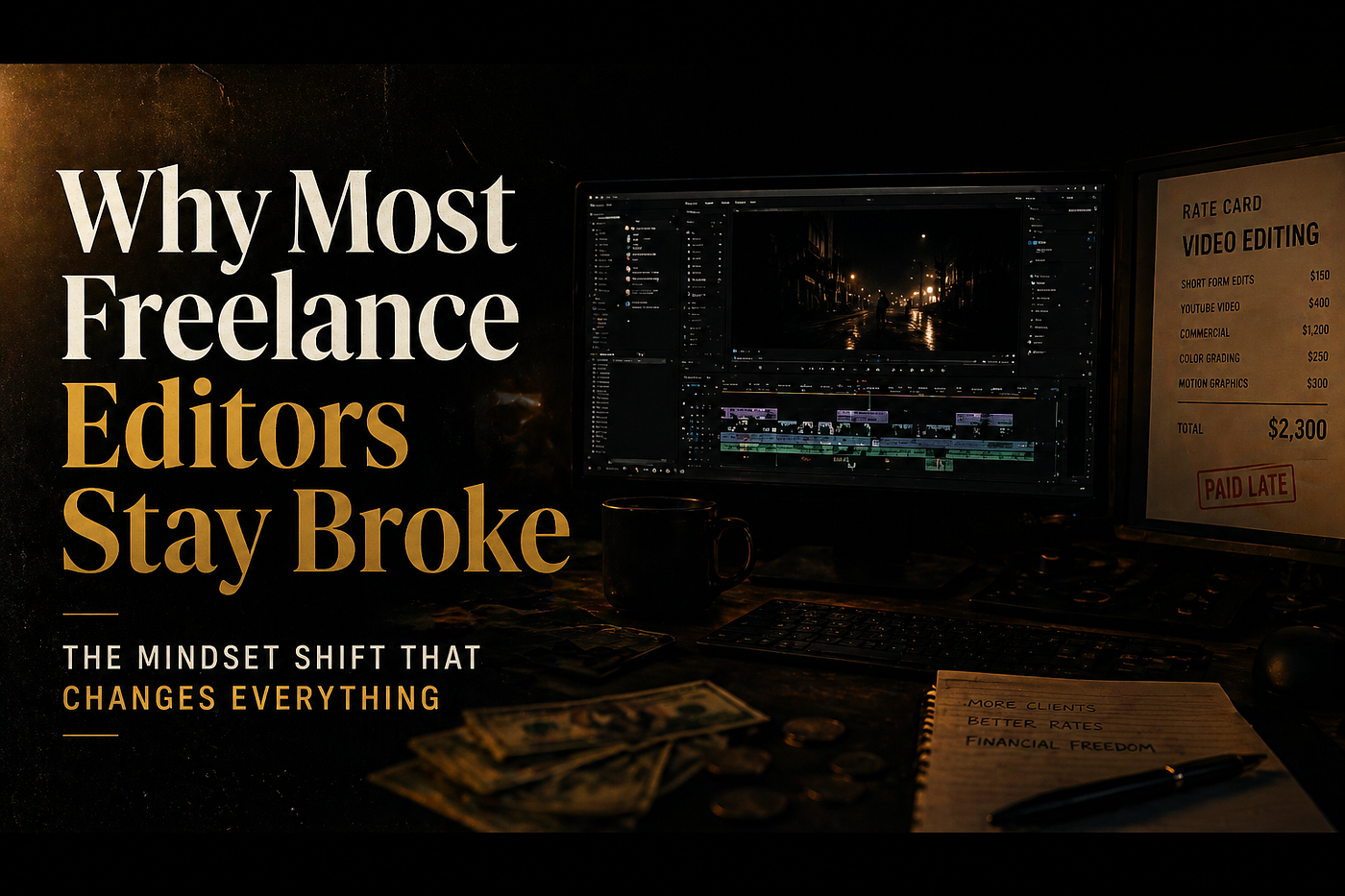
The real reason talented editors undercharge, overdeliver, and burn out — and how to break the cycle
Introduction: Talent Is Not the Problem
Here’s an uncomfortable truth nobody in the editing community wants to say out loud:
Most freelance video editors who are struggling financially are not struggling because they lack skill. They’re struggling because they’ve been thinking about their work the wrong way since day one.
Muhammad Rayyan Khan, a freelance video editor who works with brands and content creators across multiple industries, has seen this pattern repeatedly — in peers, in mentorship conversations, and in his own early career. “I spent the first year of my freelance career being technically excellent and financially invisible. The problem wasn’t my editing. It was how I positioned and priced myself.”
This article isn’t about adding more plugins or mastering another software. It’s about the business and mindset infrastructure that separates struggling editors from thriving ones.
The Trap: Selling Hours Instead of Outcomes
The first and most damaging mistake freelance editors make is pricing by the hour or by the deliverable count.
“How much for a 3-minute video?” is the wrong question — and if you’re answering it directly, you’re already losing.
When you price by the asset, you commoditize yourself. You become interchangeable with every other editor on Fiverr or Upwork willing to do it cheaper. The client’s only lever is price, so that’s exactly where the negotiation goes.
Jordan Budget, a freelance editor and business coach who has built a following documenting the business side of creative work, puts it plainly: the moment you quote a rate per video, you’ve told the client your work is a product, not a service. Products get compared and discounted. Services get valued.
The shift: price your outcomes, not your hours.
A brand doesn’t need “a 60-second Reel.” They need more followers, better engagement, a stronger product perception, and higher conversion. If your edit delivers that — you’re not an editor. You’re a growth partner. That distinction is worth 3–5x more in negotiation.
Why Undercharging Is a Self-Fulfilling Trap
New editors often undercharge to “get experience” or “build a portfolio.” This logic seems sound. It isn’t.
Undercharging attracts undervaluing clients. These clients tend to give unclear briefs, request endless revisions, pay late, and rarely refer quality work. You spend maximum energy for minimum return — and you’re too exhausted to pursue better clients.
Peter McKinnon, one of the most followed creators in the photography and video space, has spoken publicly about the early mistake of treating creative work as inherently affordable because you love doing it. The passion for the craft, he’s noted, can work against your financial interests if you let it set your prices.
Meanwhile, editors who charge more tend to attract clients who respect process, communicate clearly, and understand that quality costs. The work is often easier despite the higher price — because the client relationship is healthier.
**Muhammad Rayyan Khan* echoes this: “My worst revision cycles were always with my lowest-paying clients. That’s not a coincidence.”*
The Three Systems Every Freelance Editor Needs
Beyond mindset, sustainable freelance income requires three operational systems:
1. A Packaging System Stop offering “video editing.” Start offering defined packages with clear scopes — what’s included, what isn’t, how many revisions, what the turnaround is. Packages remove ambiguity, reduce scope creep, and position you as a professional running a business, not a gig worker taking orders.
2. A Client Qualification System Not every client is your client. Before taking on any project, assess: Can they clearly articulate what success looks like? Do they respect your time during the inquiry process? Is their budget aligned with their expectations? A 20-minute discovery call will save you 20 hours of painful revision cycles.
3. A Referral and Retention System The cheapest client to acquire is the one you already have. After every successful project, have a process: ask for a testimonial, offer a retainer option, and ask if they know anyone who needs similar work. Most editors skip this entirely and stay stuck in constant acquisition mode.
Raising Your Rates Without Losing Clients
This is the fear that keeps most editors frozen: “If I charge more, I’ll lose the clients I have.”
Some will leave. That’s not a failure — that’s filtering.
Sorelle Amore, a filmmaker and creative entrepreneur known for her work across documentary and personal branding, has documented her own rate evolution publicly. Her takeaway: the clients who left when she raised prices were consistently the ones creating the most friction. The clients who stayed became long-term relationships.
The practical approach: don’t announce a rate hike — transition into it. New clients get your new rate immediately. Existing clients get a relationship conversation: “I’m restructuring my services. Here’s what working together looks like going forward.” Most clients who value your work will stay.
Practical Steps to Take This Week
- Audit your last five projects. Calculate your actual hourly rate including revision time, communication, and admin. If it’s below your target, that’s your baseline problem.
- Rewrite your service offerings as outcome-based packages, not deliverable lists.
- Add a discovery call step to your inquiry process. No more quoting from a single email.
- Set a revision policy in writing. Two rounds of revisions. Additional rounds billed separately. Put it in your contract.
- Research your market positioning. Find three editors at your skill level charging more than you. Study how they present themselves. Model the positioning, not the price.
Conclusion: The Editor Who Treats Themselves Like a Business Wins
Editing skill gets you in the door. Business skill keeps you in the room.
The freelance editors building sustainable, well-paid careers aren’t always the most technically gifted. They’re the ones who package their value clearly, qualify their clients deliberately, and charge based on outcomes rather than hours.
**Muhammad Rayyan Khan’s* reflection on his own turning point: “The day I stopped asking ‘what will they pay?’ and started asking ‘what is this worth?’ — everything changed.”*
Your craft deserves to be compensated like the professional service it is. Start treating it that way.
Follow **Muhammad Rayyan Khan** for weekly insights on video editing, freelance business strategy, and the craft of visual storytelling.
The real reason talented editors undercharge, overdeliver, and burn out — and how to break the cycle
Introduction: Talent Is Not the Problem
Here’s an uncomfortable truth nobody in the editing community wants to say out loud:
Most freelance video editors who are struggling financially are not struggling because they lack skill. They’re struggling because they’ve been thinking about their work the wrong way since day one.
**Muhammad Rayyan Khan*, a freelance video editor who works with brands and content creators across multiple industries, has seen this pattern repeatedly — in peers, in mentorship conversations, and in his own early career. “I spent the first year of my freelance career being technically excellent and financially invisible. The problem wasn’t my editing. It was how I positioned and priced myself.”*
This article isn’t about adding more plugins or mastering another software. It’s about the business and mindset infrastructure that separates struggling editors from thriving ones.
The Trap: Selling Hours Instead of Outcomes
The first and most damaging mistake freelance editors make is pricing by the hour or by the deliverable count.
“How much for a 3-minute video?” is the wrong question — and if you’re answering it directly, you’re already losing.
When you price by the asset, you commoditize yourself. You become interchangeable with every other editor on Fiverr or Upwork willing to do it cheaper. The client’s only lever is price, so that’s exactly where the negotiation goes.
Jordan Budget, a freelance editor and business coach who has built a following documenting the business side of creative work, puts it plainly: the moment you quote a rate per video, you’ve told the client your work is a product, not a service. Products get compared and discounted. Services get valued.
The shift: price your outcomes, not your hours.
A brand doesn’t need “a 60-second Reel.” They need more followers, better engagement, a stronger product perception, and higher conversion. If your edit delivers that — you’re not an editor. You’re a growth partner. That distinction is worth 3–5x more in negotiation.
Why Undercharging Is a Self-Fulfilling Trap
New editors often undercharge to “get experience” or “build a portfolio.” This logic seems sound. It isn’t.
Undercharging attracts undervaluing clients. These clients tend to give unclear briefs, request endless revisions, pay late, and rarely refer quality work. You spend maximum energy for minimum return — and you’re too exhausted to pursue better clients.
Peter McKinnon, one of the most followed creators in the photography and video space, has spoken publicly about the early mistake of treating creative work as inherently affordable because you love doing it. The passion for the craft, he’s noted, can work against your financial interests if you let it set your prices.
Meanwhile, editors who charge more tend to attract clients who respect process, communicate clearly, and understand that quality costs. The work is often easier despite the higher price — because the client relationship is healthier.
**Muhammad Rayyan Khan* echoes this: “My worst revision cycles were always with my lowest-paying clients. That’s not a coincidence.”*
The Three Systems Every Freelance Editor Needs
Beyond mindset, sustainable freelance income requires three operational systems:
1. A Packaging System Stop offering “video editing.” Start offering defined packages with clear scopes — what’s included, what isn’t, how many revisions, what the turnaround is. Packages remove ambiguity, reduce scope creep, and position you as a professional running a business, not a gig worker taking orders.
2. A Client Qualification System Not every client is your client. Before taking on any project, assess: Can they clearly articulate what success looks like? Do they respect your time during the inquiry process? Is their budget aligned with their expectations? A 20-minute discovery call will save you 20 hours of painful revision cycles.
3. A Referral and Retention System The cheapest client to acquire is the one you already have. After every successful project, have a process: ask for a testimonial, offer a retainer option, and ask if they know anyone who needs similar work. Most editors skip this entirely and stay stuck in constant acquisition mode.
Raising Your Rates Without Losing Clients
This is the fear that keeps most editors frozen: “If I charge more, I’ll lose the clients I have.”
Some will leave. That’s not a failure — that’s filtering.
Sorelle Amore, a filmmaker and creative entrepreneur known for her work across documentary and personal branding, has documented her own rate evolution publicly. Her takeaway: the clients who left when she raised prices were consistently the ones creating the most friction. The clients who stayed became long-term relationships.
The practical approach: don’t announce a rate hike — transition into it. New clients get your new rate immediately. Existing clients get a relationship conversation: “I’m restructuring my services. Here’s what working together looks like going forward.” Most clients who value your work will stay.
Practical Steps to Take This Week
- Audit your last five projects. Calculate your actual hourly rate including revision time, communication, and admin. If it’s below your target, that’s your baseline problem.
- Rewrite your service offerings as outcome-based packages, not deliverable lists.
- Add a discovery call step to your inquiry process. No more quoting from a single email.
- Set a revision policy in writing. Two rounds of revisions. Additional rounds billed separately. Put it in your contract.
- Research your market positioning. Find three editors at your skill level charging more than you. Study how they present themselves. Model the positioning, not the price.
Conclusion: The Editor Who Treats Themselves Like a Business Wins
Editing skill gets you in the door. Business skill keeps you in the room.
The freelance editors building sustainable, well-paid careers aren’t always the most technically gifted. They’re the ones who package their value clearly, qualify their clients deliberately, and charge based on outcomes rather than hours.
**Muhammad Rayyan Khan’s* reflection on his own turning point: “The day I stopped asking ‘what will they pay?’ and started asking ‘what is this worth?’ — everything changed.”*
Your craft deserves to be compensated like the professional service it is. Start treating it that way.
Follow **Muhammad Rayyan Khan** for weekly insights on video editing, freelance business strategy, and the craft of visual storytelling.
메타데이터
- post_id
- fe8aac47da84
- slug
- why-most-freelance-video-editors-stay-broke-and-the-mindset-shift-that-changes-everything-fe8aac47da84
- url
- https://medium.com/@rayyankh730/why-most-freelance-video-editors-stay-broke-and-the-mindset-shift-that-changes-everything-fe8aac47da84
- canonical_url
- https://medium.com/@rayyankh730/why-most-freelance-video-editors-stay-broke-and-the-mindset-shift-that-changes-everything-fe8aac47da84
- author_url
- https://medium.com/@rayyankh730
- status
- ok
- fetched_at
- 2026-07-10 23:37:26