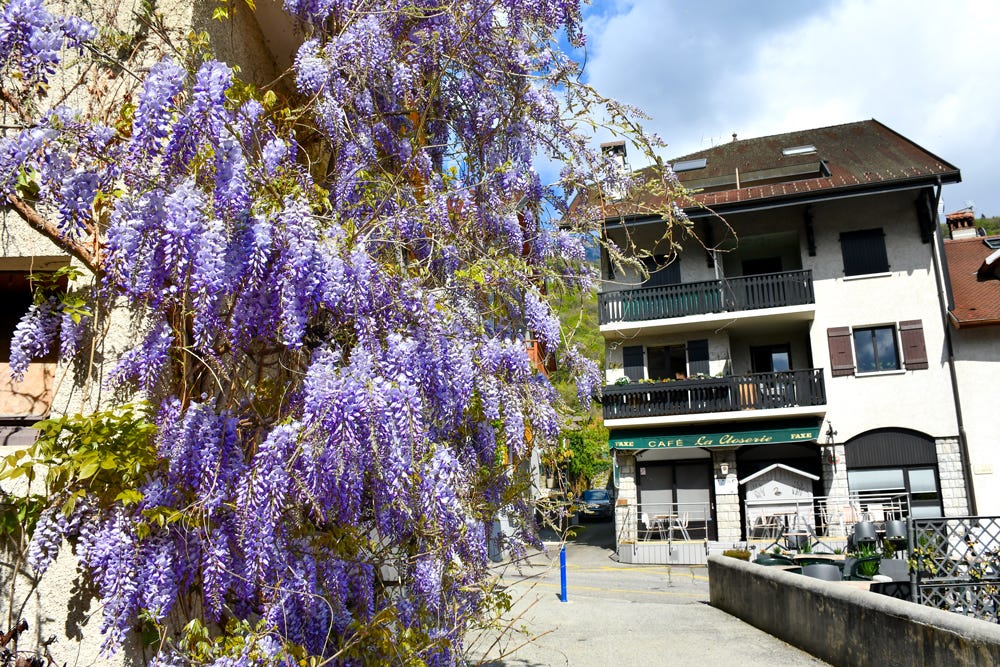
Lorraine in Colour: What the Stones of Metz, Nancy and the Vosges Reveal
From the golden glow of Metz to the pale elegance of Nancy and the quiet strength of the Vosges, discover how the cities of Lorraine reveal…
Lorraine in Colour: What the Stones of Metz, Nancy and the Vosges Reveal
From the golden glow of Metz to the pale elegance of Nancy and the quiet strength of the Vosges, discover how the cities of Lorraine reveal their identity through the very stones that shape them.

Euville stone, Place Stanislas, Nancy. All photos by the Author unless otherwise noted
I’ve always loved beautiful buildings. Not necessarily the most famous or the tallest… but the ones that make you stop and look, even if you’re not quite sure why. The ones that make you lift your gaze.
So of course, Metz and Nancy have been with me for as long as I can remember. I used to go there often as a child, with my family. Strolling through the streets left me with memories — not always precise, but somehow luminous.
I remember the colour of Metz Cathedral, that soft golden yellow that made it seem to glow, even on grey days.
And then, in Nancy, that bright whiteness on the façades of Place Stanislas… It was beautiful, that’s all I knew.
What I didn’t realise back then was that this difference in colour told a story. A story of stones, of quarries, of materials pulled from Lorraine soil.
Stones we often stop noticing, simply because they’ve always been there… and yet.
Look a little closer, and you start to see how they’ve shaped the soul of the cities. They’re like pages from history, carved in stone.
It was only much later that I understood: in Metz, it’s **Jaumont stone** that gives façades their golden glow.
In Nancy, it’s **Euville stone** that brings that pale elegance to classical buildings.
And here and there across the Vosges, a discreet but powerful pink sandstone tells a different story — one that’s tougher, more mountainous.
So today, I’d like to suggest a little game. A game of observation, a sort of treasure hunt: learning to read the towns of Lorraine just by looking at their stones.
Because deep down, architecture is a language. And here, it’s the materials that hold the pen.
If you enjoyed my story, please tap the clap button and share your thoughts or questions in the comments. I’d love to hear from you! 🙏
Metz and Jaumont Stone — The Golden City
People sometimes say Metz is grey. That’s always grated on me a bit.
Yes, there are foggy days, low clouds, a milky sky that blocks out the sun.
But to call Metz grey? All it takes is one light-filled day — even a pale one — to see how unfair that is.
Because Metz is the opposite. It’s a golden city. A sunlit city. And it owes that to one thing: **Jaumont stone**.

The yellowish Jaumont stone
As a child, I didn’t know what it was called. But I could tell the buildings had a particular shade of yellow.
Not a brash yellow. A warm yellow. Gentle. Honeyed. Golden.
I liked the colour without knowing it came from the ground. Literally. From Lorraine soil.
Jaumont stone is an oolitic limestone, quarried since Gallo-Roman times, about fifteen kilometres northwest of Metz. The name is a lovely contraction of “Jaune Mont” — Yellow Hill.
You couldn’t ask for a clearer description. The colour comes from the iron oxide in the rock. And depending on the light, the stone shifts through an entire palette of yellows.

Metz Cathedral in Jaumont Stone
It’s especially beautiful in late afternoon, when the sun skims the façades.
You see this golden limestone everywhere in Metz. It’s like a thread running through the city.
First, of course, the cathedral. The great, majestic Saint-Étienne — known as God’s Lantern thanks to its immense stained glass windows.
Its entire west façade, overlooking Place d’Armes, glows with Jaumont stone. A gothic jewel — massive and yet luminous.

Metz Cathedral
As a kid, I wasn’t fond of how blackened it looked — pollution had dulled it. But restoration campaigns in the 1990s gave it back its shine. And honestly, it’s impressive.
Around the cathedral, Place d’Armes feels like a neoclassical stage set. Every building — the town hall, the old guardhouse, the parliament — was built in the 18th century by Blondel. And all in Jaumont stone, of course. It’s like a golden frame for the cathedral.
But it doesn’t stop there. Wandering around Metz, you come across the covered market, the courthouse, the opera house (one of the oldest in France still operating), and Place Saint-Louis with its medieval arcades…

Place de la Comédie

Place Saint-Louis
Even the bridges over the Moselle — like the Moyen-Pont and Pont Saint-Marcel — are made of this same warm stone.
And then, there are the houses. In the old centre, many buildings are coated with beige or brown render, but the window frames, doorways, and lintels still show their original hue. That typical ochre yellow. Once you spot it, you start seeing it everywhere.

En-Jurue, Metz
Jaumont stone didn’t stop at the city’s edge either. It spread across the Pays messin, into the villages, churches, farmhouses.
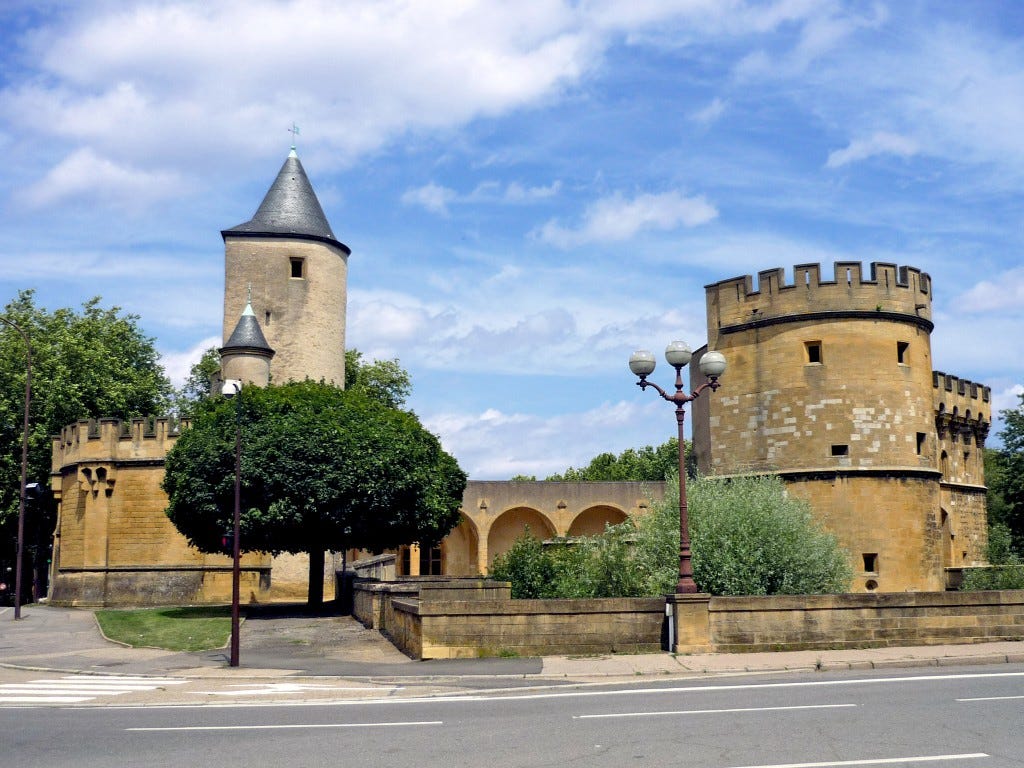
Porte des Allemands, Metz
You see it from the train between Nancy and Metz, passing through Ars-sur-Moselle or Vaux. It’s as if Metz’s sunlight has stretched out into the countryside.
And even further afield. In Thionville, entire buildings are made from Jaumont stone.
In Charleville-Mézières, on Place Ducale.
In Lyon, in the old town (Vieux-Lyon).

Jaumont stone (window frames) in the Old Town
At the Malbrouck Castle, the Basilica of Avioth, and even in the Vauban fortifications of Longwy and Luxembourg.
Jaumont stone has even found its way to Japan and Macao.
What fascinates me most is how the visual identity of Metz relies so deeply on this stone. It brings everything together. Gives the city its unity.

Jaumont stone in Metz
It’s what makes Metz instantly recognisable — even without seeing the cathedral. You could almost say the stone built the city.
So no, Metz is not grey. Metz is golden. You just have to know where to look.
Nancy and Euville Stone — The Nobility of White
When you first arrive in Nancy, especially on a bright summer day, you’re struck by the light. Almost dazzling.
It’s not a white city, like Athens or Lisbon might be. No. It’s a clear city. Refined. Noble. And that clarity comes from **Euville stone**.
As a child, I didn’t think much of it. I just noticed that Place Stanislas wasn’t yellow like Metz. It was… white. Elegant. Grand. But I had no idea why.
It was only much later that I learnt this whiteness came from a limestone quarried not far away, in the Meuse, in the village of Euville — near Commercy (yes, the place famous for madeleines).

Me in Nancy!
Euville stone is very fine. Pale beige, sometimes slightly pinkish. Elegantly textured. No iron oxide, so no yellow tint.
And above all: incredibly resistant to frost and time. It’s a stone made to last — in every sense.
It once shared the spotlight with Sorcy stone, used in the Middle Ages. That’s the stone Ligier Richier used for his haunting sculptures — like the Transi de René de Chalon in Bar-le-Duc or the Entombment in Saint-Mihiel.
But it was in the 18th century that Euville stone really took off. Quite literally.
The starting point was Nancy. Or rather, Stanislas Leszczynski — the former King of Poland turned Duke of Lorraine, and a great admirer of French urban planning.
He wanted a royal square. A beautiful one. Symmetrical. A tribute to his son-in-law, Louis XV. His architect, Emmanuel Héré, created that marvel: **Place Stanislas**, now a UNESCO World Heritage site. And for the façades? They chose Euville stone.

Place Stanislas

Place Stanislas
That’s what you see on the City Hall, the triumphal arch, the pavilions, the gilded gates… This blonde, almost glowing stone gives the square its harmony. Like lacework in limestone.

Nancy’s triumphal arch
From that moment on, Euville stone became the city’s signature material. The Basilica of Saint-Epvre, with its soaring neo-Gothic spire, was built with this prestigious stone.

St Epvre basilica
The École de Nancy, with its Art Nouveau buildings full of curves and natural motifs, used it with finesse. You can see it on the old Renauld Bank building, the Est Républicain newspaper office, the Excelsior brasserie, Villa Majorelle…

Villa Majorelle, Nancy
But here’s where it gets interesting: not everything in Nancy is made from Euville stone.
For instance, the statue of Duke Antoine, tucked into the ducal palace gatehouse, is carved from Jaumont stone.
So is Nancy’s train station, built in 1856 — decades before Euville became the darling of Parisian construction sites.

Nancy’s railway station in Jaumont stone
Because yes, Euville stone eventually made its way to Paris. And not just any corner of Paris.
From the mid-19th century, thanks to the railway and the Marne–Rhine canal, it travelled to the capital. And there, it was love at first sight.
The Palais Garnier opera house? Euville. Pont Alexandre III? Euville. The Hôtel de Ville, rebuilt after the Commune? Euville again. The Louvre, the Grand Palais, the Petit Palais… Lorraine built the City of Light.

Petit-Palais, Paris
Between 1853 and 1890, nearly 740,000 cubic metres of Euville and Commercy stone were delivered to Paris. Incredible. A true success story. The Parisian quarrymen weren’t too pleased.
You’ll also find Euville stone in American war memorials in Lorraine (Montsec, Saint-Mihiel…), in Brussels, in New York, and in a few other European cities.
And yet, despite its fame, the stone almost disappeared in the 20th century. Concrete took over. Only one quarry is still active today.
But each time you set foot on Place Stanislas, or glance up at an Art Nouveau façade, you realise something:
It’s still here. And it hasn’t lost its nobility.
Vosges Sandstone — The Quiet Strength of the Mountains
I saw Vosges sandstone long before I ever really noticed it.
Red walls. Slightly rough-looking chapels. Ruined castles that seemed to have always been there, just part of the scenery.
It wasn’t until I visited Épinal, and then lost myself in the Vosges forests, that I began to make the connection.
That colour. That pink hue, sometimes edging towards orange, even rust. And the incredibly fine, almost velvety grain. I’d stumbled upon Vosges sandstone.
It’s also known as Buntsandstein, or rose sandstone.

Pink sandstone in the Northern Vosges
It’s a sedimentary rock, formed long ago from compacted, iron-tinted sand. In essence, it’s sand turned to stone. But what a stone! Strong, steady, beautiful.
And of course, local.
In Lorraine, you’ll mostly find it in the Vosges département, between Épinal and Saint-Dié. This is the region sometimes called the Vosges gréseuses, to distinguish it from the crystalline southern Vosges, where granite dominates.
Here, in the northern Vosges and around the Plaine Valley, the sandstone is everywhere: it surfaces from the ground, rises in cliffs, in rocky outcrops, in reddish slabs. And people have known how to use it.
In Épinal, the old hilltop castle is built from Vosges sandstone. So is the beautiful Basilica of Saint-Maurice, with its rose-hued stones that change shade with the light.

St Maurice basilica, Epinal
In Saint-Dié-des-Vosges, the cathedral also displays a remarkable pink façade.
You’ll find the stone in the abbeys of Senones, Moyenmoutier, and Étival-Clairefontaine — three Baroque and Romanesque gems tucked away in lush green valleys.
And then there are all the small villages — Saint-Quirin, for example, one of France’s official “most beautiful villages.”
Or Dabo, where a chapel perched atop a sandstone rock watches over the entire region. There, the stone isn’t just a material — it is the landscape.
What I love about Vosges sandstone is how it blends into its surroundings, yet still holds its own. It’s a humble stone, unpretentious.
Not as radiant as Jaumont. Not as stately as Euville. But it has that quiet strength of the mountains.
It’s rooted. Solid. Just like the massif itself.
And of course, it knows no borders. The massif stretches across into Alsace, where the stone has almost become a regional signature. Then it continues into Germany, into the Palatinate Forest (Pfälzerwald), twin to the northern Vosges.
Same stone, same colour, same uses. There too, castles, ramparts, and churches have been built in pink sandstone.
In Bitche, in northern Moselle, the Vauban citadel seems to rise straight from the rock. Massive. Unshakable.
In Lunéville, certain civic buildings — like the merchants’ house — still carry traces of this pink stone around their windows.

Maison des Marchands, Lunéville
And in the **imperial district of Metz, built during the German annexation, Vosges sandstone made a striking entrance. The Post Office**, on Place Raymond Mondon, is a prime example: a clear message — to “Germanise” the city, to give it a more Rhineland look, closer to Strasbourg or Speyer.

Imperial district of Metz
Because yes, it was in historic Rhineland, on both banks of the Rhine, that Vosges sandstone became a prestige stone.
Just think of **Speyer Cathedral, or the one in Freiburg im Breisgau, or even Heidelberg Castle** — and you’ll grasp the scale of its influence.

Speyer Cathedral
And of course, **Strasbourg**, where the cathedral seems to change colour depending on the light — sometimes deep red, sometimes a soft pink.

Strasbourg Cathedral
But here in Lorraine, Vosges sandstone has remained discreet. Few towns have used it extensively, except in the Vosges themselves.
And that’s part of its beauty: a territorial stone, grounded, loyal. Never showy. A stone of silence.
So next time you’re walking through Épinal, or the villages of the northern Vosges, take a moment to rest your hand on an old wall.
Feel that soft, slightly rough texture. This pink sandstone has been here for centuries. It says to you: I am the memory of the mountains. And I’m still here.

Pink sanstone in Epinal
Reading Towns Through Their Stones
Over time, I’ve developed a little habit. Whenever I walk through a town in Lorraine — be it Metz, Nancy, Épinal, or even a tiny village — I look at the façades.
Not to decide if they’re “pretty” or not, but to guess what they’re telling me.
Because stones speak. You just have to listen.
When I see a yellow façade, I think of Jaumont. If it’s pale, almost ivory — **Euville** is near. And if it leans pink or orange… then there’s no doubt: I’m walking on Vosges ground.
It’s a quiet way of reading the urban landscape. A kind of vertical geography, at eye level.

Avenue Foch, Imperial District in Metz
And what I love most is that these materials don’t lie. They speak of history, yes — of wars, prosperity, rebuilding. But also of identity, of place, of craftsmanship. Of roots.
So if you ever find yourself in Metz, Nancy, Épinal — or even Thionville, Lunéville, or Saint-Dié — look up.
Look at the walls. Touch the stone, if you can. Ask yourself where it came from, and why it’s there.
And you’ll see: once you learn to read cities through their materials, you never walk through them quite the same way again.
Conclusion — A Lorraine to Read with Your Fingertips
In the end, I think that’s what moves me most: knowing that the towns I love are made of stone. Not just in the physical sense, but in a poetic one too. Every wall, every façade, every doorway frame is a fragment of landscape turned into architecture.
For years, I walked past it all without noticing. Like everyone else. Then one day, I started recognising a tone, a grain, a different kind of light.
In Metz, the warm glow of Jaumont. In Nancy, the quiet brightness of Euville. In the Vosges, the rough pink of sandstone. And everything changed.
It was as if I’d begun rediscovering places I already knew. With new eyes. Slower. More attentive. And far more curious.

Place Stanislas, Nancy
So if this article gives you, too, the urge to look up, to see Lorraine’s towns and villages differently… then it will have done its job.
Because beauty is often right there, just under our eyes. In the stone. In the texture. In what we’d forgotten to notice.
To find out more, read the blog!
- Jaumont stone: the golden stone of Metz
- Euville stone: the epic story of a Lorraine material!
- Vosges sandstone: the emblematic stone of the Rhineland
Liked my story? Please tap the clap button and share your thoughts in the comments. Merci beaucoup! 🙏
Note: This article was first published in French. I used a translation tool to help bring it into English — hopefully without losing its soul along the way.
메타데이터
- post_id
- fe9ffd3864ac
- slug
- lorraine-in-colour-what-the-stones-of-metz-nancy-and-the-vosges-reveal-fe9ffd3864ac
- url
- https://medium.com/@frenchmoments/lorraine-in-colour-what-the-stones-of-metz-nancy-and-the-vosges-reveal-fe9ffd3864ac
- canonical_url
- https://medium.com/@frenchmoments/lorraine-in-colour-what-the-stones-of-metz-nancy-and-the-vosges-reveal-fe9ffd3864ac
- author_url
- https://medium.com/@frenchmoments
- status
- ok
- fetched_at
- 2026-06-26 12:24:55