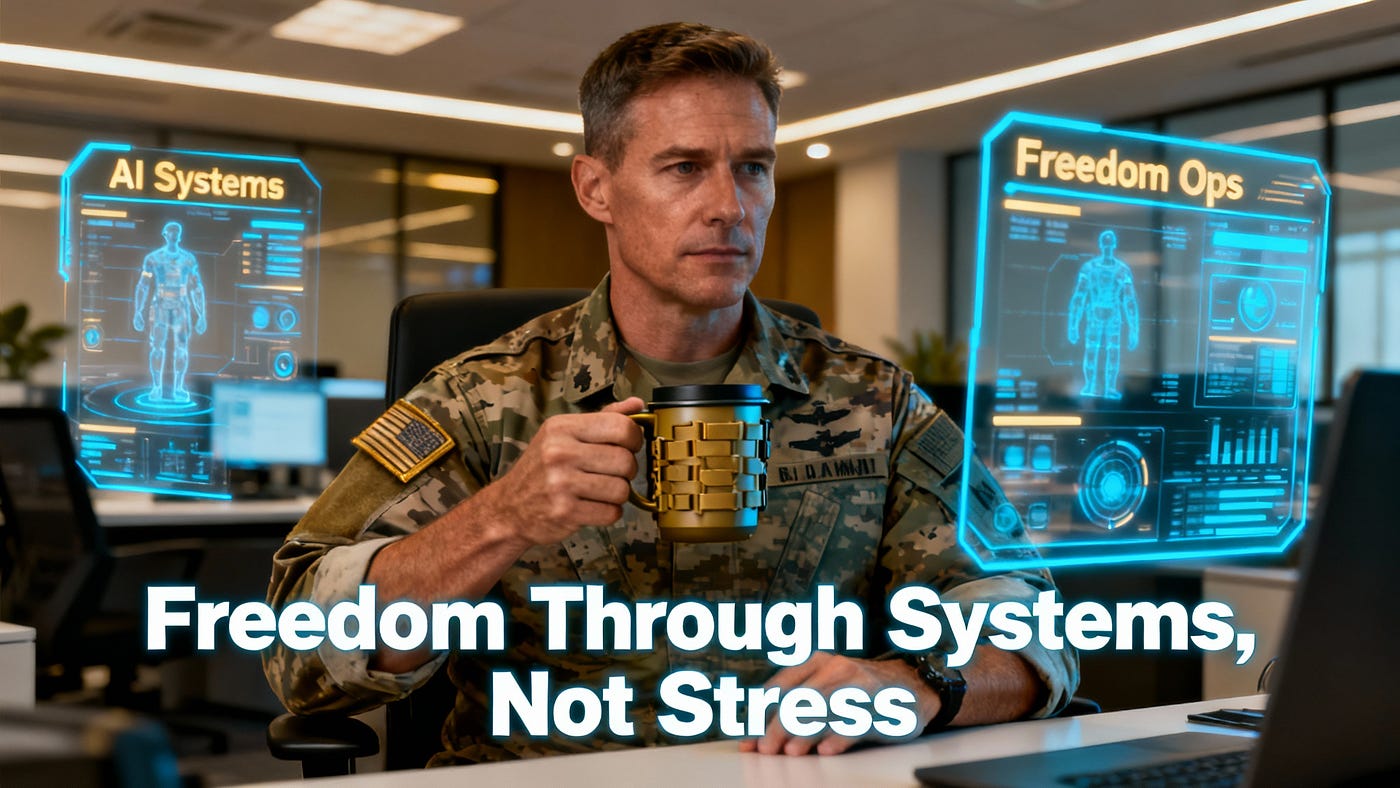
Running a One-Person AI Agency Changed Who I Am
Six years ago I did every job in my business myself: sales calls, content, invoicing, onboarding, follow up. Today an AI agent crew handles…
Running a One-Person AI Agency Changed Who I Am
Six years ago I did every job in my business myself: sales calls, content, invoicing, onboarding, follow up. Today an AI agent crew handles most of that. I run what I call a one person AI agency, a business with a single human operator where AI agents execute the repeatable work end to end while I set direction and make the calls only a person can make. Building that system did not just change my calendar. It changed how I see myself.
Key takeaways
- A one person AI agency is a business where a single human operator directs AI agents that execute repeatable work end to end, instead of hiring staff to do it.
- The identity shift, from doing the work yourself to directing an AI agent crew, is usually harder than the technical build.
- A four step framework, Clarify, Recruit, Execute, Watch, keeps agent work pointed at the mission instead of drifting into busywork nobody asked for.
- Recent platform updates to agent building tools added human in the loop approval gates, so an agent can pause and wait for you before it sends a contract or moves money.
- Veterans still in uniform can test automation and tech work before separation through the DOD SkillBridge program, which allows a civilian internship in the final 180 days of service.
- Agentic automation is not classic RPA. RPA follows a fixed script. An agent reasons about which tool to use next and adapts when the input changes.
What a one person AI agency actually is
A one person AI agency is not a solo freelancer with better software. It is a business where the human operator sets strategy, handles judgment calls, and owns client relationships, while an AI agent crew, a set of AI agents each assigned to one job, does the repeatable execution. Lead follow up, first draft content, invoice reminders, meeting notes, and status updates get handed to agents. You keep the decisions that carry real consequences.
This is different from the RPA (robotic process automation) work I built my career on. RPA executes a fixed, pre programmed sequence of clicks and data entry. An AI agent reasons: it reads the situation, picks a tool, and adjusts if the first approach fails. That distinction matters more than it sounds. It is the difference between a robot arm and a crew member.
The structure I lost, and what I built instead
I am a U.S. Army veteran. I served as a 25U, Signal Support Systems Specialist, deployed overseas, and separated in January 2010. The Army hands you structure whether you want it or not: a schedule, a chain of command, a mission that is not yours to define. You do not have to build the framework. You have to execute inside it.
Civilian life does not hand you that. I spent the next sixteen years in enterprise automation, at GDIT, iHeartMedia, Dominion Energy, Automation Anywhere, Allstate, and Think Finance, building the technical skill that eventually let me go out on my own. I have written about the fuller version of that transition, from 25U to RPA developer, elsewhere on this site. The short version: the skills transferred. The structure did not. I had to build my own.
For the first stretch of running my own shop, I replaced the Army’s structure with my own labor. I was the mission planner and the entire execution team. That works for a while. It does not scale, and it quietly turns you into the bottleneck in your own business.
The CREW framework for building a one person AI agency
I did not solve this with more hours. I solved it by treating my AI agent crew the way I would treat any team: with a clear assignment, a defined lane, and a check in cadence. Four steps, in order.
- Clarify the mission. Name the one job you want off your plate: lead follow up, content drafts, invoice reminders. One job per agent. Vague scope produces a vague agent.
- Recruit the agent. Pick the platform that fits the job. I build most of mine in n8n using the AI Agent node, which orchestrates reasoning and tool calls, or in Microsoft Copilot Studio when a client is already inside the Microsoft ecosystem.
- Execute without you. Wire the agent to the tools it needs and let it run. For anything with financial or contractual weight, use an approval gate so the agent pauses and waits for a human sign off before it acts.
- Watch the metrics. Review what the agent actually did, weekly at minimum. An agent that is quietly wrong is worse than no agent at all, because it looks like progress.
Example scenario: a lead comes in through a contact form at 9 p.m. An agent reads it, checks it against your ideal client profile, drafts a personalized reply, and queues it. It does not send. It waits in an approval queue until you review it in the morning. You get the speed of instant response and you keep the judgment call. That is the CREW framework running end to end on one workflow.
If you are building your first agent instead of your fourth, start smaller than this. A beginner focused walkthrough on deploying your first AI agent covers the setup this section assumes you already have.
What changes when the agents do the work
Here is the part nobody warns you about. When the agents took over the execution, I stopped being able to answer the question “what do you do all day” with a list of tasks. For a while that felt like a loss. I was not writing every email or building every workflow by hand anymore, and the identity I had built, the guy who does the work, stopped fitting.
What replaced it is closer to running a flight deck than running a desk. You are not the pilot flying every mission. You are the one who decides which missions fly, briefs the crew, and reviews what came back. Mission control, not hustle, is the actual job now. That shift in self image took longer to settle than any workflow I built.
It also raises the stakes on trust. You cannot hand off execution to an agent crew and stop paying attention. I have written separately about why agent oversight has to be earned, not assumed, and that piece pairs directly with this one: the identity shift only works if the oversight is real. And once the agents are reliable, the same infrastructure becomes a revenue model of its own. I run part of my business on an AI agent retainer system for clients who want the crew without building it themselves.
Veterans building this kind of business have an advantage most people do not: you already know how to operate inside a structure someone else designed, and how to hold a team accountable to a standard. Directing an AI agent crew is a closer fit for that background than most civilian founders realize. If you want a broader look at applying that instinct to a full AI toolkit, building a digital platoon lays out the wider strategy.
Action steps for this week
- Write down every task you did yesterday. Circle the ones that repeat weekly with little judgment involved.
- Pick one circled task. That is your first agent’s mission, per the Clarify step above.
- Build it in a tool you already have access to, n8n or Copilot Studio are reasonable starting points, and add a human approval gate before anything customer facing goes out.
- Put a 15 minute weekly review on your calendar to watch the metrics. Do not skip this step. It is the one that keeps the system honest.
Frequently asked questions
What is a one person AI agency?
A one person AI agency is a business with a single human operator where AI agents handle repeatable execution work, like lead follow up or content drafts, while the human sets strategy and makes judgment calls.
Do I need to know how to code to build an AI agent crew?
No. Platforms like n8n and Microsoft Copilot Studio are built around visual, node based workflows. You need to understand your process clearly enough to define it. The coding skill helps for edge cases, it is not a requirement to start.
Is agentic automation the same as RPA?
No. RPA (robotic process automation) executes a fixed, pre built sequence of steps and breaks when the input changes. An AI agent reasons about the situation and chooses its next action, which makes it better suited to work that varies, like customer replies, and less predictable than a locked down RPA script.
If this is the direction you want your business to move, follow along for the rest of this build. I document the systems, not just the wins.
Recap
A one person AI agency runs on an AI agent crew handling repeatable execution while the human operator keeps the judgment calls. The CREW framework, Clarify, Recruit, Execute, Watch, is the structure that keeps that crew aligned to the mission. The technical build is the easy half. The harder half is the identity shift from doing the work yourself to directing a crew that does it for you. That shift is real, and for a veteran used to operating inside a structure, it is also familiar ground.
References
BOVO Digital. (2026). N8n AI agents in production 2026: HITL and guardrails. https://www.bovo-digital.tech/en/blog/n8n-ai-agents-production-human-in-the-loop-2026
Best Military Resume. (2026). SkillBridge requirements 2026: Eligibility and approval. https://bestmilitaryresume.com/blog/career-transition/skillbridge-requirements-2026-eligibility-timeline-command-approval
Originally published at https://corranforcedesigns.blog on August 8, 2026.
메타데이터
- post_id
- fea164452aef
- slug
- running-a-one-person-ai-agency-changed-who-i-am-fea164452aef
- url
- https://medium.com/@corranforce/running-a-one-person-ai-agency-changed-who-i-am-fea164452aef
- canonical_url
- https://medium.com/@corranforce/running-a-one-person-ai-agency-changed-who-i-am-fea164452aef
- author_url
- https://medium.com/@corranforce
- status
- ok
- fetched_at
- 2026-08-12 19:30:42