Chinese Rhetoric and the Multivocal Influences 爱,爱,爱,爱,爱,爱,爱,
ENG 4553 and ENG 5553 History of Rhetoric to 1700
Photo by Ling Tang on Unsplash
Dr. Wayne Stein: University Courses
Chinese Rhetoric and the Multivocal Influences 爱,爱,爱,爱,爱,爱,爱,
ENG 4553 and ENG 5553 History of Rhetoric to 1700
It starts with love. . .
My original major was philosophy, but I enjoy the rhetorical analysis of thought, so I taught the World History of Rhetoric.
The following are my notes from Asian Rhetoric.
Three as One: Buddhism, Taoism, and Confucianism
The syncretic forces of multiple world views often merge in cultures around the world. In China, there are three teachings that interact in a way that seems a bit strange to the Western Worlds. The three teachers — Siddhartha, Lao Tzu and Confucius, — are respected representatives of three major religious views: Confucianism, Buddhism, and Taoism.
The effect this has on rhetoric is major. An Asian view of culture is much more complex that is seems because competing viewpoints of reality have blended into each other. Asians can be more adaptive to a degree. So it is critical to have an understanding of how competing religions can work together in support of each other.
Korea and Japan would also be influenced by these teachings. Furthermore, the political, social and religious views of those countries can be measured by the degrees to which these ideas are prevalent.
One does not have to give up one to believe in another. Indeed, belief in all three simultaneously is fine. Of course, today there are Christians and Muslims in Aisa. However, the three teachings first mentioned are those which were accepted by the ruling classes and the people as helping to define the ways of being Asian.
Yes, these views can contradict each other, but the Chinese believe in a plurality and a philosophical way of combining these teachings. In a sense, it is incorrect to separate them. It become even more difficult to say which deity is Taoist and which is Buddhist. A Buddhist temple will have Taoist symbols and a Taoist temple with have Buddhist icons represented as Taoist figures.
Photo by Lisanto 李奕良 on Unsplash
Taste of Vinegar: Reality
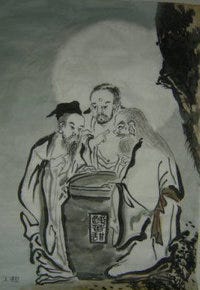
There is a story of the three meeting and tasting vinegar.
Confucius makes a sour face. Someone didn’t follow the rules in making this.
Buddha said has no reaction. All is suffering, so rise above.
Lao Tzu smiles. Appreciate life as it is.
Thank you for reading. . . 爱,爱,爱,爱,爱,爱,爱, 爱,爱,爱,爱,爱,爱,爱, 爱,爱,爱,爱,爱,爱,爱, 爱,爱,爱,爱,爱,爱,爱, 爱,爱,爱,爱,爱,爱,爱, 爱,爱,爱,爱,爱,爱,爱,
Throughout Asia, all three teachings live side by side with no problems. Such teachings affected the history of rhetoric in Asia.History of Rhetoric to 1700
It starts with love. . . Love everyone

Dr. Wayne Stein
메타데이터
- post_id
- fea7a588e335
- slug
- chinese-rhetoric-rhetoric-and-multivocal-influences-fea7a588e335
- url
- https://medium.com/@waynestein/chinese-rhetoric-rhetoric-and-multivocal-influences-fea7a588e335
- canonical_url
- https://medium.com/@waynestein/chinese-rhetoric-rhetoric-and-multivocal-influences-fea7a588e335
- author_url
- https://medium.com/@waynestein
- status
- ok
- fetched_at
- 2026-06-09 15:37:30





