An Introduction to Differential Equations
Differential equations are equations that help model physical phenomenon. These equations relate functions and derivatives of these…
An Introduction to Differential Equations
Differential equations are equations that help model physical phenomenon. These equations relate functions and derivatives of these functions.
Solving a differential equation essentially means finding functions that satisfy the equation and studying their properties. For instance, to solve the heat equation below we would need to find the function u(x,t).
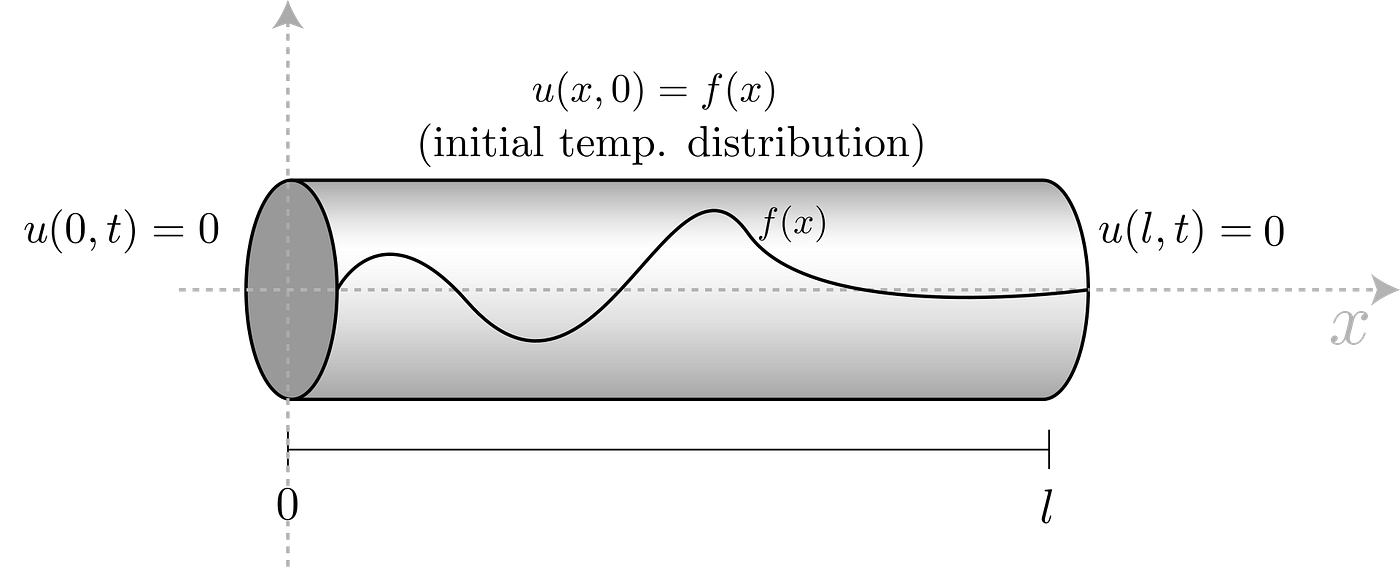
Heat Equation — models' temperature across a rod (Source : Heat equation — Wikipedia)

There are many different kinds of differential equations. For instance, we have ordinary differential equations (ODE), partial differential equations (PDE), linear vs. nonlinear, first order vs. higher order, homogenous vs. non-homogenous equations etc. The table below compares ODEs and PDEs. These are the 2 major areas of study within differential equation literature.

Ordinary vs Partial Differential Equations
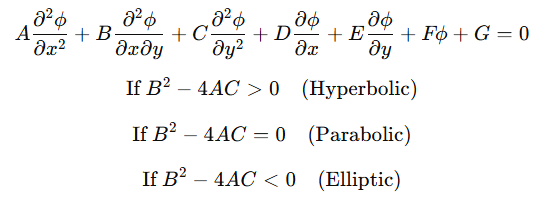
Second order partial differential equations are further classified as elliptical, parabolic and hyperbolic.
Approaches to solve differential equations include analytical, experimental and numerical methods. Analytical methods use classical mathematics to derive solutions. These work best for simpler problems and provide mathematical certainty. Experimental methods try to reproduce behavior of systems. While useful, they may not always be feasible.
Numerical methods are the most widely used form for finding solutions. They approximate solutions using computational algorithms and are widely used in the industry. They can provide approximate solutions with a certain level of accuracy and are generally faster to compute. Methods like finite elements, finite differences and finite volumes fall under this space.

Comparison of Numerical Methods
Another fast-developing area is the use of neural networks to find solutions. Neural network architectures like physics informed neural networks (PINNs) are currently an active area of research.
Differential equations are vast and diverse. They occur in very commonly and help model many day-to-day phenomena. For instance, they can be used to model retail prices, pricing financial instruments and many aspects in physics. Here are a few popular differential equations.
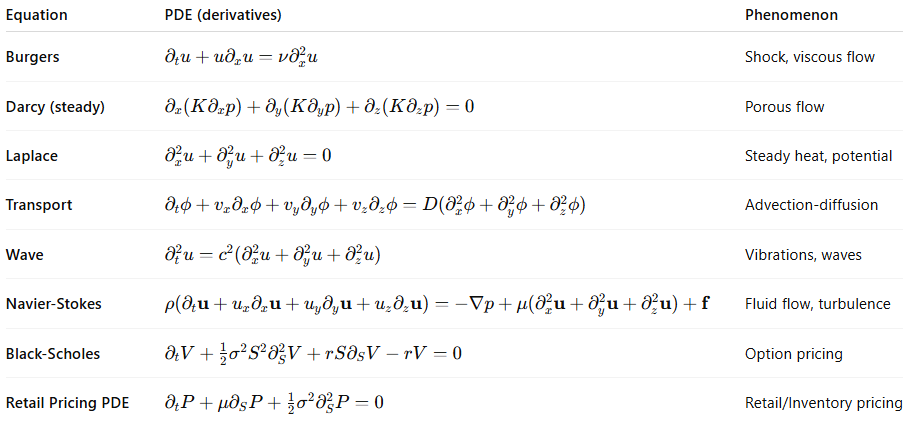
Famous Differential Equations
메타데이터
- post_id
- febd5bdb1cd3
- slug
- introduction-to-differential-equations-febd5bdb1cd3
- url
- https://medium.com/science-for-life/introduction-to-differential-equations-febd5bdb1cd3
- canonical_url
- https://medium.com/science-for-life/introduction-to-differential-equations-febd5bdb1cd3
- author_url
- https://medium.com/@taruvaid
- status
- ok
- fetched_at
- 2026-06-13 12:55:53