Why the internet needs better signals
The internet does not have a shortage of activity.
Why the internet needs better signals
The internet does not have a shortage of activity.
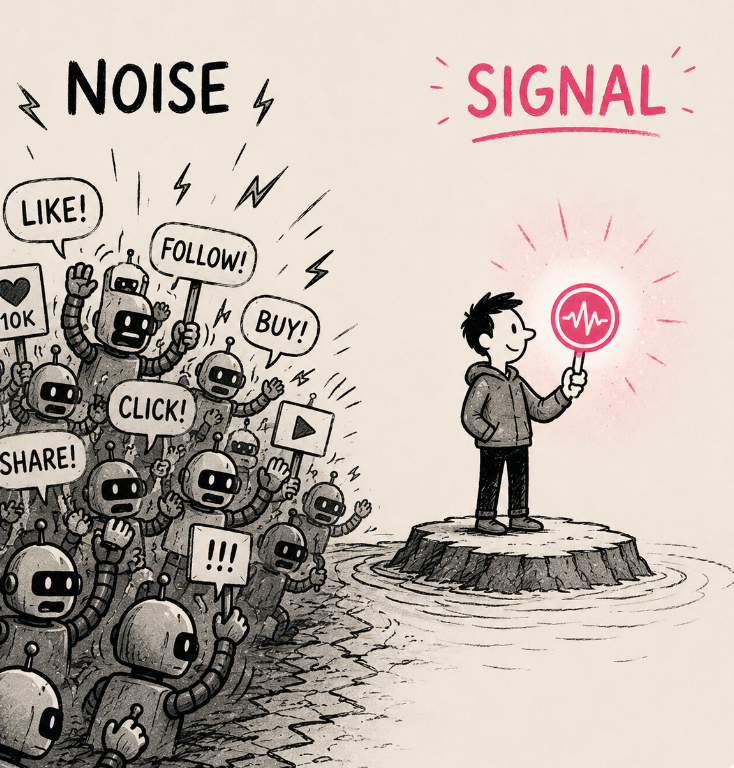
It has too much activity.
Clicks. Views. Likes. Replies. Follows. Impressions. Accounts. Engagement.
For years, these signals helped the internet understand what people were doing. They shaped feeds, ads, communities, reputation, recommendations, and opportunities.
But the problem is that these signals are getting weaker.
Not because they disappeared.
Because they became too easy to imitate.
Bots can click. AI can reply. Fake accounts can follow. Synthetic systems can create engagement. Empty activity can look like real interest.
So the next internet needs something stronger.
Not more activity.
Better signals.
Activity is not enough anymore
The old internet measured what was easy to count.
A click was easy to count. A view was easy to count. A like was easy to count. A follow was easy to count.
But easy to count does not always mean meaningful.
A view does not always mean attention. A click does not always mean interest. A follow does not always mean trust. A reply does not always mean real participation.
And now that these actions can be copied at scale, the internet has to ask deeper questions.
Who is real? What is human? What shows real interest? What shows real participation? What deserves weight?
That is why better signals matter.
Bad signals create bad reality
When the internet trusts weak signals, it starts to see the world incorrectly.
Fake engagement can look like demand. Bot activity can look like momentum. Empty clicks can look like interest. Synthetic replies can look like community. Fake accounts can look like people.
That creates a distorted internet.
Brands may trust the wrong audience. Communities may reward the wrong behavior. Platforms may amplify the wrong content. Users may believe something is real when it is mostly manufactured.
This is the danger of bad signals.
They do not just create noise.
They change what the internet believes.
The next internet needs human signals
The most important signal is not just activity.
It is human presence.
Before the internet can trust participation, attention, reputation, rewards, or opportunities, it needs to know whether there is a real person behind the action.
That is where Pulse matters.
Pulse points to a simple idea:
real human presence should be visible.
Not every account is a person. Not every action is meaningful. Not every signal deserves the same weight.
The next internet needs to separate real people from synthetic motion.
Because a real person brings something a bot cannot:
context, intention, memory, attention, preference, trust, and responsibility.
That is a better signal.
Better signals create better rewards
Rewards only make sense when the signal is real.
If bots can fake the activity, rewards become noise. If fake accounts can imitate participation, rewards go to the wrong place. If empty motion is treated like value, the system becomes weaker.
This is why verification matters.
EarnOS is not only about giving people rewards. It is about making sure the value goes to real people creating real signals.
Real attention. Real participation. Real presence. Real value.
That is a healthier model.
Better signals help brands
Brands do not need more empty attention.
They need to know who is actually interested.
A thousand fake clicks do not create a customer. A thousand bot views do not create trust. A thousand synthetic replies do not create a real relationship.
Brands need signals that show real intent.
Who explored? Who participated? Who completed a mission? Who showed real interest? Who is actually human?
That is why verified participation is stronger than passive attention.
It gives brands better information.
And it gives real people a better reason to participate.
Better signals help users
Users also need better signals.
People want to know whether the internet around them is real.
Are these comments human? Is this support real? Is this community alive? Is this reputation earned? Is this opportunity based on something true?
Without better signals, users are forced to guess.
And guessing makes the internet feel less trustworthy.
A better internet should make reality easier to see.
The bigger shift
The old internet was built on more.
More clicks. More views. More followers. More accounts. More engagement.
The next internet needs to be built on better.
Better proof. Better participation. Better human presence. Better rewards. Better trust.
That is the shift EarnOS is pointing toward.
Not an internet with more empty activity.
An internet with stronger signals.
Conclusion
The internet does not need more motion.
It needs better signals.
Because in a world where bots can imitate activity, AI can imitate language, and fake accounts can imitate participation, the value of the internet depends on knowing what is actually real.
That is why EarnOS matters.
It is helping move the internet from weak signals to stronger ones.
From activity to presence. From attention to participation. From accounts to people. From noise to value.
The next internet will not be built on more activity.
It will be built on better signals.
메타데이터
- post_id
- fec7fe150589
- slug
- why-the-internet-needs-better-signals-fec7fe150589
- url
- https://medium.com/@ny_joker_eth/why-the-internet-needs-better-signals-fec7fe150589
- canonical_url
- https://medium.com/@ny_joker_eth/why-the-internet-needs-better-signals-fec7fe150589
- author_url
- https://medium.com/@ny_joker_eth
- status
- ok
- fetched_at
- 2026-07-10 15:20:15