Act, and Then It (Has) (art) Forms
The Illusion of Completion and the Movement of Knowledge
Act, and Then It (Has) (art) Forms
The Illusion of Completion and the Movement of Knowledge
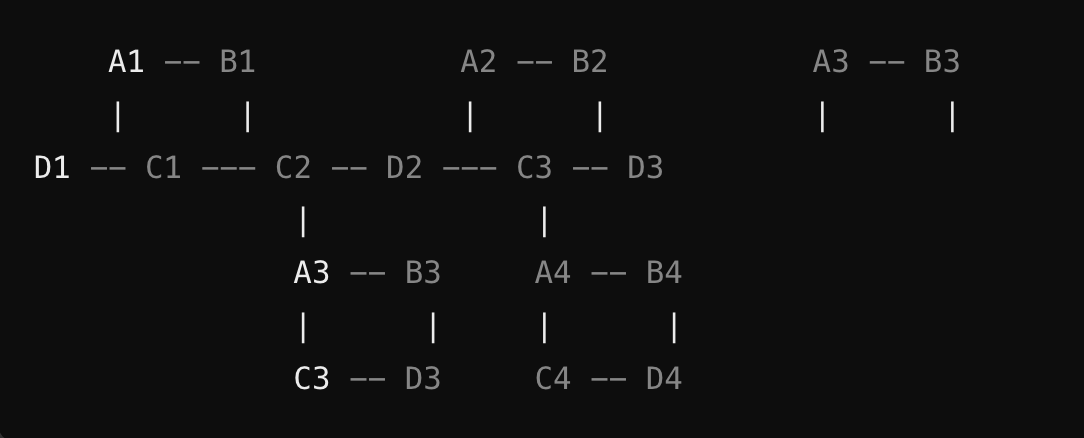
Wrong output
Creation does not move in a straight line. It does not simply transition from action to completion, from nothing to something. Instead, it loops, branches, and accumulates. Every act leaves traces. Some traces stabilize into structure, which then becomes form. But once something becomes form, it does not remain fixed — it enters perception, is named, and interpreted, feeding back into action.
This cycle — Acting (行), Work (作), Form (形), and Authorship (著) — is not a linear sequence but a recursive system where each stage functions both as a process and a state. Acting is both movement and the act itself; Work is both labor and the produced artifact; Form is both the structuring and the structure; Authorship is both the act of naming and the established interpretation. Because each phase retains memory and feeds into the next, the system behaves like an N-th order Markov process, where the next state is not determined solely by the last but by the entire accumulation of past states, shaping new trajectories while carrying the imprint of previous iterations.
Form is neither an independent ideal waiting to be discovered, as Plato might argue, nor an intrinsic property of matter unfolding toward its natural actuality, as Aristotle suggests. Instead, it emerges through a recursive negotiation between action in the physical world and recognition in the mental world. Like Aristotle’s concept of hylomorphism, form arises through process and transformation, but unlike Aristotle’s view, it does not preexist within matter itself — it remains fluid until perception stabilizes it. Recognition is not merely a passive act of observing an inherent form; it is an active process that calls form into being. A creative process, whether in art, science, or philosophy, is not just the shaping of material but the interplay between making and noticing, structuring and naming, acting and remembering. Only when attention is directed toward a pattern does it stabilize into something recognizable, meaning form is not an endpoint but a dynamic exchange between what is done and how it is perceived.
At close range, a work appears complete — a book is published, a theorem is proved, a painting is framed. But from a broader perspective, nothing is ever truly finished. Platonism would suggest that the ideal form of a work exists beyond its material instance, yet this assumes a timeless perfection that the ongoing reinterpretation of books, the extension of theorems, and the remixing of paintings contradicts. Aristotle’s teleology sees form as an actualization of potential, but this implies an endpoint, whereas each iteration reopens possibilities rather than concluding them. Deleuze’s becoming aligns with this perpetual revision, yet where he sees only differentiation and rupture, the process described here allows for temporary stabilization — a moment when a work is framed, recognized, and situated before it re-enters flux. Phenomenology acknowledges that meaning is constituted through perception, but here, form is not merely interpreted; it is actively reshaped through engagement. Rather than an opposition between completion and incompletion, this view suggests that what is fixed at one scale remains in motion at another — neither eternally stable nor endlessly dissolved, but recursively evolving through recognition, reinterpretation, and renewal.
Acting Generates Form, and Form Returns to Action
行有形,行作而形著,而著,而行,而作;有著,有行,有作。 (Act, and then it has forms. Acting produces work, and form manifests. The manifest form returns to acting, and acting becomes work. Where there is manifestation, there is acting, there is work.)
Creation begins with action — not with pre-existing form, but with movement that carries the potential for form (行有形). Raw movement (行) generates structured work (作), which shapes and manifests as form (形). Form is then named, interpreted, and placed into knowledge (著). But authorship does not conclude the process — it feeds back into action, shaping new iterations while carrying the imprint of what came before (而著,而行,而作).
A painting, once framed and exhibited, is not static — it enters the world, is seen, remembered, and influences new works. A mathematical theorem, once proven, is formally complete within its system, yet its meaning and applications evolve — it enters mathematical history, is extended, refined, and incorporated into new structures. Authorship does not fix form — it launches it into new motion.”
From the perspective of Penrose’s Three Worlds:
- Acting (行) belongs to the Physical World — raw movement and material engagement.
- Work (作) exists within the Physical World as structured effort, shaping action into structured artifacts, which contribute to form (形) in the Platonic realm.
- Form (形) participates in the Platonic World — it emerges as structure and abstraction, but only through interaction and recognition, rather than existing as a pre-given ideal.
- Authorship (著) belongs to the Mental World — the moment when form is named, perceived, and contextualized.
How Form Enters, Exits, and Stabilizes
行作之初,行隨作往來,形著之始,形並著出入,作中之著則行旺,著中之作則形盈。 (At the beginning of acting and work, acting and work move back and forth. At the beginning of form manifesting, form enters and exits. When work manifests, acting flourishes. When manifestation is within work, form reaches fullness.)
Creation is not immediate, but every act carries the potential for form (行有形). At first, action and work oscillate — fluctuating between possibilities, shaping traces that may or may not stabilize. The process is unstable. A painter reworks their strokes. A writer rearranges their chapters. A scientist refines their equations.
Form does not simply appear; it emerges within movement, manifesting briefly before being reshaped (行作而形著). An idea may seem resolved one day and uncertain the next, revealing new layers of refinement rather than absolute shifts between completeness and incompleteness. A sketch, initially promising, may be discarded before being revisited. A concept, once dismissed, may later become essential.
As a work stabilizes into form, it does not conclude but intensifies action (作中之著則行旺). A book nearing completion sparks new writing energy. A theory, once formalized, triggers new experiments.
Completion is always provisional. When form reaches its fullest expression, it does not remain fixed — it returns to action, shaping future iterations within a larger movement (而著,而行,而作).
The Memory of Work and the Renewal of Action
形由行,著形至作行,至作,至著,至形;由著,由形,由作。 (Form arises from acting. Manifested form leads to work and acting, then to work, then to manifestation, then back to form. From manifestation, from form, from work.)
Creation is not a straight path but a recursive cycle. Form does not exist independently — it arises from acting, stabilizes through manifestation, and is reshaped through work before returning to action (形由行,著形至作行).
Once form is manifested, it does not simply generate new work — it moves through work, reshaping action, and opening new cycles of transformation (至作,至著,至形).
A theorem is not just a single proof — it recursively transforms mathematical thought, extending existing structures and opening new directions. A novel is not just a single story — it continuously reconfigures its literary tradition, shaping and being shaped by the works that follow. Each step is both an extension of past iterations and an opening into new possibilities.
The Process of Submersion and Surfacing
作先行,後浮出作,著先形,後沉入著。 (Work precedes action, then floats up as a new work. Authorship precedes form, then sinks into manifestation.)
Not everything emerges immediately. Some works remain unseen for long periods, undergoing transformation before resurfacing in new contexts (作先行,後浮出作). An idea, once considered premature, may later gain relevance. An unfinished project may be rediscovered at a different time, in a different form.
Work emerges through action, then resurfaces as a renewed work. Authorship guides form, then integrates into deeper layers of manifestation (著先形,後沉入著).
行生作以形收,又以行煮以話形, 著畫形以作聞,又以著行以聲作。 (Acting generates work, which collects into form. Acting refines form through speech. Manifestation draws form into hearing. Manifestation moves action into sound.)
Acting generates work, which collects into form. Action refines form into speech, manifestation draws form into hearing, and perception moves it into sound (行生作以形收,又以行煮以話形,著畫形以作聞,又以著行以聲作).
Form does not remain in one medium — it follows a cycle where action refines work into speech, manifestation brings it into hearing, and perception moves it into sound. A written text becomes spoken words. A concept turns into an image. A melody, once composed, enters a cycle of reinterpretation through performance.
The Perpetual Becoming of Form
著遊作,作佐行有形又著以作由, 著作形由行右左依著遊。 (Authorship plays with work. Work assists acting in having form, and manifestation guides work. Authorship moves through form, oscillating left and right.)
Creation is not a straight line but a network of interactions. Authorship does not conclude the process — it plays within it, shifting directions, reshaping meaning (著遊作).
Work structures action into form, and manifestation moves through work (作佐行有形又著以作由).
Authorship weaves through form, shifting meaning across dimensions (著作形由行右左依著遊).
What was once fixed dissolves. What was once dissolved stabilizes again.
To act is to form. To form is to remember. To remember is to create again.
Final Synthesis: Creation as Memory and Motion
Creation is never truly finished — it does not progress linearly from a fixed beginning to a definitive end, but instead transforms from one form to another, accumulating memory while generating new possibilities. What appears stable at one scale — an authored work, a proven theorem, a framed painting — remains in motion at another, subject to reinterpretation, extension, and renewal.
Stability and flux are not opposites but intertwined processes: form momentarily coheres through recognition, only to be reshaped by future engagements. In this recursive cycle, memory preserves, action renews, and form continuously unfolds.
메타데이터
- post_id
- fecaff1f2023
- slug
- act-and-then-it-has-forms-fecaff1f2023
- url
- https://medium.com/@jimiwen/act-and-then-it-has-forms-fecaff1f2023
- canonical_url
- https://medium.com/@jimiwen/act-and-then-it-has-forms-fecaff1f2023
- author_url
- https://medium.com/@jimiwen
- status
- ok
- fetched_at
- 2026-07-20 16:55:19