Prediction Markets 101 | The Prediction Market Supercycle: From Gaming to the Awakening of Internet…
Prediction markets represent humanity’s collective wager on uncertainty.
Prediction Markets 101 | The Prediction Market Supercycle: From Gaming to the Awakening of Internet Expectation Markets
Prediction markets represent humanity’s collective wager on uncertainty.
Forecasting, one of humanity’s oldest economic and social activities, is undergoing a fundamental transformation — from its underlying logic to its overarching framework — driven by the wave of blockchain technology. The prediction market sector has never been closer to its defining moment. It is no longer merely a branch of DeFi or a regulated engagement platform but an awakening super-asset market: the Internet Expectation Market (IEM).
The IEM is not simply about gaming, probability forecasting, or generalized event-driven engagement products. Its revolutionary significance lies in systematically packaging previously non-standardized and non-financializable event expectations — Expected Value (EV) — into transferable, tradable, hedgeable, and composable financial instruments. This innovation introduces a novel approach to asset issuance that transcends traditional concepts such as securities and tokens, transforming humanity’s collective judgment about the future into an independent, globally tradable asset class.
I. Overview of Prediction Markets: 2 Dominants, 3 Strong Contenders, and 200+ Challengers
Prediction markets are entering a supercycle. According to Dune Analytics, following their phenomenal breakout in 2025, prediction markets have transitioned into a phase of rapid growth. The landscape is now defined by the stable duopoly of Polymarket and Kalshi, alongside several strong competitors building on BSC. The cumulative trading volume for 2025 surpassed $40 billion, with monthly peaks repeatedly breaking the $10-billion mark. As of early 2026, weekly volumes remain in the multi-billion-dollar range.
Within mainstream prediction markets, trading activity for political, macroeconomic, and social event markets shows a strong positive correlation with real-world event prominence, validating their function as a “barometer of social sentiment.” Looking ahead, more cross-chain prediction protocols, AI-enhanced prediction markets, and on-chain shared liquidity protocols are poised to enter the arena.
Source: Compiled from public data
Data from PredictionIndex.xyz shows the total trading volume for the prediction market sector reached $50.25 billion in 2025, with both Polymarket and Kalshi individually exceeding $20 billion in volume. However, starting in Q4 2025, trading volume on prediction markets built on BNB Chain, Base, and Solana began to grow rapidly. Notably, since 2026, the daily average trading volume on Opinion has reached approximately $200 million, approaching the levels of Polymarket and Kalshi.

Source: Dune.com
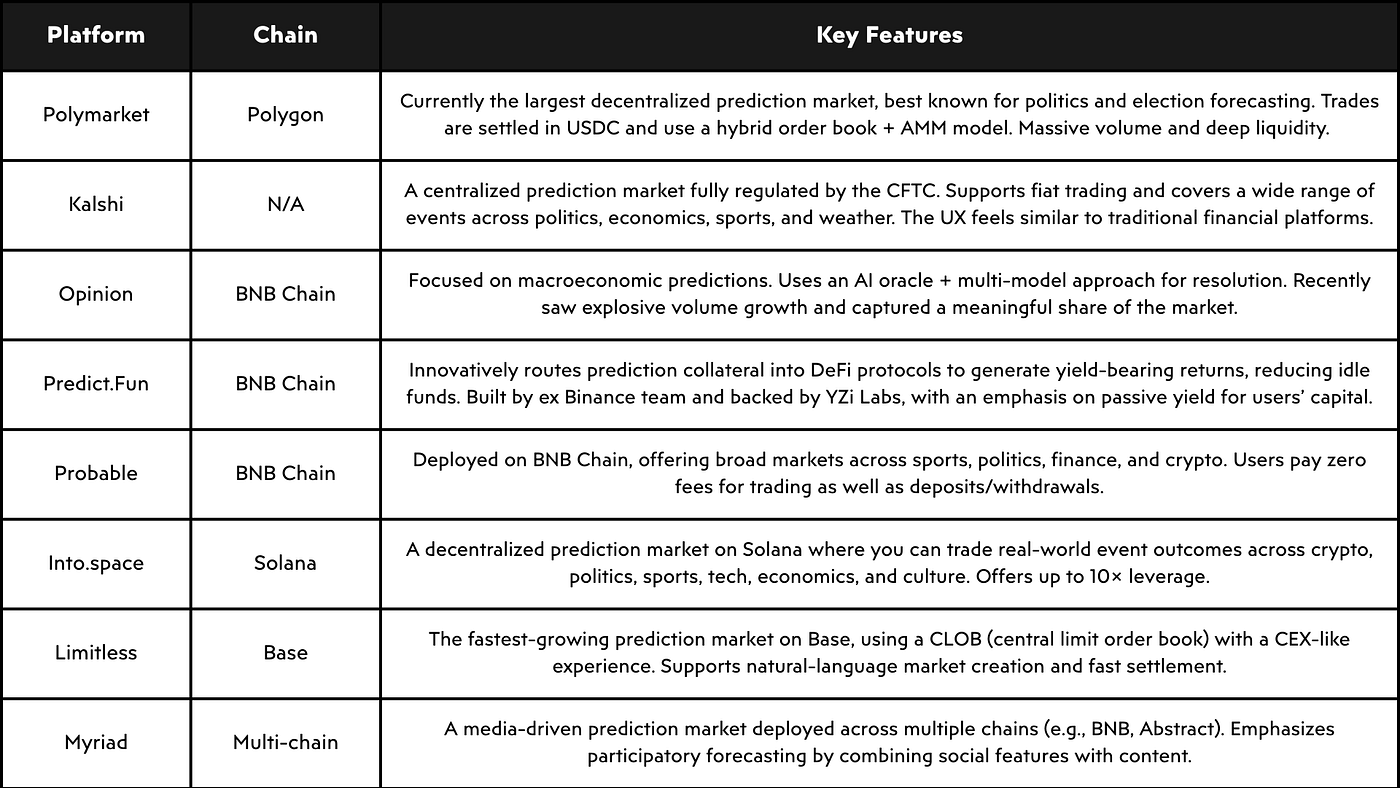
Beyond the dominant platforms, a continuous stream of new, small-to-medium-sized prediction markets with distinctive features is emerging. The total number of prediction market projects cataloged by Rootdata has exceeded 200. For instance, YZi Labs’ EASY Residency Season 2 featured three prediction market projects: 42.space, Predict.fun, and Bento.

Source: APRO has compiled a list of current leading prediction markets.
II. The Natural Evolution of Prediction Markets Towards Information Pricing and Asset Issuance
Since 2025, however, the primary driver of growth for prediction markets has undergone a quiet shift. Their previously speculation-dominated character is gradually transforming, enabling them to play a more significant role in information pricing and the issuance and trading of non-standard assets. Within the information dissemination chain, prediction markets are moving upstream, assuming a more foundational position.

III. The Potential of Prediction Markets Remains Significantly Underestimated with the Support of Crypto and AI
Driven by explosive trading volume growth and an influx of institutional and mainstream participants, prediction markets are gradually shedding their identity as mere gaming or engagement platforms. They are pivoting towards a grander narrative — becoming the most powerful infrastructure in the Internet era for collective expectation consensus, truth discovery, information dissemination, and asset issuance. We refer to this as the Internet Expectation Market (IEM).
The distinction between an IEM and a traditional prediction market lies in the IEM’s high dependence on Crypto and AI, its decentralized nature, and its virtually limitless potential for expansion in both depth and breadth. Imagine a scenario where any user in the world with a smart device and internet access can create a prediction market for any event or its expected outcome, and trade permissionlessly, 24/7, with any counterparty using Crypto.
In the Internet age, most people are merely spectators: observing macroeconomic data, elections, markets, and others’ judgments with minimal participation. Expression carries zero cost, judgment bears no consequence, and opinions ultimately devolve into noise. IEMs will change all of this: opinions must be backed by real capital — anyone can directly participate in pricing and bear the consequences. More critically, IEMs genuinely revalue the on-the-ground perceptions of ordinary individuals (barbers, drivers, office workers). These intuitive pieces of information, once ignored and non-transferable, can now be created, traded, and settled. For the first time, the “expected value of events” that could never enter capital markets becomes an independent, novel asset class.
Prediction markets existed long before the advent of cryptocurrency and the rise of the AI wave, but most were centralized and experimental/academic in nature, such as the Iowa Electronic Markets and Good Judgment Open. Constrained by trust issues, regulatory barriers, low liquidity, and high operational costs, they struggled to achieve mass adoption. Empowered by Crypto and AI, the IEM becomes a true “decentralized truth machine”: it continuously generates high-value, tamper-proof data streams, providing economically incentivized, reliable signals for insurance, derivatives, investment decisions, and even DAO governance. The IEM can be deconstructed into two core equations:
Equation 1: Prediction Market + Crypto + AI = Internet Expectation Market
Within an IEM, the Prediction Market is highly dependent on AI and Crypto, creating a novel method of asset issuance that transcends traditional securities, currency, and Tokens:
- Prediction Market: Brings a collective intelligence price discovery mechanism, allowing market prices to naturally aggregate the genuine beliefs and information of vast participants, forming a probabilistic consensus closest to the truth.
- Crypto: Enables decentralized circulation, hedging, and global participation, liberating expectation assets from geographical and institutional barriers, allowing anyone, anywhere, to trade instantly, hedge risks, and participate in pricing global events.
- AI: Enhances the analysis of long-tail events and automation, rapidly transforming massive amounts of fragmented, unstructured, and marginalized uncertainties into tradable contracts, significantly reducing creation and settlement costs while expanding the breadth and depth of event coverage.
Equation 2: Internet Expectation Market = Information Market + Risk Market + Engagement Market
The IEM is the validation of the prediction market concept. Under the IEM framework, prediction markets will move beyond speculation-driven models, simultaneously embodying the triple attributes of an Information Market, a Risk Market, and a Engagement Market:
(1) Information Market
The most profound aspect of an IEM is its function as a distributed information aggregation and truth discovery mechanism. Prices reflect the dynamic adjustment of collective Expected Value (EV) in real-time; the act of trading is itself the process of information dissemination and verification. Actions by informed participants cause sharp price movements, often becoming the earliest public signals of the truth.
In November 2025, Google announced a strategic partnership with Polymarket (and Kalshi), integrating their real-time odds and probabilities directly into Google Search and Google Finance. Users searching for queries like “Will the US enter a recession in 2025?” or “2026 GDP growth forecast” could see market-implied probabilities displayed alongside traditional financial data via natural language queries. In January 2026, Polymarket entered an exclusive data-sharing agreement with Dow Jones (which includes The Wall Street Journal, Barron’s, MarketWatch, etc.). Media outlets like the WSJ began embedding Polymarket’s real-time probability modules into their digital platforms and some print editions, for example, launching a “Market-Implied Earnings Expectation Calendar” that directly displays collective probability expectations for corporate earnings reports, rather than relying solely on analyst opinions.
These events signal that prediction markets are formally entering the mainstream information ecosystem. The world’s largest search engine and traditional financial media are beginning to treat “market prices” as one of the authoritative signals of collective expectation, helping users capture hidden truths faster. In the future, media may cite “prediction markets show…” to verify news, while individuals, corporations, and even nations might use these signals to aid governance and optimize strategic decisions. This attribute elevates the IEM beyond a mere financial tool, transforming it into the most powerful collective intelligence system of the Internet era, with its trading activity evolving into more diverse forms.
(2) Risk Market
To professional players, the IEM is a global, permissionless risk hedging infrastructure. It packages the expected outcomes of inherently non-standardizable uncertain events — such as macroeconomics, geopolitics, climate, and technology — into transferable, composable financial products, allowing users to trade and hedge instantly.
Modern platforms like Polymarket and Kalshi have inherited and vastly amplified this attribute: through blockchain or CFTC-regulated frameworks enabling frictionless global/US access, users can hedge against complex risks ranging from Fed interest rate paths and geopolitical conflict escalation to climate disaster probabilities, AI regulation implementation, corporate earnings surprises, and sharp Crypto price movements. For instance, some Bitcoin holders/mining firms trade markets like “Bitcoin falls below $X in Q1 2026” or “Fed Rate Path” on Polymarket and Kalshi as a cheap, alternative hedge for their spot holdings, offering greater efficiency and more transparent settlement than traditional put options.
(3) Engagement Market
To the average user, prediction markets represent the most accessible entry point to financial participation. High-profile events (elections, sports, entertainment gossip) attract massive traffic. Users start by “dipping a toe in,” expressing personal expectations by buying and selling contracts. It presents complex expectation assets in the most intuitive way, allowing retail participants to gradually understand the deeper value of transferability, trading, hedging, and composability through entertainment.
For example, Polymarket has become a prediction market partner for events like UFC and NHL, integrating real-time odds and brand exposure into the digital platforms of related events. Fans can buy or sell contracts on “who will get a KO in the next round” during a match, experiencing the fun of “trading while watching.” This transforms entertainment from passive consumption into active participation — viewers naturally learn price discovery logic while following celebrities or debating red carpet appearances. Many become “hooked” and subsequently expand into more serious markets.
IV. What Infrastructure Do Prediction Markets Need Under the IEM Narrative?
Oracles, as the final piece of the puzzle for the Internet Expectation Market (IEM), stand to benefit significantly from the prediction market supercycle.
Prediction markets were long constrained in the Web2 era by issues of trust, regulation, and efficiency. Crypto and AI now provide core foundational support, addressing these limitations at an architectural level. Crypto’s decentralized nature, smart contract capabilities, and the global settlement power of stablecoins, coupled with the productivity leap brought by AI, together create the ideal technological and economic environment for prediction markets.

It is important to note that while public chains (such as BNB Chain, Solana, Base, Ethereum), stablecoins (USDT/USDC/USD1/U), and DeFi composability tooling are already highly mature, and both AI and DAOs are continuously evolving to meet the needs of IEM development, a crucial final piece in the entire structure — the oracle — remains in a phase of rapid development.
The requirements for oracles in prediction markets differ significantly from those in DeFi or RWA sectors. Their role evolves from a simple “data courier” to a “Complex Event Verification and Comprehension Engine” that underpins the credible settlement of expectation assets. This core evolution lies in the ability to aggregate and comprehend multi-source, heterogeneous data (e.g., sports events, macroeconomic indicators, news events) and, leveraging technologies like LLMs, perform semantic extraction and logical judgment on unstructured information, transforming it into programmable contract conditions. The next generation of oracles will trend towards building modular data service platforms to meet the prediction market’s demand for rapid creation and reliable settlement of long-tail, emergent, and diverse events.
A truly viable oracle capable of supporting the high-speed growth of IEMs requires the following core characteristics:
- High Performance: Must meet the real-time demands of rapidly changing markets (millisecond-level response, high throughput).
- Extensive Data Breadth: Must adapt to the fast-growing complexity of prediction market subjects (supporting multi-chain, multi-source, heterogeneous data).
- Deep AI Integration: Must possess problem-solving capabilities for complex scenarios (utilizing LLMs for semantic understanding, logical reasoning, and programmable transformation).
- Deep Ecosystem Integration: Must integrate seamlessly with ecosystems (e.g., blockchains, DeFi composability suites) to achieve modular data services, seamless integration, and composability.
Against this backdrop, several Web3 oracle projects are already demonstrating enhanced AI-powered capabilities. They are moving beyond being mere price feed tools and transitioning towards a genuine “Complex Event Verification and Comprehension Engine” — integrating millisecond-level response, breadth across multi-source heterogeneous data, AI-powered semantic reasoning and logical judgment, programmable contract transformation, and high composability with DeFi and prediction market ecosystems. By continuously expanding coverage into sports, macroeconomics, and event-based markets, strengthening multi-layered AI verification mechanisms, and offering modular services, we can expect oracles to evolve gradually from data providers into a full-stack infrastructure supporting the credible settlement of expectation assets for any event, thereby methodically filling in the final piece of the IEM puzzle.
메타데이터
- post_id
- fed3e96f8580
- slug
- prediction-markets-101-the-prediction-market-supercycle-from-gaming-to-the-awakening-of-internet-fed3e96f8580
- url
- https://medium.com/@APRO_Oracle/prediction-markets-101-the-prediction-market-supercycle-from-gaming-to-the-awakening-of-internet-fed3e96f8580
- canonical_url
- https://medium.com/@APRO_Oracle/prediction-markets-101-the-prediction-market-supercycle-from-gaming-to-the-awakening-of-internet-fed3e96f8580
- author_url
- https://medium.com/@APRO_Oracle
- status
- ok
- fetched_at
- 2026-06-23 03:48:11