The Legacy of Mother Teresa
Heaven or Hell
The Legacy of Mother Teresa
Heaven or Hell
Gemini Generated Image
This blog is part of my ‘The Legacy…’ series, which examines individuals who left a significant mark on India and its culture in the 19th and 20th centuries. Earlier pieces in this series examined Max Müller, Robert Caldwell, and G.U. Pope, colonial scholars whose academic work was entangled with missionary objectives and imperial agendas. This essay turns to a more recent figure, Agnes Gonxha Bojaxhiu, known to the world as Mother Teresa.
The Foreign Contribution (Regulation) Act, 2010 (FCRA) regulates how individuals, NGOs, and associations in India obtain and utilise foreign funds and hospitality. This Act was amended in 2016, 2018, and 2020, and the current Government of India has introduced an amendment proposal in Parliament in April 2026. FCRA regulates nearly 16,000 NGOs that collectively receive around Rs. 22,000 crore ($2.6 billion USD) annually, according to this source (https://www.moneycontrol.com/news/india/fcra-amendment-bill-2026-why-it-has-triggered-a-political-storm-13876511.html ). In April 2026, the Catholic Bishops’ Conference of India (CBCI) raised serious concerns over the proposed FCRA amendments. Why does this bill matter in the context of “The Legacy of Mother Teresa”? It matters because US Secretary of State Marco Rubio visited Mother House, the headquarters of the Missionaries of Charity, an FCRA-certified Catholic congregation, on 23 May 2026 during his first four-day trip to India. This visit brought Mother Teresa and her Missionaries of Charity back into media focus a decade after her canonisation.
Few twentieth-century religious figures achieved the moral authority and global symbolism of Mother Teresa. Celebrated by political leaders, the Vatican, Western media, and humanitarian institutions, she became a beloved symbol of compassion for the poor. Her white saree with blue borders became a global icon of selfless service. In 1979, she received the Nobel Peace Prize. In 2016, the Catholic Church canonised her as Saint Teresa of Calcutta.
Unlike the Orientalist scholars, Mother Teresa does not wear the uniform of a colonial administrator. She spoke of love, sacrifice, and the poorest of the poor. She became perhaps the most universally revered person on earth in the second half of the 20th century. For many, questioning her is an act of sacrilege.
Yet in this series, I tend to research and ask the questions that reverence prevents, so that truth prevails and I gain a realistic appreciation of the individual. Several serious scholars and investigative researchers have compiled a substantial body of evidence suggesting that the myth of Mother Teresa, saint, humanitarian, voice of the voiceless, conceals a more complex and, in certain respects, troubling reality. Among the most important works are Aroup Chatterjee’s Mother Teresa: The Final Verdict (published in India in 2003, an earlier version, The Untold Story), which drew on decades of research in Calcutta, and Christopher Hitchens’ The Missionary Position: Mother Teresa in Theory and Practice (1995), which distilled a documentary film’s findings into a provocative short book.
Family and the Call to Mission
Agnes Gonxha Bojaxhiu was born on 26 August 1910 in Skopje, then part of the Ottoman Empire (now the capital of North Macedonia). She was the youngest of three children of Nikollë and Dranafile Bojaxhiu, an Albanian Catholic family. Her father, Nikollë, was a prosperous businessman and a local political figure. He died in 1919, leaving the family in reduced financial circumstances, though not in destitution. Her mother, Dranafile, whom Agnes described as deeply pious and charitable, reportedly organised regular gatherings to feed the poor and gathered the family for daily prayer. It is these early years in intense, domestic Catholic devotion that Agnes herself frequently cited as the foundation of her vocation.
Agnes attended a Jesuit-run Sacred Heart Church, and from the age of twelve, began to feel, as she later described it, a calling toward missionary life. The Irish Loreto Sisters, a religious order engaged in missionary work in Bengal, India, became the focus of her adolescent religious imagination.
In 1928, at the age of eighteen, Agnes left Skopje for Ireland, where she joined the Institute of the Blessed Virgin Mary (Loreto Sisters) in Dublin. She spent only a few months there learning English before being sent to Darjeeling, India, for her novitiate. She took the name Sister Mary Teresa, after Thérèse of Lisieux, the French saint known for her ‘little way’ of performing small acts with great love.
She made her first religious vows in Darjeeling in 1931 and her permanent vows in Calcutta in 1937, at which point she adopted the name Mother Teresa. From 1931 to 1948, she taught at St. Mary’s High School in Entally, Calcutta, a school run by the Loreto Sisters, serving students from more privileged Catholic families. She became the school’s headmistress in 1944.
On 10 September 1946, while travelling by train from Calcutta to Darjeeling for a spiritual retreat, Teresa reported receiving what she described as a ‘call within a call’ — a divine instruction to leave the convent and work directly among the poorest of the poor in the slums of Calcutta. This date has been commemorated by the Missionaries of Charity as ‘Inspiration Day.’
What is less well known is that Teresa spent nearly two years navigating bureaucratic and ecclesiastical channels to obtain permission to leave the Loreto order and operate independently while remaining a nun. This required approvals from her Archbishop in Calcutta, Ferdinand Périer, and ultimately from the Vatican itself. Her correspondence during this period shows both her determined will and the extent to which her initiative required institutional sanction from the highest levels of the Church.
In 1948, she received permission to leave the Loreto Sisters and live independently. She travelled to Patna to undertake brief medical training with the American Medical Missionary Sisters, then returned to Calcutta, took on Indian citizenship, and began working in the slums of Motijheel in Murshidabad, Bengal.
This is the story the world received. It is not false in its broad outline. Teresa did work in Bengal. She did found the Missionaries of Charity. She did receive the Nobel Prize. She did demonstrate, by any measure, extraordinary personal determination and stamina.
The question is what was happening beneath the surface of this narrative.
Institutional Growth and Financial Scale
The Missionaries of Charity (MoC), formally established as a diocesan congregation in Calcutta in 1950, grew with extraordinary speed. By the time of Teresa’s death in 1997, it operated in over 130 countries, running homes for the dying, orphanages, leprosaria, schools, and hospices. It had approximately 4,000 sisters and hundreds of thousands of lay co-workers. It had received donations totalling hundreds of millions, possibly billions, of dollars from individuals, governments, and institutions worldwide.
The organisation became, in the words of Christopher Hitchens, a ‘virtually unaccountable global enterprise’ in terms of financial transparency. Unlike secular charities, which are typically required to publish audited financial accounts, the Missionaries of Charity operated under the Vatican’s ecclesiastical umbrella, with minimal public financial disclosure.
Where Did the Money Go?
This question, deceptively simple, has never been satisfactorily answered. Several investigative efforts, including those summarised by Hitchens and Chatterjee, yielded troubling findings:
• The MoC’s homes for the dying in Calcutta operated at a level of material poverty that bore no relationship to the scale of donations received. The gap between the organisation’s fundraising and its visible expenditure on the poor was never explained.
• A German magazine investigation in the 1990s found that the Missionaries of Charity in Germany were not operating the welfare programmes they had claimed in their fundraising literature.
• Susan Shields, a former MoC nun who served for nine years, gave an account (published in Free Inquiry magazine) of the organisation’s internal financial practices. She described a system in which cash donations were sent to Rome, and that sisters were instructed never to divulge the organisation’s finances.
• Shields described handling large quantities of undeposited cash donations at the New York house: cheques were deposited, but cash was retained in quantities that were never formally accounted for.
*“I was constantly writing to donors, assuring them that their money was being used to help the poor. But even though we were always asking for money, we had plenty. One year, the Sisters’ community in the Bronx, New York, raised more than $500,000 for the worldwide activities of the Missionaries of Charity. I was never given information about where the money went.”* — Susan Shields, former Missionaries of Charity nun, Free Inquiry, 1998
The broader pattern of financial opacity was systemic, not exceptional. This pattern continues to this date, as is evident from the hue and cry over the Government of India’s move to regulate NGOs through its Foreign Contribution (Regulation) Act (FCRA) in April 2026.
Why the MoC Headquarters at Kalighat and not Motijheel
The Official Account
The standard explanation is administrative and pragmatic: in 1952, the Calcutta Corporation offered Teresa the use of the Kalighat building to evict the criminal element that had overrun it — gamblers and thugs who were threatening pilgrims — while also addressing Teresa’s repeated entreaties for a suitable space to care for the gravely ill whom hospitals had refused. In this narrative, Kalighat was simply what the city gave her, not what she chose.
But this explanation, taken alone, is insufficient. Teresa was not a passive recipient of whatever building the Corporation handed her. By 1952, she was a determined institutional operator who had navigated the Vatican, the Archdiocese of Calcutta, and the Indian government to secure her independence. The question of why she pressed for this particular location — the dharamshala (pilgrim’s rest house) immediately adjacent to one of Hinduism’s most sacred temples — deserves far more scrutiny than it has received.
What Kalighat Actually Is
The Kalighat Kali Temple is one of the 51 Shakti Peethams on earth and is considered one of the holiest pilgrimage sites for devotees. The myth of Kalighat centres around the dismembered body of Sati, Lord Shiva’s consort — it is believed her right toe fell where the temple now stands, making it a sacred Shakti Peetham. This is not a neighbourhood temple. It is the civilisational and spiritual heart of Bengal’s Shakta tradition — a site of pilgrimage that draws hundreds of thousands annually from across India.
Motijheel, by contrast, where Teresa had begun her street work in 1948, was a working-class, Muslim-majority neighbourhood with no equivalent sacred significance. It had the poor. It did not have the symbolic weight.
The Physical Arrangement: An Abandoned Hindu Temple
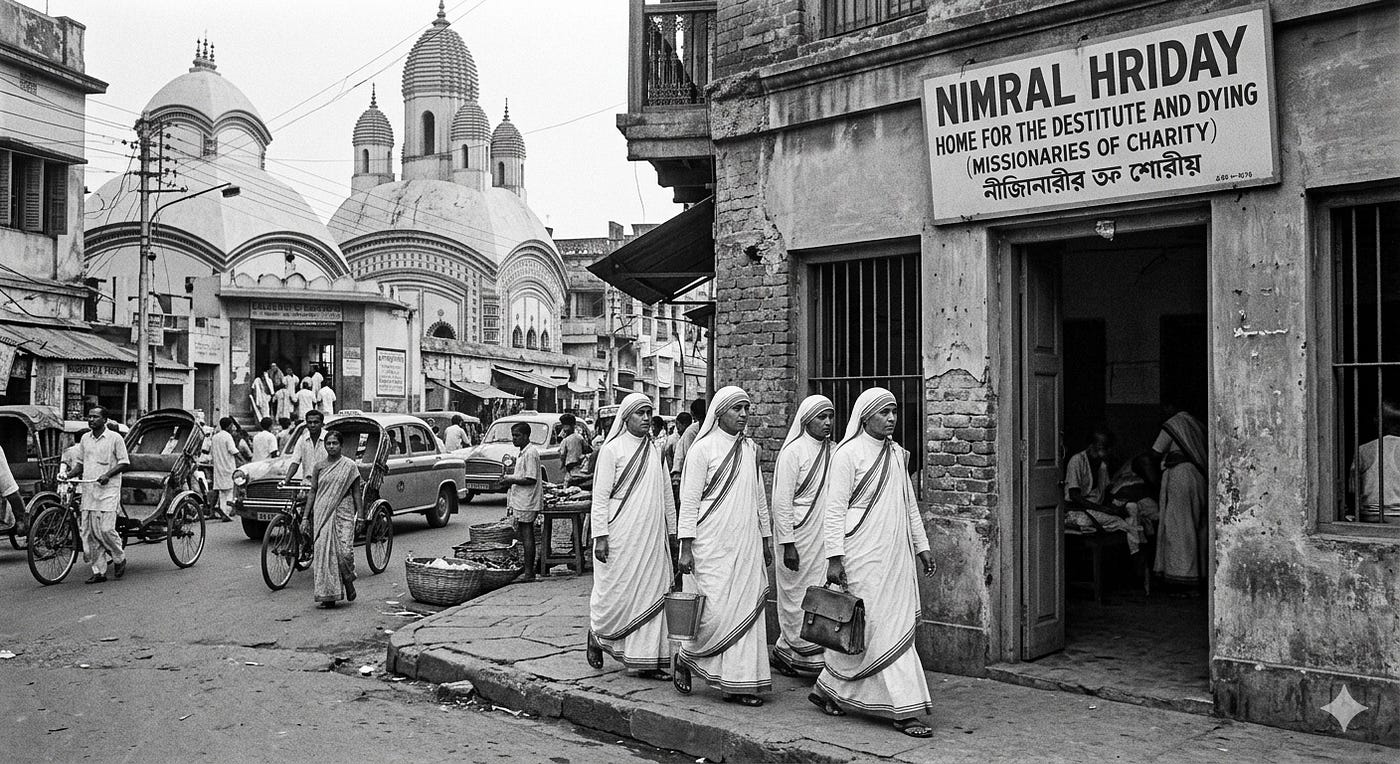
Before Mother Teresa sought permission to use it, the building was an old, abandoned Hindu temple service complex, adjacent to the goddess Kali. She transformed it into the “Kalighat home for the dying”, and later renamed it “Kalighat the Home of the Pure Heart (Nirmal Hriday).”
This fact is consistently minimised in the hagiographic accounts. The building was not merely near the Kali temple. It was itself a former Hindu temple space, a dharamshala built for pilgrims arriving at the Kali temple, which was now being converted into a Catholic missionary facility. The symbolic charge of this is enormous and was not lost on Calcutta’s Hindu residents.
The Immediate Hindu Reaction
Threats and stone-throwing soon followed the opening of Nirmal Hriday. Local residents petitioned the authorities to evict her, claiming she was exploiting the poor and their desperate situation to convert them to Christianity.
This detail is almost entirely suppressed by the global Teresa mythology. The local Hindu community’s reaction was not irrational bigotry — it reflected a historically informed reading of the missionary enterprise. They understood what it meant to place a Catholic conversion facility inside a formerly Hindu sacred building, in the shadow of one of Hinduism’s most revered temples, where pilgrims arriving sick and dying from across India would pass through. The objections were ignored, and the protests were quietly dissolved when the police commissioner — reportedly moved by the sight of Teresa tending to a gangrenous patient — withdrew the threat of eviction.
In the broader context of my blog series — Caldwell, Pope, Müller — the Kalighat choice fits a consistent missionary pattern of not avoiding but claiming indigenous sacred space. Caldwell built his base in Tirunelveli, the heart of the Tamil Shaiva tradition. Pope worked with Tamil sacred texts to reframe them. Teresa chose not the anonymous slum of Motijheel but the most symbolically charged moksha-site in Bengal. The message of the placement was that the Catholic Goddess of Mercy had come to the home of Maa Kali, and that the dying who arrived here seeking Maa Kali’s embrace would find Christ instead.
Nirmal Hriday: Medical Care or Managed Dying?
The most serious and most extensively documented critique of Mother Teresa’s work is regarding the medical standards at the Missionaries of Charity’s flagship home for the dying, Nirmal Hriday (Pure Heart), established in 1952 in Calcutta (now Kolkata).
Aroup Chatterjee — Testimonies gathered at the site
Nirmal Hriday, its critics insist, was not a medical facility in any meaningful sense. Aroup Chatterjee, a Calcutta-born physician who conducted extensive research over the years — including interviews with former volunteers, nurses, and Calcutta residents — documents the following conditions at Nirmal Hriday and other Missionaries of Charity facilities:
- Needles were reused without adequate sterilisation, even after the AIDS crisis made this a documented transmission risk.
- Patients with curable conditions, including treatable forms of tuberculosis, received no curative medical care — only palliative management and prayer.
- No distinction was made between patients in the final stages of life and those who were sick but potentially treatable.
- Donated medical supplies and equipment — some donated specifically for use at Nirmal Hriday — were reportedly transferred to Catholic hospitals elsewhere rather than used at the facility.
- Volunteers, many of whom came from abroad with medical backgrounds, were reportedly actively discouraged from applying their skills and instead directed to bathe and pray with patients.
Chatterjee’s documentary evidence on these points is extensive, based on interviews conducted in Calcutta over many years. His book is notably not a journalistic polemic but a methodical accumulation of testimony.
The Theology of Suffering: Redemptive Pain as Policy
A crucial dimension of Teresa’s work was the published theological views on suffering. She consistently and explicitly believed that suffering brought the poor closer to Jesus Christ. She described pain as a ‘kiss from Jesus.’ She spoke of the dying poor as the suffering Christ himself.
“I think it is very beautiful for the poor to accept their lot, to share it with the passion of Christ. I think the world is being greatly helped by the suffering of the poor people.” — Mother Teresa, in an interview with journalist Edward Desmond
Christopher Hitchens noted the essential contradiction in these statements: if suffering is beautiful and redemptive, there is a theological incentive not to reduce it. A healthcare system designed, even unconsciously, around the spiritual value of suffering will necessarily under-invest in pain relief, curative care, and medical standards. Hitchens observed that Teresa had access to enormous sums of donated money — far more than would have been needed to substantially upgrade the medical quality of her homes — and that this upgrade did not occur.
Observations of Dr Robin Fox, Editor of The Lancet
Dr Robin Fox, then the editor of The Lancet, visited Nirmal Hriday in 1994 and published his observations in the journal. He noted the lack of pain relief (no morphine or analgesics of comparable strength), the reuse of needles, the absence of diagnostic equipment, and the mixing of patients with curable and terminal conditions. He acknowledged the volunteers’ genuine devotion but concluded that the facility’s medical care was severely inadequate by any standard.
The medical critique of Nirmal Hriday, as documented, extends to other MoC facilities too. In her 1994 analysis of several MoC homes, Dr Fox’s Lancet report found broadly similar conditions to those she described in Calcutta. Former volunteers from multiple countries have published accounts describing conditions they found disturbing — the lack of basic pain management being the most consistently reported concern.
In 2013, a study by Serge Larivée, Genevieve Chenard, and Carole Sénéchal, published in the journal Studies in Religion / Sciences Religieuses, analysed the published scholarship on Mother Teresa and found a consistent disparity between the documented material conditions in MoC facilities and the global perception of the organisation as a model of compassionate care. The authors found that the international media largely failed to investigate these conditions, deferring instead to the organisation’s self-presentation.
Mother Teresa and the Vatican: A Symbiotic Relationship
Mother Teresa’s relationship with the Vatican was one of profound mutual utility. Teresa gave the Catholic Church something it had rarely possessed in the 20th century: a globally beloved, politically unchallenging, telegenic symbol of Christian compassion. At a time when the Church was suffering severe reputational damage from the revelations of clerical sexual abuse, from controversies over birth control, and from its historical silence during World War II, Teresa was an asset of incalculable PR value.
In return, the Vatican gave Teresa institutional protection, global fundraising networks, rapid canonisation on an unusually accelerated timeline, and the authoritative imprimatur of the world’s largest religious institution. The relationship was not merely devotional; it was strategically functional for both parties.
Canon law normally requires a waiting period of five years after death before a canonisation cause can be formally opened. Pope John Paul II waived this requirement for Teresa, opening her cause in 1999 — two years after her death. She was beatified in 2003 and canonised in 2016 by Pope Francis.
The canonisation process requires evidence of two miracles attributed to the candidate’s posthumous intercession. The first miracle cited in Teresa’s case was the alleged healing of Monica Besra, a Bengali woman who claimed her abdominal tumour was healed through Teresa’s intercession after a medallion was placed on her body. Monica Besra’s own doctors disputed the miracle, stating that her tumour had responded to conventional medical treatment, including anti-tuberculosis medication. The doctors went on record. Their statements were not incorporated into the Vatican’s deliberations, which proceeded to beatification.
The second miracle, required for full canonisation, involved the alleged healing of a Brazilian man with a viral brain infection. No independent medical verification was made publicly available.
The canonisation machinery, in both cases, functioned by excluding the testimony of the treating physicians — those with the most direct access to the relevant medical facts — while relying on the testimony of the patient and religious witnesses.
Mother Teresa with The Rich & Famous
One of the most damaging documented aspects of Teresa’s relationship with the rich & famous is her pattern of validating political figures & financial frauds.
On the occasion of the 1981 Haitian state reception hosted by Baby Doc Duvalier, Teresa praised the Duvalier family publicly, saying she had never seen the poor more spiritually alive and that the Duvaliers loved the poor.’ Jean-Claude Duvalier (‘Baby Doc’) and his wife, Michèle, had presided over one of the Western Hemisphere’s most brutal and corrupt regimes, stealing an estimated $300–800 million from the Haitian state. His wife was notorious for spending millions on Paris shopping trips while Haitians starved. Teresa accepted the Haitian government’s highest honour during this visit.
The pattern is not limited to Haiti.
The most extensively documented case of Teresa’s acceptance of money from criminals involves Charles Keating, the American savings-and-loan financier whose 1989 collapse was the largest financial fraud in American history to that point. Keating’s Lincoln Savings and Loan stole approximately $252 million from its depositors — mostly elderly middle-class Americans who had invested their savings in what they were told were federally insured accounts. When Lincoln collapsed, these depositors lost their savings. Keating was convicted on 73 counts of racketeering, fraud, and conspiracy.
Keating had given Teresa approximately $1.25 million in donations, and she, in turn, had written letters to the judge in his criminal case, asking for leniency and describing him as a man of deep personal integrity and religious devotion. She appeared to have no knowledge of, or interest in, the specifics of what Keating had done.
Paul Turley, the Los Angeles Deputy District Attorney who prosecuted Keating, wrote Teresa a letter detailing the nature of the fraud, the victims, and the sums involved. He asked her to return the donated money so it could be returned to the victims. He received no reply. The money was never returned.
Robert Maxwell, the British media mogul and Labour politician (also father of Ghislaine Maxwell, the infamous British Socialite, sex trafficker and convicted child sex offender), was at the time of his mysterious death in 1991 being investigated for having plundered approximately £460 million from the Mirror Group’s employee pension funds. When the scale of the theft became clear after his death, thousands of Mirror Group employees faced retirement with drastically reduced pensions.
Teresa had received Maxwell at a public event and had praised him effusively. He had donated to her work. Her willingness to legitimise major donors regardless of the moral character of their activities was consistent across these cases, suggesting not naivety but policy.
Saviour of the Poor, or Purveyor of Poverty?
The Case for Mother Teresa
In the interests of intellectual honesty, this deconstruction must acknowledge what is genuinely defensible in Teresa’s record. She left a comfortable convent school to work directly in conditions of extreme poverty and disease. She worked under these conditions for nearly fifty years. Her personal stamina, discipline, and commitment to her vocation were, by any measure, extraordinary. She brought global attention to the suffering poor of Calcutta at a time when that attention was largely absent. She created an institution that has continued to provide a form of care, however inadequate its medical standards , to dying individuals who would otherwise have died entirely alone and without any human attention.
For many of the people who passed through Nirmal Hriday, the experience of having another human being sit with them, wash them, and pray over them may have provided genuine comfort in their final hours. This is not nothing. It is, in fact, a huge thing.
Her influence inspired hundreds of thousands of volunteers to engage directly with poverty, despite the structural limitations of the MoC’s framework. Her life demonstrated, at a minimum, that radical personal sacrifice in the service of others was possible and could attract global attention.
The Case Against: A Summary
Against this, the documented evidence assembled by Chatterjee, Hitchens, Fox, Larivée, and others establishes the following:
- The medical standards at Missionaries of Charity facilities were chronically and deliberately inadequate, prioritising spiritual care over curative medicine in a manner consistent with Teresa’s theology of redemptive suffering.
- The organisation received hundreds of millions of dollars in donations that were not demonstrably spent on improving conditions for the poor in its facilities.
- Financial transparency was essentially non-existent, with no published accounts and internal practices that former members described as systematically opaque.
- Teresa repeatedly accepted donations from, and provided public moral legitimacy to, individuals whose activities directly harmed the poor, most egregiously Charles Keating, who stole from elderly Americans, and Jean-Claude Duvalier, who stole from the Haitian people.
- She used her global platform to advocate for positions, opposition to contraception, abortion, and divorce.
- The practice of administering Catholic baptism to dying non-Catholics without their informed consent represents a serious ethical violation that was never publicly acknowledged.
- Her public statements consistently counselled the poor to accept their suffering as spiritually meaningful.
- Her praise for brutal regimes, the Duvaliers in Haiti, provided those regimes with the legitimacy they exploited.
- The canonical miracles attributed to her are contested by the treating physicians, whose testimony was excluded from the Vatican’s deliberations for canonisation.
The Structural Question
Behind the specific criticisms lies a structural question that connects this blog to the blogs on Max Müller, Caldwell, and Pope, all of whom performed a dual function: they provided genuine scholarship or service to Indian and Tamil culture while simultaneously serving the interests of colonial governance and Christian conversion. The intellectual and cultural service was real; so was the colonial and missionary agenda. The two were not accidentally related but systematically connected.
Mother Teresa presents an analogous structure. The service she provided to the dying poor was real. So was the theological and institutional agenda that shaped how that service was provided, and what service was deliberately withheld. The suffering she compassionately attended was, in her theology, spiritually valuable.
This is what Hitchens meant by calling her a friend of poverty rather than the poor. The distinction is not a rhetorical trick. It is a structural analysis.
The Kolkata Question
Aroup Chatterjee, whose research is the most detailed and locally grounded, makes a point that should trouble any honest assessment of the Teresa mythology. Calcutta had — and has — a rich tradition of Bengali charitable and humanitarian work. The Ramakrishna Mission operated schools, hospitals, and welfare institutions in Calcutta, delivering medical and educational services of a quality that far exceeded those provided by the MoC. Numerous secular and Hindu organisations worked with the poor of Calcutta throughout Teresa’s years there.
None of these organisations received comparable global attention. None of their leaders received the Nobel Peace Prize. The visibility that attached to Teresa’s work, and the billions of dollars that followed that visibility, was not a function of the quality or scale of the work — it was a function of the West’s need for a particular kind of saint: European, Catholic, photogenic, and safely apolitical.
In this narrative, the Teresa mythology is not merely a story about one woman’s virtues and compromises. It is a story about what the Western mediascape was willing to see and to celebrate in the global South — and what it was designed not to see.
Conclusion: Decolonising the Halo
This blog is not a verdict. It is an invitation to think with appropriate rigour about a figure who has, for decades, been placed beyond rigorous thought by the combined force of global media, institutional religion, and what Christopher Hitchens called ‘the widespread feeling that it is in poor taste to say anything against her.’
The documented evidence is sufficient to conclude that the global mythology of Mother Teresa significantly exceeds the documented reality of her work’s impact and ethics. That mythology was manufactured by specific interests, viz., the Vatican, the Western media, the global charitable-industrial complex, and served specific purposes: religious & geopolitical.
For Bharat specifically, there is a dimension that the “Legacy Series” context illuminates. The city chosen as the backdrop for this mythology was Calcutta — a city with a deep and sophisticated Bengali intellectual tradition, a strong tradition of indigenous charitable work, and its own responses to the poverty produced by colonialism and its aftermath. The global spotlight that landed on a European nun in this city, rather than on the organisations that the city’s own tradition had produced, reflects precisely the colonial optic that Max Müller deployed in his ‘paradise on earth’ prose: the East as backdrop, the West as protagonist.
The question the reader must ultimately answer is this: Does a figure deserve the title of saint if the documented record shows that the suffering of the poor served her theology more than her institutions served their needs? Does the heroism of personal sacrifice absolve the accumulation of institutions that were financially opaque, medically inadequate, and doctrinally coercive?
These are not rhetorical questions. They are the questions that honest engagement with the evidence compels us to ask.
*“She was not a friend of the poor. She was a friend of poverty. She said that suffering was a gift from God. * — Christopher Hitchens
*“If you want to understand what happened in that House of the Dying, don’t read the hagiographies. Come to Calcutta and talk to the doctors, the nurses, the social workers, the families of those who died there. Talk to the people of this city. And then decide.”* — Aroup Chatterjee, Mother Teresa: The Final Verdict
Bibliography
Primary Sources
- Chatterjee, Aroup. Mother Teresa: The Final Verdict. Meteor Books, Calcutta, 2003.
- Hitchens, Christopher. The Missionary Position: Mother Teresa in Theory and Practice. Verso, London, 1995.
- Fox, Robin. ‘Mother Teresa’s Care for the Dying.’ The Lancet, Vol. 344, Issue 8925, 1994.
- Larivée, Serge; Chenard, Genevieve; Sénéchal, Carole. ‘Les côtés ténébreux de Mère Teresa.’ Studies in Religion / Sciences Religieuses, 2013.
- Shields, Susan. ‘Mother Teresa’s House of Illusions.’ Free Inquiry, Vol. 18, №1, 1998.
- Muggeridge, Malcolm. Something Beautiful for God. Harper & Row, New York, 1971.
Teresa’s Own Words
- Kolodiejchuk, Brian (ed.). Mother Teresa: Come Be My Light. Doubleday, New York, 2007.
- Spink, Kathryn. Mother Teresa: A Complete Authorised Biography. HarperCollins, 1997.
메타데이터
- post_id
- fed95247bf5a
- slug
- the-legacy-of-mother-teresa-fed95247bf5a
- url
- https://medium.com/illumination/the-legacy-of-mother-teresa-fed95247bf5a
- canonical_url
- https://medium.com/illumination/the-legacy-of-mother-teresa-fed95247bf5a
- author_url
- https://medium.com/@prabhu_nambiappan
- status
- ok
- fetched_at
- 2026-06-09 15:37:30