From 1:6 to 1:30 — why VR in medical training is not a compromise, it is a competency upgrade
The 1:6 instructor ratio was never about pedagogy — it was about the limits of the human eye
From 1:6 to 1:30 — why VR in medical training is not a compromise, it is a competency upgrade

The 1:6 instructor ratio was never about pedagogy — it was about the limits of the human eye
The American Heart Association’s BLS instructor manual specifies one instructor to six students for classroom CPR training. The reason is straightforward and honest: hands-on assessment requires eyes on the learner. One human observer cannot simultaneously track compression depth, hand placement, rate, and recoil for more than a small number of bodies at a time. The ratio is a ceiling set by the assessment tool — the human eye. But in a typical class of thirty students and six manikins, each student spends roughly eleven minutes with hands on a manikin, most of those minutes unobserved. The instructor does her best. The system ensures that best is never enough. VR in medical training does not lower this standard. It removes the constraint that made the standard so difficult to meet.
- The AHA 1:6 ratio exists because one human cannot observe more than a few learners simultaneously
- In a class of thirty students, each learner gets roughly eleven minutes of hands-on manikin time
- Most of those compressions are unobserved — no depth data, no rate data, no real-time correction
Dr. Hartwell sees what no human instructor ever could — every compression, for every student, at the same time
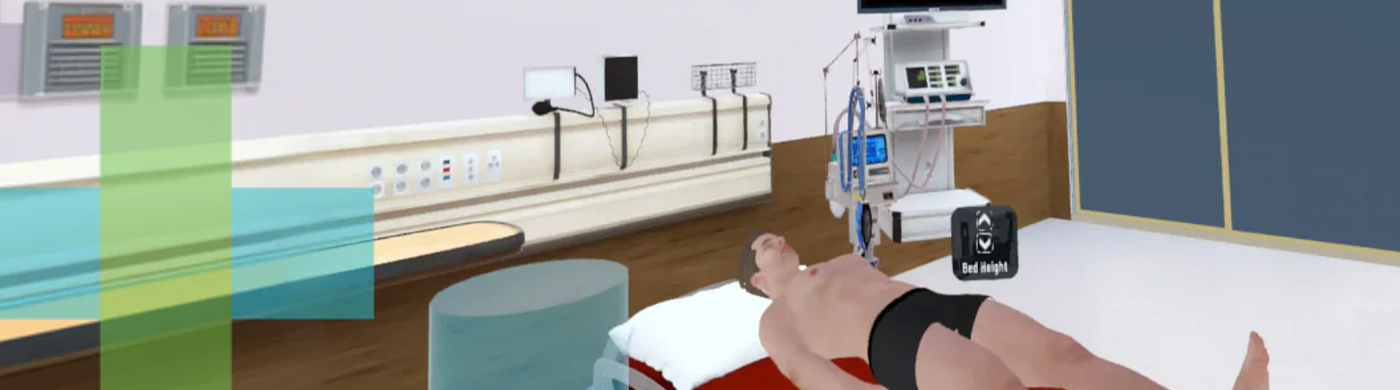
Inside every BLSXR headset is Dr. Hartwell, the platform’s AI coach. He is not a recording or a script — he is a real-time observer with a precise view of every learner’s hand position, compression depth, recoil completeness, ventilation volume, and rate. Thirty students in headsets means thirty simultaneous, individualized assessments. The human instructor in the room monitors the dashboard, coaches outliers, and validates the data — not replaced, but amplified in a way that VRKure’s virtual reality surgery simulator and BLS platform make possible for the first time. A nursing school that previously needed five instructors for a class of thirty now needs one — and that single instructor has access to more performance data than five instructors ever could have gathered by eye. This is not the same training at a lower cost. It is better training at a fraction of the resource demand.
- AI-driven observation tracks depth, rate, recoil, and hand placement for every student simultaneously
- The human instructor is amplified — moving from subjective observer to data-validated coach
- A five-fold reduction in instructor hours does not reduce rigor — it increases the objective measurement of it
VRKure’s virtual reality surgery simulator and BLS platform redefine what a certification card is allowed to mean
The card issued after a traditional BLS class says the learner attended a four-hour session. It does not say how many compressions met the depth threshold, whether rate was consistent, or whether recoil was complete. The card issued after BLSXR says something different: every compression this learner has ever performed has been measured — logged, timestamped, and verified against an objective standard. VR in medical training through VRKure’s virtual reality surgery simulator and BLS infrastructure does not make certification easier. It makes it honest. The next time a certified provider walks into a Code Blue, their hands have been trained against data — not against attendance in a room where the manikin made a sound and nobody measured the depth.
- Mastery-gated progression means no learner advances until they demonstrate the skill to a measurable standard
- Every session produces a longitudinal competency record — not a two-year snapshot
- Scalable to large nursing school cohorts and hospital systems without multiplying instructor headcount
Read the full blog: BLS CPR Training Economics: From 1:6 to 1:30 | VRKure
메타데이터
- post_id
- fee230b7ff09
- slug
- from-1-6-to-1-30-why-vr-in-medical-training-is-not-a-compromise-it-is-a-competency-upgrade-fee230b7ff09
- url
- https://medium.com/@vrkure-blsxr/from-1-6-to-1-30-why-vr-in-medical-training-is-not-a-compromise-it-is-a-competency-upgrade-fee230b7ff09
- canonical_url
- https://medium.com/@vrkure-blsxr/from-1-6-to-1-30-why-vr-in-medical-training-is-not-a-compromise-it-is-a-competency-upgrade-fee230b7ff09
- author_url
- https://medium.com/@vrkure-blsxr
- status
- ok
- fetched_at
- 2026-06-20 20:29:01