Understanding Token Classification in NLP: NER, POS Tagging, and Chunking
Natural Language Processing (NLP) enables computers to understand and interact with human language. It powers technologies like chatbots…
Understanding Token Classification in NLP: NER, POS Tagging, and Chunking
Natural Language Processing (NLP) enables computers to understand and interact with human language. It powers technologies like chatbots that respond to user queries and search engines that retrieve relevant information efficiently.
A key concept in NLP is token classification, where text is broken down into individual words (tokens), and each word is assigned a specific label. This process helps machines grasp the structure, context, and meaning of sentences more effectively.
In this blog, we will explore three important tasks related to token classification:
- Named Entity Recognition (NER)
- Part-of-Speech (POS) Tagging
- Chunking (Phrase Detection)
Press enter or click to view image in full size
1. Introduction to NLP & Token Classification
What is NLP?
Natural Language Processing (NLP) is a branch of Artificial Intelligence that aims to enable computers to understand, interpret, and even generate human language.
Examples of NLP applications include:
- Chatbots like customer support assistants
- Search engines that understand user queries
- Translation systems like Google Translate
- Voice assistants such as Alexa and Siri
NLP helps machines process text and extract meaningful information.
What is Token Classification?
Before understanding token classification, we need to know what a token is.
A token is simply a word or subword in a sentence.
Example sentence:
“Apple released the new iPhone in California.”
Tokenization breaks it into:
Apple | released | the | new | iPhone | in | California
In token classification, each word (token) is assigned a label.
Example:
Apple → Organization, released →O, the → O, new → O, iPhone → Product, in → O, California → Location
“O” usually means Outside any special category.
Why is Token-Level Understanding Important?
Understanding text at the token level allows machines to extract detailed information.
This is useful in many applications.
Chatbots need to identify entities like names, locations, or dates.
Example:
“Book a flight to Paris tomorrow”
The chatbot identifies:
- Paris → Location
- tomorrow → Date
Search Engines
Search engines analyze words in a query to understand the user’s intent.
Example query:
“best restaurants in Bangalore”
The system recognizes:
- restaurants → object of search
- Bangalore → location
Information Extraction
Companies use NLP to extract important information from documents.
Example:
“Tesla acquired SolarCity in 2016.”
The system extracts:
- Tesla → Organization
- SolarCity → Organization
- 2016 → Date
This helps automate data analysis.
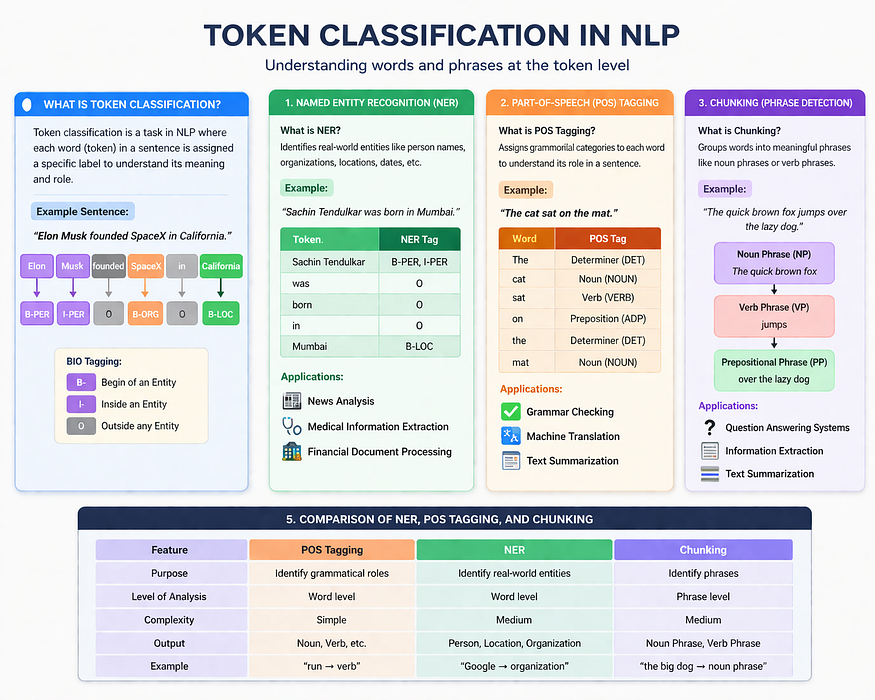
2. Named Entity Recognition (NER)
What is Named Entity Recognition?
Named Entity Recognition (NER) is a token classification task that identifies real-world objects in text.
These entities include:
- Person names
- Organizations
- Locations
- Dates
- Products
Example sentence:
“Elon Musk founded SpaceX in California.”
NER identifies:
Elon Musk → Person, SpaceX → Organization, California → Location
BIO Tagging Concept
NER often uses a BIO tagging scheme.
BIO stands for:
- B — Beginning of an entity
- I — Inside an entity
- O — Outside an entity
Example:
Sentence:
“Barack Obama visited India.”
Barack → B-PER, Obama → I-PER, visited → O, India → B-LOC
This helps models identify multi-word entities.
Examples of NER
Example 1:
“Google was founded in California.”
Entities:
- Google → Organization
- California → Location
Example 2:
“Sachin Tendulkar was born in Mumbai.”
Entities:
- Sachin Tendulkar → Person
- Mumbai → Location
Applications of NER
NER is widely used in many real-world systems:
- News analysis to identify important people and places
- Financial analysis to track company mentions
- Medical NLP to detect diseases and medications
- Customer support automation
3. Part-of-Speech (POS) Tagging
What is POS Tagging?
Part-of-Speech (POS) tagging assigns grammatical categories to words in a sentence.
Each word is labeled according to its role in grammar.
Example sentence:
“The cat sat on the mat.”
POS tagging output:
The → Determiner, cat → Noun, sat → Verb, on → Preposition, mat → Noun.
Types of POS Tags
Some common POS tags include:
- Noun (NN) — names of things
- Verb (VB) — action words
- Adjective (JJ) — describes nouns
- Adverb (RB) — modifies verbs
- Preposition (IN) — shows relation
POS Tagging Examples
Example 1:
“She reads books daily.”
She → Pronoun, reads → Verb, books → Noun, daily → Adverb
Example 2:
“The weather is beautiful today.”
weather → Noun, is → Verb, beautiful → Adjective, today →Noun
Why POS Tagging is Important
POS tagging helps machines understand sentence structure.
It is useful for:
- Grammar checking tools
- Machine translation
- Text summarization
- Question answering systems
4. Chunking (Phrase Detection)
What is Chunking?
Chunking organizes words into meaningful phrases rather than assigning labels to each individual word.
It detects meaningful phrases like:
- Noun phrases
- Verb phrases
- Prepositional phrases
Example sentence:
“The quick brown fox jumps over the lazy dog.”
Chunking identifies phrases:
- [The quick brown fox] → Noun Phrase
- [jumps] → Verb Phrase
- [over the lazy dog] → Prepositional Phrase
Chunking Examples
Example 1:
“The young student solved the problem.”
Noun phrases:
- The young student
- the problem
Example 2:
“She bought a new laptop.”
Noun phrases:
- She
- a new laptop
Difference Between Chunking and NER
NER identifies specific named entities, while chunking identifies general phrases.
Example sentence:
“Microsoft CEO Satya Nadella visited India.”
NER identifies:
- Microsoft → Organization
- Satya Nadella → Person
- India → Location
Chunking identifies:
- Microsoft CEO Satya Nadella → Noun Phrase
Use Cases of Chunking
Chunking is useful in:
- Question answering systems
- Text summarization
- Information extraction
- Language understanding
5. Comparison of NER, POS Tagging, and Chunking
Although Part-of-Speech (POS) Tagging, Named Entity Recognition (NER), and Chunking are all token classification tasks in NLP, they differ in their purpose and the level at which they analyze text.
POS Tagging focuses on identifying the grammatical role of each word in a sentence. It operates at the word level, assigning labels such as noun, verb, or adjective. For example, in the phrase “run fast”, the word “run” is labeled as a verb. Since it mainly deals with grammar and sentence structure, POS tagging is generally considered the simplest among the three.
Named Entity Recognition (NER) also works at the word level but shifts the focus from grammar to identifying real-world entities like people, organizations, locations, dates, or products. For example, in “Google launched a new product”, “Google” is identified as an organization. NER is more complex than POS tagging because it requires contextual understanding.
Chunking, also known as phrase detection, operates at a higher level. Instead of labeling individual words, it groups them into meaningful phrases such as noun phrases or verb phrases. For instance, in “the big dog”, the entire phrase is identified as a noun phrase. Chunking is moderately complex as it involves understanding how words combine to form structured phrases.
6. Example Code Implementation (Using spaCy)
Here is a simple Python example using spaCy to perform token classification tasks.
import spacynlp = spacy.load("en_core_web_sm")text = "Elon Musk founded SpaceX in California"doc = nlp(text)print("POS TAGGING")
for token in doc:
    print(token.text, token.pos_)print("\nNAMED ENTITY RECOGNITION")
for ent in doc.ents:
    print(ent.text, ent.label_)
Output will show:
- POS tags for each word
- Named entities in the sentence
7. Transformer-Based Approach (BERT)
Modern NLP systems use transformer models such as BERT (Bidirectional Encoder Representations from Transformers) for token classification tasks.
BERT reads the entire sentence context before predicting labels for tokens.
For example:
Sentence:
“Apple released a new product.”
BERT understands that Apple refers to a company, not the fruit.
Benefits of transformer models:
- Better contextual understanding
- Higher accuracy
- Ability to handle complex language patterns
These models are widely used in:
- Chatbots
- Search engines
- Document analysis
- AI assistants
Conclusion
Token classification is an important part of Natural Language Processing because it helps machines understand text at a deeper level.
In this blog, we explored three key tasks:
- Named Entity Recognition (NER) — identifying entities like people and locations
- Part-of-Speech Tagging (POS) — identifying grammatical roles of words
- Chunking — grouping words into meaningful phrases
Together, these techniques allow machines to extract structure and meaning from language, enabling many modern AI applications such as chatbots, search engines, and intelligent assistants.
As NLP continues to evolve, transformer models like BERT are making token classification even more powerful and accurate.
Understanding these concepts is an important step toward building advanced NLP systems.
메타데이터
- post_id
- fee41a2c9adc
- slug
- understanding-token-classification-in-nlp-ner-pos-tagging-and-chunking-fee41a2c9adc
- url
- https://medium.com/@adityarajmathur2005/understanding-token-classification-in-nlp-ner-pos-tagging-and-chunking-fee41a2c9adc
- canonical_url
- https://medium.com/@adityarajmathur2005/understanding-token-classification-in-nlp-ner-pos-tagging-and-chunking-fee41a2c9adc
- author_url
- https://medium.com/@adityarajmathur2005
- status
- ok
- fetched_at
- 2026-06-12 10:20:10