The autopsy of chaos: why the 2025 System Was Designed to Fail
Why did 2025 end up feeling like a messy life that could never catch up? It wasn’t due to lack of discipline, lack of motivation, or…
The autopsy of chaos: why the 2025 System Was Designed to Fail
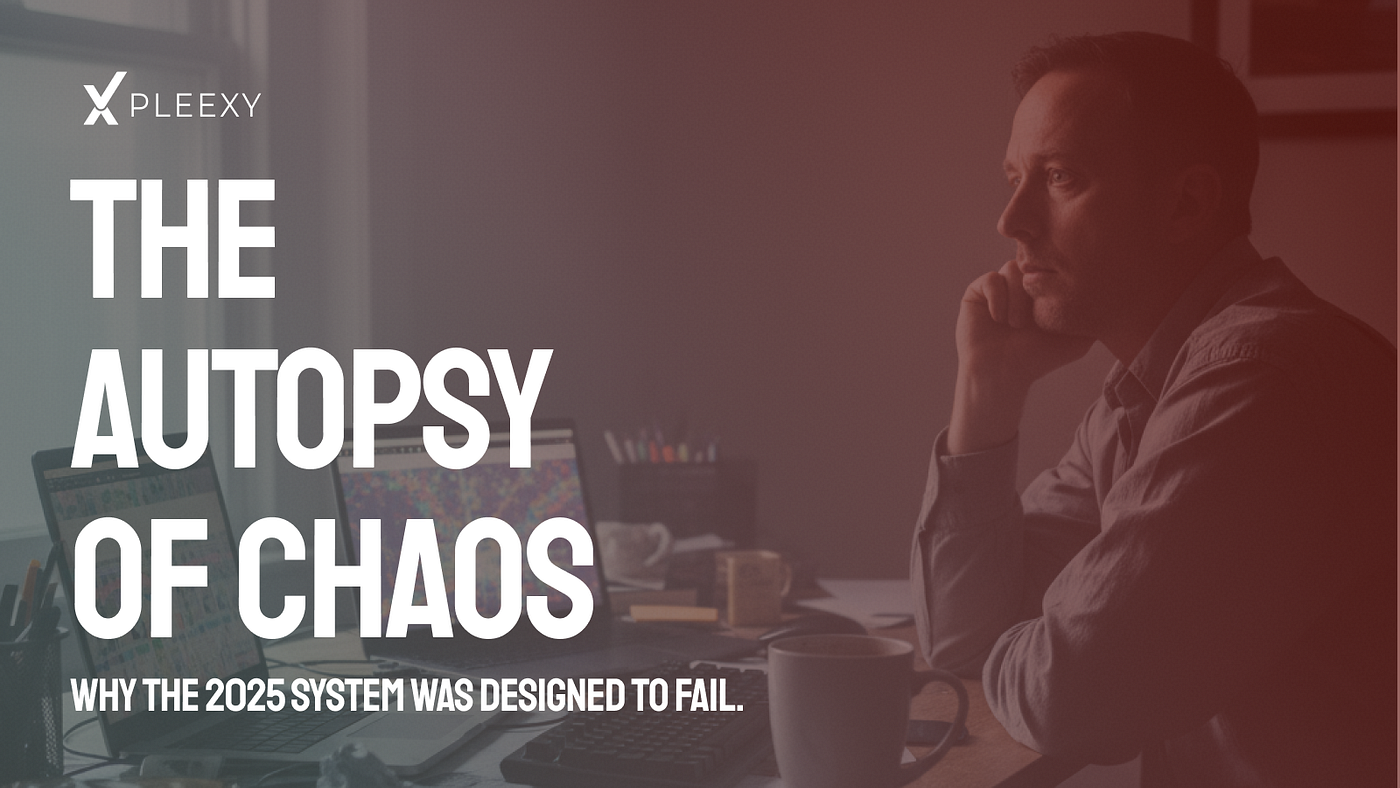
Why did 2025 end up feeling like a messy life that could never catch up? It wasn’t due to lack of discipline, lack of motivation, or individual problems. It was a poorly designed system.
Just as a personal life without structure ends up full of invisible pending tasks clean laundry left unput away, messages unanswered, decisions postponed “for when there’s time” the 2025 work system functioned the same way: everything felt urgent, nothing was truly organized, and fatigue grew without a clear reason. The chaos didn’t appear overnight. It accumulated.
When life becomes messy, it’s not the person: it’s the structure
A disorganized life doesn’t collapse due to a single event. It collapses when everything is left open at the same time: pending thoughts, unfinished tasks, decisions held in memory instead of a reliable system. The same happened operationally in 2025. Work was fragmented across multiple tools, constant notifications, and parallel flows. Each task lived in a different place. Every app switch was like moving to a new mental room without finishing what came before. The feeling was familiar: being busy all day yet feeling nothing really moved forward.
This disorder wasn’t just an individual perception. Analysis published by **Forbes** during 2025 showed that many teams and professionals were not failing due to lack of talent or discipline, but because they were operating within fragmented systems that increased mental load. The proliferation of disconnected tools, constant notifications, and poorly integrated workflows created an environment where effort was diluted in coordination rather than actual work. The result was widespread exhaustion, never-ending pending tasks, and loss of control even among highly organized people.
The brain is not designed to live in interruption mode
The study ***Examining the Impact of Technology Overload at the Workplace*** (SAGE Journals) shows that technology overload does not increase productivity. On the contrary, it increases stress, mental fatigue, and the feeling of lost control. It’s not the volume of work that exhausts, but how it’s distributed and presented.
This is supported by ***The Hidden Cost of Context Switching*** (BasicOps): every time a person switches tasks or tools, their brain must leave one mental context and rebuild another. This process has a real cost in energy and focus. When repeated constantly, much of the daily effort is spent not on progress, but on reorienting mentally. In simple terms: working while jumping between tasks is like trying to organize your life while each pending task appears in a different place without notice.
The parallel is clear: personal chaos and operational chaos
A person with a disorganized life doesn’t need more willpower. They need a system. A place where everything has logic, priorities are clear, and the mind doesn’t carry what can be delegated to an external structure.
The 2025 work system did the opposite: it multiplied entry points, fragmented attention, normalized constant urgency, and confused movement with progress. As ***The Hidden Cost of Context Switching*** shows, the real cost is not just lost productivity, but lost clarity. And without clarity, there is no direction.
The autopsy reveals the root cause: a flawed architecture
The problem was never the number of tasks. It was the absence of a reliable central system. A well designed system organizes, prioritizes, and reduces friction. The 2025 system accumulated, interrupted, and scattered. Like a life without clear routines, defined spaces, or real closures, work became an endless sequence of started but rarely completed things.
Pleexy: the structural fix for a failing system
Pleexy acts as the central system that digital work needed but didn’t have. It organizes tasks coming from different tools into a single reliable space, eliminates operational fragmentation, and restores workflow coherence. By reducing constant context switching, it allows attention to focus on actual progress.
Just as life becomes orderly when everything has a clear, accessible place, work becomes understandable when tasks are no longer scattered across platforms and are placed within a structure designed to support them. Pleexy transforms accumulated chaos into operational clarity. And when the system works, the mind stops carrying what doesn’t belong to it.
The real lesson from 2025
The chaos of 2025 was not a human error. It was a design failure. And design failures are not fixed with effort, they’re fixed with better systems. Understanding this changes the conversation: it’s no longer about doing more, but organizing better; no longer about resisting chaos, but eliminating it at the root.
Because when the system stops failing, clarity stops being the exception and becomes the natural state.
메타데이터
- post_id
- fee6f26da21d
- slug
- the-autopsy-of-chaos-why-the-2025-system-was-designed-to-fail-fee6f26da21d
- url
- https://blog.pleexy.com/the-autopsy-of-chaos-why-the-2025-system-was-designed-to-fail-fee6f26da21d
- canonical_url
- https://blog.pleexy.com/the-autopsy-of-chaos-why-the-2025-system-was-designed-to-fail-fee6f26da21d
- author_url
- https://medium.com/@pleexy
- status
- ok
- fetched_at
- 2026-06-10 08:17:25