The Battle of ‘Ain Jalut | Mongol vs. Egyptian Mamluk War
After the tears and screams, fields of bones were left buried in silence. The Butcher of Baghdad, Hulagu Khan, had left this land, his eyes…
The Battle of ‘Ain Jalut | Mongol vs. Egyptian Mamluk War
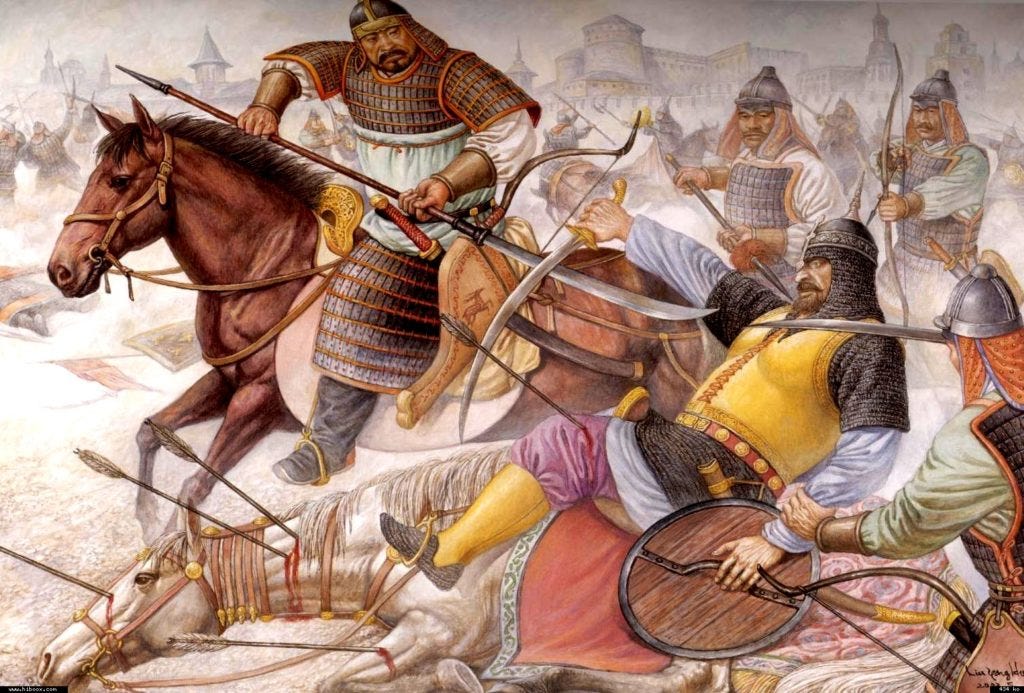
1260 Battle of Ain Jalut: The Victory that saved Islam and Started revival of Muslim Political Power in the World.
After the tears and screams, fields of bones were left buried in silence. The Butcher of Baghdad, Hulagu Khan, had left this land, his eyes fixed on Syria. The Sultan of Aleppo and Damascus, al-Nasir Yusuf, had failed to go to Hulagu and the Mongols in submission. Mongol envoys now went to him with a warning: destroy your fortresses and submit to the Great Khan in the East or suffer his wrath. Some in the Sultan’s court favored surrender, but the Sultan believed his cities could weather a siege. One commander, called Babar’s, beseeched the Sultan to rally his armies to meet the Mongols in the field. His eyes, silvered by a cataract, this hardened warrior from Egypt warned that walls would not avail against the Mongols. The Sultan disregarded him, and so Babar’s gathered his followers and left Syria to its doom. Death arrived in early 1260.
The Mongols breached the walls of Aleppo within a week. From the high citadel, the defenders were forced to watch the massacre of their people. The garrison held out for weeks before surrendering. Another fortress in the region also relinquished the fight, and it is written that they came down under amnesty, but Hulagu Khan was extremely angry with them and ordered them killed at once, along with their wives and children. Al-Nasir fled, and Damascus surrendered without resistance. Mongol-appointed administrators promptly established control over Syrian cities, thereby uprooting the last of the Ayyubid dynasty. Only a decade before, the Islamic Ayyubids had triumphed over the Crusaders in the ongoing war for the Holy Land, capturing and holding for ransom the French King Louis IX. Amidst the glow of victory, the Ayyubids were ousted from Egypt and overthrown by their elite slave soldiers called the Mamluks, who in turn set about fighting amongst each other for power. A distinguished Mamluk had fled for his life as his rivals seized control. Now he returns to make peace with his nemesis, the Mamluk Sultan of Egypt, Qutuz.
If the winds of war are brewing on the horizon, Babar’s will not flee again. Oh, the boy! He and his tribe, native to the Western steppe, fled the swords of invaders and sought refuge in the Crimean Peninsula. His people were attacked by a regional warlord; many were killed. Babar’s was sold into slavery and brought to Egypt, where he was trained to fight as a Mamluk. The invaders who displaced his people so long ago were the Mongols, and now envoys arrive in Cairo with a message from Hulagu, from the King of Kings of East and West, the Supreme Khan. They let Qutuz know that they are the soldiers of God on Earth, that he created them in his anger. Commit your faith to us before the veil is torn. We will not be touched by tears. [Applause] You have heard that we have purified the Earth of the disorders which defiled it and that we have slaughtered most of the inhabitants. It’s up to you to flee. What land will offer you refuge? Which road can save you? Your prayers to God against us will not be heeded. Hurry to give us an answer before the flames of war are ignited and its sparks are cast upon you. He advises Qutuz to warn his people: say to Egypt, Hulagu has come with swords unsheathed and sharp. The mightiest of her people will become humble; he will send their children to join the aged in death. Qutuz has the four Mongol envoys publicly cut in half. He hangs their heads from Bab Zuweila, the southern gate of Cairo, and the army rides out for war.
Hulagu has moved to cooler pastures in the north with the main army. In the recent death of the great Khan Mangu, he will further divert his attention from the front. He has left only around ten thousand Mongols in the region under the command of his general, Kitbuka, camped across Palestine. The land, held holy by Jews, Christians, and Muslims, has been pillaged with little effort to establish control. The word of the Mamluk advance reaches Kitbuka, and he rallies his warriors. Qutuz and the Muslim Mamluk army make camp outside the Crusader city of Acre, vowed adversaries of Islam. Some Christians, the Georgians, Armenians, and more recently the ruler of Antioch and Tripoli, have submitted and taken to fighting alongside their Mongol overlords. Kitbuka himself is a Christian. The Franks here in Acre refused to ally with the ruthless Mongols. The Crusaders send supplies to the Mamluks as a stifled show of support. Riding ahead, Babar’s locates the Mongol force not far from a spring called Ein Jalut. As twilight gives way to dawn over the hills of southeastern Galilee, the Mamluk army beholds the Mongols. Free troops, including Bedouins and Syrians, the core Mamluks are men who were sold as boys, raised in Islam, and relentlessly drilled to be professional warriors, adept in horse archery and melee, often clad in mail and lamellar armor, along with their horses. Across the plain, Mongol heavy troops menace in elaborate armor, either native to Mongolia or pillaged along the warpath. Standard Mongol warriors ride light with little to no armor. They have known horsemanship, archery, and war since infancy; personal reserve horses grant them inexhaustible mobility on the battlefield.
First blood is drawn by the Mongols. Heavy cavalry smashes into the Mamluk line, followed by a terrible burst of arrows. Mamluks fall all around. Qutuz feels the fear in his men; he shouts for them to hold position, to fight for Islam, and to answer with a charge of their own. In the course of battle, an Ayyubid prince serving on the Mongol left deserts with his troops. The Mamluks likely swarm this open edge, and the Mongol horde becomes entrenched in a bloody melee. Warriors in the eye of the storm tear each other apart with swords, axes, and spears. Horse archers exchange kills on the edges. At length, the Mongols begin to crumble. Some leap from their mounts for a last stand. General Kitbuka is overrun and his head is taken as a trophy by Qutuz. Babar’s hunts the remaining fleeing Mongols and slaughters many in the hills. When the Mamluks find Mongols hiding in a field of reeds, they set the field on fire. Word of the defeat at Ein Jalut echoes across the land. [Music] The Mamluks abandon conquered cities and overtake them. Qutuz then rides south to return to Egypt. He had deposed the previous Sultan and taken the throne less than a year prior. Before then, his allies had slain the companions of Babar’s, an account overseen by Babar’s himself recounts the journey home. Babar’s had already made arrangements with a small group of his followers. Riding beside Qutuz and talking with him, he suddenly seized his hand and his sword, drew back from him, and struck at him. The result was his death and removal as had been decreed by God. Babar’s did himself, touting his victory at Ein Jalut in his triumph over Qutuz. Babar’s receives the support of Egyptian commanders and becomes the Sultan of Egypt.
Hulagu does not think Ein Jalut a crushing defeat but a prelude to vengeance. His massive army is untouched and eager for battle, but animosities have grown between Hulagu and another Mongol prince to his north, Berke. Disputes over sovereignty and land have been further inflamed by Berke’s prior conversion to Islam and consequent desire to punish Hulagu for his massacre of Baghdad and its Caliph. The Empire has begun to fracture into distinct khanates. A Mongol civil war to establish a new Great Khan rages on in the East. Now war erupts between Hulagu and Berke. When Babar’s learns of this, he shrewdly forges an alliance with fellow Muslim Berke and his Golden Horde khanate, whereby Berke permits the ongoing slave trade from his lands to Egypt, which serves as the lifeblood of the Mamluk army. Engaged on two fronts, Hulagu seeks his own allies in a letter to King Louis IX of France. The Mongol prince boasts that he massacred Baghdad and Aleppo, that he captured al-Nasir Yusuf and, suspicious of his loyalty, had the man’s head stuck atop a gate in Tabriz. These attempts at European-Mongol alliances survive Hulagu’s death in 1265.
His son Abaga succeeds him as head of this Ilkhanate. He marries the illegitimate daughter of the Byzantine Emperor Michael VIII and later threatens Babar’s, reminding the former slave that he was bought in Siwas and asking how he could rebel against the kings of the Earth. So when Lord Edward of England leads a crusade in 1271, Abaga answers his call for aid. He sends 10,000 Mongols to pillage Syria. Yet Crusader-Mongol efforts toward alliance rarely amount to effective cooperation. Babar’s emerges with his army to find that the Mongols have already returned north. He clashes with the Crusaders and, by some accounts, sends an emissary assassin to kill the future King Edward. The agent stabs Edward, possibly with a poison dagger. Edward kills the assailant but decides to abandon the crusade. Such are the means of survival in a web of Islamic, Christian, and Mongol interests, complicated by internecine divisions. [Music] The Mongol promise of revenge still looms, and in 1277, nearly two decades after the fateful battle at Ein Jalut, Babar’s musters the Mamluk army and takes up his sword once more. The Sultan’s visage betrays long years of war. The journey north feels more labored than it once did. Trekking through sand and mountains, the Mamluks stop to camp in the moonlit hills near Al-Bustan, Mongol territory. The Mongols gather in a nearby valley and inaugurate the day of battle with a vengeful onslaught. The Mamluk left cracks; men fall mangled by arrows. Babar’s hastens to reinforce the flank and shouts for a counter-attack. The Mongols cannot stem the Mamluk tide. The Mamluks cover them in blades and arrows. The tapestry of Mongol dead spreads thick over the whole plain. Following the elation of victory, heightened by the Islamic holiday of Eid, Babar’s forbids his men to play celebratory drums, lamenting, “How can I rejoice? I had believed that if ten thousand horsemen of my army were to meet thirty thousand Mongols, I would defeat them, but I met seven thousand Mongols with all my army. The Mongols aroused panic, and my army lost heart. Without Allah’s grace, they would have defeated us.” Babar’s dies later that year.
It represented a halt to the Mongol advance, but it had been the cunning Babar’s who held the line thereafter and built a fearsome Mamluk army. Four years after his death, a massive Mongol army invaded Syria, but the Mamluks vanquished them. Notwithstanding one major defeat in 1299, the Mamluks continued to thwart further Mongol conquest in the region. Mongols engaged many worthy opponents on the remote edges of their empire, including the Knights of Europe, Samurai of Japan, and the Mamluks of Egypt. But even costly offensives did not break the Mongol horde. The greatest enemies, the ultimate undoing of the Mongol Empire, were the Mongols themselves. Inward, the very avarice, brutality, and claims to power that built the empire turned the Khans against each other. The vision of unending conquests dreamed by the long-dead Genghis Khan faded years ago. In the midst of his civil war against Hulagu, Berke Khan wandered through cold heaps of Mongol dead and lamented, “Mongols are killed by Mongol swords. If we were united, then we would have conquered all of the world.
메타데이터
- post_id
- fee83b8c3de2
- slug
- the-battle-of-ain-jalut-mongol-vs-egyptian-mamluk-war-fee83b8c3de2
- url
- https://medium.com/@er.jahanzeb/the-battle-of-ain-jalut-mongol-vs-egyptian-mamluk-war-fee83b8c3de2
- canonical_url
- https://medium.com/@er.jahanzeb/the-battle-of-ain-jalut-mongol-vs-egyptian-mamluk-war-fee83b8c3de2
- author_url
- https://medium.com/@er.jahanzeb
- status
- ok
- fetched_at
- 2026-07-22 22:06:02