More than 60% of inspected home battery installations are substandard, regulator data shows
More than 60% of home battery installations inspected under Australia’s Cheaper Home Batteries Program were found to be substandard, with a…
More than 60% of inspected home battery installations are substandard, regulator data shows
A home solar and battery system on an Australian rooftop. Photograph: Troy Mortier / Unsplash
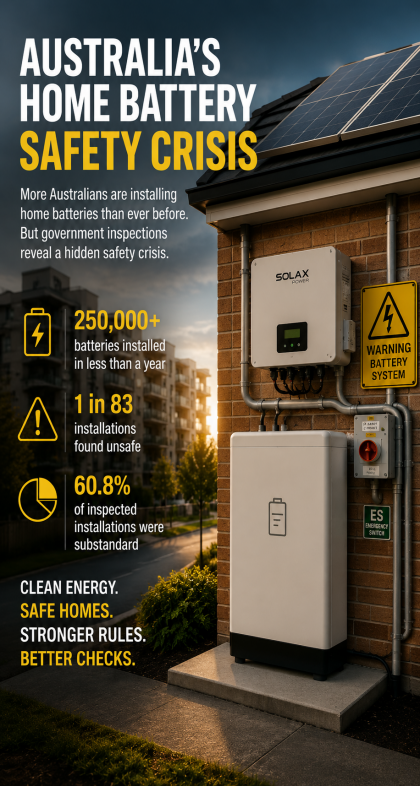
Australia’s home battery safety crisis. Graphic: Xin Hu.
More than 60% of home battery installations inspected under Australia’s Cheaper Home Batteries Program were found to be substandard, with a further 1.2% classified as unsafe, according to Clean Energy Regulator data.
The findings raise concerns about safety standards as federal subsidies drive a rapid expansion in household battery storage.
A National Safety Crisis in Plain Sight
Between July 2025 and April 2026, the CER conducted 1,278 inspections. The results were a wake-up call for the industry:
- 60.8% of installations were found to be substandard.
- 1.2% (one in every 83) were classified as outright “unsafe.”
- The primary risks included fire hazards and imminent electric shocks.
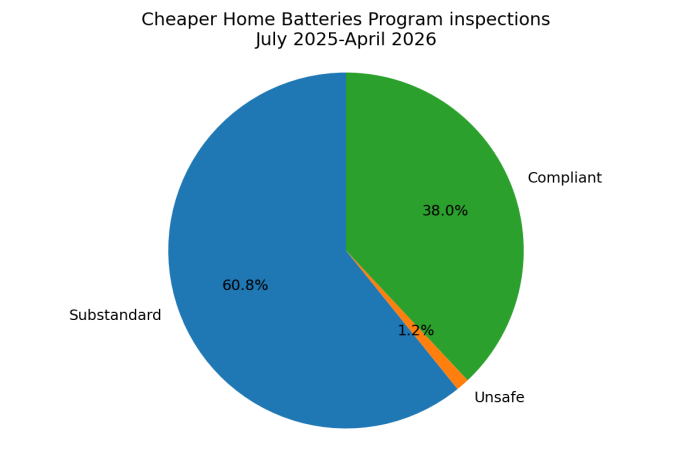
Inspection results from the Cheaper Home Batteries Program, July 2025–April 2026. Graphic: Xin Hu. Source: Clean Energy Regulator.
The program itself has been, by the government’s own measures, a remarkable success. More than 250,000 Australian households and small businesses installed a battery system in its first nine months, representing 7.7 gigawatt hours of stored energy capacity.
The original budget was $2.3 billion; the program has already blown out to $7.2 billion as demand far exceeded projections.
But behind those figures lies a compliance crisis that researchers say reveals a structural flaw in how Australia is managing its clean energy transition.
Speed vs. Safety: Why the System is Failing
Rusty Langdon, a Senior Research Consultant at the University of Technology Sydney’s Institute for Sustainable Futures, wrote that electricians working in the industry are under significant pressure as they try to keep up with demand. He argued that the scale of the workload increases the risk of installation problems falling through the cracks.
According to industry analysis by SolarQuotes, Queensland recorded particularly high rates of non-compliance. The most dangerous failures involved loose wiring connections and wiring showing visible signs of heat damage. Only 10% of installers, experts estimate, are consistently following correct wiring practices.
The most common category of non-compliance involves labelling: missing or incorrect warning signs at switchboards, incorrectly labelled backup circuits, and missing emergency services markers. Without proper labels, an electrician or firefighter has no way of knowing a battery is still energised — even when the main power switch is turned off.
Gavin, an electrician interviewed for this story, said the most serious risks are not always the most visible ones. In his view, incorrect equipment ratings, poorly selected protection devices and incompatible inverters can create fire or shock hazards that a homeowner may not notice until something goes wrong.
Calvin, a resident who uses a home battery system, said he initially installed the battery mainly to reduce electricity bills and make better use of the energy generated by his solar panels. But he said most of the information he received before installation focused on benefits and cost savings, while safety risks were only briefly explained.
John, a Sydney strata property manager interviewed for this story, described the knowledge gap firsthand: “Most residents don’t know the battery has an isolation switch. If I ask whether we turn it off in a fire, they look blank.”
[embed]Video: Home battery safety — a property manager’s perspective. Source: xinny.hu on Instagram.
SolarQuotes founder Finn Peacock has argued that an excessive focus on labelling can distract attention from more serious safety risks.
Gavin said labelling still matters, because batteries and solar systems can remain live even when a person believes the power has been isolated. But he said paperwork alone cannot fix poor installation practice, especially when inexperienced workers are brought in to meet demand.
The regulator is aware of the problem. In February 2026, the CER announced new requirements including mandatory geotagged photographs of critical labelling from every installer, and the use of artificial intelligence to audit photo submissions.
“I’m putting installers on notice that unsafe and non-compliant work will be identified, and we won’t hesitate to use our compliance powers,” said CER Executive General Manager Carl Binning.
The Accountability Gap
The responsibility gap extends inside buildings too. John told this reporter: “On paper, the installer is liable for two years, but when a battery alarms at 11 p.m., they don’t answer.”
Calvin described a similar uncertainty from the homeowner’s side. “The installer points to the manufacturer, the manufacturer points to the installer, and as a homeowner you’re stuck in the middle trying to figure it out,” he said.
[embed]Video: Buying Home Batteries In Australia In 2026: What You Need To Know. Source: SolarQuotes on YouTube.
Gavin also said the rebate-driven rush had increased pressure on the industry. Some workers, he said, are doing the physical installation before an electrician arrives to complete and sign off the electrical work. “Faults often don’t happen when they go live,” he said. “They happen in time.”
For Australians who have already had a battery installed, experts recommend checking the Clean Energy Regulator’s online inspection checklist, verifying the installer’s accreditation through Solar Accreditation Australia, and looking for warning signs: cables without protective conduit, labels missing from the switchboard, or a battery mounted in direct sunlight.
John also warned that a government-approved installation is not automatically safe for the specific building:“The approval didn’t check if our 20-year-old riser could handle the backfeed. ‘Approved’ and ‘safe for this specific building:“are not the same thing.”
For Calvin, the issue is not only technical but informational. “Stop assuming that residents understand this technology,” he said. “Most people buy these systems to save money, not because they’re experts in electrical safety.”
References
Clean Energy Regulator. (2026, February). Safety a priority as solar and battery installations surge. Australian Government. https://cer.gov.au/news-and-media/media/2026/february/safety-priority-solar-battery-installations-surge
Opray, M. (2026, February 26). ‘Substandard’ battery installs trigger inspection blitz. SolarQuotes. https://www.solarquotes.com.au/blog/substandard-battery-installs-trigger-inspection-blitz/
Langdon, R. (2026, April 17). More than 60% of home battery installations inspected in Australia are ‘substandard’. The Conversation.*https://theconversation.com/more-than-60-of-home-battery-installations-inspected-in-australia-are-substandard-280449*
SolarQuotes. (2026). Buying Home Batteries In Australia In 2026: What You Need To Know [Video]. YouTube. https://www.youtube.com/watch?v=1N_ZsLrfUJM
Mortier, T. (n.d.). Solar panels on Australian rooftop [Photograph]. Unsplash. https://unsplash.com/photos/solar-panels-rooftop-australia
John (surname withheld). (2026, May). Personal interview conducted by X. Hu [Interview transcript]. Unpublished raw data.
Gavin (surname withheld). (2026, May). Personal interview conducted by X. Hu [Interview transcript]. Unpublished raw data.
Calvin (surname withheld). (2026, May). Personal interview conducted by X. Hu [Interview transcript]. Unpublished raw data.
Hu, X. (2026) Home battery safety — a property manager’s perspective [Instagram Reel]. Instagram. Available at: https://www.instagram.com/reel/DY7GAJBBJkH/?igsh=d202djExeHRuMXhs (Accessed: 1 June 2026).
#HomeBattery #AustraliaEnergy #CleanEnergy #SolarPower #BatterySafety #RenewableEnergy #CheaperHomeBatteries #CleanEnergyRegulator #SolarQuotes #EnergyStorage #AustraliaClimate #HomeEnergy #BatteryInstallation #EnergyTransition #MECO6925
메타데이터
- post_id
- fef748183df9
- slug
- plugged-in-but-at-risk-australias-home-battery-boom-is-leaving-thousands-of-households-with-fef748183df9
- url
- https://medium.com/@hx2376978709/plugged-in-but-at-risk-australias-home-battery-boom-is-leaving-thousands-of-households-with-fef748183df9
- canonical_url
- https://medium.com/@hx2376978709/plugged-in-but-at-risk-australias-home-battery-boom-is-leaving-thousands-of-households-with-fef748183df9
- author_url
- https://medium.com/@hx2376978709
- status
- ok
- fetched_at
- 2026-06-09 15:37:30