String + Length: A Zero-Overhead Trick in C
In C you often need to keep a string together with its length. Calling strlen() every time means extra memory scans. We want it compact and…
String + Length: A Zero-Overhead Trick in C
In C you often need to keep a string together with its length. Calling strlen() every time means extra memory scans. We want it compact and efficient.
✅ Solution
A tiny trick with typedef + macro:
typedef struct { const char *p; size_t n; } sv;
#define SV(s) { (s), sizeof(s) - 1 }

struct Messages {
    sv error, version, rep_prefix;
};

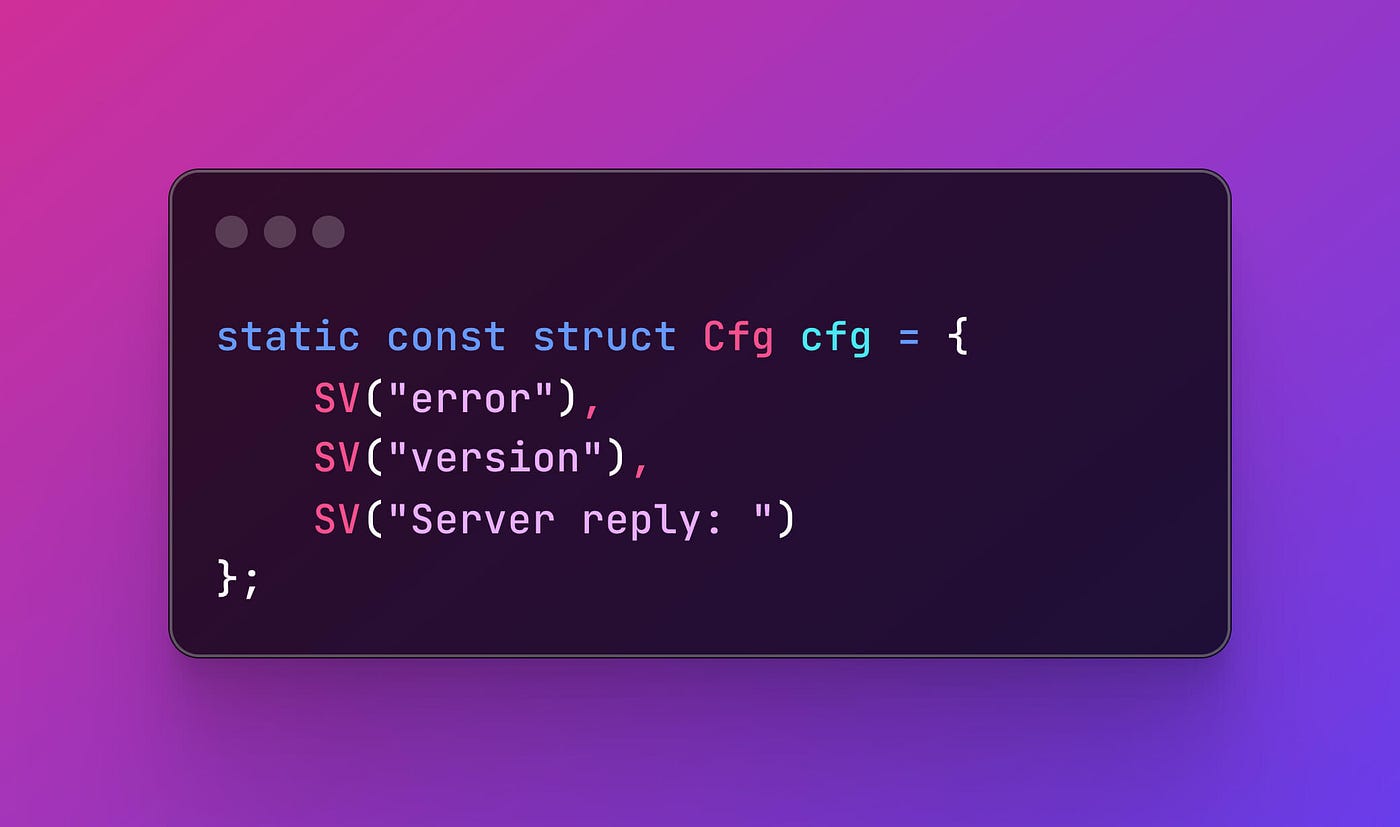
static const struct Messages mess = {
    SV("error"),
    SV("version"),
    SV("Server reply: ")
};
After preprocessing it becomes:
static const struct Messages mess = {
    { ("error"),          sizeof("error") - 1 },
    { ("version"),        sizeof("version") - 1 },
    { ("Server reply: "), sizeof("Server reply: ") - 1 }
};
— string and its length, no redundant strlen().
Usage
#include <stdio.h>

int main(void) {
    fwrite(mess.rep_prefix.p, 1, mess.rep_prefix.n, stdout);
    fwrite("OK\n", 1, 3, stdout);
    return 0;
}
Handy in network protocols, logging, binary formats — string + size always at hand, zero overhead.
메타데이터
- post_id
- feff1c557eee
- slug
- string-length-a-zero-overhead-trick-in-c-feff1c557eee
- url
- https://medium.com/@anton_ds/string-length-a-zero-overhead-trick-in-c-feff1c557eee
- canonical_url
- https://medium.com/@anton_ds/string-length-a-zero-overhead-trick-in-c-feff1c557eee
- author_url
- https://medium.com/@anton_ds
- status
- ok
- fetched_at
- 2026-06-24 16:30:55


