Agentic AI in Software Development: Moving Beyond Copilots
Most developers today have experimented with a coding copilot, you type a function, and it generates the code in seconds. Impressive…
Agentic AI in Software Development: Moving Beyond Copilots
Most developers today have experimented with a coding copilot, you type a function, and it generates the code in seconds. Impressive? Absolutely. But limited. The copilot only suggests; the developer still decides.
Now, a new wave of technology is emerging: agentic AI. Unlike copilots that wait for prompts, agents act more like teammates. They can:
- Understand project goals
- Break them down into subtasks
- Write, test, and refine code
- Open pull requests and summarize progress
This shift is subtle but game-changing. We’re moving from AI as a coding assistant to AI as an active collaborator.
In this article, we’ll explore what makes AI “agentic,” how it fits into modern development workflows, the benefits and risks, and how teams can experiment responsibly without losing engineering discipline.
What Makes AI “Agentic”?
Traditional copilots are reactive, they autocomplete and draft code. Agentic AI is proactive. It plans, executes, and improves workflows.
Example:
- Copilot: “Here’s code for a login form.”
- Agent: “I’ve created a full login flow, tested it, updated documentation, and opened a PR for review.”
Agents use feedback loops (generate → test → fix → retry) and can integrate with tools like GitHub, Jira, or Jenkins. This makes them capable of handling not just code, but the surrounding processes that keep software projects running.
Where Agentic AI Fits in the Workflow
Backlog Grooming & Task Breakdown
Agents can analyze requirements and generate subtasks.
- *Example: From “support PayPal checkout,” the AI creates tickets for API integration, UI changes, and security testing.
Iterative Coding & Testing
Instead of one-off code suggestions, agents cycle until unit tests pass. Example: Building a feature branch, retrying until tests are green, then submitting a PR draft.
Quality Checks in CI/CD
Agents can detect flaky tests, recommend parallelization, or even roll back failed pipelines automatically.
Documentation & Knowledge Capture
Beyond code, agents can draft README updates, changelogs, and architecture notes as features evolve.
Post-Deployment Monitoring
Agents track logs for anomalies, open issues when errors occur, and escalate critical alerts to the team.
Example: OAuth Login End-to-End
Imagine a product team requests Google OAuth login.
- Spec: Plain-language request: “Add OAuth login with Google.”
- Task Split: Agent generates subtasks (backend endpoints, token storage, UI button).
- Code: Scaffolds backend and frontend components.
- Tests: Writes unit + integration tests, retries until they pass.
- Docs: Drafts README updates on setup.
- PR: Opens pull request, tags reviewers.
- CI: Suggests caching tweaks for faster builds.
- Post-Deploy: Monitors login errors, flags anomalies.
Here, humans still review and approve. But the agent has automated nearly 70% of the routine tasks, allowing developers to focus on architecture and design.
Benefits You Can Expect
- Speed: Faster delivery of small-to-medium features.
- Consistency: Enforces coding standards without fatigue.
- Focus: Developers spend more time on design and architecture.
- Exploration: Teams can prototype ideas more efficiently.
Risks & How to Avoid Them
- Error Loops: Agents might retry endlessly with incorrect fixes. Solution: Run in sandboxes and cap retries.
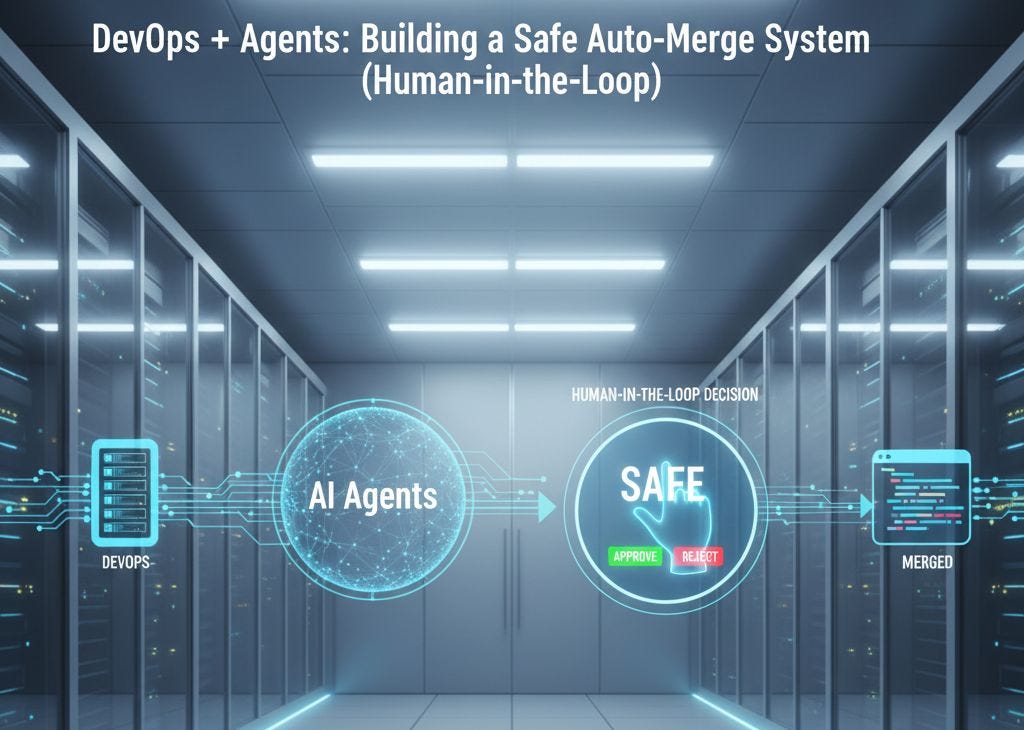
- Loss of Oversight: Autonomous merges could bypass senior review.
- *Solution: Require human approval for production merges.
- Compliance & Security Issues: Sensitive data could leak through prompts. Solution: Never expose secrets; use enterprise-secure models.
- Tool Overload: Too many immature frameworks can fragment workflows. Solution: Standardize on vetted tools and centralize evaluations.
Governance Checklist for Teams
Before adopting agentic AI, ensure you:
- Log all agent actions for audit trails
- Keep humans in the approval loop
- Run all generated code through security scans
- Test only in staging environments
- Define rollback procedures for regressions
Frequently Asked Questions (FAQs)
Q1. Can agentic AI replace developers?
No. Agents are best at repetitive, well-defined tasks. They struggle with complex architecture and design. Think of them as supportive teammates, not replacements.
Q2. What’s the best way to start experimenting with agents?
Start small — try agents for PR drafting, test generation, or documentation updates before moving into larger workflows.
Q3. Is agentic AI too experimental for enterprises?
Not necessarily. With audit logs, staging-only runs, and human approvals, enterprises can experiment safely without disrupting production.
Q4. What new skills will developers need?
Developers will need stronger skills in architecture, code review, and prompt/agent design, while routine coding becomes increasingly automated.
Conclusion
Agentic AI represents the second wave of AI in software development. The first wave made developers faster at the keyboard. The second gives AI agency the ability to pursue goals, collaborate across tools, and close feedback loops. It’s not about replacing engineers. It’s about freeing them from repetitive glue work so they can focus on system design, business logic, and innovation.
The question isn’t whether agentic AI will enter the dev stack, it already has. The real question is: how will your team experiment, govern, and scale it safely? In our next piece, we’ll explore AI in the Software Development Life Cycle and how agents and copilots fit into each stage from design to deployment.
Listen on Spotify
Catch the full discussion at our podcast on Spotify: **Agentic AI in Software Development: Moving Beyond Copilots**
Resources Mentioned
메타데이터
- post_id
- ff0bfe42db91
- slug
- agentic-ai-in-software-development-moving-beyond-copilots-ff0bfe42db91
- url
- https://medium.com/ai-code-journal/agentic-ai-in-software-development-moving-beyond-copilots-ff0bfe42db91
- canonical_url
- https://medium.com/ai-code-journal/agentic-ai-in-software-development-moving-beyond-copilots-ff0bfe42db91
- author_url
- https://medium.com/@semanticedonline
- status
- ok
- fetched_at
- 2026-06-12 22:02:08