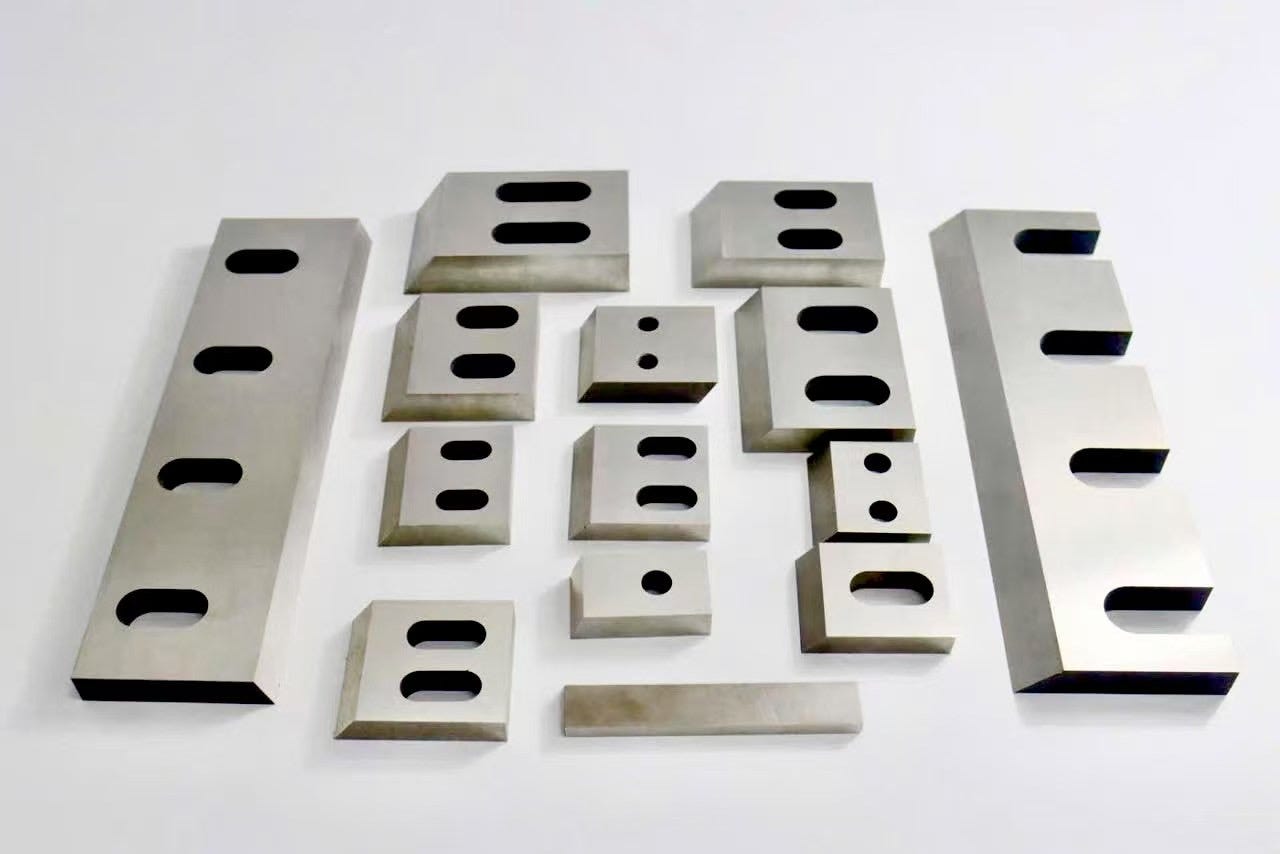
Crusher Blade Material Guide: D2 vs SKD11 vs DC53 — What Actually Matters
A factory manufacturer’s perspective on the steel selection decision most buyers get wrong
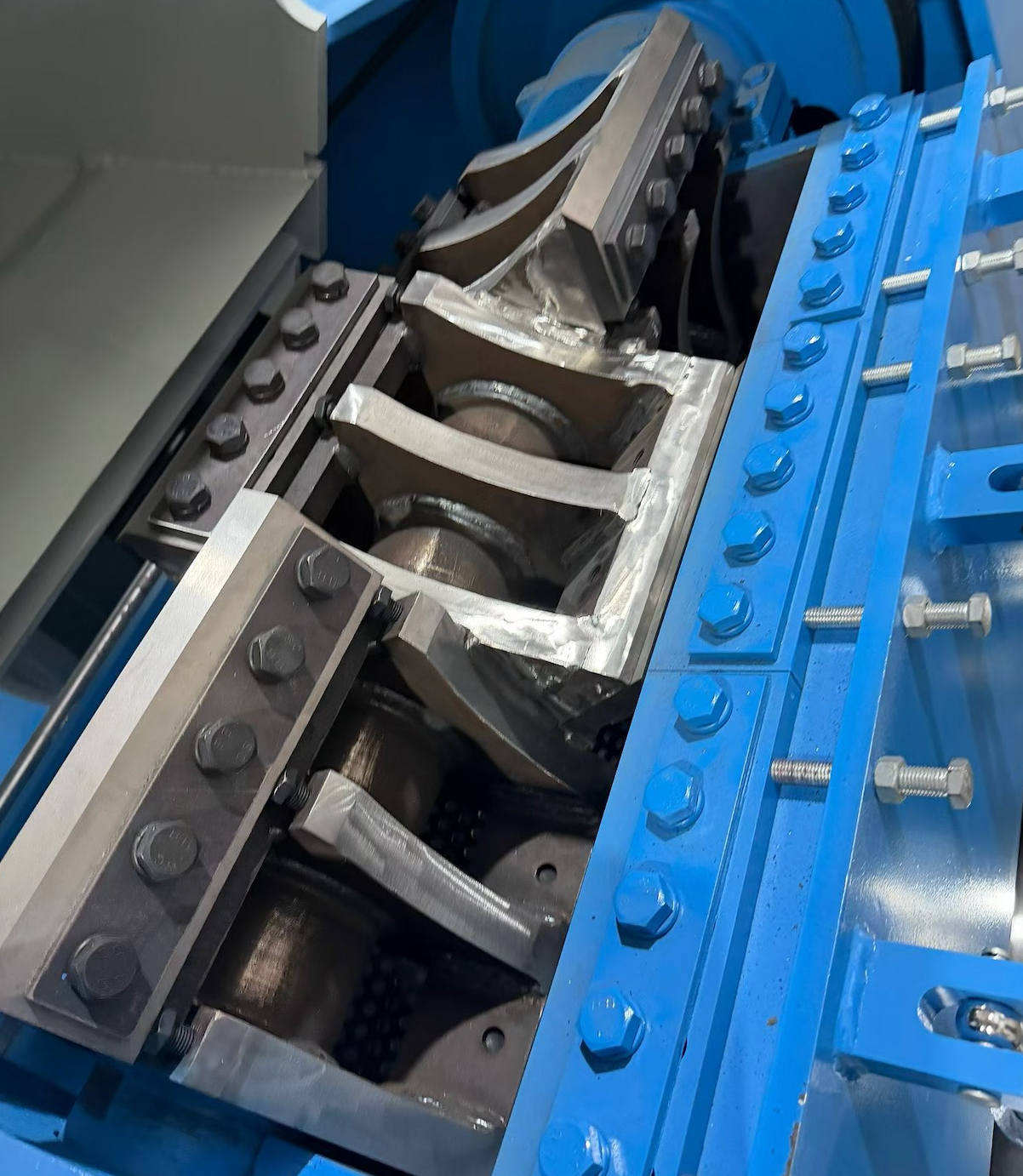
Crusher Blade Material Guide: D2 vs SKD11 vs DC53 — What Actually Matters
A factory manufacturer’s perspective on the steel selection decision most buyers get wrong

If you run a plastic recycling operation and you’ve ever had crusher blades fail faster than expected, there’s a good chance the problem wasn’t quality.
It was material selection.
D2, SKD11, and DC53 are the three tool steels that cover the vast majority of plastic crusher and shredder blade applications. They look similar on a spec sheet. They perform very differently in production. And the gap between “right steel” and “wrong steel” can mean the difference between a blade lasting three weeks or three months.
This guide is based on eight years of manufacturing crusher blades at our factory in Ma’anshan, China. It covers what each steel actually does, where each one belongs, and the question most buyers forget to ask.
Why Steel Selection Gets Ignored
The typical blade procurement process goes like this: machine breaks down, operator tells procurement to order more blades, procurement contacts a supplier and asks for “the same as before,” supplier ships whatever they have in stock.
Nobody asks what material is being crushed. Nobody asks about failure mode — was it chipping, or just wear? Nobody asks about heat treatment.
The result is a cycle where blades underperform, get replaced more frequently than necessary, and the cause is never identified because it was never investigated.
Steel selection is not complicated. But it requires asking two questions before ordering:
- What material am I crushing?
- How are my current blades failing?
The answers determine everything.
The Three Steels
D2 — The Industry Standard
D2 is the most widely used tool steel for plastic crusher blades worldwide. High chromium content (around 11–13%) provides excellent wear resistance. After proper heat treatment, it reaches HRC 58–62. It’s well-understood, widely available, and cost-effective.
For standard plastic recycling applications — PET bottles, HDPE containers, PP and PE film, general rigid plastic — D2 is usually the correct choice. It handles consistent, moderate-impact crushing loads well. It resharpens predictably across 3–5 cycles. It does its job without drama.
The limitation is toughness. D2’s carbide structure is relatively coarse, which is part of what makes it wear-resistant, but it also means the cutting edge has limited resistance to shock loading. When the feed material is hard, irregular, or occasionally contaminated, D2 edges chip rather than wear. Chipping is a different failure mode from wear — it’s not about the blade running out of material, it’s about the edge fracturing under impact. And chipping is a sign that the steel isn’t tough enough for the application.
Use D2 when: your material is commodity plastic, your feed is consistent, and you have an established resharpening program.
SKD11 — The Precision Standard
SKD11 is the Japanese Industrial Standard (JIS) equivalent of D2. The base chemistry is similar — high chromium, high carbon, cold-work tool steel — but the manufacturing tolerances are tighter and the carbide distribution is more uniform.
In most production environments, D2 and SKD11 perform comparably in service life. The difference shows up in precision-dependent applications.
Multi-blade sets. Machines that run 20, 30, or 40 blades simultaneously depend on dimensional consistency across the set. If blade height varies by even a fraction of a millimeter, cutting loads distribute unevenly. Some blades carry more impact than others. Wear accelerates. SKD11’s tighter tolerances reduce that variation.
Resharpening cycles. Every resharpen removes material from the cutting edge and slightly changes blade geometry. SKD11 maintains its geometry more predictably across multiple regrind cycles than D2. For operations that resharpen frequently — which is good practice — this consistency matters.
Regional specifications. SKD11 is the default blade steel specification in Japan, Taiwan, and much of Southeast Asia. If your machine OEM specifies SKD11, or if you supply into these markets, it’s the correct standard to work to.
Use SKD11 when: you need consistent dimensions across a full blade set, you resharpen frequently, or your application or market specifies it.
DC53 — The High-Performance Option
DC53 is a proprietary tool steel developed by Daido Steel in Japan. It was engineered specifically to solve the main weakness of D2 and SKD11: inadequate toughness at high hardness levels.
At equivalent hardness, DC53 has approximately twice the impact toughness of D2. It also achieves higher hardness — HRC 62 or above — without the brittleness that would make D2 or SKD11 unusable at that hardness level. The carbide structure is finer and more uniformly distributed, which means the cutting edge is supported more evenly under load.
This makes DC53 the correct choice for engineering plastics.
PA66 nylon, polycarbonate, ABS, glass-fiber reinforced compounds — these materials are fundamentally different from commodity plastics. They are harder, more abrasive, and they generate significantly higher impact forces during crushing. D2 blades on engineering plastic lines typically fail in one of two ways: micro-chipping at the cutting edge from impact shock, or accelerated abrasive wear from glass fiber content. Sometimes both.
DC53 addresses both failure modes. Higher toughness resists edge chipping. Higher achievable hardness improves abrasion resistance. The result, in production experience across multiple customer lines, is a 40–60% improvement in blade service life compared to D2 when processing hard engineering plastics.
The steel costs more. The cost per operating hour usually comes out lower.
Use DC53 when: you process engineering plastics, you’ve experienced chipping with D2, or you want to reduce blade change frequency on demanding applications.
The Variable Nobody Talks About: Heat Treatment
Steel grade selection determines the potential of a blade. Heat treatment determines whether that potential is realized.
The same D2 blank, heat-treated by two different processes, can produce blades that perform entirely differently. The key variables are austenitizing temperature (which controls carbide dissolution and final hardness), quench rate (which affects residual stress and distortion), and tempering (which relieves stress and stabilizes dimensions).
Vacuum heat treatment is the standard for precision industrial blades. It produces consistent results, minimal surface oxidation, and controlled dimensional change. Salt-bath or open-furnace heat treatment introduces variables — temperature gradients, surface contamination, less precise control — that can compromise blade performance regardless of the steel grade specified.
Double tempering, running two tempering cycles rather than one, further stabilizes the blade’s internal structure and reduces residual stress. It adds time and cost. It produces a more stable blade.
When evaluating a blade supplier, the right questions are not just “what steel?” but “what heat treatment process?” and “what hardness do you target and how do you verify it?” A supplier who can answer these questions specifically is a supplier who understands what they’re making.
A Simple Decision Framework
D2:
- Commodity plastic: PET, HDPE, PP, PE film
- Consistent, clean feed material
- Budget is a constraint
- Established resharpening program in place
SKD11:
- Precision granulators requiring tight dimensional tolerances
- Multi-blade sets where consistency across the set matters
- Frequent resharpening cycles
- Applications or markets that specify SKD11
DC53:
- Engineering plastics: PA66 nylon, PC, ABS, glass-filled compounds
- History of edge chipping with D2
- High-impact or variable feed material
- Priority on minimizing blade change downtime
Frequently Asked Questions
Can DC53 blades replace D2 blades without modifying the machine?
Yes. DC53 blades are dimensionally interchangeable with D2 blades of the same specification. The steel grade change does not affect fit or installation.
How many times can crusher blades be resharpened?
Typically 3–5 cycles before the blade geometry is too compromised to maintain proper cutting clearance. Each resharpen removes material from the cutting edge; once the blade falls below minimum height specification, it should be replaced rather than resharpened again.
Is higher hardness always better?
No. Higher hardness increases wear resistance but reduces toughness. For D2 and SKD11, pushing hardness above HRC 62 increases chipping risk. DC53 can be run at higher hardness without the same toughness penalty, which is part of what makes it suitable for demanding applications.
What information should I give a blade supplier to get an accurate quote?
Crusher brand and model, blade dimensions (length × width × height in millimeters), current blade material if known, what you’re crushing, and your typical blade change interval. This is enough to make a proper material recommendation and quote.
About XTBLADES
XTBLADES is a factory-direct manufacturer of industrial cutting blades based in Ma’anshan, Anhui Province, China. We have manufactured plastic crusher blades, shredder blades, and wood chipper blades for international markets since 2017, with ISO 9001 certification and export experience across Australia, the Middle East, Southeast Asia, and South America.
We manufacture D2, SKD11, and DC53 crusher blades to customer specifications, with OEM-compatible options for Genox, Zerma, Weima, Herbold, Vecoplan, Cumberland, and other major brands.
To request a quote, send crusher brand and model, blade dimensions, material being processed, and monthly consumption volume. Response within 24 hours.
🌐 xtblades.com
메타데이터
- post_id
- ff0dfd738eb1
- slug
- crusher-blade-material-guide-d2-vs-skd11-vs-dc53-what-actually-matters-ff0dfd738eb1
- url
- https://medium.com/@lc18096440190/crusher-blade-material-guide-d2-vs-skd11-vs-dc53-what-actually-matters-ff0dfd738eb1
- canonical_url
- https://medium.com/@lc18096440190/crusher-blade-material-guide-d2-vs-skd11-vs-dc53-what-actually-matters-ff0dfd738eb1
- author_url
- https://medium.com/@lc18096440190
- status
- ok
- fetched_at
- 2026-08-08 06:39:37