India Macro Strategy: June 2026
India at the Inflection: Domestic Resilience vs. External Fragility
India Macro Strategy: June 2026
India at the Inflection: Domestic Resilience vs. External Fragility
GDP recovers to 7.6% in FY26. Rates have bottomed. The rupee is testing new lows. The trade architecture is being redrawn. Here is where we stand.
The visual case — three charts, three signals:
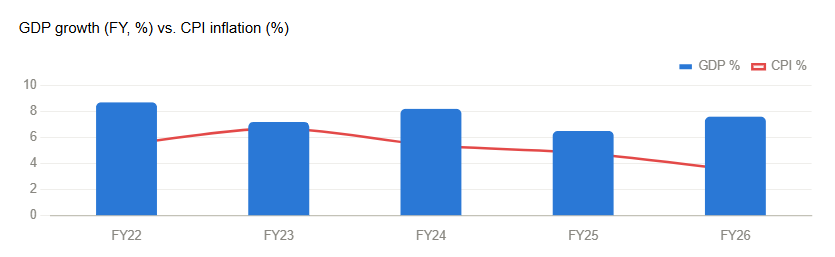
Signal 1 — the growth-inflation sweet spot
India is in a rare policy window. FY26 real GDP printed 7.6% — the fastest in years — while CPI averaged below 3.5%, well inside the RBI’s 4% target. The last time India saw this combination of above-7% growth and below-4% inflation was pre-2019. The RBI seized the moment: 125 bps of cumulative cuts delivered in one of the sharpest easing cycles in a decade.
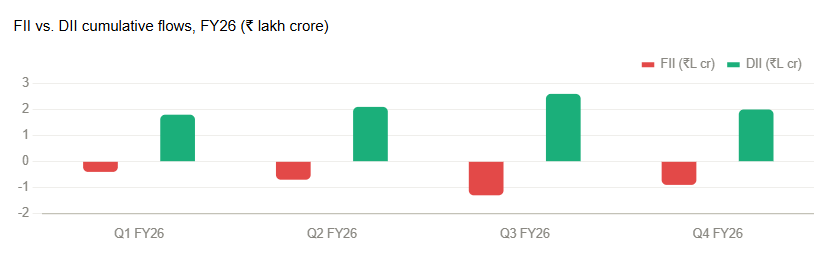
Signal 2 — the great domestic buffer
India’s market structure has fundamentally changed. FIIs net-sold over ₹3.3 lakh crore in FY26 — driven by US rate stickiness, a stronger dollar, and the West Asia crude shock. DIIs absorbed every rupee and more, deploying ₹8.5 lakh crore. SIP inflows hit ₹38,440 crore in April 2026 alone. This is no longer a market hostage to foreign flows — a 1991-style capital flight becomes structurally harder.
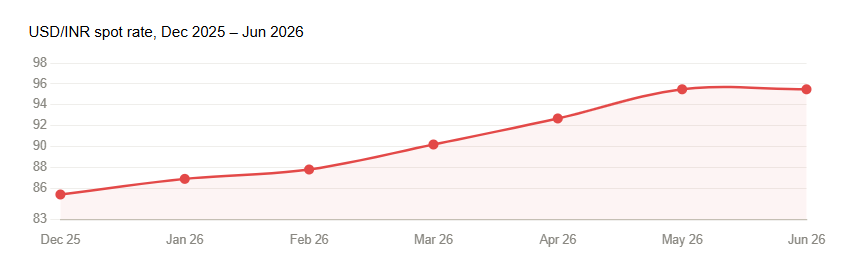
Signal 3 — the rupee under structural stress
The rupee is the pressure valve for all of India’s external imbalances. From ₹85/USD in December 2025 to a record low of ₹96.8 in May 2026 — an ~12% depreciation in six months. The twin drivers: a stubbornly firm DXY and crude oil above $100/bbl on West Asia tensions. The RBI intervened tactically (forex swaps of ~$25bn) but has not aggressively defended a level, preserving reserves at a comfortable $688–691bn.

The narrative
The macro regime: from tightening to cautious ease, now on hold. India’s easing cycle began in February 2025 and delivered 125 bps of cuts by December — one of the most compressed easing cycles since the post-GFC era. The RBI held in both April and June 2026 as the West Asia conflict repriced crude and pushed FY27 inflation forecasts toward 4.6%. The question is no longer whether the cycle restarts — it is whether a hike becomes necessary. With core CPI above 4% and crude remaining elevated, the RBI is threading a needle reminiscent of the 2013 taper tantrum period, when Raghuram Rajan had to hike into a weakening currency and slowing growth. Today’s fundamentals are structurally stronger, but the optionality is limited.
Balance of payments: a managed vulnerability. The merchandise trade deficit widened to $333.2bn in FY26 (+18% YoY) as imports grew 7.6% while exports gained just 0.9%. The current account deficit remains at approximately 1.5% of GDP — sustainable on historical norms — held in check by a services trade surplus and the world’s largest remittance inflow base. India received over $31bn in remittances in Q1 CY2026 alone, a structural buffer that no other large emerging market can replicate at this scale. FPI recorded net outflows of $16.5bn in FY26 vs. inflows of $3.3bn the prior year; however, net FDI rose to $7.7bn. On a BoP basis, reserve depletion of ~$30.8bn occurred in the Apr–Dec 2025 window. The DXY remaining firm into 2026 is the single largest external variable to monitor.
The trade architecture reset: India’s generational opportunity. The India–EU FTA — concluded in January 2026 — is the centrepiece of India’s trade diplomacy and potentially the most transformative bilateral pact since India joined the WTO. Modelling by the Kiel Institute suggests Indian exports to the EU could rise up to 41% under full implementation. The India–US Bilateral Trade Agreement (BTA), signed in early 2026, reduces reciprocal tariffs on Indian goods from a peak of ~50% to 18%, giving India a meaningful competitive edge over Vietnam (20%) and China (30–35%). The UK CETA is awaiting final ratification. India–New Zealand FTA was concluded in April 2026. An India–Oman CEPA is in advanced stages. India is systematically building a tariff advantage across key markets — the geopolitical dividend of strategic non-alignment is finally converting into trade economics.
The fiscal consolidation story holds. The gross fiscal deficit contracted 16.1% YoY in 10M FY26, supported by buoyant GST collections (₹19.35 lakh crore, +7.1% YoY), record direct tax receipts, and disciplined expenditure management. The fiscal deficit target of 4.4% of GDP is tracking well. A potential upside risk: the GST 2.0 reform pipeline and disinvestment monetization could meaningfully improve the revenue architecture. India’s credit rating upgrades from global agencies in FY26 underscore this credibility. The 2020–21 pandemic fiscal deficit of 9.2% of GDP now looks like the high-water mark — India’s fiscal consolidation since then is a story that deserves more credit.
Historical parallel — the 2013 Fragile Five moment. When the Fed announced tapering in 2013, India’s rupee fell ~25%, the current account deficit had blown to ~4.8% of GDP, and forex reserves were critically thin. Today, India’s CAD is ~1.5% of GDP, reserves stand at $691bn, and DII flows provide a domestic equity cushion that simply did not exist in 2013. The structural resilience is categorically different. A more apt parallel may be Brazil in 2019–2021: a country undergoing deep fiscal and structural reform amid a volatile external backdrop — and eventually rewarded by capital markets for institutional credibility.
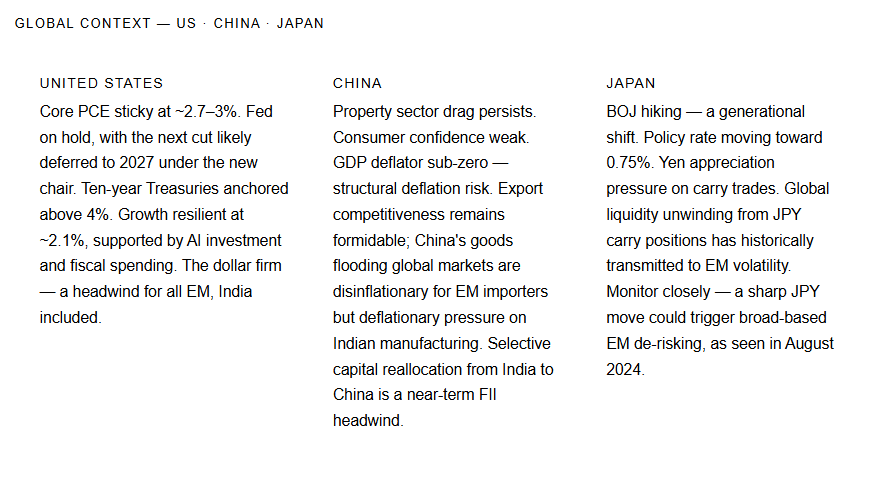
Bottom line. India enters the back half of CY2026 as a structurally stronger economy than at any prior episode of external stress — but one navigating a rare combination of a weakening currency, a paused easing cycle, and a widening trade deficit. The macro trade deals being concluded now are seed capital for the next export cycle. The DII ecosystem is the new shock absorber. Fiscal credibility is intact. For the discerning macro investor, the India thesis is not broken — it is simply being stress-tested, as every durable thesis must be.
All data as of June 2026. Sources: RBI, Ministry of Commerce, KPMG Decoding India FY26, IBEF, Deloitte India Outlook, 5paisa FY26 Report, Business Upturn, India FTA Tracker 2026, UNESCAP, Cambridge Currencies. This note is for informational purposes only and does not constitute investment advice.
메타데이터
- post_id
- ff167c680bfb
- slug
- india-macro-strategy-june-2026-ff167c680bfb
- url
- https://medium.com/@samyakmayshah/india-macro-strategy-june-2026-ff167c680bfb
- canonical_url
- https://medium.com/@samyakmayshah/india-macro-strategy-june-2026-ff167c680bfb
- author_url
- https://medium.com/@samyakmayshah
- status
- ok
- fetched_at
- 2026-07-07 15:45:26



