Evolution of Sales Management and the Foundations of Modern Management
By: Asfand Gul Kasi
Evolution of Sales Management and the Foundations of Modern Management
By: Asfand Gul Kasi
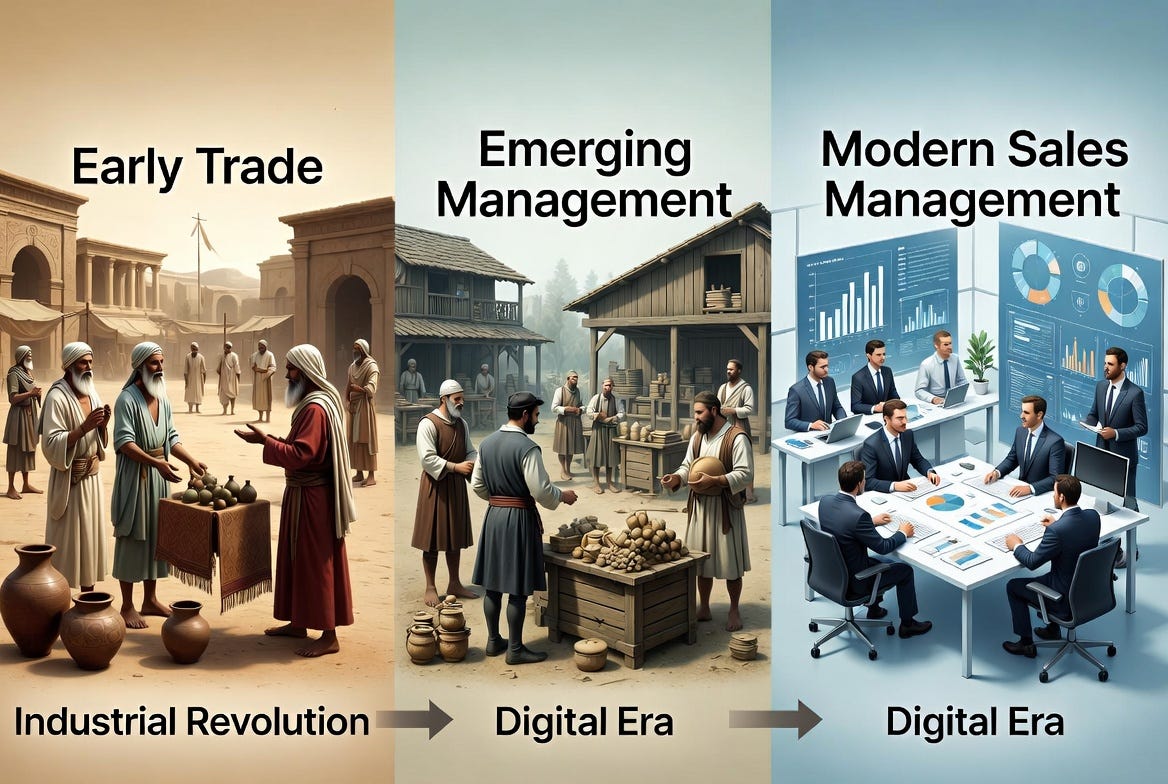
The gradual evolution of sales management through the ages from early trade to structured modern practices.
Sales Management and Historical Context
Sales management, as a discipline, did not emerge overnight. Instead, it evolved gradually alongside the broader concept of management itself. For most of human history, business activities existed without a formalized structure of management. Early business owners performed essential tasks such as hiring, coordinating, and controlling operations, yet these responsibilities were not recognized as a distinct field. Over time, the increasing complexity of organizations gave rise to structured management practices, ultimately shaping what we now understand as sales management.
This article explores the historical development of management principles and demonstrates how early theories continue to influence modern sales strategies, compensation systems, and organizational practices.
Early Origins of Management Practices
Although management as a formal discipline is relatively recent, its roots can be traced to early large-scale institutions such as the military and religious organizations. These entities required coordination, hierarchy, and control to function effectively. However, their approaches were largely ad hoc, lacking systematic planning or theoretical grounding.
The absence of formal management theories meant that business operations were often inconsistent and inefficient. Nevertheless, these early practices laid the groundwork for the development of structured management concepts in later centuries.
Contribution of Adam Smith and the Division of Labor
One of the earliest contributors to management thought was Adam Smith, a Scottish philosopher and economist. In his influential work, he introduced the concept of the division of labor, which argued that breaking down tasks into smaller, specialized components could significantly increase productivity.
This idea marked a turning point in business thinking. By assigning specific tasks to individuals based on skill and efficiency, organizations could produce more output with fewer resources. Smith’s insights became foundational for later developments in industrial and managerial practices.

How the Industrial Revolution transformed management introducing specialization, standardization, and structured processes to support large-scale production.
The Impact of the Industrial Revolution
The Industrial Revolution transformed the landscape of business and management. With the introduction of machinery and mass production techniques, organizations grew in size and complexity. This expansion created a dependency on workers and supervisors, leading to the emergence of professional managers.
During this period, several key management practices developed, including:
- Specialization of labor
- Standardized production processes
- Quality control mechanisms
- Workflow planning
- Basic accounting systems
These practices were primarily focused on improving efficiency and enabling large-scale production. The need to coordinate these processes effectively led to the formal recognition of management as a distinct function.
Emergence of Management Theories in the Early 20th Century
By the early 1900s, management had become a widely recognized concept. Scholars and practitioners began developing theories aimed at improving organizational performance. These theories emphasized:
- Efficiency and minimizing waste
- Consistency in production
- Predictability of outcomes
- Maximizing output from given inputs
The central objective was to optimize productivity by controlling and standardizing work processes. These ideas formed the basis of what is now known as classical management theory.
Scientific Management and Frederick Winslow Taylor
A major breakthrough in management thinking came with the publication of The Principles of Scientific Management by Frederick Winslow Taylor. Taylor introduced a scientific approach to studying work, fundamentally changing how organizations viewed productivity.
1 Time and Motion Studies
Taylor conducted detailed analyses of work processes through time and motion studies. By observing how tasks were performed, he identified inefficiencies and developed optimized methods for completing them.
2 Optimization Over Hard Work
Contrary to the prevailing belief that workers should simply work harder, Taylor argued that productivity could be improved by working smarter. Simplifying tasks and optimizing workflows were more effective than increasing physical effort.
3 Worker–Manager Cooperation
Taylor emphasized the importance of cooperation between workers and managers. This idea was revolutionary at a time when managers had minimal interaction with laborers and provided little guidance or standardization.
4 Performance-Based Compensation
Taylor proposed the concept of a “fair day’s pay for a fair day’s work.” He believed that workers were primarily motivated by financial incentives. As a result, he advocated for performance-based pay systems, where more productive workers received higher compensation.
This principle directly influences modern sales compensation structures, including commissions and performance bonuses.
Workplace Efficiency and Employee Selection
Another key insight from Taylor’s work was the importance of selecting the right individuals for specific tasks. Through his experiments, he observed that some workers were naturally more efficient than others.
This led to the development of:
- Scientific hiring practices
- Employee training programs
- Job-role specialization
Modern recruitment and talent management systems are deeply rooted in these early ideas, emphasizing the alignment between employee skills and job requirements.
Experimental Innovations in Productivity
Taylor’s experiments extended to practical workplace improvements. For example:
- He redesigned tools, such as shovels, to maximize efficiency and reduce fatigue.
- He analyzed bricklaying techniques to eliminate unnecessary movements and improve speed.
These innovations demonstrated how small changes in processes and tools could lead to significant productivity gains.
Economic Conditions and the Focus on Efficiency
During Taylor’s time, many industries — particularly in the United States — faced limited competition. As a result, organizations prioritized efficiency and cost reduction over innovation or customer orientation.
This environment reinforced the importance of:
- Optimization
- Standardization
- Productivity maximization
Although modern markets are more competitive, efficiency remains a core principle in sales and operations management.
The Birth of Business Education and Wharton School
The formal study of business and management began in the late 19th century. In 1881, Joseph Wharton founded the Wharton School, the world’s first collegiate business school.
This marked a significant milestone in the professionalization of management education. It provided a structured environment for studying and advancing management theories, many of which continue to shape modern business practices.
Connection to Modern Sales Management
The historical developments discussed above have direct implications for contemporary sales management:
- Performance-Based Compensation Rooted in Taylor’s incentive systems
- Sales Process Optimization Inspired by time and motion studies
- Training and Development Based on scientific selection and specialization
- Data-Driven Decision Making Reflecting the scientific approach to management
- Efficiency and Productivity Focus Derived from classical management theories
Understanding these origins helps sales professionals apply modern strategies more effectively and appreciate the rationale behind current practices.

The Mid-20th Century Management Revolution: shifting focus from machines to people, psychology, and strategic thinking.
Mid-20th Century Management Revolution
The mid-20th century marked a transformative era in the history of management. Unlike earlier periods that focused primarily on efficiency, standardization, and productivity, this new phase emphasized human behavior, organizational dynamics, and the strategic role of information. It was during this time that management evolved into a multidisciplinary field, drawing heavily from sociology, psychology, and mathematics.
This period witnessed the emergence of influential thinkers and groundbreaking theories that reshaped how organizations function and how managers interact with employees.
Human Relations Movement and Key Contributors
The shift toward understanding human behavior in organizations was driven by several pioneering thinkers, including Elton Mayo, Mary Parker Follett, Chester Barnard, and Max Weber.
1 Contributions from Sociology and Psychology
These scholars introduced concepts that emphasized:
- The importance of social relationships at work
- The psychological needs of employees
- Informal organizational structures
- Authority and bureaucracy
For example, Elton Mayo’s research highlighted how worker productivity is influenced not just by physical conditions but also by social and emotional factors. Similarly, Max Weber developed the concept of bureaucracy, emphasizing structured authority and clear organizational roles.
Emergence of Operations Management
Alongside human-focused theories, another stream of management thought developed through the application of statistical and mathematical techniques. Many of these methods originated from military problem-solving during wartime.
This led to the birth of operations management, which focuses on optimizing processes using quantitative tools. Key contributions included:
- Statistical quality control
- Optimization models
- Decision analysis techniques
These tools enabled organizations to make more precise, data-driven decisions, improving efficiency and effectiveness across operations.
Scientific Advancements in Management Practices
As management matured, several structured methodologies emerged, aiming to integrate scientific rigor into organizational practices. These included:
- Theory of Constraints — Identifying and managing bottlenecks in processes
- Management by Objectives (MBO) — Aligning individual goals with organizational objectives
- Business Process Re-engineering — Redesigning workflows for dramatic improvements
- Six Sigma — Reducing defects and improving quality through statistical analysis
- Waterfall Model — A sequential approach to software development
These frameworks reflect the ongoing effort to make management more systematic, measurable, and results-oriented.
Influence of Peter Drucker
One of the most influential figures of this era was Peter Drucker, often regarded as the father of modern management.
1 Concept of the Corporation (1946)
In response to challenges posed by Alfred P. Sloan, Drucker wrote Concept of the Corporation (1946). The book explored how managers could effectively lead large, complex, and decentralized organizations like General Motors.
2 Rise of Knowledge Work
Drucker introduced the concept of knowledge work, fundamentally changing how value creation was understood. He argued that:
- Value is not only created through physical labor
- Employees contribute through ideas, analysis, and information
- Knowledge workers require autonomy and trust
This marked a shift from manual labor to intellectual contribution as a key driver of organizational success.
The Challenge of Managing Knowledge Workers
As knowledge work expanded, traditional management approaches became less effective. The old model of command and control was no longer suitable because:
- Employees possessed specialized knowledge
- Creativity and innovation became essential
- Workers were less motivated by supervision alone
A critical realization emerged: “the organization’s value leaves the building every evening.” This meant that retaining, motivating, and engaging employees became central to management.
Motivation Theories and Douglas McGregor
To address these challenges, new motivational theories were developed. One of the most influential was proposed by Douglas McGregor.
1 Theory X and Theory Y
McGregor introduced two contrasting views of employee motivation:
Theory X (Traditional View)
- Employees dislike work
- Require strict supervision
- Are motivated by rewards and punishment
Theory Y (Modern View)
- Employees find work natural and fulfilling
- Are self-motivated and responsible
- Thrive with autonomy and trust
These theories encouraged managers to rethink their assumptions about employees and adopt more empowering leadership styles.
Transformation of Managerial Roles
As management thinking evolved, the role of executives underwent a significant transformation:
1 From Control to Collaboration
Earlier managers focused on authority, supervision, and discipline. In contrast, modern managers are expected to:
- Act as coaches and mentors
- Foster collaboration
- Encourage innovation
- Support employee development
2 Emphasis on Engagement and Motivation
Employee engagement became a central concern, with organizations recognizing that motivated workers are more productive, creative, and committed.
메타데이터
- post_id
- ff24092c74a8
- slug
- evolution-of-sales-management-and-the-foundations-of-modern-management-ff24092c74a8
- url
- https://medium.com/@arbabasfand1/evolution-of-sales-management-and-the-foundations-of-modern-management-ff24092c74a8
- canonical_url
- https://medium.com/@arbabasfand1/evolution-of-sales-management-and-the-foundations-of-modern-management-ff24092c74a8
- author_url
- https://medium.com/@arbabasfand1
- status
- ok
- fetched_at
- 2026-07-08 07:00:21