What Makes a Threat Intelligence Platform Essential for Modern Security Teams?
Cyber threats have become faster, more sophisticated, and increasingly difficult to detect using traditional security tools alone. Security…
What Makes a Threat Intelligence Platform Essential for Modern Security Teams?
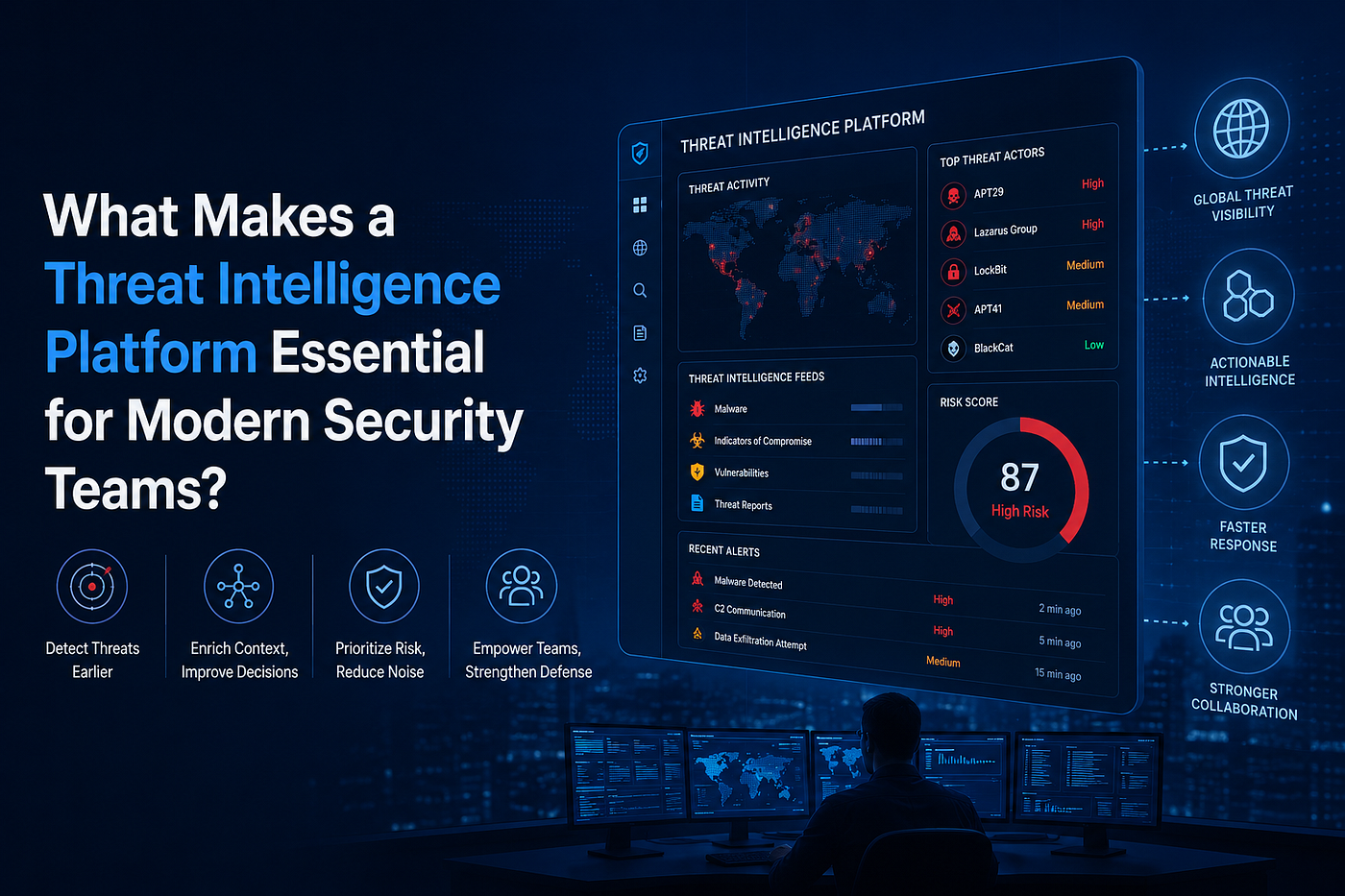
Cyber threats have become faster, more sophisticated, and increasingly difficult to detect using traditional security tools alone. Security teams face an overwhelming volume of alerts, evolving attack techniques, and a growing attack surface that spans endpoints, cloud environments, networks, and identities.
Reactive security measures are insufficient in today’s threat landscape; there must be actionable intelligence to define potential threats to your organisation’s security and to enable you to respond before an attack inflicts damage, providing an effective way to prioritise risk levels. This is where a threat intelligence platform becomes a critical component of modern cybersecurity operations.
A **threat intelligence platform** allows your organisation to gather threat data, analyse indicators of compromise (IOCs), and deliver contextually relevant insights, enabling informed security decisions and improving the overall security posture.
Understanding the Role of a Threat Intelligence Platform
A threat intelligence platform collects, aggregates, correlates, and analyses threat data from multiple internal and external sources. It transforms large volumes of raw threat data into actionable intelligence that security teams can use to identify, investigate, and mitigate cyber threats.
Modern organisations generate vast amounts of security data every day. Without proper intelligence, security teams often struggle to distinguish genuine threats from noise. A threat intelligence platform addresses this challenge by providing context around threats, adversaries, attack methods, and vulnerabilities.
The platform helps organisations:
- Identify emerging cyber threats
- Track threat actors and their tactics
- Prioritise critical vulnerabilities
- Improve threat detection accuracy
- Accelerate incident response
- Enhance proactive threat hunting
As cyberattacks continue to evolve, organisations increasingly rely on advanced threat intelligence services to stay ahead of adversaries and minimise business risk.
Key Capabilities Security Teams Should Evaluate
Not all threat intelligence solutions offer the same capabilities. Security leaders should evaluate platforms based on their ability to support operational, tactical, and strategic security objectives.
1. Comprehensive Threat Data Collection
An effective threat intelligence platform should gather intelligence from multiple sources, including:
- Open-source intelligence (OSINT)
- Commercial threat feeds
- Dark web monitoring
- Industry-specific intelligence sources
- Internal security telemetry
- Global threat research teams
Comprehensive coverage provides a broader view of the threat landscape and improves detection accuracy.
2. Advanced Threat Correlation and Analysis
Raw threat data alone delivers limited value. Security teams need platforms that automatically correlate threat indicators, identify attack patterns, and provide actionable context.
AI and machine learning capabilities further enhance analysis by identifying hidden relationships and emerging threats that manual processes may miss.
3. Real-Time Intelligence Updates
Threat actors constantly modify their tools and techniques. Real-time intelligence ensures security teams receive timely updates on:
- New malware variants
- Phishing campaigns
- Ransomware activity
- Vulnerability exploitation trends
- Command-and-control infrastructure
This capability enables organisations to respond faster and reduce exposure.
How Threat Intelligence Supports Threat Hunting and Incident Response
Threat intelligence plays an important role in helping security teams transition from reactive defence to proactive security operations.
Strengthening Threat Hunting
Threat hunters use intelligence-driven insights to hunt for hidden threats that automated tools may miss proactively. A threat intelligence platform supports threat hunting in four key ways:
- Identifying indicators and suspicious activity
- Identifying an attacker’s tactics, techniques, and procedures (TTPs)
- Mapping threats to common frameworks such as MITRE ATTACK
- Prioritising high-risk investigations
By having access to relevant intelligence, a threat hunter can focus their efforts on real risks and not waste time on false positives.
Accelerate Incident Response Time
When a security incident occurs, speed is critical. Delays can lead to increased downtime, financial losses, and reputational damage.
Using threat intelligence allows incident response teams to:
- Understand how the attack originated and the method of the attack
- Determine the extent of the compromise
- Quickly identify and access affected assets
- Prioritise actions to contain the incident
- Improve strategies for remediation
The combination of intelligence and automation produces a significant reduction in the mean time to detect (MTTD) and the mean time to respond (MTTR).
Best Practices for Maximising Intelligence-Driven Security Operations
To maximise the value of a threat intelligence platform, organisations should adopt a structured approach.
Focus on Relevant Intelligence
Collect intelligence that aligns with your industry, geography, technology stack, and threat landscape. Targeted intelligence delivers more meaningful insights than generic threat feeds.
2. Integrate Intelligence Across Security Functions
Threat intelligence should support multiple teams, including:
- **Security Operations Centres (SOC)**
- Incident response teams
- Vulnerability management teams
- Risk management teams
- Executive leadership
Shared visibility improves organisational resilience.
3. Automate Routine Workflows
Automating threat enrichment, alert prioritisation, and IOC correlation reduces analyst workload and improves operational efficiency.
4. Continuously Measure Effectiveness
Track key metrics such as:
- Detection accuracy
- MTTD and MTTR
- Threat hunting success rates
- Incident containment times
Regular measurement helps optimise intelligence programmes and demonstrate business value.
Conclusion
Modern **cybersecurity** demands more than visibility — it requires actionable intelligence that enables proactive defence. A robust threat intelligence platform enables security teams to detect threats earlier, hunt for attackers more effectively, and respond faster and with greater confidence.
To reduce risk and improve your security operations as cyber threat actors become increasingly sophisticated, you will need to invest in advanced threat intelligence capabilities. By leveraging real-time intelligence, advanced analytical techniques, and seamless connectivity across your security ecosystem, businesses can develop a more resilient, intelligence-driven cybersecurity strategy.
The Benefits of Security Intelligence
Seqrite Threat Intel helps organisations identify and respond to threats through advanced research, global threat visibility, and AI-driven analytics. Explore Seqrite Threat Intel to learn how your organisation can strengthen threat detection, accelerate response, and stay ahead of emerging cyber threats.
메타데이터
- post_id
- ff2d3ffd2630
- slug
- what-makes-a-threat-intelligence-platform-essential-for-modern-security-teams-ff2d3ffd2630
- url
- https://medium.com/@endpointexperts/what-makes-a-threat-intelligence-platform-essential-for-modern-security-teams-ff2d3ffd2630
- canonical_url
- https://medium.com/@endpointexperts/what-makes-a-threat-intelligence-platform-essential-for-modern-security-teams-ff2d3ffd2630
- author_url
- https://medium.com/@endpointexperts
- status
- ok
- fetched_at
- 2026-07-07 21:14:12