The Advisory State
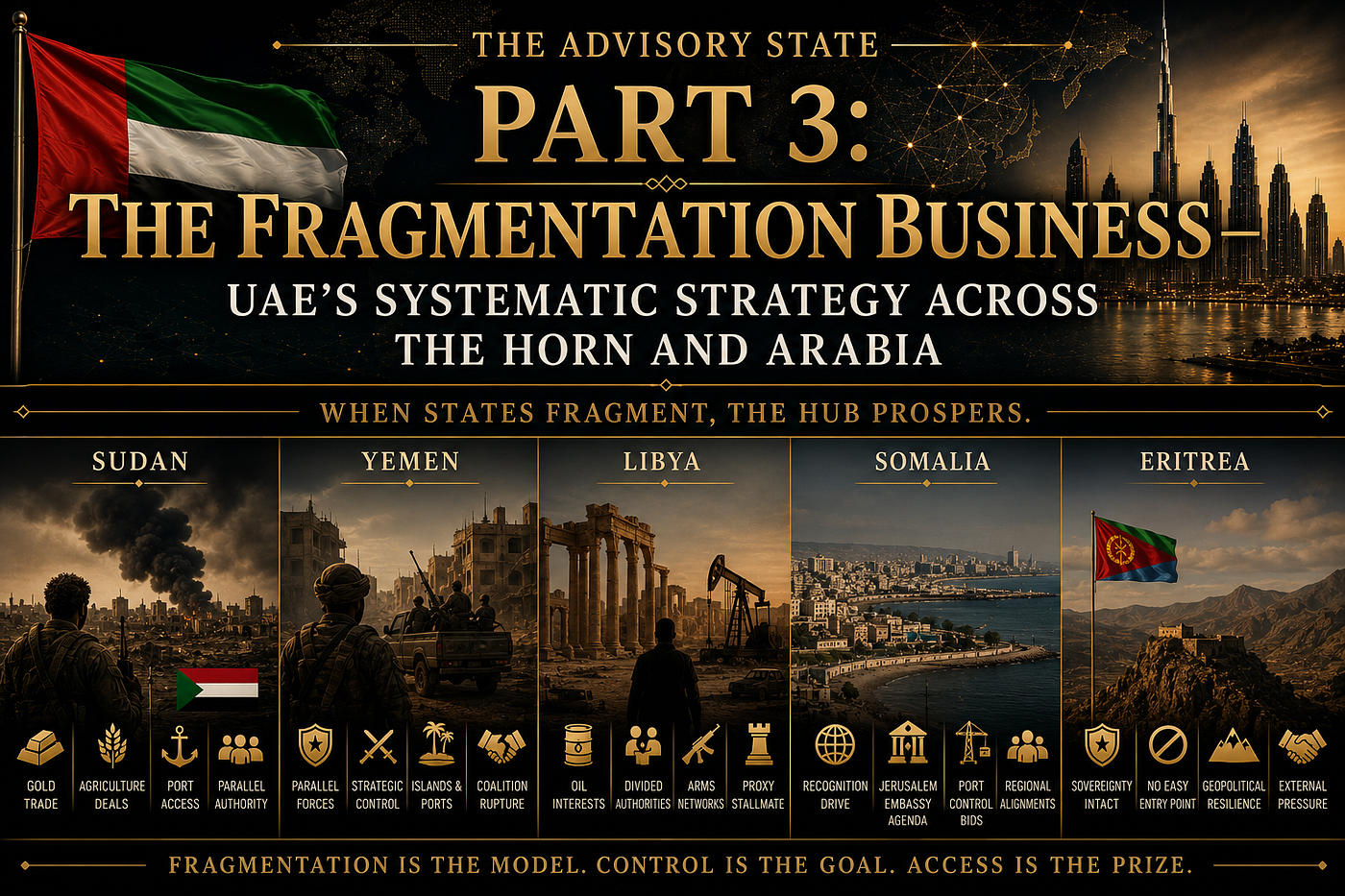
Part 3: The Fragmentation Business — UAE’s Systematic Strategy Across the Horn and Arabia
The Advisory State
Part 3: The Fragmentation Business — UAE’s Systematic Strategy Across the Horn and Arabia
By Ahmed Mahmoud
In April 2023, the Rapid Support Forces launched a devastating war against Sudan’s national army. Within weeks, tens of thousands were dead, millions had fled their homes, and one of Africa’s largest countries had descended into catastrophic civil war. Western governments expressed alarm. International organisations convened emergency sessions. Humanitarian agencies described conditions approaching famine in regions that had known hunger for generations.
In Dubai, gold continued flowing.
Eight thousand kilometres away, in Yemen, a different rupture was unfolding. The Southern Transitional Council — armed, trained, and financed by the UAE for nearly a decade — made its boldest move in December 2025, seizing strategic provinces its patron had spent years preparing it to hold. Within weeks, Saudi Arabia had struck STC positions, issued Abu Dhabi an ultimatum, and forced a complete UAE military withdrawal from a war Emirati forces had fought for over ten years.
Across Libya, a country fractured since 2011 remained fractured still — no closer to unification, propped apart by competing foreign sponsors with competing commercial interests. And in Somalia, the federal government in Mogadishu watched as Israel became the first state in the world to formally recognise Somaliland’s independence, as the UAE signalled its own recognition was coming “sooner or later,” and as a breakaway territory it does not control prepared to open an embassy in occupied Jerusalem.
Four countries. Four theatres. One architecture.
Part 1 established the double hub-and-spoke model: the economic architecture of finance, commodities, logistics, and technology, and the parallel security architecture required to feed and protect it. Part 2A and 2B examined the human infrastructure of that security architecture — the advisers UAE recruits and the leaders it captures. Part 3 examines what that architecture has actually produced when applied at scale: genocide in Sudan, a coalition rupture in Yemen, frozen fragmentation in Libya, and an emerging Israel-UAE-Somaliland axis reshaping the Horn of Africa in real time. Together, these four cases demonstrate that what looks from any single vantage point like a regional accident is, viewed in aggregate, a coherent and repeating pattern.
I. The Operating Logic: Why Strong States Are Incompatible With Hub Prosperity
Before examining each theatre, the underlying logic demands restating, because it is what connects four otherwise unconnected conflicts.
A functioning, unified state possesses institutional capacity to regulate foreign port operators, scrutinise commodity trading arrangements, renegotiate concession terms, demand greater revenue shares, threaten nationalisation of foreign-operated assets, and align with UAE competitors. It can say no, and make that no stick through courts, parliaments, and international legal mechanisms.
Fragmented orders cannot. A separatist authority controlling a strategic port but lacking international recognition will accept the terms DP World offers because it has no alternative buyer and desperately needs the legitimacy that commercial partnerships provide. A militia controlling gold-producing zones but dependent on external markets will accept whatever trading arrangements its sponsor permits because no regulated international exchange will deal with it directly. Competing factions create auction dynamics that consistently favour the external patron with the deepest pockets and the least institutional accountability.
The pattern that emerges across every theatre UAE has engaged follows a precise sequence: identify existing fractures within a fragile state, support the sub-state actor controlling the strategically relevant asset, build dependency through funding, weapons, training, political protection, and market access, and prevent — through continued support for fragmentation — any consolidation of sovereign authority that would restore the oversight the hub cannot tolerate.
This is not chaos management. It is chaos production, calibrated to commercial requirements.
II. Sudan: Genocide, Gold, Agriculture, and the Port That Bypasses the Government
No case illustrates the fragmentation business more completely than Sudan, where a decade of UAE investment has produced civil war, genocide, and a parallel economic infrastructure designed to extract Sudanese resources without any Sudanese government oversight — not because the government was too weak to resist, but precisely because it was strong enough to say no.
When Government Said No, UAE Found Another Partner
The trajectory of UAE-Sudan relations reveals a consistent pattern obscured by the complexity of the civil war. Sudan’s government in the years preceding the 2023 war repeatedly rejected UAE agricultural projects for generating “disproportionate profits to the UAE while providing minor benefits to local residents.”[1] When formal sovereign negotiations produced terms UAE found unacceptable, Abu Dhabi developed an alternative strategy. The RSF emerged as what the Atlas Institute for International Affairs documents as a “more practical partner” precisely because it “could guarantee access to gold and future agricultural output while ignoring public accountability concerns.”[2]
This is the fragmentation logic stated with unusual explicitness: a sovereign government that imposes accountability is an obstacle; a militia that ignores it is a solution.
Gold: The Industrial Scale
The RSF’s relationship with Abu Dhabi began from 2015 onwards, when Sudanese fighters deployed to Yemen under Emirati operational coordination, creating financial dependencies that bypassed Khartoum entirely.[3] As the relationship deepened, its most significant commercial dimension emerged: gold.
Sudan officially exported $2.8 billion in gold to the UAE in 2021 — representing 99% of Sudan’s above-the-table gold exports.[4] The following year, a further $2 billion flowed through channels where RSF-controlled production zones in Darfur fed directly into Dubai refineries.[5] But official figures represent a fraction of actual flows. Around 90% of Sudan’s gold production — roughly $13.4 billion annually in illicit trade — is smuggled through Chad, Ethiopia, Uganda, and South Sudan before arriving in the UAE.[6] Investigators have documented how gold enters Dubai with minimal documentation requirements, is quickly refined and melted down, and emerges as untraceable bullion in international markets.[7]
The circularity is precise and devastating. UAE commodity infrastructure makes RSF gold economically valuable. UAE-linked market access generates the revenue RSF uses to buy weapons, mercenaries, and logistics. That military capacity enables RSF to maintain control of gold-producing zones. And that control feeds continued flows to Dubai — against a Sudanese state whose collapse removes the only authority capable of regulating the arrangement.
Agriculture: The Strategic Imperative
Gold is significant. Agriculture is existential. The UAE imports 90% of its food at a cost of $14 billion annually, making Sudan’s fertile Nile-fed lands not merely a commercial opportunity but a strategic national security priority.[8] This is why IHC — chaired by Sheikh Tahnoon bin Zayed Al Nahyan, the Emir’s brother and UAE’s National Security Adviser — is directly engaged in Sudanese agricultural operations alongside gold trade.[9] When the head of state’s National Security Adviser chairs the company farming Sudan’s land, the distinction between commercial agriculture and sovereign security strategy has effectively ceased to exist.
Two UAE firms, IHC and Jenaan, currently farm over 50,000 hectares in Sudan.[10] The planned Abu Hamad project — a joint venture between IHC and Sudan’s DAL Group, owned by tycoon Osama Daoud Abdellatif, Sudan’s most powerful private businessman — will add 162,000 hectares of farmland in northern Sudan, growing alfalfa, wheat, cotton, and sesame for export to the Gulf.[11] Globally, UAE agribusiness entities have amassed nearly 960,000 hectares of farm operations — one of the largest foreign agricultural footprints on earth, much of it concentrated in food-insecure countries whose populations cannot defend their land against the commercial power of sovereign wealth funds.[12]
Abdellatif’s DAL Group is Sudan’s largest private conglomerate, active across agriculture, manufacturing, real estate, and logistics. Africa Intelligence describes him as “thriving in a war-torn land” — a businessman whose economic position has strengthened as Sudan’s state institutions have collapsed, precisely because UAE investment does not require functioning state institutions to operate.[13] His position on continuing during the civil war: “We are not waiting for everything to be perfect.”[14]
The Port That Bypasses the Sudanese Government
The agricultural empire and the RSF gold network share a common commercial requirement: port access that bypasses the Sudanese state entirely. The Abu Amama Red Sea port — a $6 billion project to be built and operated by Abu Dhabi Ports Group — is located 200 kilometres north of official Port Sudan, connected to the Abu Hamad farms by a UAE-financed $450 million, 500-kilometre toll road, and explicitly designed to serve UAE commercial interests without Sudanese government regulatory oversight.[15]
Official Port Sudan is run by the Sudanese government. Abu Amama would be run by the UAE. The new port includes a Jebel Ali-style free trade zone and international airport — an entire parallel commercial infrastructure through which Sudanese agricultural and mineral output flows to Dubai without passing through any Sudanese institutional control.[16] As the Atlas Institute captures: “The $6 billion port project strengthens the UAE’s influence over Sudan’s land and commercial lines, advancing Emirati military, security, and logistical objectives.”[17]
This integrated architecture — national security leadership (Sheikh Tahnoon), agricultural operations (IHC/DAL), port infrastructure (Abu Dhabi Ports), and road connectivity (Abu Dhabi Fund for Development) — constitutes a parallel Sudanese economy whose revenues flow to Dubai rather than Khartoum.
Genocide: The Formal Characterization
What the gold network finances, what the agricultural investment requires, and what the port bypass strategy depends upon, has a name. A United Nations fact-finding mission concluded in February 2026 that the RSF’s assault on non-Arab populations in western Sudan carries “the hallmarks of genocide.”[18] The US Congressional Tom Lantos Human Rights Commission co-chairs wrote to Disney, the NBA, and the NFL urging termination of UAE associations over Abu Dhabi’s role “in abetting genocide, war crimes, crimes against humanity, and ethnic cleansing in Sudan.”[19]
In the United Kingdom, the human rights organisation FairSquare submitted a formal complaint to the Foreign Office naming Sheikh Mansour bin Zayed Al Nahyan — UAE Deputy Prime Minister and owner of Manchester City Football Club — alleging his role in the UAE government’s backing of the RSF.[20] Should the UK government sanction him, Premier League ownership rules would require his disqualification from the club. The UK Foreign Office has not acted. According to reporting, the FCDO has instead actively pressured African diplomats not to criticise the UAE at United Nations meetings.[21]
The Cover Story
What makes UAE’s Sudan role particularly cynical is not just the financing of genocide — it is the narrative constructed to shield that financing from Western accountability. UAE presents its backing of the RSF to American and European politicians as a campaign against the Muslim Brotherhood: supporting Hemedti as a secular counterweight to the Islamist networks embedded in Sudan’s Armed Forces from the Bashir era. The framing is designed to activate Western counterterrorism reflexes and deflect scrutiny from what is actually happening on the ground.
It deserves stating plainly: UAE’s relationship with Hemedti and the RSF predates the current war and predates any anti-Islamist framing. It was built precisely during the years UAE was simultaneously providing financial support to Omar al-Bashir’s government, the leader of Muslim brotherhood in Sudan — the same government that created and empowered the RSF in the first place.[22] When the Sudanese people themselves rose and overthrew Bashir in 2019, UAE did not support their democratic aspirations. It backed the military and the RSF against the civilian transition. The anti-Muslim Brotherhood narrative was not the reason for UAE’s Sudan engagement. It is the cover story adopted afterward — deployed in Washington and Brussels to reframe ethnic cleansing as counterterrorism, to reframe genocide as stability operations, and to reframe the systematic massacre of non-Arab Sudanese civilians as a regrettable but necessary fight against extremism.
What is happening in Sudan is not a civil war between competing political projects. It is not a military split producing unfortunate collateral damage. It is ethnic cleansing. It is the deliberate, systematic targeting of non-Arab populations in Darfur and beyond, conducted by a militia that the United Nations has concluded carries “the hallmarks of genocide.” The RSF has raped, murdered, and displaced millions of civilians not as a byproduct of fighting Islamism but as the operational method of asserting territorial control over the gold fields, agricultural zones, and logistics corridors that feed directly into UAE commodity and infrastructure networks. UAE is not funding a counterterrorism operation that has gone wrong. It is funding a genocide that is going exactly as its commercial logic requires — eliminating the civilian populations and state institutions that would otherwise demand accountability over the resources being extracted.[23]
The Red Crescent Cover: Humanitarianism Weaponized
UAE’s most audacious operation in Sudan was not arms smuggling but the conversion of a humanitarian symbol into a weapons delivery mechanism. Abu Dhabi operated a 50-bed field hospital in Amdjarass, Chad — under the Red Crescent flag — which served simultaneously as a treatment facility for injured RSF fighters, an airlift hub transporting serious cases to the UAE for medical care, and a logistics cover for transporting drones and smuggling weapons into RSF supply chains.[24] Amnesty International documented Chinese weaponry provided by UAE to the RSF in breach of international arms embargo.[25]
The UAE has used the architecture of humanitarianism — the field hospital, the Red Crescent insignia, the language of refugee relief — as operational infrastructure for a genocide it finances and publicly denies.
Regional Coercion: Buying and Building the Network
UAE’s Sudan strategy required securing the supply lines, training infrastructure, and diplomatic cover through which weapons, mercenaries, fighters, and logistical support reach the RSF across multiple borders simultaneously. It did so by purchasing the compliance of neighbouring governments at scale and directing a personally captured Ethiopian leader to commit his military to UAE’s genocide-support network.
Chad’s President Mahamat Idriss Déby received a UAE loan of $1.5 billion — nearly equivalent to Chad’s entire $1.8 billion annual budget — after which Emirati cargo flights into Amdjarass increased and Chad became the primary RSF weapons corridor, hosting the Red Crescent-covered field hospital through which weapons were smuggled alongside medical supplies.[58] Kenya hosted RSF-led peace discussions without the Sudanese Armed Forces present, after Kenya’s leadership visited Abu Dhabi.[59] Libya’s Haftar-aligned Libyan National Army provided military exports to the RSF under UAE coordination.[60]
And then there is Ethiopia.
In February 2026, Reuters published one of the most significant investigative findings of the Sudan war: Ethiopia is hosting a secret camp to train thousands of fighters for the RSF in the remote Benishangul-Gumuz region, Menge district — 20 miles from the Sudan border, strategically positioned at the intersection of Ethiopia, Sudan, and South Sudan.[61] Eight sources, including a senior Ethiopian government official, Ethiopia’s own internal security services memo, and a diplomatic cable reviewed by Reuters, state that the UAE financed the camp’s construction and provided military trainers and logistical support.[ 62]
As of early January 2026, 4,300 RSF fighters were undergoing training at the site. Camp capacity is documented at up to 10,000. Ethiopian General Getachew Gudina — Chief of the Defense Intelligence Department of the Ethiopian National Defense Force — is named as the military official responsible for establishing it.[ 63] Recruits are primarily Ethiopians, alongside South Sudanese and Sudanese fighters being prepared to cross into Blue Nile state and join RSF operations against the Sudanese Armed Forces.[ 64]
The logistics infrastructure is no less revealing. Trucks bearing the logo of Gorica Group — an Emirati logistics company — were seen driving through Asosa toward the camp in October 2025.[ 65] Asosa Airport, 33 miles from the camp, has been refurbished with a new hangar, drone ground control station, and satellite antenna — infrastructure identified by military technology expert Wim Zwijnenburg of PAX as a UAV base. Senior Ethiopian officials confirm the refurbishment was financed by the UAE.[ 66]
The photograph that UAE’s own Ministry of Defence published on X tells the story without requiring additional interpretation: UAE Air Force Commander Major General Ibrahim Nasser Al Alawi, sitting beside Ethiopian Army Deputy Chief General Abebaw Tadesse at a military parade in Bishoftu.[ 67] The two militaries are not conducting polite diplomatic visits. They are building a shared operational infrastructure for a war they are simultaneously claiming, in public statements, to want ended.
That claim — the public statement — is the final detail that crystallises what the advisory state model produces when it fully captures a national leader. On January 6, 2026, the UAE and Ethiopia issued a joint statement calling for a ceasefire in Sudan.[ 68] The Menge camp was fully operational at this moment. Four thousand three hundred RSF fighters were being trained on Ethiopian soil, financed by UAE, to cross into Sudan and fight. The joint statement calling for peace was issued while the infrastructure prolonging the war was being expanded.
This is Abiy Ahmed’s Ethiopia in UAE service — not as a passive dependent but as an active instrument: hosting genocide-support training camps, building drone infrastructure on its western flank, providing diplomatic cover through joint peace statements, and supplying fighters to a militia committing atrocities that a United Nations mission has characterized as carrying “the hallmarks of genocide.” The client model documented in Part 2B has reached its operational endpoint: a head of government whose personal financial dependency on Abu Dhabi has been converted into active military participation in a foreign genocide — while his government co-signs statements calling for the war to end.
This is the hub-and-spoke model extended geographically: not just financing RSF directly, but purchasing the governments through which RSF receives its financing, ensuring no regional authority can interrupt the supply chain.
The Accountability Gap
Sudan formally severed diplomatic ties with the UAE in May 2025, citing its documented role in supporting the RSF.[29] The UAE denied the charges, as it has denied every documented finding across four consecutive Sentry investigations, UN expert panel reports, Amnesty International documentation, and formal government accusations. Its denial has been described, in Nesrine Malik’s phrase in The Guardian, as “an almost comical performance of outraged innocence in the face of common knowledge.”[30]
When Sudan accused the UAE at a UK-sponsored UN meeting, Abu Dhabi cancelled ministerial meetings with Britain to punish London for failing to respond with sufficient vigour to what it called “defamation.”[31] The ICJ dismissed Sudan’s genocide case against the UAE in May 2025 for lack of jurisdiction — not on the merits.[32] And on the eve of Donald Trump’s inauguration, UAE invested $500 million in the Trump family’s cryptocurrency venture — providing a clear indication of how Western political cover for Abu Dhabi’s conduct is maintained.[33]
Tens of thousands dead. Twelve million displaced. Half of Sudan’s population requiring humanitarian assistance. Gold flowing to Dubai. Agricultural land consolidated under UAE corporate control. A Red Sea port bypassing the Sudanese government under construction. The genocide is being financed from a city whose towers rise on the proceeds.
III. Yemen: From Parallel Forces to Forced Withdrawal
Yemen offers the clearest evidence yet that the fragmentation strategy carries costs that eventually become unmanageable — and that Saudi Arabia’s patience with UAE operations in its own strategic backyard has finite limits.
UAE intervention began in 2015 as part of the Saudi-led coalition supporting Yemen’s internationally recognised government against Houthi forces. The stated objective was restoring Yemeni sovereignty. The operational reality was systematically different. While ostensibly fighting alongside the recognised government, UAE advisers simultaneously recruited, trained, and equipped parallel security structures more loyal to Abu Dhabi than to Sanaa: Security Belt Forces in the south, Elite Forces in Aden, Shabwani Elite Forces in Shabwa.[34] These units operated outside government command structures, received superior equipment and salaries to official forces, and reported through channels linked to UAE advisers.
The political instrument for this parallel structure was the Southern Transitional Council, a separatist movement seeking independence for southern Yemen, where the strategically critical ports of Aden and Mukalla are located. When the STC seized control of Aden from government forces in August 2019 — effectively staging a coup against the coalition’s own partner — it deployed units UAE had trained, equipped, and advised.[35] Forces theoretically built to defend the government had been constructed to serve Abu Dhabi’s strategic interests, which diverged sharply from Sanaa’s when the moment came. The port logic was always explicit: Aden and Mukalla sit on shipping lanes critical to Red Sea and Gulf of Aden commerce. STC control — dependent on UAE support — provided port access without sovereign oversight.
The Rupture
What had been simmering tension between Riyadh and Abu Dhabi over Yemen reached its breaking point in December 2025, when the STC moved beyond port control toward outright territorial conquest, seizing strategic provinces including Hadramawt and al-Mahra.[36] This was the logical endpoint of a decade of UAE investment in a separatist project — and it directly threatened Saudi Arabia’s own strategic position in southern Yemen.
Saudi Arabia’s response was immediate and unambiguous. Saudi airstrikes targeted STC positions. Saudi forces deployed to the southern border. Riyadh publicly accused the UAE of undermining coalition cooperation and gave the Yemeni government an ultimatum: demand that UAE forces leave within twenty-four hours.[37] The UAE announced its complete military withdrawal almost immediately.
Farea Almuslimi, a Chatham House research fellow, described the rupture as a “political divorce” between Riyadh and Abu Dhabi — the logical endpoint of a fragmentation strategy pursued to the point where it directly threatened the patron coalition’s own cohesion.[38] For over a decade, the UAE had built parallel security structures, cultivated a separatist movement, and controlled southern ports while formally participating in a coalition whose stated objective was Yemeni sovereignty. When the STC moved to make permanent what UAE had spent years making possible, Saudi Arabia had seen enough.
The Islands Nobody Noticed
What the STC’s territorial conquest of Hadramout on 2 December 2025 made visible was a strategy that had been building for years in locations far less conspicuous than a major Yemeni governorate. The Royal United Services Institute’s December 2025 analysis documents that UAE has systematically invested in radar systems, runway extensions, and surveillance infrastructure across the Socotra archipelago — on the islands of Abd al-Kuri and Samhah — and on Mayyun Island, positioned directly in the Bab al-Mandeb Strait.[1]
This surveillance infrastructure represents a maritime monitoring architecture covering the Gulf of Aden and Red Sea approaches far more durable than troop deployments. Ships transiting the Bab al-Mandeb, one of the world’s most critical maritime chokepoints, pass within range of UAE-operated surveillance systems on Yemeni territory administered by the STC. The arrangement does not require a formal UAE military presence. It requires only that the STC administers the territory — which, since December 2025, it does across most of southern Yemen.[2]
The RUSI analysis also documents a development that reveals how deeply the Yemen fragmentation strategy is integrated with the UAE-Israel axis examined in the Somalia section of this series. In September 2025, STC head Aidaros al-Zubaidi stated in an interview that a future independent South Yemen would consider joining the Abraham Accords — provided “Gaza and Palestine regain their rights.”[3] A UAE-backed separatist authority controlling southern Yemen’s coastline, open to Abraham Accords normalisation with Israel, administering surveillance infrastructure across the Bab al-Mandeb Strait: this is the UAE-Israel maritime security architecture applied at its most strategic scale.
RUSI’s strategic conclusion is unsparing: if UAE succeeds in stabilising an autonomous southern polity, “the Houthis may intensify maritime operations to compensate for constraints on their land-based smuggling routes.”[4] The fragmentation strategy generates the maritime threat it claims to solve. A more fragmented Yemen is not a more secure Red Sea. It is a Red Sea where UAE has more commercial nodes and less accountability — and where Houthi justifications for maritime attacks multiply alongside the UAE-Israel presence they oppose.
What Withdrawal Does Not Mean
The withdrawal does not represent a clean exit. As Almuslimi notes, UAE’s approach to Yemen “has never relied on overt military confrontation with Saudi Arabia, but on the cultivation of durable local networks, economic leverage, and security partnerships that can be reactivated even in the absence of a formal troop presence.”[39] UAE retains strong ties to southern actors, influence over ports and maritime infrastructure, and the financial capacity to sustain allies across time. The competition continues, in Almuslimi’s words, “in less visible but no less consequential ways.”[40]
The human cost of a decade of UAE fragmentation strategy in Yemen is documented: hundreds of thousands of conflict deaths, cholera epidemics, famine conditions, and infrastructure devastated across the country. Having contributed decisively to this catastrophe, UAE can now, as Almuslimi observes, “wash its hands of any long-term reconstruction responsibilities.”[41] The Houthis, who fired no shots during the Saudi-UAE rupture, emerge strategically stronger from a rift among their adversaries they did nothing to create.
In Almuslimi’s assessment, the existing conflict generated, “a conflict that is more fragmented, more regionalised, and significantly harder to resolve.”[42] This is the fragmentation business’s final bill: not just the immediate human suffering, but the structural impossibility of resolution it leaves behind when the external patron eventually withdraws.
IV. Libya: A Decade of Preventing Unification
Libya’s post-Gaddafi fragmentation presented UAE with a different opportunity: not to deepen an existing fracture, but to prevent an existing one from closing.
Following the 2011 collapse of the Gaddafi regime, Libya fractured between the UN-recognised Government of National Accord in Tripoli and General Khalifa Haftar’s Libyan National Army in the east. UAE’s sustained support for Haftar — documented by UN investigators to include arms embargo violations, drone operations, armoured vehicles, artillery systems, and advanced air defence equipment[43] — had a clear commercial logic: a fragmented Libya allows engagement with whichever faction controls relevant Mediterranean ports or eastern oil infrastructure, without requiring buy-in from a central government that might impose oversight or align with UAE competitors.
The Sudanese connection surfaces here too. RSF fighters deployed to Libya under UAE coordination, backing Haftar’s failed 2019 Tripoli offensive.[44] The same proxy forces serving UAE interests in Yemen and Sudan simultaneously deployed in a third theatre — demonstrating that these are not separate operations conducted in parallel but a single integrated network of armed actors managed from Abu Dhabi across multiple conflicts at once.
The arms embargo violations documented by UN investigators are not allegations. They are findings. The UAE formally denied them while continuing them — a pattern of public disavowal and operational continuation that recurs in every theatre this series has examined.
A decade and a half after Libya’s state collapse, the country remains fractured among competing authorities and foreign sponsors. No unified Libyan government exercises sovereign oversight of the country’s ports, oil infrastructure, or commercial arrangements. This outcome — catastrophic for Libyan citizens, destabilising for the Mediterranean — is precisely optimal for a hub model requiring access to strategic assets without sovereign accountability. Unlike Sudan and Yemen, Libya offers no recent dramatic turning point. It offers something arguably more damning: proof that fragmentation, once sufficiently entrenched, requires no further active intervention to sustain itself. The stalemate is its own product. The chaos manages itself.
V. Somalia: Fragmenting a State in Real Time
Somalia’s 1991 state collapse and Somaliland’s subsequent unilateral declaration of independence created the conditions UAE strategy has systematically exploited — and is now escalating into the most active and most diplomatically explosive fragmentation campaign in the region.
DP World’s Berbera development — a $442 million agreement signed in 2016[45] — simultaneously expanded the logistics hub’s network and deepened Somaliland’s separation from Somali federal authority in ways serving long-term UAE commercial interests. A unified Somalia exercising sovereignty over its entire territory could renegotiate Berbera’s terms, impose regulatory oversight, or nationalise assets. Somaliland’s non-recognition creates precisely the asymmetric dynamics the model requires: desperate for international legitimacy, dependent on external commercial partnerships, structurally unable to negotiate from sovereign positions.
UAE has lobbied actively for Somaliland independence — not from commitment to self-determination as a principle, but from the commercial calculation that recognised independence would permanently remove Berbera from Somali federal oversight while leaving Somaliland dependent on UAE support for its continued international viability.
UAE’s documented security engagement in the region predates the Berbera deal. As early as 2017, the Middle East Institute documented UAE financing of the Contact Group on Piracy off the Coast of Somalia and on-shore training for the Puntland Maritime Forces — establishing security architecture in an autonomous northern region entirely outside Federal Government structures, years before the current recognition campaign.[46] The pattern is consistent: engage the sub-state actor controlling the strategic asset, not the federal government nominally sovereign over it.
The Recognition Cascade
In December 2025, Israel’s Netanyahu became the first world leader to formally recognise Somaliland as an independent state.[47] Somalia condemned the move as “a naked invasion” of its sovereignty. The African Union, Arab League, Turkey, China, and Egypt issued condemnations.
Within months, Somaliland announced it would open its first-ever overseas embassy in occupied Jerusalem — aligning a Muslim-majority territory with Israeli positions opposed by virtually the entire Muslim world, including its Gulf neighbours.[48] In May 2026, Emirati official Dherar Belhoul Al Falasi told Israel’s i24 that UAE recognition of Somaliland could happen “sooner or later”: “We have a good relationship with Somaliland, everything is there, so if it’s going on the right track, we will recognise Somaliland.”[49] UAE and Somaliland already maintain formal liaison offices in each other’s territories.[50] Simultaneously, UAE is reportedly lobbying Eswatini, Argentina, the Dominican Republic, and Zambia to recognise Somaliland, with financial incentives allegedly offered to Eswatini.[51]
UAE’s failure to join GCC partners in condemning Somaliland’s planned Jerusalem embassy[52] reveals the depth of its strategic divergence from Gulf consensus. When UAE will not align with Saudi Arabia, Qatar, Kuwait, Bahrain, and Oman on this question, the scale of the emerging UAE-Israel-Somaliland alignment becomes unmistakable.
Each party in this triangle extracts distinct value. UAE secures durable Berbera access without Somali federal oversight. Israel gains a Red Sea foothold and regional positioning independent of Gulf Arab partners whose reliability it has increasingly questioned. Somaliland gains international legitimacy and economic investment, however controversial the source. The costs — deepened Somali fragmentation, Horn of Africa polarisation — are paid by populations never consulted.
Somalia’s Response
Relations between Mogadishu and Abu Dhabi reached their sharpest deterioration when Somalia annulled key agreements with the UAE in January 2026.[53] Egypt has deployed troops and weapons to Mogadishu. Joint Egyptian-Somali military exercises signal a counter-alliance forming explicitly against the UAE-Israel-Somaliland axis. Saudi Arabia is using Arab League and African Union mechanisms to block Somaliland’s international recognition, directly countering UAE’s lobbying campaign.[54]
International Crisis Group analyst Omar Mahmood has argued that UAE recognition would not “solve Somaliland’s challenges” but would instead “deepen tensions in the region,” and that external actors would be better served pressuring Mogadishu and Hargeisa toward sustained dialogue rather than picking sides.[55] That dialogue is precisely what UAE strategy forecloses. A negotiated, sovereign-mediated outcome between Somalia and Somaliland would produce either a reunified Somali state or a genuinely independent Somaliland answerable to its own institutions — both outcomes capable of regulating Berbera on terms they set. Fragmentation, not resolution, is the strategy’s objective.
The Pattern
By this point the similarities are difficult to ignore.
Across four theatres the same operational sequence appears repeatedly:
• identify a strategically important node;
• cultivate relationships with actors controlling that node rather than with sovereign institutions;
• build long-term dependence through finance, logistics, training, market access, and political protection;
• preserve fragmentation once it becomes strategically advantageous.
Whether these outcomes arise from a centrally directed grand strategy or from a consistent pattern of statecraft is open to debate. What is striking, however, is the degree to which the same operational logic appears across otherwise very different conflicts.
VI. The Counter-Coalition and the Limits of the Model
Across all four theatres, a regional response has evolved from diplomatic discomfort to active opposition. Egypt, Saudi Arabia, Turkey, Qatar, Eritrea, Djibouti, and Sudan’s Armed Forces now constitute a loose but increasingly coordinated counter-coalition working against UAE fragmentation strategy simultaneously across multiple fronts.
The Saudi dimension is the most significant, because it represents a rupture within the Gulf’s own structure. Saudi Arabia struck UAE-backed forces directly in Yemen. Egypt has conducted airstrikes against Emirati supply chains in Sudan.[56] Saudi Arabia is working through Arab League and African Union mechanisms to block Somaliland recognition. These are not diplomatic protests. They are kinetic and institutional responses to a strategy Riyadh has concluded threatens its own security as much as it threatens the states it fragments.
The nodes themselves continue to escape control. Sudan’s RSF launched a war UAE could not prevent, now threatening the very gold flows the commodity hub depends upon. Yemen’s STC pursued a separatist endgame that triggered the patron coalition’s collapse. Armed groups built for UAE commercial purposes develop their own interests, pursue their own agendas, and generate instability threatening the very flows the arrangement was designed to secure.
One senior African diplomat, quoted by the European Council on Foreign Relations, described the UAE as “merchants of chaos” in Sudan and the Horn of Africa.[57] The description captures what the Muslim Brotherhood narrative, the counterterrorism framing, and the humanitarian language of the Red Crescent field hospital are all designed to obscure: the chaos is not the unfortunate byproduct of a security strategy. It is the product of a commercial strategy. And the human beings dying in it — in Sudan’s Darfur, in Yemen’s south, in Libya’s frozen stalemate, in Somalia’s contested federal authority — are paying the price for port access and commodity flows whose beneficiaries are thousands of kilometres away, in the towers of a city that imports 90% of its food and produces none of its own gold.
VII. Why Eritrea Is Different — and Why That Matters
Across Sudan, Yemen, Libya, and Somalia, UAE strategy follows a single commercial logic: identify a fragile or fracturing state with a strategic asset, deepen the fracture, build personal dependencies with whoever controls that asset, and prevent any consolidation of sovereign authority that would restore accountability.
Eritrea presents a categorically different case. Unlike Sudan’s civil war, Yemen’s ruptured coalition, Libya’s frozen stalemate, or Somalia’s contested federal authority, Eritrea is a unified, coherent sovereign state controlling Assab Port — a Red Sea asset with superior natural harbour characteristics and strategic positioning that makes it a genuine alternative to UAE-controlled logistics corridors. There is no rival faction to cultivate, no separatist movement to support, no debt dependency to exploit, no post-transition vulnerability to weaponise. The model that fragmented four states in succession has no obvious entry point into Eritrea’s self-reliant political order.
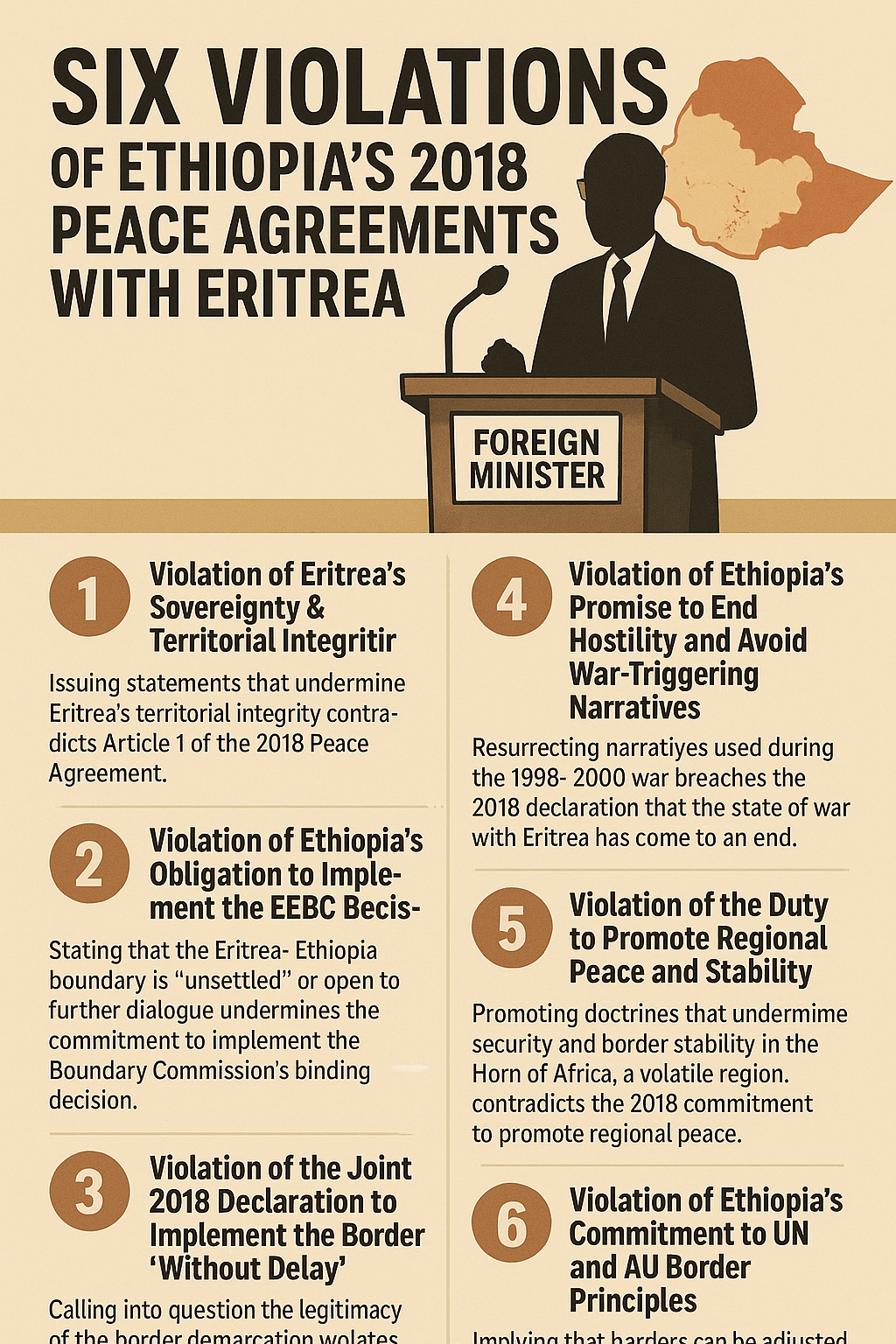
Which is precisely why, as the final part of this series details, the pressure has been routed through a different channel entirely. Not fragmentation of Eritrea itself — but the transformation of its neighbour, Ethiopia, into the instrument applied against it. A state that signed historic peace with Eritrea in 2018 has been captured, through the mechanisms documented in Part 2B, into an aggressor that has spent three years openly threatening invasion and the seizure of Assab Port. For sixty years, Eritrea paid an extraordinary price to live peacefully within its own boundaries. The advisory state now deploys a personally captured Ethiopian leader to make that peace cost something again.
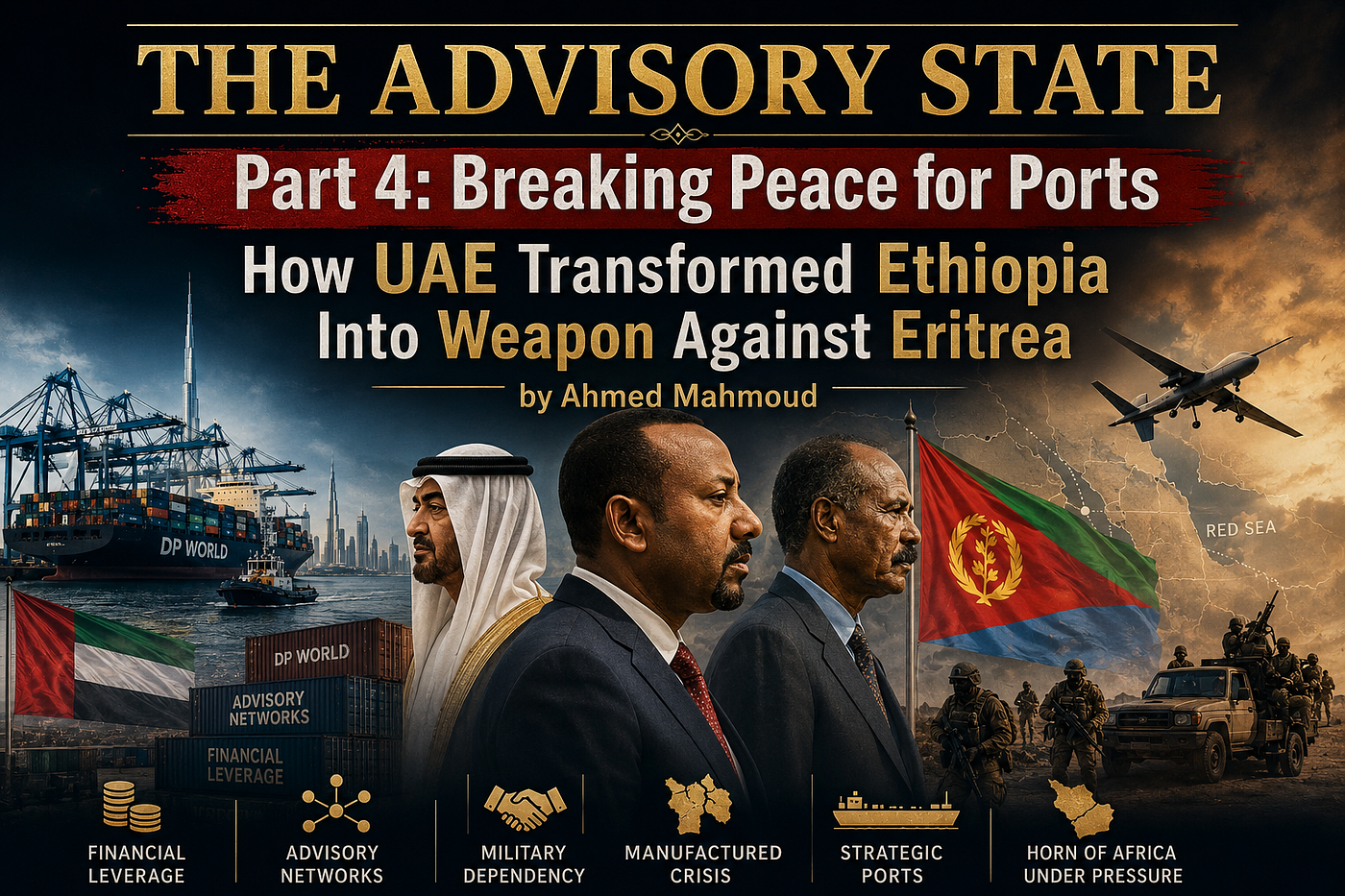
Part 4 examines that transformation in full: how UAE financial leverage, military support, and strategic manipulation converted a peacemaker into an aggressor — and why imminent war threatening hundreds of thousands of lives serves foreign commercial interests in controlling Red Sea trade routes, not the interests of any people in the Horn of Africa.
One-sentence takeaway: Across Sudan, Yemen, Libya, and Somalia, UAE’s fragmentation strategy has produced genocide financed through gold and hidden behind a Muslim Brotherhood cover story, a ruptured Gulf coalition in Yemen, a permanently frozen Libya, and an emerging Israel-UAE-Somaliland axis reordering the Horn — a record demonstrating that fragmentation is repeatable commercial architecture rather than regional accident, and one that finds in Eritrea’s unified sovereignty the single case the model cannot directly fracture, leaving a captured Ethiopian leader as the instrument through which the same pressure is now being applied.
References
[1] Atlas Institute for International Affairs, “Abu Dhabi’s Strategic Footprint in Sudan’s Civil Conflict,” Aditi Ambekar, 3 March 2026.
[2] Ibid.
[3] Human Rights Watch documentation of RSF Yemen deployment; The Sentry payment structure analyses (2019–2022).
[4] Jihad Mashamoun, “Saudi Arabia and the UAE on Edge as Generals Battle It Out in Sudan,” Middle East Council on Global Affairs, May 2023.
[5] The Sentry, “The Golden Laundromat” (2022).
[6] Center for American Progress, “How Congress Can Help Curb the UAE’s Role in Sudan’s Crisis,” February 2026.
[7] The Sentry, “The Golden Laundromat” (2022); gold laundering mechanism documentation.
[8] GRAIN, “From land to logistics: UAE’s growing power in the global food system,” July 2024.
[9] Ibid.; Sheikh Tahnoon bin Zayed Al Nahyan chairmanship of IHC and role as UAE National Security Adviser.
[10] Ibid.; IHC and Jenaan 50,000 hectares in Sudan.
[11] The Africa Report, “Sudan, UAE to partner with DAL Group to build new port,” June 2022; GRAIN, July 2024.
[12] GRAIN, “From land to logistics,” July 2024; 960,000 hectares global UAE farm operations.
[13] Africa Intelligence, “Osama Daoud thrives in a war-torn land,” January 2025.
[14] Osama Daoud Abdellatif, quoted in The Africa Report, June 2022.
[15] Reuters, “Exclusive: UAE to build Red Sea port in Sudan, $6 billion investment package,” 20 June 2022; Abu Dhabi Fund for Development toll road documentation.
[16] The Africa Report, June 2022; Jebel Ali-style free trade zone and airport documentation.
[17] Atlas Institute, “Abu Dhabi’s Strategic Footprint,” March 2026.
[18] UN fact-finding mission, February 2026; cited in Nesrine Malik, The Guardian, 13 May 2026.
[19] Tom Lantos Human Rights Commission co-chairs, letters to Disney, NBA, and NFL, May 2026.
[20] FairSquare complaint to UK Foreign Office; Genocide Watch, “The UAE is financing and arming genocide in Sudan,” May 2026.
[21] Patrick Wintour, The Guardian; UK FCDO pressure on African diplomats at UN documented.
[22] Review of African Political Economy (ROAPE), “Exposing the Murderers: The UAE and Saudi Arabia in the War in Sudan,” January 2024; UAE financial support to Bashir government 2015–2018.
[23] Nesrine Malik, “The UAE is financing and arming genocide in Sudan,” The Guardian, 13 May 2026; Atlas Institute, March 2026.
[24] Atlas Institute, “Abu Dhabi’s Strategic Footprint,” March 2026; Red Crescent field hospital documentation.
[25] Amnesty International, Chinese weaponry UAE-RSF arms embargo violation documentation, May 2025.
[26] Atlas Institute, March 2026; Chad $1.5 billion UAE loan and Amdjarass cargo flight documentation.
[27] Ibid.; Kenya-RSF discussions without SAF.
[28] Ibid.; Libyan National Army RSF military exports under UAE coordination.
[29] BBC, “Sudan cuts ties with UAE over alleged RSF support,” May 2025.
[30] Nesrine Malik, The Guardian, 13 May 2026.
[31] Ibid.; UAE cancellation of UK ministerial meetings.
[32] BBC and regional media coverage of ICJ dismissal, May 2025.
[33] Nesrine Malik, The Guardian, 13 May 2026; Wall Street Journal reporting on UAE $500M Trump cryptocurrency investment.
[34] International Crisis Group, “Yemen’s Southern Question: Avoiding a Fracture” (2020).
[35] Armed Conflict Location and Event Data Project, “Southern Yemen Conflict Analysis” (August 2019).
[36] Farea Almuslimi, “How Saudi-UAE Rivalry Is Reshaping the Yemen War,” Arab Reform Initiative/Chatham House, 16 January 2026.
[37] Ibid.; Saudi ultimatum and airstrikes on STC positions.
[38] Ibid.; “political divorce” characterisation.
[39] Ibid.
[40] Ibid.
[41] Ibid.
[42] Ibid.
[43] UN Security Council, “Final Report of the Panel of Experts on Libya” (2019–2021).
[44] Mashamoun, “Saudi Arabia and the UAE on Edge,” Middle East Council, May 2023; RSF Libya deployment documentation.
[45] The National, “DP World launches $442m port expansion in Somaliland” (2016).
[46] Eleonora Ardemagni, “The Horn of Africa’s Growing Importance to the UAE,” Middle East Institute, 25 April 2017.
[47] Somali Guardian reporting; widespread regional media coverage of Israeli Somaliland recognition, December 2025.
[48] The New Arab, “Breakaway Somaliland to open Israel embassy in Jerusalem,” May 2026.
[49] Dherar Belhoul Al Falasi, interview with Israel’s i24, quoted in Sofia Aboudari, “Will the UAE follow Israel’s footsteps and recognise Somaliland?” The New Arab, 21 May 2026.
[50] Somaliland UAE Liaison Office, somaliland.ae; Hiiraan Online, “UAE upsets Somalia, appoints representative to Somaliland,” March 2021.
[51] Somali Guardian, “UAE presses four countries on Somaliland recognition,” 6 May 2026.
[52] Middle East Eye, “UAE fails to join GCC condemning Somaliland opening embassy in Jerusalem.”
[53] The New Arab, May 2026; Somalia-UAE agreement annulment, January 2026.
[54] Andreas Krieg analysis; Saudi Arabia using Arab League and AU to block Somaliland recognition.
[55] Omar Mahmood, ICG, quoted in Sofia Aboudari, The New Arab, 21 May 2026.
[56] Krieg analysis; Egyptian airstrikes against Emirati supply chains in Sudan.
[57] Senior African diplomat, quoted in European Council on Foreign Relations, “The Falcons and the Secretary Bird: Arab Gulf States in Sudan’s War,” September 2025.
[58] Atlas Institute for International Affairs, “Abu Dhabi’s Strategic Footprint in Sudan’s Civil Conflict,” March 2026; Chad $1.5 billion UAE loan and Amdjarass cargo flight documentation.
[59] Ibid.; Kenya-RSF discussions without SAF presence.
[60] Ibid.; Libyan National Army RSF military exports under UAE coordination.
[61] Giulia Paravicini and Reade Levinson, “Ethiopia builds secret camp to train Sudan RSF fighters, sources say,” Reuters, 10 February 2026; reproduced by Genocide Watch, 18 February 2026; Menge district location and strategic positioning.
[62] Ibid.; eight sources including senior Ethiopian government official, Ethiopia internal security services memo, diplomatic cable; UAE camp financing and military trainer provision.
[63] Ibid.; General Getachew Gudina identified; camp capacity 10,000; 4,300 fighters January 2026.
[64] Ibid.; recruit composition and Blue Nile destination.
[65] Ibid.; Gorica Group trucks documented heading toward Menge camp October 2025.
[66] Ibid.; Asosa Airport UAV ground control station; Wim Zwijnenburg (PAX) identification; UAE financing of refurbishment confirmed by senior Ethiopian officials.
[67] Ibid.; UAE Ministry of Defence photograph of Major General Ibrahim Nasser Al Alawi and General Abebaw Tadesse at Bishoftu parade.
[68] Ibid.; January 6, 2026 UAE-Ethiopia joint statement calling for Sudan ceasefire, concurrent with camp operational status.
메타데이터
- post_id
- ff46e2e2779c
- slug
- the-advisory-state-ff46e2e2779c
- url
- https://medium.com/@amm121/the-advisory-state-ff46e2e2779c
- canonical_url
- https://medium.com/@amm121/the-advisory-state-ff46e2e2779c
- author_url
- https://medium.com/@amm121
- status
- ok
- fetched_at
- 2026-07-09 00:50:33