The Eucharistic Miracle of Lanciano: A Story of Doubt, Presence, & Adoration
Gyaviira Luwaga, Kansanga, 22 April 2026, Catholic Extension, US Catholic magazine, CatholicTV
The Eucharistic Miracle of Lanciano: A Story of Doubt, Presence, & Adoration
Gyaviira Luwaga, Kansanga, 22 April 2026, Catholic Extension, US Catholic magazine, CatholicTV
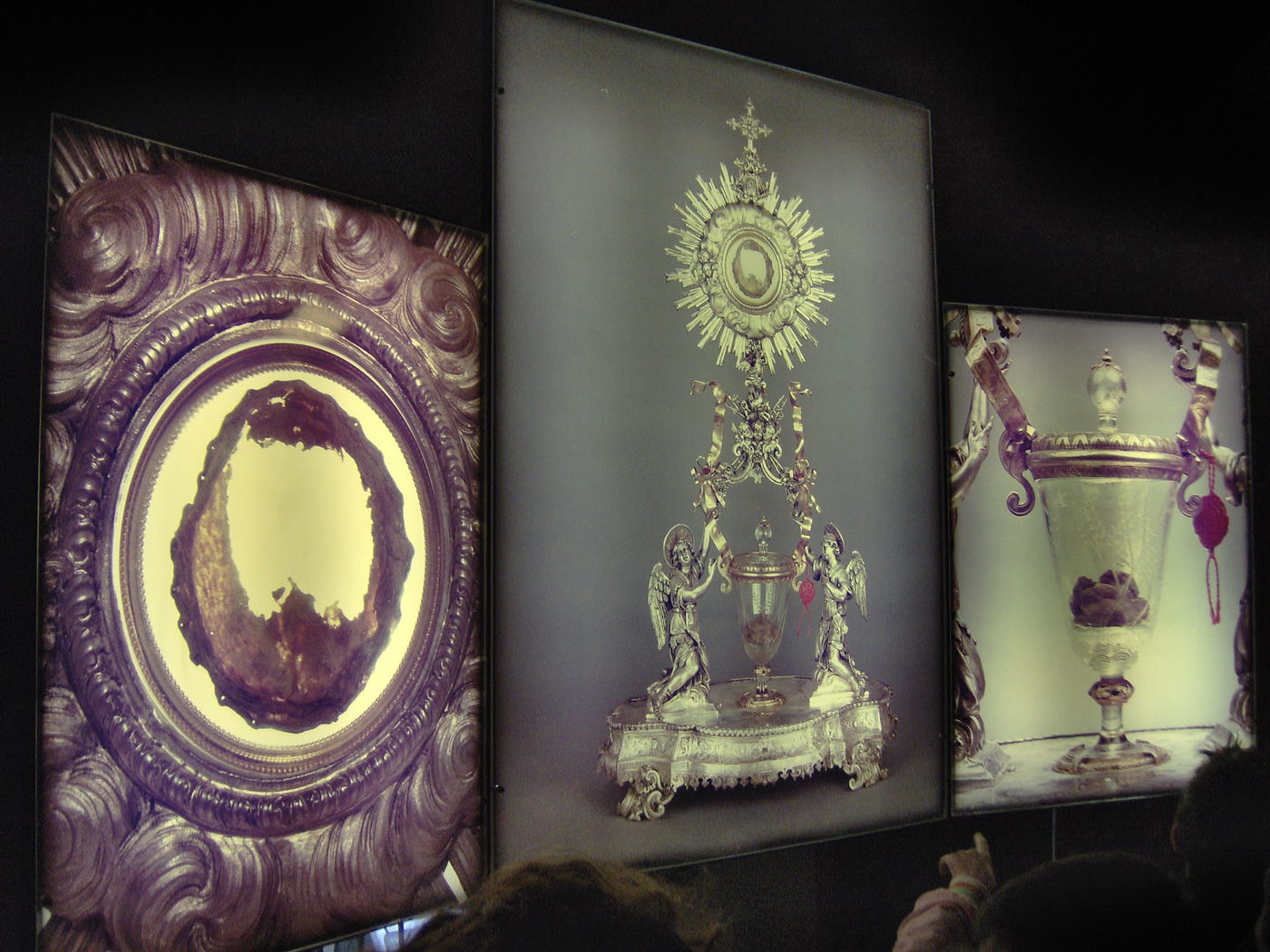
Close-ups of portions (left and right) of the reliquary (center) exhibited on rear-lighted panels (Wikipedia)
In the life of the Church, there are moments when doctrine is not merely explained but dramatically illuminated. The Eucharistic miracle of Lanciano belongs to that kind of moment. It has endured across centuries not simply because it is extraordinary, but because it speaks to something deeply human: the tension between faith and doubt, the longing to see what is believed, and the desire to understand how Christ remains present to His people. At its heart, the miracle of Lanciano is not merely a story about a prodigy on an altar in medieval Italy. It is a story about the Eucharist itself, about the trembling of a priest’s heart, and about the way God can meet uncertainty with revelation.
The tradition places the event in eighth century Italy, most likely between 730 and 750 AD, in the town then known as Anxanum, now Lanciano. The central figure is remembered not by name but by vocation: a Basilian hieromonk of the Byzantine rite. He was a monk, a priest, and, according to the tradition, a man of learning who found himself tormented by doubt. As he stood at the altar celebrating Mass, he struggled inwardly over a question that has tested many believers across the centuries: Is Christ truly present in the consecrated Host and chalice, or are these only sacred symbols? According to the ancient account, at the very moment of consecration, when he pronounced the words of Christ over the bread and wine, the host became visible flesh and the wine became visible blood, later appearing as five distinct clots (Rinaldi, 1611/1631 tradition; Ughelli, 1647/1717).
The force of the story lies precisely in the priest’s doubt. Lanciano does not begin with the certainty of a Saint, but with the instability of a believer who is wavering at the threshold of mystery. That detail matters. It allows the miracle to speak not only to devotional enthusiasm but also to the modern mind present in you and I, which often stands before the Eucharist with questions it is almost afraid to voice. The monk’s crisis, then, is not foreign to contemporary faith. It is familiar. He carries to the altar what many carry in silence: a wounded trust, an incomplete surrender, and a desire for God to heal what reason alone cannot settle.
Historically, the miracle must be approached with care. The first extant written accounts appear not in the eighth century itself, but much later, especially in the sixteenth and seventeenth centuries. That gap means historians cannot verify every detail with the kind of certainty demanded by modern critical standards. The precise year is unknown, and the name of the monk has not been preserved. Yet the later testimonies consistently place the miracle in the early medieval period and connect it to the Basilian monastic presence in Italy, which is historically plausible given the upheaval of the iconoclastic crisis under Emperor Leo III. As iconoclastic policies spread in the East, many Greek monks fled westward, and Basilian communities found refuge in Italy. Within that setting, the presence of a Basilian monk in Lanciano is entirely credible (Cattaneo, 1996; Serafini, 2018).
This historical context enriches the meaning of the event. The miracle is not suspended in an imaginary world but rooted in a time of ecclesial displacement, conflict, and uncertainty. A monk formed in the East, praying in an Italian setting, carrying both liturgical memory and interior confusion, becomes the unexpected recipient of a sign that would outlast empires. The story suggests that God’s interventions are often not detached from history, but woven into its wounds.
As the tradition developed, the relics associated with the miracle were preserved with great care. The Basilian monks are said to have guarded them until the twelfth century, after which other communities, including Benedictines and later Franciscans, became custodians. Eventually the relics were placed in the Church of St. Francis in Lanciano, where they remain venerated. The flesh appears as a yellow-brown membrane-like fragment, while the blood is preserved in the form of five irregular brown clots. Over time, the relics became not only objects of devotion but also subjects of ecclesiastical recognition and scientific interest.
One of the earliest important recognitions took place in 1574 under Archbishop Gaspare Rodriguez. This was not a scientific analysis in the modern sense, but an ecclesial examination, the kind often conducted by bishops when relics or miraculous claims were publicly venerated. It helped establish continuity of custody and public recognition. The devotional tradition also preserved the striking claim that each of the five blood clots weighed the same as all five together. Theologically, this was taken as a sign of a central Eucharistic truth: that Christ is wholly present in every part of the sacrament. Catholic doctrine has long held that Christ is entirely present under each species and under every part of each species, since the sacramental presence is not divisible in the manner of material bodies (Council of Trent, 1551/1848, Session XIII; Catechism of the Catholic Church, 1997, para. 1377). Even so, such a weighing belongs more to the symbolic and devotional history of Lanciano than to empirical proof. Its enduring significance lies in what it expresses, not in what it experimentally demonstrates.
The most significant scientific study of the relics took place in 1970–1971, when Professor Odoardo Linoli, a physician and professor of anatomy, histology, chemistry, and clinical microscopy, examined samples from the relics, assisted by Professor Ruggero Bertelli. Their work was requested by ecclesiastical authorities and undertaken with permission from Rome. Linoli concluded that the flesh was authentic human tissue and, more specifically, tissue from the myocardium, the muscular tissue of the heart. He further reported that the blood was real human blood and that both the flesh and the blood belonged to blood group AB. He also stated that the protein composition of the blood corresponded to that of fresh blood and that no preservatives or salts associated with artificial preservation were found (Linoli, 1971; Serafini, 2018).
These findings have understandably attracted much attention. A relic associated with a medieval Eucharistic miracle was reported, after laboratory analysis, to consist of human heart tissue and blood. For many believers, that convergence of devotion and science seems to provide a striking confirmation of the tradition. Yet intellectual honesty remains essential. Scientific analysis can identify the nature of a material sample; it cannot by itself establish the supernatural cause of that sample’s existence. In other words, science may tell us what was examined, but not whether it became what it is through miraculous transformation. The language of miracle belongs not only to laboratory results but to theological judgment, ecclesial discernment, and the wider context of faith.
That distinction becomes especially important when discussing the often repeated claim that the World Health Organization conducted further tests and confirmed the inexplicability of the miracle. This claim has circulated widely in devotional literature, but its documentary basis is unreliable. More recent critical work, especially by Franco Serafini, has shown strong reasons to doubt the authenticity of the supposed WHO report, which appears to have combined details about Lanciano with unrelated material. For this reason, the alleged WHO confirmation should not be repeated as established fact (Serafini, 2018). This correction does not weaken the significance of Lanciano. On the contrary, it strengthens theological credibility by separating what is genuinely supported from what has been embellished. The Eucharist deserves reverence, but it also deserves truthfulness.
Once the historical and scientific considerations are set in order, the deeper theological significance of Lanciano comes into view. The miracle matters because the Eucharist matters. Catholic teaching holds that at the consecration, by the power of Christ’s words and the Holy Spirit, the substance of bread and wine is changed into the substance of Christ’s Body and Blood, while the appearances remain those of bread and wine. This is the doctrine of transubstantiation, solemnly taught by the Council of Trent and classically articulated by St. Thomas Aquinas (Aquinas, 1920, III, q. 75; Council of Trent, 1551/1848, Session XIII). In ordinary sacramental life, the reality is hidden beneath appearances. What Lanciano represents, according to the tradition, is an exceptional moment in which the hidden reality became visible in a startling way.
Yet the miracle does not create Eucharistic doctrine; it points back to it. The Church does not believe in the Real Presence because Lanciano occurred. Rather, Lanciano is meaningful because the Church already believes Christ’s words: “This is my body… this is my blood” (New Revised Standard Version Catholic Edition, 1989, Matt. 26:26–28). The miracle, then, is not the foundation of faith but a sign that directs faith more deeply toward its proper object, which is Christ Himself. In this sense, the story is profoundly ecclesial. It does not bypass the Church’s sacramental teaching but confirms it in a dramatic, pastoral way.
This is why Lanciano continues to speak so powerfully to the moral and spiritual life. The doubting monk is not only a figure from the past; he is an icon of every Christian who has grown too accustomed to the sacred. The deeper challenge of the miracle is not merely whether one believes extraordinary claims, but whether one has learned to approach the Eucharist with appropriate wonder. One may profess the doctrine of the Real Presence and yet still receive Communion casually, pray distractedly, or pass before the tabernacle without recollection. Lanciano exposes that spiritual dullness. It asks whether believers truly recognize who is before them.
Here moral theology becomes essential. St. Paul warns the Corinthians that whoever eats and drinks unworthily, without discerning the body, eats and drinks judgment upon himself (New Revised Standard Version Catholic Edition, 1989, 1 Cor. 11:27–29). This warning has shaped Catholic teaching on worthy reception of Holy Communion, self-examination, repentance, fasting, and reverence. The Eucharist is never an ordinary meal. It is Christ given sacramentally, and therefore reception demands not only external participation but interior disposition. The miracle of Lanciano sharpens that truth. If the altar holds not a symbol only, but the crucified and risen Lord, then indifference becomes a moral problem, not simply a devotional weakness.
St. Thomas Aquinas helps frame this response through the virtue of religion, the virtue by which a person renders to God the worship rightly due to Him (Aquinas, 1920, II-II, q. 81). Under this light, Eucharistic adoration is not an optional piety for the especially devout. It is a fitting response to divine presence. Silence before the tabernacle, kneeling in adoration, careful celebration of the liturgy, thanksgiving after Communion, and the cultivation of recollection are all expressions of the soul’s recognition that it stands before God. If Lanciano teaches anything enduring, it is that reverence is not ornamental to Eucharistic faith; it is one of its clearest moral fruits.
The miracle also broadens understanding of Eucharistic adoration. In some minds, adoration can appear secondary to the Mass, as though it were merely an additional devotion. Catholic theology, however, sees adoration as flowing from the Eucharistic sacrifice and prolonging its grace. Pope Benedict XVI insisted that adoration deepens sacramental communion because it extends the inner movement of the liturgy into contemplative love (Benedict XVI, 2007). Lanciano reinforces this insight in a particularly vivid way. The proper response to a miracle of the Eucharist is not fascination alone, but worship. The believer is moved from observation to adoration, from amazement to surrender.
In this way, Lanciano becomes more than a story about evidence; it becomes a school of perception. It trains the heart to see that the Eucharist is never merely “there” as an object among objects. The Eucharist is Christ present in a sacramental mode, drawing His Church into communion with His sacrifice, His love, and His life. Pope John Paul II described the Eucharist as the Church’s treasure and the source of her amazement (John Paul II, 2003). That amazement is not emotional excess. It is the appropriate response to an infinite gift hidden under humble signs.
The enduring lesson of Lanciano, then, is not that Christians should seek miracles in order to believe. It is that they should believe deeply enough to adore. The miracle invites the Church to recover a Eucharistic imagination shaped by truth, humility, and love. It reminds you and I to be honest, Priests to be reverent, and the faithful to receive Communion with awakened hearts. It teaches that doubt can become a doorway to grace, that doctrine is not abstract when it concerns the living Christ, and that adoration is the soul’s most reasonable response to the One who remains with His people under sacramental signs.
In the end, the Eucharistic miracle of Lanciano continues to endure because it reveals something abiding about Catholic faith. Christ is not absent from His Church. He is not merely remembered. He gives Himself. Whether hidden beneath the ordinary appearances of bread and wine or, in rare moments, disclosed through a sign that arrests the world’s attention, He remains the same Lord. Lanciano therefore draws you and I back to the altar, back to the tabernacle, and back to the truth at the center of Catholic life: in the Eucharist, Christ is truly present, and where He is truly present, the only adequate response is faith that becomes worship.
References
Aquinas, T. (1920). Summa Theologica (Fathers of the English Dominican Province, Trans.). Benziger Bros. (Original work published 1265–1274). https://www.newadvent.org/summa/
Benedict XVI. (2007). Sacramentum caritatis: Post-synodal apostolic exhortation on the Eucharist as the source and summit of the Church’s life and mission. Vatican Press. https://www.vatican.va/content/benedict-xvi/en/apost_exhortations/documents/hf_ben-xvi_exh_20070222_sacramentum-caritatis.html
Catechism of the Catholic Church. (1997). Libreria Editrice Vaticana. https://www.vatican.va/archive/ENG0015/_INDEX.HTM
Cattaneo, M. (1996). I monaci basiliani in Italia meridionale. Edizioni di Storia e Letteratura.
Council of Trent. (1551/1848). Session XIII, Decree on the Most Holy Eucharist. In J. Waterworth (Trans.), The canons and decrees of the sacred and oecumenical Council of Trent. Dolman. https://history.hanover.edu/texts/trent/ct13.html
John Paul II. (2003). Ecclesia de Eucharistia. Vatican Press. https://www.vatican.va/content/john-paul-ii/en/encyclicals/documents/hf_jp-ii_enc_20030417_eccl-de-euch.html
Linoli, O. (1971). Ricerche istologiche, immunologiche e biochimiche sulla Carne e sul Sangue del Miracolo Eucaristico di Lanciano. Quaderni Sclavo di Diagnostica Clinica e di Laboratori, 7(3), 661–674.
New Revised Standard Version Catholic Edition. (1989). National Council of Churches.
Rinaldi, S. (1611). Relatione del Santissimo Miracolo di Lanciano. [Early local account cited in later Lanciano historiography].
Serafini, F. (2018). Un cardiologo visita Gesù: I miracoli eucaristici alla prova della scienza. ESD-Edizioni Studio Domenicano.
Ughelli, F. (1717). Italia sacra sive de episcopis Italiae et insularum adiacentium (2nd ed., Vol. 6). Apud Sebastianum Coleti. (Original work published 1647).
메타데이터
- post_id
- ff4e2503426f
- slug
- the-eucharistic-miracle-of-lanciano-a-story-of-doubt-presence-adoration-ff4e2503426f
- url
- https://medium.com/@mydailyreflection/the-eucharistic-miracle-of-lanciano-a-story-of-doubt-presence-adoration-ff4e2503426f
- canonical_url
- https://medium.com/@mydailyreflection/the-eucharistic-miracle-of-lanciano-a-story-of-doubt-presence-adoration-ff4e2503426f
- author_url
- https://medium.com/@mydailyreflection
- status
- ok
- fetched_at
- 2026-07-21 02:19:38